
How to Get Pre-Approved for an Auto Loan Online
To get pre-approved for an auto loan online, choose a lender, complete its application, upload income and ID documents, and submit the credit check. Some lenders return a decision in minutes; others need more review. A sloppy application or missing documents can delay approval, reduce the amount you qualify for, or weaken your position at the dealership. This guide walks you through the online steps, the information lenders ask for, typical timing, and how to use the preapproval at the dealership.
What auto loan preapproval means
Auto loan preapproval is a lender review of your credit, income, and other financial details that can lead to a conditional loan amount and rate. It is stronger than a simple estimate because the lender checks more of your file before you shop. That gives you a clearer budget and a cleaner offer to compare.
Preapproval can help you shop with more confidence, but it is not the final loan contract. The lender can still verify details later, and the vehicle itself can change the final terms if the car price, age, mileage, or title situation does not fit the lender’s rules.
Why preapproval helps before you shop
Preapproval gives you a spending ceiling before you sit down with a salesperson. That matters because it narrows the cars worth looking at and gives you a cleaner way to judge dealer financing offers. It also helps you spot credit issues early, before you are under time pressure.
Say your credit report shows a missed payment that was reported twice by mistake. If you find it during preapproval, you can dispute it before you choose a car. Waiting until the dealership can slow the deal and may leave you reacting to a worse offer.
Preapproval vs. pre-qualification
Pre-qualification uses less information than preapproval. It is often based on self-reported details, usually uses a soft inquiry, and gives you an estimate rather than a firmer offer. Preapproval relies on a lender review and can be closer to the rate and amount you may actually receive.
The difference matters because preapproval rate details are less likely to change than pre-qualification. If you are close to buying, preapproval is usually the better tool. If you are early in the process, pre-qualification can still help you get a rough range without the same credit impact.
Soft inquiry versus hard inquiry
Prequalification typically uses a soft inquiry that won’t affect credit scores. Auto loan preapproval can involve a hard credit inquiry, and a hard inquiry may slightly lower credit scores. Ask the lender which pull it uses before you apply, especially if you are comparing several lenders.
Multiple credit inquiries in a short window can be recorded as one hard inquiry. That shopping window is often discussed as about 14 to 45 days, so it is smart to keep your lender applications close together instead of spreading them out over weeks.
The online process follows a clear order, and the steps each have a purpose. You choose a lender, complete the form, upload documents, submit the request, and wait for the decision. If the lender needs more proof, it will ask for it before issuing the final conditional offer.
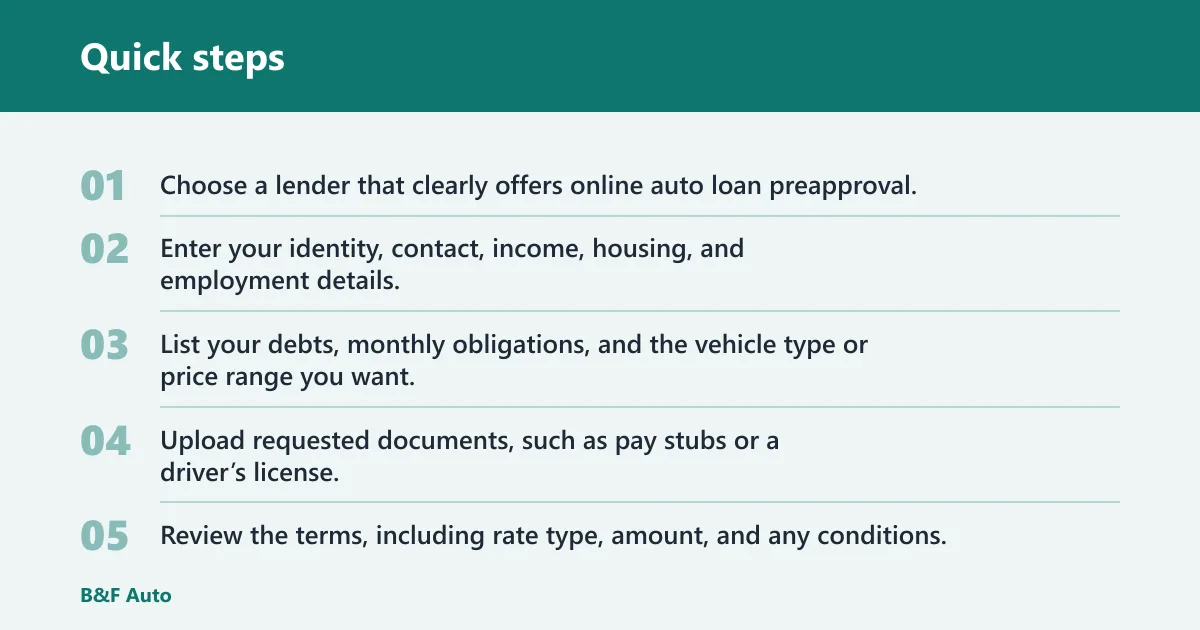
- Choose a lender that clearly offers online auto loan preapproval.
- Enter your identity, contact, income, housing, and employment details.
- List your debts, monthly obligations, and the vehicle type or price range you want.
- Upload requested documents, such as pay stubs or a driver’s license.
- Review the terms, including rate type, amount, and any conditions.
- Save the approval letter or email before you start shopping.
Choose a lender and start the form
Start with lenders that clearly say they handle online auto loan preapproval. Compare the basic rules first: whether they finance new or used cars, whether they allow dealer purchases, and whether they mention a hard inquiry. A lender that fits your target vehicle is more useful than one with a lower headline rate you cannot use.
Enter identity, income, and housing details
Expect the form to ask for your legal name, address, date of birth, Social Security number, phone number, email, employment status, employer name, and housing cost. These fields help the lender match your credit file and check whether your income supports the payment you want.
Upload documents and submit the request
Many lenders ask you to upload income and identity documents right away. Others may approve the application first and request documents afterward. Either way, submit clean copies that match the information on the form. Small mismatches can slow the review or trigger a manual check.
Review the decision and next steps
The decision may be a conditional amount and rate, a request for more documents, or a denial. Read the conditions carefully. If the lender gives you an approval letter, save it in a place you can access at the dealership, because the salesperson may want to see the amount, term, and expiration date.
What information lenders ask for online
Lenders usually ask for personal, income, housing, debt, and vehicle details. That information helps them judge borrowing capacity through a credit review and debt-to-income ratio, or DTI, which compares your monthly debt with gross monthly income. The more complete and consistent your answers are, the smoother the review tends to be.
Personal and contact details
Have your full legal name, previous address if you moved recently, date of birth, phone number, and email ready. Lenders also often ask for your driver’s license information or government ID. These details help verify identity and reduce the chance of a file mismatch.
Income and employment details
Be ready to enter employer name, job title, start date, and annual income. Lenders may verify annual income, especially if the amount you request is close to your limit. If you earn overtime, bonuses, or commission, enter only what the lender asks for and be consistent with your documents.
Debt, housing, and monthly payment details
Include your rent or mortgage payment and any existing monthly debt payments, such as student loans or credit cards. These numbers help the lender estimate DTI. If your reported housing payment on the form does not match what appears on your credit file or documents, the lender may pause the approval.
Vehicle and loan preference details
Some lenders ask for the vehicle type, estimated price, down payment, and desired term. That helps them set the likely loan amount and rate. If you know you want a used SUV with a specific price cap, enter that range rather than a vague guess.
Online preapproval readiness checklist
Gather the paperwork before you start the form. Missing fields and stale documents are among the easiest ways to slow an online review. This checklist shows what lenders ask for, why it matters, where to find it, and the mistakes that cause delays.
| Field or document | Why lenders ask for it | Where to find it | Common mistakes |
|---|---|---|---|
| Legal name, date of birth, address | Identity matching and credit file lookup | Driver’s license, utility bill, lease | Nickname instead of legal name; old address; typo in apartment number |
| Social Security number | Credit report pull and identity verification | Tax records, Social Security card, payroll records | Transposed digits; leaving a digit blank |
| Employer name and job details | Income stability and employment review | Paystub, offer letter, HR records | Old employer listed after a job change |
| Annual income | Ability to repay and DTI review | Paystubs, W-2s, tax return, bank deposits | Using gross and net income interchangeably |
| Housing payment | Monthly obligation estimate for DTI | Lease, mortgage statement, rental ledger | Guessing a number that does not match records |
| Recent debt payments | Debt load and borrowing capacity | Credit report, monthly statements | Missing a card or loan account |
| Government-issued ID | Identity verification | Driver’s license or passport | Expired ID or unreadable upload |
| Vehicle and down payment target | Sets the likely loan amount and term | Your budget, dealer listings, savings plan | No price cap; unrealistic down payment |
Does preapproval hurt your credit score?
Auto loan preapproval can involve a hard credit inquiry, and a hard inquiry may slightly lower credit scores. That does not mean you should avoid it. It means you should apply when you are ready to shop and keep your lender applications close together so the credit impact stays contained.
How inquiry shopping windows can work
Multiple auto loan inquiries in a short window may be grouped as one hard inquiry. That is why timing matters. If you are comparing lenders, submit those applications within the shopping window rather than over a long stretch. Ask each lender whether it will use a hard pull before you apply.
When to ask the lender before applying
Ask whether the preapproval uses a hard inquiry, what documents it needs, and how long the approval stays valid. This matters most if your credit file is thin or rebuilding, because even a small score drop can affect the rate or amount you receive.
When should you apply for preapproval?
Apply after you narrow your budget, but before you visit dealerships. Lifehacker says pre-approvals are generally good for 60 to 90 days, and it recommends getting pre-approved two to three months before purchase. That timing gives you room to compare cars without letting the approval expire.
Apply after you narrow your budget
Do not wait until you are already negotiating on the lot. First, decide the monthly payment you can handle, the down payment you can make, and the price range you want. Then apply for preapproval so the lender’s decision matches the cars you are actually considering.
Apply before dealership visits
Use the approval letter as your baseline before you talk numbers with a dealer. If you walk in with a valid preapproval, you can compare the dealer’s financing offer against a known starting point. That makes it easier to see whether the dealer is matching, beating, or missing your outside offer.
Watch the 60 to 90 day validity window
Preapproval expiration matters because the letter can go stale before you buy. If you wait too long, you may need a fresh credit check and updated documents. A common first-timer mistake is getting approved too early, then discovering the car search took longer than expected.
What happens after you get pre-approved?
After approval, you use the letter at the dealership, confirm the final vehicle details, and compare the dealer’s financing offer with your preapproved terms. The preapproval is a bargaining tool, not the final paperwork. The car, contract, and lender verification still matter before funding.
How to use the letter at the dealership
Bring the approval letter or a digital copy to the finance office. The dealer can use it to see your likely amount, rate, and term. If the dealer’s offer is worse, ask whether it can match or beat the preapproved rate before you agree to the contract.
What can still change before funding?
The final contract can still change if the vehicle price, term, down payment, or lender conditions differ from what was approved. A newer model, a longer term, or a higher price may change the monthly payment. If the deal changes, ask for a fresh calculation before signing.
When to compare other lender offers
If you have multiple preapprovals, compare the full cost, not only the monthly payment. Look at the rate, term, amount financed, fees, and any restrictions on vehicle age or mileage. A lower payment can hide a longer term or added fees that make the deal more expensive overall.
Common approval blockers and fixes
Many online preapprovals fail or stall for simple reasons. Income mismatches, stale documents, high DTI, and recent credit changes are common blockers. Fix those before you submit, and you are more likely to get a clean decision without back-and-forth email requests.
| Approval blocker | Why it causes trouble | How to fix it before submitting |
|---|---|---|
| Income mismatch | Reported income does not match paystubs, tax forms, or employer records | Use the same income figure across the form and documents; verify annual income before uploading |
| Stale or missing documents | The lender cannot verify identity, income, or residence | Upload current paystubs, a clear ID, and a recent proof of address; replace blurry scans |
| High debt-to-income ratio | Monthly debt leaves less room for a car payment | Pay down revolving balances, lower the requested amount, or add a larger down payment |
| Recent credit changes or too many inquiries | New accounts, missed payments, or a burst of applications can change the file quickly | Pause new credit applications, check the credit report for errors, and group lender shopping into one window |
Best next actions for different credit profiles
If your file is thin, use prequalification first only if you want a soft-inquiry estimate, then move to preapproval once you are ready to shop. If you are rebuilding, pull your credit report early and fix errors before applying. If you have strong credit, compare several lenders close together and choose the cleanest offer.
Frequently asked questions
How do I get pre approved for a car loan online?
Choose a lender, complete its online form, and upload the documents it asks for, such as ID and proof of income. Then submit the application for review. The lender checks credit, income, and debt details, then sends a conditional amount and rate if you qualify.
Can you get pre approved for an auto loan online?
Yes. Many lenders offer online auto loan preapproval, and the process usually starts with a digital application and document upload. Some lenders decide within minutes, while others need extra verification before they issue a conditional approval letter.
How long does it take to get pre approved for a car loan online?
Prequalification may arrive within minutes, but full preapproval can take longer if the lender needs income or identity documents. Many approvals come back the same day, though manual review can add time if your file has a mismatch or missing paperwork.
Can I buy a car with a pre approved loan?
You can usually use a preapproved loan to buy a car, but the final deal still has to fit the lender’s terms. The dealer, vehicle, and contract details must match what was approved. If they do not, the lender may revise the amount or rate.
What information do I need to apply for auto loan preapproval online?
Have your legal name, address, Social Security number, income, employer details, housing payment, monthly debt payments, and vehicle preferences ready. You may also need a driver’s license, paystubs, or other proof of income and residence, depending on the lender’s review process.
Does auto loan preapproval hurt my credit score?
It can, because auto loan preapproval may involve a hard credit inquiry, and a hard inquiry may slightly lower credit scores. If you compare lenders, ask about the pull first and keep applications within a short shopping window so the impact is grouped more efficiently.
Should I get pre approved or pre qualified first?
Prequalification is useful early because it often uses a soft inquiry and is based on self-reported information. Preapproval is better when you are ready to shop, because the lender review is firmer and the rate details are less likely to change.
How long does auto loan preapproval last?
Preapproval commonly expires after 60 to 90 days. That window matters because the lender’s review can go stale if your credit, income, or target vehicle changes. Apply close enough to your shopping date that the approval is still valid when you visit the dealership.