How Long Should a Test Drive Be Before You Buy?
A 15-minute test drive covers the basics. About a 30-minute drive is better for checking warmed-up behavior, and a second drive can help if anything still feels off. A short, careless drive can hide noises, warning lights, brake issues, and transmission problems that show up only after heat builds. This guide explains what to check in each time window and how to judge whether the car is worth buying.
Why a longer test drive matters
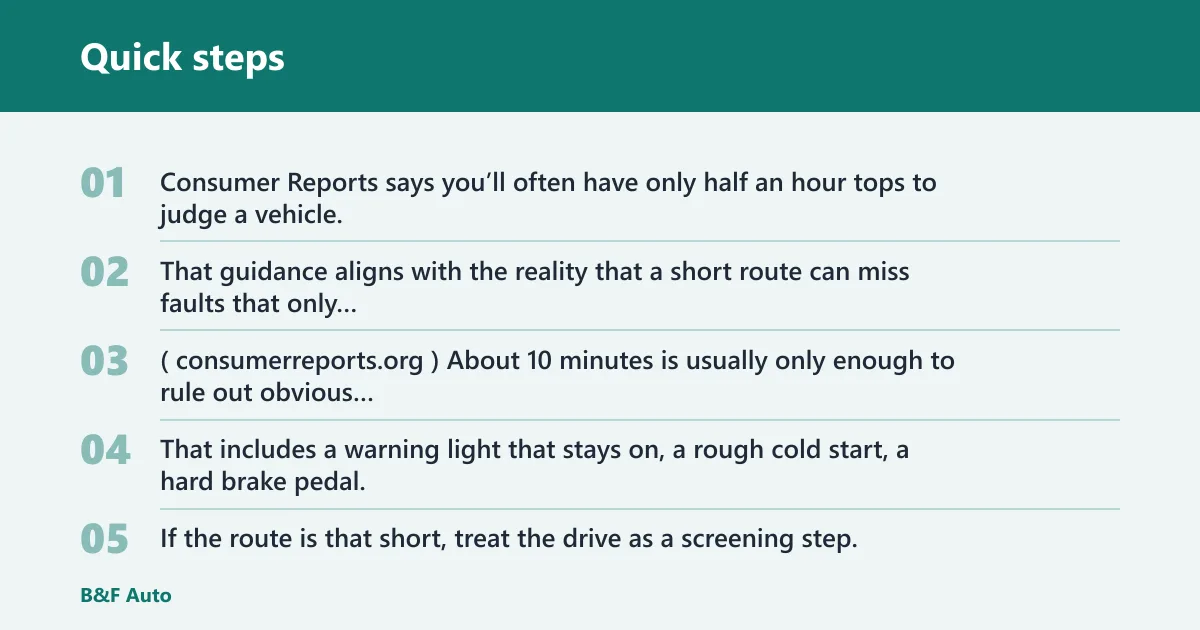
Consumer Reports says you’ll often have only half an hour tops to judge a vehicle, and it recommends driving as long as possible, at least 30 minutes. That guidance aligns with the reality that a short route can miss faults that only appear once the car is warm, under load, or at speed. (Consumerreports)
When 10 minutes is enough
About 10 minutes is usually only enough to rule out obvious dealbreakers. That includes a warning light that stays on, a rough cold start, a hard brake pedal, a steering wheel that shakes immediately, or a transmission that behaves badly within the first few blocks. It is not enough to trust the car.
If the route is that short, treat the drive as a screening step. You can confirm basic comfort, visibility, and whether the car moves, brakes, and steers cleanly. You cannot reliably judge heat-related faults, speed-related vibration, or how the car feels once the engine and gearbox have warmed up.
When you should plan a second drive
Ask for a second drive when the first pass leaves any doubt. That matters if you hear a noise, feel a vibration, notice a pull under braking, or cannot get the road mix you need. It also matters when the car type needs more time, such as a used car, a hybrid, an EV, or a family car with more controls to check.
Suppose a used hatchback feels fine at 20 mph on a quiet side street, but the seller will not allow a faster road. That drive has not proved much. A second route with a higher-speed stretch, some stop-start traffic, and a rougher surface can expose issues that a short loop hides.
| Drive length | What you can verify | What problems it can miss | When to book a second drive |
|---|---|---|---|
| 10 minutes | Cold start behavior, basic visibility, seat position, obvious warning lights, immediate brake and steering faults | Warmed-up noises, speed-related vibration, gear hesitation, brake pull that appears later, infotainment problems | If the car feels fine but you have not reached mixed traffic, higher speeds, or rough roads |
| 15–20 minutes | Comfort, mirror adjustment, control layout, straight-line braking, low-speed steering, phone pairing, basic transmission feel | Issues that appear once the engine, brakes, or gearbox are fully warm; vibration at road speed; suspension clunks over rough surfaces | If you still have not driven city streets and a faster road, or if any fault needs a clearer check |
| 30 minutes | Warmed-up idle quality, braking from different speeds, steering at road speed, automatic shift smoothness, manual clutch bite, cabin noise | Longer-term heat soak issues, intermittent warning lights, problems that only appear on a repeated route or after more traffic | If the car is a used example, hybrid, EV, family car, or anything with a doubtful noise, vibration, or control feel |
| Longer route or repeat drive | Used-car condition, hybrid system behavior, EV range and regen feel, private-sale logistics, family-car comfort on varied roads | Anything a short controlled route can hide, especially warm faults and speed-related symptoms | Always for used cars, hybrids, EVs, and private sellers when the first route was short or too neat |
What roads should you include?
Your route should include the roads you are likely to use, not only the smoothest loop a seller can offer. The same source recommends driving on a mix of roads, and Auto Express says to include the kinds of roads you expect to use, such as city and motorway-style driving. That mix is what reveals noise, vibration, brake feel, and steering behavior. (Consumerreports)
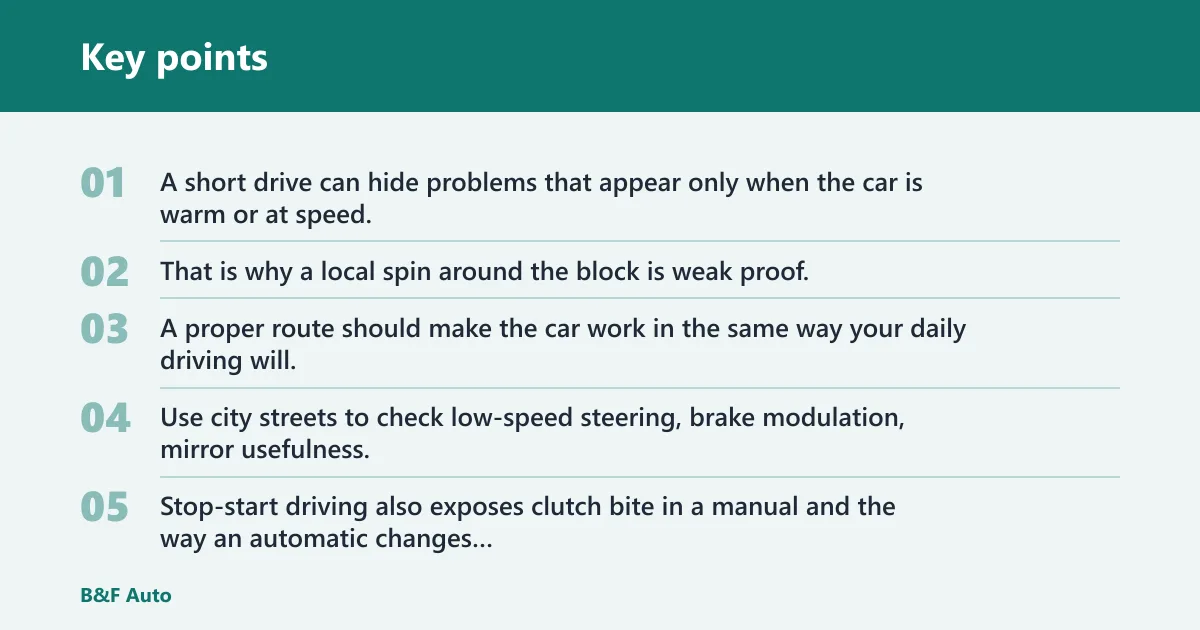
A short drive can hide problems that appear only when the car is warm or at speed, and a vibration at 60 mph may not show at 20 mph. That is why a local spin around the block is weak proof. A proper route should make the car work in the same way your daily driving will.
City streets
Use city streets to check low-speed steering, brake modulation, mirror usefulness, and visibility in traffic. Stop-start driving also exposes clutch bite in a manual and the way an automatic changes ratios at low speed. If the car feels awkward in town, it will not get better on the motorway.
Highway or dual carriageway
A highway or dual carriageway stretch helps you judge noise, straight-line stability, and vibration at road speed. It is also the best place to feel whether the car wanders, pulls, or shakes once speed rises. If the route never reaches that point, you may miss a fault that only appears under load.
Bumpy roads and speed bumps
Use bumpy roads, speed bumps, or a rough car park surface to listen for suspension knocks, trim rattles, and interior squeaks. Speed bumps and rough parking lots are commonly used as useful tests. These surfaces can expose loose trim, worn bushings, and other noises that smooth roads hide.
Traffic conditions
Traffic matters because it forces starts, stops, lane changes, and repeated gear selection. It is the fastest way to see whether the car is easy to control when it is not cruising. A route with only empty roads can make a car feel better than it will in real use.
What should you check before and during the drive?
Check the car before it moves, then repeat key checks once it is warm. The cold start tells you a lot about engine behavior, while the road test tells you how the car behaves under load. You want both, because one drive stage does not replace the other.
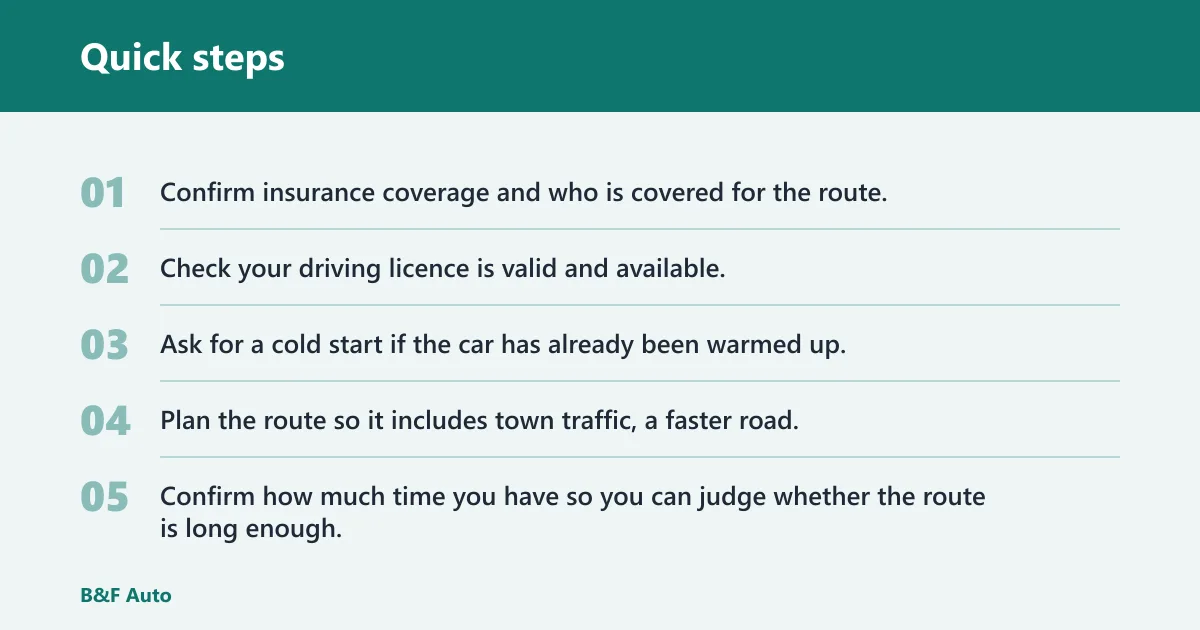
Before you leave, confirm that you are legally and practically covered to drive the car. Auto Express notes that UK road use without insurance is illegal, and private-sale test drives are especially dependent on who is insured and what the policy allows. If the cover is not clear, do not drive.
Pre-drive checklist
- Confirm insurance coverage and who is covered for the route.
- Check your driving licence is valid and available.
- Ask for a cold start if the car has already been warmed up.
- Plan the route so it includes town traffic, a faster road, and a rougher surface if possible.
- Confirm how much time you have so you can judge whether the route is long enough.
Cold start checks
At cold start, look for smoke, rattle, warning lights, and how the engine settles into idle. A brief rough start is not the same as a serious fault, but persistent smoke, repeated warning lamps, or a noisy start should slow you down. If the seller has already warmed the car, ask to return when it is cold.
Cabin setup
Before moving off, check the seat adjustments, mirror adjustments, wheel position, and pedal reach. If you cannot sit correctly, the rest of the drive is less useful because comfort and control both change. Seat height, lumbar support, and mirror angle should let you judge visibility without strain.
Tech check
Test phone pairing, infotainment, switches, and any driver aids before you commit. Basic buttons should work cleanly, screens should respond, and pairing should not fail after a few taps. A short drive is often long enough to find out if the controls are awkward or if the system resets, freezes, or misreads inputs.
During-drive checklist
- Brake gently and firmly to see whether the car stops straight and cleanly.
- Check for steering shake, drift, or pull at road speed.
- Listen for knocks, rattles, whines, and wind noise as speed rises.
- Watch for hesitation, harsh shifting, clutch judder, or delayed response.
- Repeat a few checks after the car is fully warm, not only at the start.
What should you feel for on the road?
Pay attention to braking, steering, alignment, and transmission behavior. These are the systems most likely to feel acceptable for the first few minutes and then show their faults as speed, heat, or traffic builds. A short route can hide all three.
Braking feel
Braking should feel straight and consistent. Watch for the car pulling to one side, a pedal that feels too firm, or a spongy pedal that lacks clear resistance. Try a few stops from different speeds, not only one gentle stop at a junction.
Steering and alignment
The car should track straight without constant correction, and the wheel should not vibrate once the speed rises. Steering issues often show up at road speed rather than around a car park. If the car drifts or shudders only on a faster road, that is still a real fault.
Transmission behavior
For a manual, check clutch bite, take-up, and whether gears select cleanly. For an automatic, pay attention to shift smoothness and any hesitation when you ask for a change in speed. A gearbox that seems fine in light traffic may act differently after a few minutes of stop-start driving.
Say your family car feels smooth in town, but the automatic hesitates when pulling into a roundabout and then shifts harshly on the next acceleration. That is a reason to extend the drive, not to explain it away. A warm gearbox should feel predictable.
Do you need insurance to test drive a car?
Yes. You need proper cover before you drive on public roads. The same source says driving on UK roads without insurance is illegal, and it notes that private-sale test drives are mainly an insurance issue. Do not assume the seller’s policy covers you.
Dealer coverage may apply in some cases, but you need to confirm that before leaving the forecourt. For a private sale, ask whether the car is insured for your drive or arrange temporary insurance yourself. If you cannot confirm cover, do not move the car.
What to confirm before you leave
Confirm who is insured, what road use is allowed, and whether the policy covers your exact route and time window. If the seller says “it should be fine,” that is not enough. You need a clear answer before the keys change hands, even for a short route.
When should you ask for a second drive?
Ask for a second drive whenever the first route does not give enough proof. That is the right move if you still hear a noise, feel a vibration, notice hesitation, or only drove on one type of road. If the seller limits time or route, a second drive is often the only way to judge properly.
Ask for more time if needed, especially if the route was short or too controlled. A second drive is especially sensible for used cars, hybrids, EVs, and private sales, where condition and logistics both deserve more scrutiny.
A common first-timer mistake is accepting a five-minute loop because the seller is busy. That can be enough to say the car starts and stops, but not enough to buy it with confidence. If you cannot verify the car properly, walk away and come back later.
Frequently asked questions
How long should a test drive be before you buy?
Plan for at least 15 minutes, and aim for about 30 minutes if you want stronger proof. The same source says to drive as long as possible, at least 30 minutes, and that is a good benchmark when you want to catch warmed-up issues. The right length depends on whether you have seen the car warm up. (Consumerreports)
Is 10 minutes enough for a test drive?
Ten minutes is only enough to rule out obvious problems. You can check cold start behavior, basic steering, braking, and visibility, but you may miss noises, vibration, or hesitation that appear later. If the car feels fine in ten minutes, that is not the same as proving it is right.
Should I drive a used car for at least 30 minutes?
Yes, if you can. Used cars deserve more time because heat, speed, and repeated use can expose faults that a short route hides. A 30-minute drive gives you a better chance to catch warm noises, brake pull, and transmission issues before you commit.
Can I ask for a longer test drive at a dealership?
Yes. Ask for more time if needed, and explain that you want to cover different roads and check the car once it is fully warm. A longer loop, a highway stretch, or a repeat drive after the car has warmed up is reasonable. If the answer is no, ask why.
What roads should I include on a test drive?
Use a mix of city streets, a highway or dual carriageway, and some rougher road surfaces if possible. Consumer Reports and Auto Express both support using varied roads so you can check how the car behaves in the conditions you will actually face. That combination helps reveal noise, vibration, and braking issues.
What if the seller only offers a short route?
Treat that as a warning sign, not a final answer. A short route can hide problems that only show up when warm or at speed. Ask for a longer second drive, choose a different route, or walk away if you cannot verify the car properly.
Related guides
- used-car inspection checklist
- temporary car insurance
- automatic vs manual transmission issues
- brake warning signs
- EV buying guide