How Early Can You Renew Your Registration?
Many states let you renew 30 to 90 days before expiration, but some allow as little as 6 months or only after a renewal notice arrives; the safest rule is to renew once your notice window opens and your inspection and insurance are current. Wait too long, and you can face late fees, a registration lapse, or a citation. This guide compares state timing rules and gives your earliest-safe renew-by checklist.
Registration timing table
| Jurisdiction | Earliest renewal window | Late-renewal window | Reminder timing | Inspection required? | Insurance/CTP required? | Online/in-person options | Source |
|---|---|---|---|---|---|---|---|
| California | Up to 60 days before expiration | After expiration, but late fees can apply | Renewal notices are mailed before the expiration date; do not wait for a notice if you already know the expiry date | Smog certification is required for many vehicles before renewal | No general registration-insurance proof rule is stated on the renewal page; separate insurance compliance still applies where otherwise required | Online, mail, phone, or in person depending on the record | California DMV: Registration renewal |
| Texas | Up to 90 days before expiration | After expiration, but the vehicle is treated as expired and fees may apply | Notice timing varies by county and system delivery | Inspection is required before renewal in many cases | Insurance must be current for renewal eligibility | Online and in person; some renewals also by mail | texas.gov |
| Nevada | Up to 35 days before expiration | After expiration, with possible penalties or reinstatement steps | Notice timing varies; confirm your account details before the due date | Inspection may be required depending on county and vehicle type | Insurance must be current for registration | Online and in person; some renewals also by mail | dmv.nv.gov |
| Georgia | Up to 30 days before expiration | After expiration, but the registration is late immediately | Reminder timing varies; the state does not require a notice to renew | Emission inspection is required in counties that participate in the program | Valid insurance is required for registration | Online, in person, by mail, or kiosk depending on county | Georgia DRIVES: Renew your tag; Georgia DDS/DRIVES emission and insurance renewal rules |
| Virginia | Up to 90 days before expiration | After expiration, with possible late penalties | Renewal reminders are commonly mailed before expiration, but the notice is not always required to renew | Safety inspection is required for most vehicles before renewal | Insurance is required to register and keep a vehicle registered | Online, in person, by mail, or phone depending on the record | Virginia DMV: Registration renewal; Virginia DMV safety inspection |
| New South Wales | Up to 3 months before the due date | Within 3 months after it has expired | Renewal notice timing varies, but the notice is the key trigger for checking inspection and CTP status | Most vehicles need an annual safety inspection if the notice says so | CTP insurance must be in place before registration payment | Online with BPAY or credit card; other payment channels may apply | Service NSW: Renew your vehicle registration; Service NSW: Safety inspections; NSW CTP insurance requirements |
Source note: California DMV registration renewal; Georgia DRIVES tag renewal and Georgia insurance/emissions renewal guidance; Virginia DMV registration renewal and safety inspection guidance; Service NSW vehicle registration renewal, safety inspection, and CTP insurance pages.
How early can you renew your registration?
Early renewal means renewing before the registration expiry date, but the allowed window depends on the issuing jurisdiction. Some systems open 30 days out, some 60 or 90 days out, and New South Wales allows renewal up to 3 months before the due date. The practical limit is usually the first date the agency accepts the request.
That is only part of the answer. The earliest safe date is the later of two things: the first date the system accepts the renewal, and the date when all required checks are already current. If an inspection, insurance update, or account correction is still pending, early renewal can stop at the portal stage or at payment.
Say your registration expires on June 30 and your state opens renewals 60 days ahead. You can start in May, but only if your inspection, insurance, and account details are already valid. If the renewal notice lists a hold, the early window does not matter until that hold is cleared.
Annual, six-month, and other renewal cycles
A shorter renewal term can change the timing rules. New South Wales says 6-month renewals must be renewed within 21 days of expiry for registration and CTP. That is a specific exception, and it is more restrictive than the general 3-month-before and 3-month-after rule for standard NSW renewals.
Do not assume one state’s cycle applies to another. A six-month term, an annual term, and a fleet schedule can all have different early-renewal limits, reminder timing, and payment rules.
Can you renew your registration before it expires?
Yes, in many places you can renew before the expiration date, but not always the moment you want to. Use the state’s posted window, then check whether inspection, insurance, or account verification is already complete. A notice can help, but you do not always need one.
Renewal notices are useful because they tell you the due date, the fees, and any holds. They are not a substitute for the actual record. If the notice is wrong, or if the address on file is outdated, you still need to confirm the vehicle record before you submit payment.
When a notice is enough to start the process
A renewal notice usually means the agency has opened the renewal cycle and you can check the payment path. In NSW, renewal payment can be made online with BPAY or credit card, and eligible pensioner concession cardholders may be automatically renewed when no payment is due. That is a clean example of a notice-driven process.
In other systems, the notice mainly tells you what to fix first. If the notice says inspection is required, the notice is not enough by itself. You need the inspection outcome recorded before the renewal can clear.
State-specific timing rules
These are the timing patterns readers usually need at a glance. The exact portal flow, reminder timing, and late-fee rules can change by county or by account type, but the early-renewal window is the first number to check.
California
California generally allows renewal up to 60 days before expiration, and the DMV warns that smog or record problems can still hold the renewal even inside that window. In short, the timing is open before expiration, but the file still has to be clean.
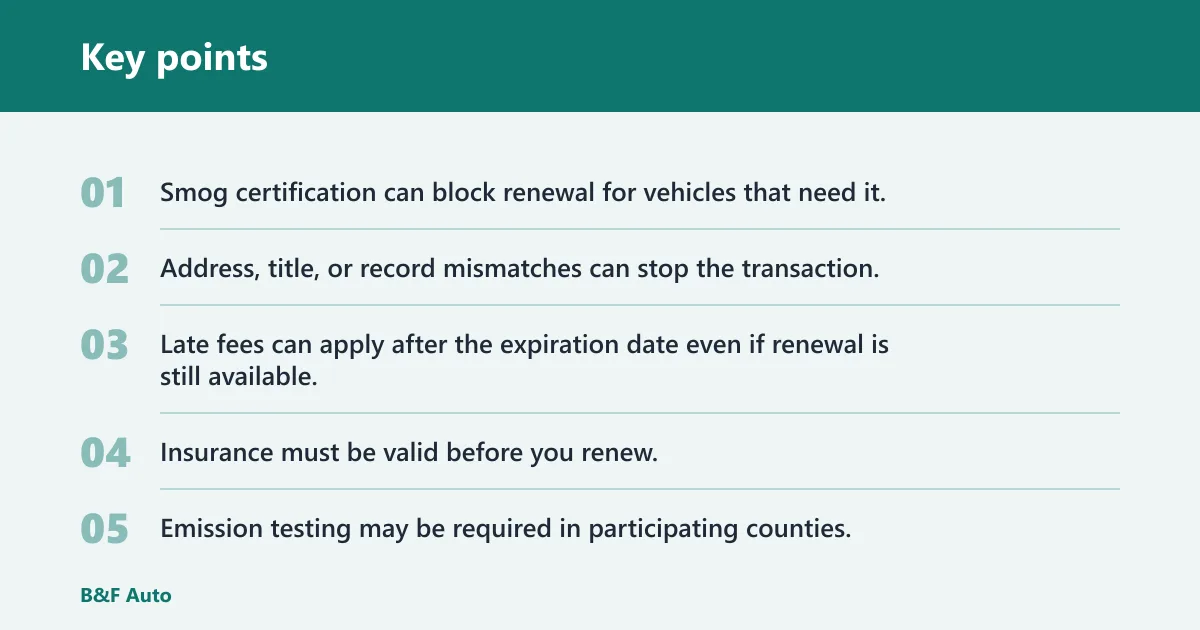
- Smog certification can block renewal for vehicles that need it.
- Address, title, or record mismatches can stop the transaction.
- Late fees can apply after the expiration date even if renewal is still available.
Texas
Texas generally allows renewal up to 90 days before expiration. That makes it one of the broader early-renewal windows in this comparison. Even so, an inspection requirement or insurance mismatch can block the transaction before the payment step, so early access does not always mean immediate completion. (Texas)
how early can you renew your registration in texas is usually answered by the state window and the record status together: if the renewal period is open and the inspection and insurance are current, you can renew before expiration; if either item is pending, the portal may stop you until it clears.
Nevada
Nevada generally allows renewal up to 35 days before expiration. That is a narrower window than some neighboring states, so the safest move is to check the record early and line up payment before the final month. If your account details or documents are out of date, early renewal can still stall.
how early can you renew your registration in nevada depends on the vehicle record and the state’s open window. If the renewal notice is missing or incorrect, confirm the plate and owner information before you try to pay.
Georgia
Georgia generally allows renewal up to 30 days before expiration, and the state’s tag-renewal process can still stop on tax, insurance, or emissions issues. The clearest answer is: the window opens about 30 days out, but the record must already be eligible.
- Insurance must be valid before you renew.
- Emission testing may be required in participating counties.
- County tax or local record issues can delay renewal even when the window is open.
Virginia
Virginia generally allows renewal up to about 90 days before expiration, and most vehicles still need a valid safety inspection before the renewal clears. The window is generous, but the inspection and registration record still have to match.
- Most vehicles need a current safety inspection.
- Insurance and account information must be in order.
- Address or vehicle-status changes can hold the renewal.
New South Wales
New South Wales allows renewal up to 3 months before the due date and within 3 months after it has expired. NSW also says 6-month renewals must be renewed within 21 days of expiry for registration and CTP. That makes NSW one of the clearest examples of a state where the renewal cycle and the insurance step are tied together.
NSW requires CTP insurance before registration payment, and the policy term must match the registration term. NSW also requires most vehicles to have an annual safety inspection if the notice says so. Online payment can be made with BPAY or credit card, and eligible pensioner concession cardholders may be automatically renewed when no payment is due.
What stops early renewal?
Early renewal is often blocked by the items that must already be current: inspection, insurance, and account access. A state may open the renewal window, but the transaction can still fail if the vehicle has a pending inspection, the insurance term does not match, or the online account cannot verify the owner.
Inspection requirement
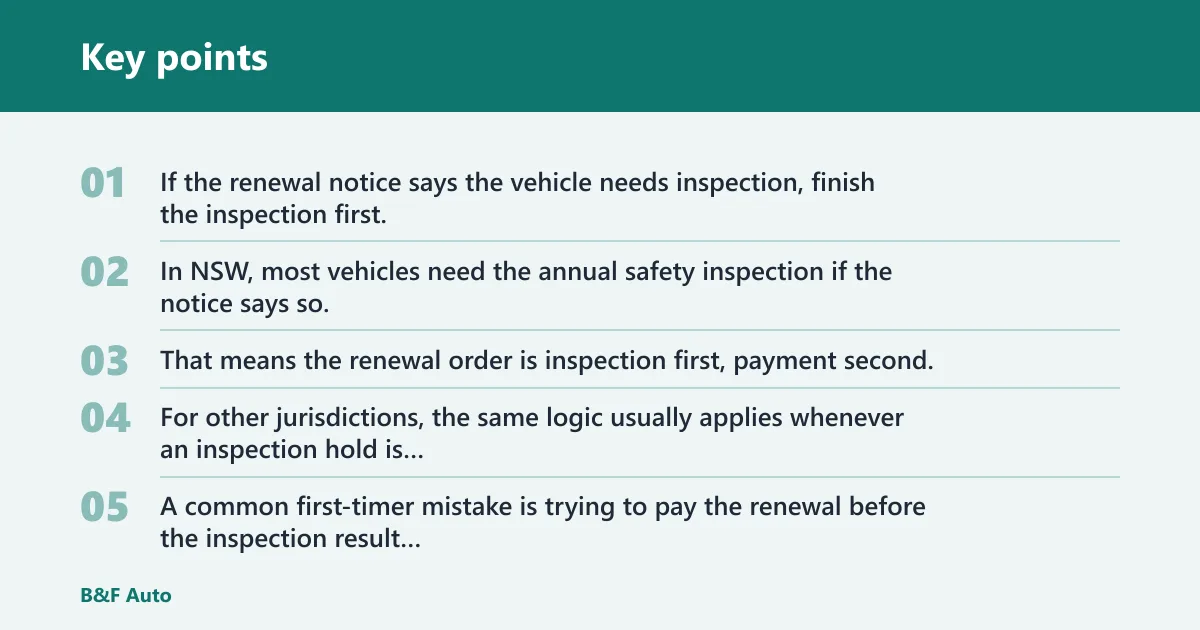
If the renewal notice says the vehicle needs inspection, finish the inspection first. In NSW, most vehicles need the annual safety inspection if the notice says so. That means the renewal order is inspection first, payment second. For other jurisdictions, the same logic usually applies whenever an inspection hold is attached to the record.
A common first-timer mistake is trying to pay the renewal before the inspection result has reached the system. The vehicle may pass on paper, but if the agency record has not updated, the renewal still looks incomplete.
CTP insurance or other insurance proof
In NSW, CTP insurance must be in place before registration payment, and the policy term must match the registration term. That is a hard pre-renewal step. In other jurisdictions, the insurance proof rule may be different, but if the record needs insurance verification, renew only after the policy dates are aligned.
Online portal access and eligibility
Online renewal is usually the fastest option, but it is not always available for every case. If the portal rejects the renewal, check for a blocked login, a mismatched plate number, or a record that needs a person-to-person correction. Some renewals move through a digital portal; others need an in-person or assisted payment path.
Outstanding address or ownership changes
Address changes, ownership transfers, and title corrections can pause a renewal even when the window is open. If the notice is sent to the wrong address, or the owner name does not match the record, fix the record first. Early renewal cannot cure a bad file.
How long can you wait to renew registration?
You can wait only until the expiry date if your state has no grace period, and in some places the vehicle becomes unregistered as soon as the deadline passes. New South Wales allows renewal within 3 months after it has expired, but many U.S. states treat the deadline more strictly and may add fees or reinstatement steps after expiration.
The deadline matters because missing it can create a lapse in registration status. That can bring late fees, a citation risk, or a need to prove compliance before the renewal is accepted. If your notice shows a hold, waiting until the last day makes the hold harder to fix.
Suppose your renewal notice arrives with an inspection flag and a due date next week. Waiting until the last day can leave no time for the station to upload the result, which turns a routine renewal into a late one. Handle the inspection first, then submit payment while the window is still open.
Registration renewal checklist
- Check the registration expiry date and the earliest renewal window.
- Read the renewal notice for inspection, insurance, tax, or account holds.
- Confirm whether the vehicle needs an inspection before renewal.
- Confirm that insurance is active and matches the renewal term where required.
- Verify portal access, login details, and the correct plate or account number.
- Choose your payment method before you start the renewal.
- Submit the renewal only when every required item is already current.
Earliest-safe-renew-by checklist
- Inspection pending: wait until the inspection is complete and posted to the record.
- Insurance pending: wait until the policy is active for the full renewal term.
- Portal access problem: use the in-person or alternate payment path if the system blocks login.
- Notice mismatch: verify the notice against the registration record before paying.
- Address or ownership change: fix the record first, then renew.
Frequently asked questions
How early can you renew your registration in California?
California generally allows renewal up to 60 days before expiration. The DMV also notes that smog or record issues can block the renewal even within that window. In practice, the file must be clear before the renewal can finish.
How early can you renew your registration in Texas?
Texas generally allows renewal up to 90 days before expiration. The practical limit is still the record status: if inspection or insurance is not current, the renewal may not clear. If everything is ready, early renewal can help you avoid a last-minute lapse.
Do you need insurance to renew your registration early?
Often yes, and in New South Wales the answer is clearly yes: CTP insurance must be in place before registration payment, and the policy term must match the registration term. In other jurisdictions, the insurance rule varies, but if the state or portal asks for proof, you need it before you submit the renewal.