Why Did I Not Receive My Car Registration Document?
A car registration document may not arrive because the DMV is still processing it, the address on file may be wrong, or the vehicle may be on hold. Check the status by VIN or license plate first, then contact the agency if the posted mailing window has passed. Waiting without acting can mean missed renewal deadlines, expired tags, late fees, or a lapse in legal driving records. This guide explains the main causes, what to verify on your record, and the exact next step for each delay.
Why did my registration document not arrive?
The most common reasons are a processing delay, a mailing error, or an agency hold. A renewal confirmation means the DMV received your payment or application; it does not always mean the paper or digital registration proof has been issued yet. Start by checking status with your VIN or license plate number, then compare that result with the agency’s posted mailing window and any notice on your account.
Check whether the DMV processed it
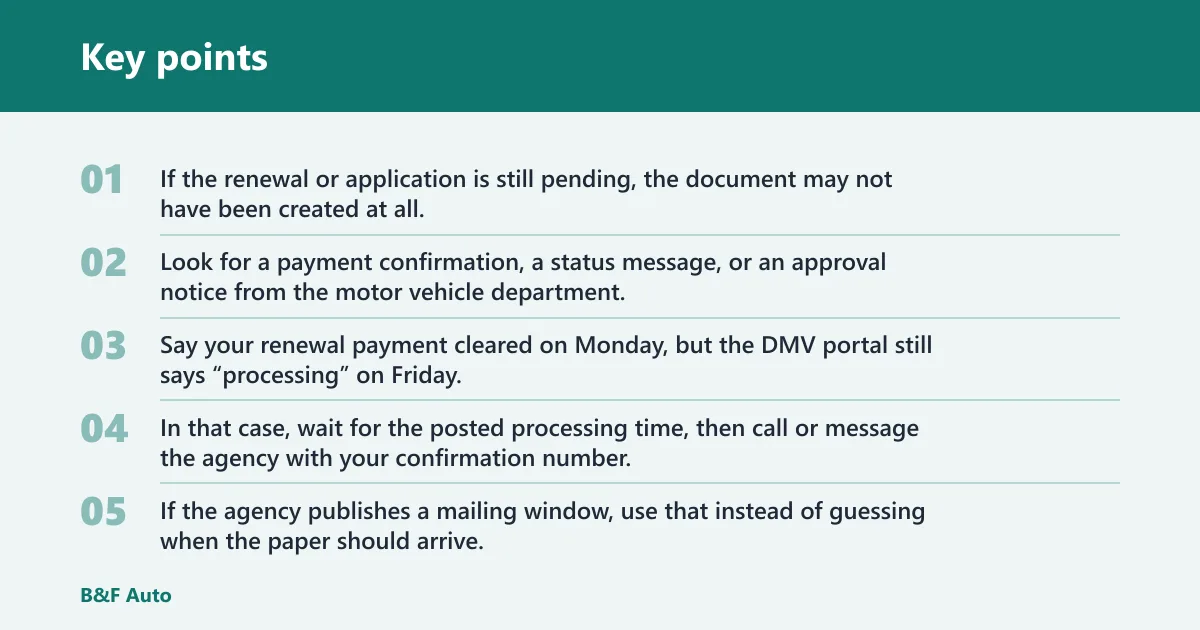
If the renewal or application is still pending, the document may not have been created at all. Look for a payment confirmation, a status message, or an approval notice from the motor vehicle department. If the record shows “received” but not “issued,” wait through the usual mailing window, then ask for a status update if it still has not moved. USPS guidance on mail forwarding and address changes also matters here, because a recent move can affect delivery timing and routing.
Registration delay checklist
| Symptom | Likely cause | What to check | How urgent is this? | Can you drive? | Next action |
|---|---|---|---|---|---|
| Renewal was paid, but nothing arrived | Processing delay | Online status using VIN or license plate number | Moderate if the mailing window has passed | Usually only if your state accepts temporary proof | Wait for the posted mailing window, then contact the DMV if it still shows pending |
| Status shows approved, but no paper document | Agency backlog | Issue date, mailing date, and any notice of delay | Moderate to high if renewal deadlines are close | Usually only with accepted temporary proof | Ask whether temporary proof is available and whether a duplicate can be issued |
| Mail never showed up after a move | Wrong address | Address on file with the DMV | High if the address change was recent | Usually only if you have valid interim proof | Correct the mailing address and request reissue or duplicate mailing |
| Returned-to-sender notice or undelivered mail | Returned-to-sender mail | Mailing date, returned envelope note, and address on file | High | Usually only if the DMV shows active registration and you have proof | Fix the address, then ask the DMV whether a re-mail or duplicate is needed |
| Post office says no delivery scan | Lost mail | Tracking status, if any, and the mailing date | Moderate | Usually only with accepted temporary proof | Request a duplicate registration document |
| Renewal payment failed or was reversed | Unpaid fees | Receipt, card charge, returned payment notice, or balance due | High | Not reliably until the renewal is completed | Pay the balance, then ask the DMV to resume processing |
| Record shows a stop on the account | Insurance or inspection hold | Insurance status, inspection due date, and any hold notice | High | Often no until the hold is cleared | Fix the missing requirement and ask for release of the hold |
| Vehicle record needs identity review before release | Identity verification hold | Name, address, ID documents, and any verification request | High | Usually no if the account is blocked | Provide the requested identity documents and wait for release |
| Name, VIN, or plate does not match the file | Record mismatch | Registration record, title record, and renewal confirmation | High | Usually no until the record is corrected | Have the DMV correct the mismatch before reissuing the document |
| Title changed, owner changed, or lender record updated | Title or ownership change hold | Title status, owner name, lienholder notice, and new registration record | High | Usually no until the updated record is finalized | Confirm the ownership change with the DMV before requesting reissue |
| Emissions or inspection requirement still open | Emissions hold | Inspection status, test result, and any state hold notice | High | Often no until the hold is cleared | Complete the required test or inspection and confirm release |
| Dealer or tag agency said it filed the renewal, but nothing is in the state system | Dealer/third-party filing delay | Submission receipt, filing date, and agency portal status | Moderate to high | Usually only if the state shows active status or temporary proof | Contact the filer and the DMV to confirm the filing was transmitted |
| Another proof was issued for the same renewal | Duplicate issuance | Whether a digital proof, temporary proof, or prior mailing already exists | Moderate | Usually yes if the valid proof is active | Ask which document is valid and request a replacement if needed |
Say your renewal payment cleared on Monday, but the DMV portal still says “processing” on Friday. That points to a status delay, not a mailing problem. In that case, wait for the posted processing time, then call or message the agency with your confirmation number. If the agency publishes a mailing window, use that instead of guessing when the paper should arrive.
A common first-timer mistake is assuming the renewal confirmation means the paper document is already on the way. In many systems, approval, printing, and mailing happen at different stages. Keep the receipt, confirmation number, VIN, and license plate number together so you can prove the transaction quickly if support asks for them. If the agency offers online status checks, use those before assuming the mail was lost.
Did the DMV mail it to the wrong address?

Yes, a bad address on file is one of the main reasons a registration document never arrives. If you moved, updated your mailing address too late, or entered a typo during renewal, the document may have gone to the old address. USPS guidance on address changes and forwarding limits makes it risky to depend on mail redirection alone, so confirm the DMV record directly.
Confirm the address on file
Check the mailing address in your DMV account, renewal notice, or recent correspondence. Compare it with the address you entered on the renewal form. If the record is wrong, correct it before requesting another mailing so the replacement does not go to the same place. If the state has a separate mailing address and residential address, verify both.
Update a changed mailing address
Open the DMV record. Use the online portal, phone line, or a local office to view the mailing address tied to the vehicle registration. The address on the vehicle record, not just your license record, is what matters.
Submit the correction. Enter the new mailing address exactly as the DMV requires it, including apartment or suite number. Small format errors can delay delivery again.
Request reissue. Ask whether the original can be canceled and remailed or whether a duplicate registration certificate is required. The agency may need identity and vehicle details before sending another document.
Suppose your renewal was approved after a move from Unit 4B to Unit 12A, but the DMV file still lists the old unit. The paper may be sitting in the wrong mailbox or returned to sender. Correcting the address first matters more than waiting an extra week. If the agency already mailed it, ask whether the return was logged before you request another copy.
Why forwarding may fail
Postal forwarding is not a dependable fix for DMV mail. USPS explains that forwarding rules have limits, and government mail may not be redirected the way standard personal mail is. If the address changed, the safer move is to update the DMV record directly and confirm the new mailing address is active before asking for reissue.
Could fees, insurance, or inspection hold it up?
Yes. Unpaid fees, a failed payment, lapsed insurance, an overdue inspection, or a record mismatch can stop issuance even after you think the renewal is complete. In that situation, the DMV may hold the registration document until the issue is cleared, so a mailed document may never be sent. State DMV pages commonly list these holds as reasons a renewal cannot be finalized.
Unpaid fees or failed payment
Check for a returned card charge, a rejected payment, or a balance due notice. If the payment did not post, the renewal may not move past intake. Pay the amount owed, keep the receipt, and ask whether the filing will restart automatically or needs a manual release. If the DMV portal shows a balance or suspended status, resolve that before expecting the mail.
Insurance lapse or inspection hold
Some states hold registration when insurance is inactive or inspection is overdue. If the renewal depends on an active policy or passing inspection, the DMV may not issue the document until that requirement is satisfied. Confirm the exact hold reason before you assume the mail was lost, and check whether the hold blocks both issuance and driving.
Record mismatch or duplicate issuance
A mismatch between the VIN, plate number, owner name, or mailing record can block issuance. The same is true if the agency already sent a duplicate or temporary proof and the file shows the matter as closed. Ask the DMV to verify the record before requesting another mailing, especially if your account was recently updated by a dealer, title office, or another third-party filer.
What should you do if it never arrives?
If the document still has not arrived after the normal mailing window, move in this order: check status online, request a duplicate registration document if allowed, and then escalate by phone or in person. Do not start with a second request if the DMV record still shows a hold or an unfinished renewal. Use the agency’s own process first so you do not create a duplicate problem.
Request a duplicate registration document
A duplicate registration certificate is the standard replacement for a lost or undelivered document. The DMV may ask for your VIN, license plate number, name, address, and a confirmation number. Some agencies charge a fee; others allow a printed or downloadable replacement if the record is current. If the original is marked returned, the duplicate request is usually faster than waiting for a second automatic mailing.
Ask for temporary proof
If the renewal is approved but the paper has not arrived, ask whether temporary proof is available. That may be a receipt, confirmation page, printable document, or digital proof in the account. Keep it with you if the agency says it counts while the official document is in transit. Make sure the proof is still valid for the period you need it.
Escalate by phone or in person
Gather your records. Have the VIN, license plate number, payment receipt, confirmation number, and address on hand. That reduces back-and-forth and lets the agent search the correct file immediately.
Call the issuing office. Ask whether the registration was issued, mailed, returned, or held. If the system shows a print date, ask for the mailing date and whether a replacement can be triggered.
Visit if needed. If the online and phone channels cannot resolve the issue, bring proof of payment and identity to a local office. An in-person visit can help when the record needs correction before a duplicate can be issued.
How do you prove registration without the paper?
You can often prove registration with a confirmation page, receipt, temporary proof, or a digital document if your state offers one. The paper is not always the only valid record. What matters is whether the agency says the vehicle is registered and what form of proof it accepts while the original is delayed. State DMV guidance usually explains what counts as valid temporary proof.
Receipt or confirmation
Keep the renewal receipt, the confirmation email, and any online status page that shows the registration was accepted. These records help prove that the transaction was completed and give the DMV the details needed to trace the filing. If the agency asks for proof of payment, these documents are the first ones to produce.
Printable or digital proof
Some motor vehicle departments let you print proof from an online account or download a temporary copy. If that option appears, print it and save a digital version as backup. Check the expiration date or validity note, because some temporary proofs are only valid for a short period. If the state says the temporary version is accepted in place of the card or certificate, keep it accessible in the vehicle.
What to keep in the vehicle
Keep the accepted proof in the vehicle if your state allows it, along with the renewal receipt and any temporary document. If law enforcement or parking officials question the registration, having the VIN, plate number, and a current proof record makes the stop easier to resolve. If the state says only a printed version is valid, do not rely on a screenshot alone.
Frequently asked questions
How long does it take to get a car registration document?
Timing depends on the state, the mailing method, and whether the renewal was fully processed. Some documents arrive within days after approval, while others take longer if there is a backlog. If the posted mailing window has passed, check status by VIN or plate number before waiting longer. State DMV pages often list estimated processing and mailing timeframes.
Can I drive while waiting for my registration document?
Often yes, if the renewal is approved and you have acceptable temporary proof, a receipt, or another valid confirmation the state recognizes. The key is whether your motor vehicle department treats that proof as sufficient. If no temporary document exists, ask the agency directly before driving, because some holds block both issuance and legal operation.
Who do I contact if the DMV sent my registration to the wrong address?
Contact the issuing DMV or motor vehicle department that holds the vehicle record, not just the post office. Ask them to correct the mailing address, confirm whether the original was returned, and issue a duplicate if needed. Have the VIN, license plate number, and proof of identity ready. If the agency shows a returned mailing, ask whether a re-mail or replacement is the next step.
What documents do I need to request a replacement registration document?
Most agencies ask for the VIN, license plate number, owner name, address, and proof of identity. A receipt or confirmation number helps the agent find the file faster. If the issue involves a fee or hold, bring proof of payment or the release notice as well. Some state DMV portals list the exact replacement requirements online.
Can I get a duplicate registration document online?
Sometimes. Many states let you request a duplicate registration certificate, print temporary proof, or view status online, but not all do. Check the DMV portal first. If the system does not offer a digital replacement, use the phone line or an office visit. If online access is available, it is often the fastest way to see whether the record is active.
What if my car registration was approved but I never got the papers?
That usually means the issue is mailing, not approval. Check the address on file, verify whether the document was printed or mailed, and ask whether a duplicate can be issued. If the address is wrong, correct it before asking for another mailing so the same problem does not repeat. Also check for a returned-to-sender note or an active hold.
Does changing my address affect registration delivery?
Yes. A changed mailing address can send the registration document to the wrong place if the DMV record is not updated before mailing. USPS forwarding may not reliably solve the problem, so the safest move is to change the address with the DMV directly and confirm the registration record reflects it. If the move was recent, verify that both the vehicle and license records are current.