How Much Should You Spend on a Car Payment Each Month?
A practical rule of thumb is about 10% to 15% of take-home pay for the full car budget, and lower if you already carry debt or high insurance costs. Push higher than that, and fuel, maintenance, emergency savings, and other bills get squeezed fast. This guide shows how to set a monthly payment budget that fits the whole car cost, not only the loan.
This guide is part of our Car payment budget: how much car can you afford? series.
A simple budgeting rule for car payments
Start with take-home income, not gross pay. Many buyers use a common transportation limit of no more than 15% of monthly take-home income for the full transportation cost, including monthly payments, maintenance, insurance, and fuel. As a rough budgeting rule, the payment itself is often kept closer to about 10% of take-home pay.
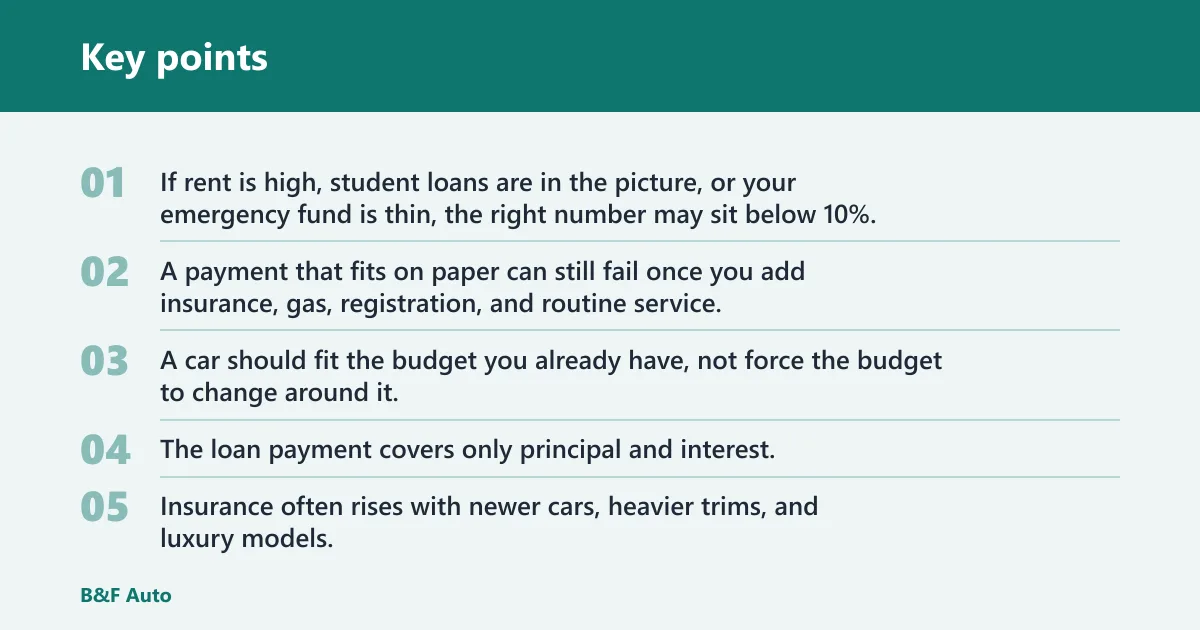
That range is a ceiling, not a target. If rent is high, student loans are in the picture, or your emergency fund is thin, the right number may sit below 10%. A payment that fits on paper can still fail once you add insurance, gas, registration, and routine service.
Use the 50/30/20 budget as a quick check. If your needs already consume most of the 50% bucket, or your 20% savings and debt repayment bucket is under pressure, a larger car payment can crowd out the rest of the plan. A car should fit the budget you already have, not force the budget to change around it.
What a car payment budget really includes
The loan payment covers only principal and interest. Your actual monthly car cost usually also includes insurance, fuel, maintenance, and repairs, plus sales tax, registration, and fees if those costs are included in financing.
Insurance often rises with newer cars, heavier trims, and luxury models. Fuel costs can swing a budget quickly, especially for long commutes or larger engines. Maintenance and repairs vary by age and reliability, so a payment that looks fine can still leave no margin for tires, brakes, or unexpected service.
Sales tax, registration, and fees are real purchase costs, even if the dealer advertises only the price before them. If you roll those costs into the loan, the monthly payment goes up. If you pay them upfront, you need more cash at signing but lower monthly debt.
Car payment budget table
| Monthly take-home income | Maximum safe payment | Estimated insurance | Estimated fuel | Estimated maintenance | Remaining cushion | If $1,500 in taxes and fees are financed vs. paid upfront |
|---|---|---|---|---|---|---|
| $2,500 | $200 | $140 | $160 | $60 | $1,940 | About +$30 per month financed; $0 extra monthly upfront |
| $3,500 | $300 | $160 | $180 | $70 | $2,790 | About +$30 per month financed; $0 extra monthly upfront |
| $5,000 | $425 | $180 | $220 | $90 | $4,085 | About +$30 per month financed; $0 extra monthly upfront |
| $7,000 | $600 | $220 | $250 | $110 | $5,820 | About +$30 per month financed; $0 extra monthly upfront |
| $9,000 | $775 | $260 | $300 | $130 | $7,535 | About +$30 per month financed; $0 extra monthly upfront |
The cushion figures above are a simple check, not a promise that the rest of the budget is free money. They show what remains after a conservative car cost stack is counted inside the 50/30/20 framework, alongside other needs and savings goals. If your other monthly debt is high, that cushion needs to cover more than comfort.
How do taxes and fees change your monthly cost?
Taxes, registration, and fees can change the budget more than shoppers expect because they raise the real purchase price. If you pay them upfront, your monthly payment stays lower. If you finance them, the payment goes up, and you pay interest on the extra amount too.
That difference matters most for buyers with tight cash flow. A payment that fits at the dealer can become hard to live with once you add a few hundred dollars more to the loan balance. The payment still looks affordable, but the extra financed cost trims your monthly room.
List the full out-the-door price. Ask for the vehicle price, sales tax, registration, and dealer fees on one sheet. That number tells you what the car actually costs before any down payment.
Compare monthly outcomes. Ask for two payment quotes: one with taxes and fees paid upfront, and one with them rolled into the loan. Even a small tax amount can add about $30 per month, depending on the term and APR.
Check the cash side. If you roll costs into the loan, make sure the higher payment still leaves room for insurance, fuel, and savings. If you pay upfront, confirm that the cash payment does not drain your emergency fund.
Say your quoted payment is $320 on a compact sedan, but the out-the-door price adds $1,200 in tax and fees. If you finance that amount, the monthly payment rises and the total interest rises too. If you pay it upfront, the payment stays lower, but only if you still keep cash for registration, insurance, and repairs.
How much down payment should you save?

A common target is about 20% down. A larger down payment lowers the amount financed, cuts monthly debt, and reduces the chance that you owe more than the car is worth early in the loan. It also helps offset tax, fee, and interest costs.
A smaller down payment can work, but it raises risk. If you put very little down, a longer term may be the only way to force the payment low enough, and that can leave you stretched for years. The loan may fit the lender’s rules while still crowding your budget.
Set a savings target. Aim for 20% of the purchase price, plus the first year of registration and part of your insurance setup costs. That gives you a better shot at a manageable payment and less cash stress at signing.
Use the payment to back into price. If you want a payment under $350, work backward from the car price, your down payment, the term, and the interest rate. This keeps the monthly number from pushing you into a more expensive vehicle than you planned.
Choose the cheaper path. If you cannot reach 20% yet, consider a lower-priced car, a longer wait, or a larger savings target. A smaller vehicle with lower insurance and fuel costs can be easier to own than a newer model with a low down payment.
Suppose a first-time buyer wants a $24,000 car and has only $1,500 saved. The monthly payment may still fit with a long term, but the small down payment leaves little margin for fees, taxes, and the first insurance bill. Waiting to save more can lower the monthly strain and reduce the loan balance at the same time.
Can you afford the car if you already have debt?
If you already make student loan, credit card, or personal loan payments, the safe car payment is usually lower than the simple 10% to 15% range. Use the 50/30/20 budget test and check whether the new car payment leaves room for debt repayment, savings, and basic living costs. If it does not, the car is too expensive for now.
A payment can look fine until you stack it on top of other fixed bills. Then the budget gets tight during the same months when insurance renews, tires wear out, or fuel prices rise. That is the failure case many shoppers miss: the loan is approved, but the cash flow breaks.
- Keep the debt cushion. Leave room after all fixed debt payments for savings, fuel, and maintenance. If the car payment pushes that cushion close to zero, the budget is too thin.
- Prefer a cheaper car. A lower-priced vehicle often brings lower insurance, lower taxes, and smaller registration fees. That combination can free up more room than stretching for a nicer trim.
- Consider a shorter shopping list. If the budget is tight, skip options you do not need. Heated seats, large wheels, and premium trims raise the price without solving the monthly squeeze.
What monthly car payment can you afford on your salary? Use take-home pay, not gross salary, and start with 10% to 15% for the full transportation bucket. Then subtract your other debt and savings goals. The answer may be much lower than a lender’s maximum approval.
How do I keep a car payment from ruining my budget?
Keep the payment small enough that it never competes with essentials or savings. That means comparing the loan number with insurance, fuel, maintenance, taxes, and your other debt before you sign. A car is affordable only when the full monthly cost still leaves a cushion.
Choose the vehicle, term, and down payment as a package. A longer term lowers the payment but raises total interest and can delay equity. A larger down payment lowers the payment and cuts interest. A cheaper car can solve the problem faster than any financing trick.
Practical decision tree
Check the budget first. If the total car cost fits under roughly 10% to 15% of take-home income and still leaves savings room, the deal may work. If not, stop before you focus on the monthly quote.
Choose the smallest fix. If the payment is only slightly too high, increase the down payment or shorten the shopping list. If it is far too high, move to a lower-priced car instead of stretching the term.
Protect emergency savings. Do not use every dollar for the down payment. Keep enough cash for insurance, registration, and an emergency repair so one flat tire does not turn into revolving debt.
Frequently asked questions
How much should I spend on a car payment each month?
A practical target is about 10% of take-home pay for the payment itself, with the full transportation budget staying near 15% or less. The right number is lower if you carry other debt, pay high insurance, or need to preserve savings. Use your actual monthly expenses, not a lender’s maximum.
What percentage of my income should go to a car payment?
For most budgets, the car payment should not consume more than a small slice of take-home pay on its own. Many shoppers use about 10% as a ceiling for the payment and about 15% for total transportation costs. If debt is high, the safe percentage may need to be lower.
Should my car payment include insurance and fuel?
No. The loan payment covers principal and interest only, but your budget should include insurance, fuel, and maintenance as separate monthly costs. A payment that looks affordable without those items can become too expensive once the real monthly outlay is added.
How do taxes and registration change my monthly car budget?
They raise the real purchase price. If you pay them upfront, your monthly payment stays lower. If you finance them, the loan balance rises, the payment increases, and you also pay interest on those costs over time.
Is 10% of take-home pay a good car payment limit?
Yes, 10% of take-home pay is a sensible limit for many buyers, especially if they have other debt or want to keep room for savings. It is still only a starting point. The full transportation cost should fit your budget, not crowd it.
How much should I save for a down payment before financing a car?
A common target is 20% of the purchase price. That amount lowers the loan balance, trims the monthly payment, and reduces the risk of being upside down early in the loan. If you cannot reach 20%, a less expensive car may be the better move.