How to Test Drive a Used Car Step by Step
Test drive a used car for about 30 to 45 minutes. Start cold, cover idle, low-speed streets, highway speeds, braking, parking, and a final check, then walk away if warning lights, leaks, pulls, or drivetrain noise appear. Bad road tests hide expensive faults until after you buy. This guide gives you a step-by-step sequence from pre-arrival prep to the post-drive go/no-go decision.
Before arrival
What you’ll need
- Driver’s license.
- Insurance proof or a temporary insurance card if required.
- Notes app, checklist, or paper worksheet.
- Phone with enough battery for photos, video, and an OBD2 scan app if you plan to scan after the drive.
- Comfortable shoes so you can feel the pedals accurately.
- Any dealer or seller permission details for route, passengers, and insurance.
Confirm the drive terms
Before you start, confirm who is driving, whether the vehicle is covered by dealer policy or whether private-seller coverage must come from you, and whether passengers are allowed. Rules for plates, insurance proof, and accompaniment vary by state and country, so do not assume one setup applies everywhere.
Plan the route
Set up a route that is long enough to show heat-related faults, road noise, and transmission behavior. A short spin rarely does that. If the seller will only allow a limited loop, treat that limit as useful information because it narrows what the car can prove before you buy.
Cold start
Start it cold
Start the engine after it has sat. The first 10 seconds can reveal rattle, smoke, hesitation, or hard starting that a warm engine may hide. Do not let the seller warm it up first.
Idle for noises
Leave the radio off and listen at idle for rough running, exhaust smoke, warning lights, or uneven engine speed. Watch for anything that settles only after the car warms up. A smooth idle after startup matters, but a car that only behaves once hot still needs a careful look.
Route segment 1: low-speed streets
Check controls at low speed
Pull away gently in a parking lot, then make full-lock turns in both directions. Feel for steering effort, clunks, and binding as the wheel reaches lock. This first segment is where you catch obvious steering, brake, and suspension problems before they get buried by road speed.
Route segment 2: parking lot and tight maneuvers
Test parking and tight turns
Use tight turns, backing, and parking maneuvers to judge visibility, steering smoothness, and brake modulation. Listen for clunks, scraping, or uneven effort. Fail the car here if the steering binds, the wheel makes repetitive noise, or the brake pedal feels inconsistent from one stop to the next.
Route segment 3: stop-start traffic and residential roads
Test brakes firmly
Use a safe straight road and brake firmly from about 40 mph to check stopping behavior. Note pedal feel, grinding or squeaking, brake pull to one side, and pulsing under braking. This segment should show whether the car tracks straight under load and whether the brakes feel predictable.
Route segment 4: rough roads and hills
Watch the drivetrain
For an automatic, note shift delay, rev flare, and whether each gear engages smoothly. For a manual, check for clutch slip, a high bite point, or difficulty getting into gear. Add rough pavement and a hill so you can hear suspension knocks and feel whether the drivetrain stays consistent under strain.
Route segment 5: highway or motorway
Listen for wheel issues
At steady speed, listen for a hum or drone that changes pitch when you gently weave. Feel for speed-dependent vibration, wheel balance issues, or bearing noise. This is the best segment for highway stability, passing power, and the kind of noise that disappears on short local streets.
Run the route fully
Include residential streets, rough roads, a hill, stop-start traffic, and straight roads as part of the route. Add highway speed if possible, since a proper route should simulate normal driving conditions, not just a quick loop. A useful test drive is built to reveal faults, not to finish fast.
After the drive
Park and inspect again
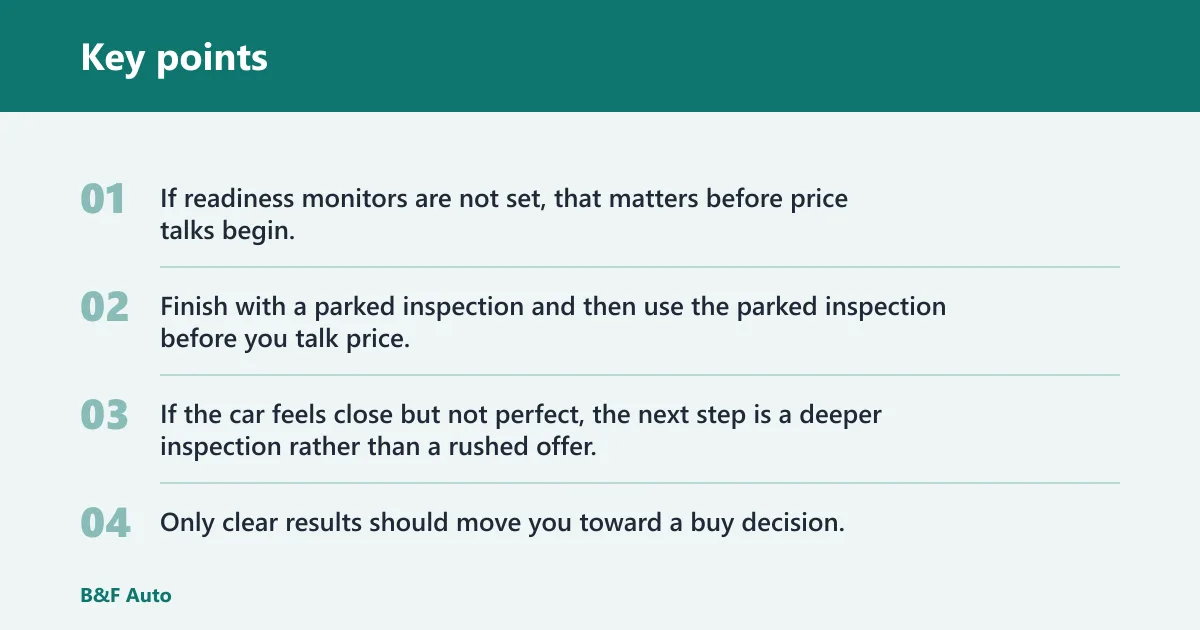
After stopping, check the temperature gauge, look under the car for fresh leaks, and scan with an OBD2 tool if available. If readiness monitors are not set, that matters before price talks begin. Finish with a parked inspection and then use the parked inspection before you talk price.
Decide what the drive means
If warning lights stay on, the car pulls, the transmission hesitates badly, or new leaks appear after shutdown, the safest answer is no. If the car feels close but not perfect, the next step is a deeper inspection rather than a rushed offer. Only clear results should move you toward a buy decision.
Test drive worksheet
Use this as a minute-by-minute log. The point is sequence: cold start first, road behavior second, parked checks last. If the seller refuses a cold start, a longer route, or a final inspection after parking, treat that as a red flag.
| Time | Action | Symptoms to note | Red flag decision |
|---|---|---|---|
| 0:00–2:00 | Cold start, idle, lights on dash | Rattle, smoke, hesitation, rough idle | Fail if warning lights stay on or start is hard |
| 2:00–6:00 | Parking lot, tight turns, parking maneuvers | Clunks, steering effort, brake feel, full-lock noise | Fail if steering binds or brakes feel uneven |
| 6:00–12:00 | Residential streets and stop-start traffic | Throttle response, shift delay, clutch slip, alignment drift | Fail if the car pulls or the transmission hesitates badly |
| 12:00–18:00 | Rough roads and a hill | Clunks over bumps, suspension noise, wheel vibration | Fail if vibration or knocking repeats on every bump |
| 18:00–30:00 | Highway or motorway segment | Speed-dependent vibration, hum, drone, lane stability, passing power | Fail if it wanders, shudders, or makes bearing-like noise |
| 30:00–40:00 | Final park and post-drive inspection | Temperature gauge, leaks, warning lights, scan results | buy / inspect further / walk away |
FAQ
How to test drive a vehicle
Use the same sequence for cars, SUVs, and trucks: cold start, low-speed checks, brakes, steering, highway, then post-drive inspection. Keep the radio off, bring notes, and avoid a route that is too short to heat the drivetrain. If the seller limits the route, that limitation is itself useful information.
How long should a test drive be before you buy?
A practical target is about 30 to 45 minutes. That window usually covers warm-up, multiple road types, and the final parked check. Shorter drives can miss heat-related noise, brake behavior, or transmission delay, especially on cars that only show symptoms after several miles.
What should you bring on a test drive?
Bring your license, insurance proof if needed, a notes app or paper checklist, and a phone for photos. A charger is smart if you plan to scan codes with an OBD2 tool. Keep the list short enough that you can focus on what the car is doing instead of what you forgot.
What should you check after the test drive ends?
Check the temperature gauge, look under the car for fresh leaks, and scan for codes if you can. Also watch whether the idle stays smooth after shutdown and restart. If the check engine light returns or monitors are incomplete, the car needs more scrutiny before any offer.
Do you need insurance to test drive a car?
Often, yes. Dealer policies may cover a drive differently than private-seller arrangements, and borrower coverage is not the same as dealer coverage. Insurance, plates, and accompaniment rules vary by state and country, so confirm the seller’s requirements before you go.
Can you test drive a car from a private seller safely?
Yes, if you treat it as a controlled public-road drive. Bring proof of license and any insurance the seller asks for, keep to daytime roads, and choose a route with traffic, hills, and highway speed. If the seller blocks those conditions, do not treat that as a small problem.
For manuals, a slipping clutch can mean a repair that one guide places at roughly 500 to 1,200 dollars depending on the car. For high-mileage cars, pay extra attention to vibration, bearing noise, and how the engine behaves when hot; those faults often get louder once the drive lasts long enough.
What should you check after the test drive ends?
Check the temperature gauge, look for fresh leaks under the car, and scan the car with an OBD2 tool if you have one. If readiness monitors are incomplete or codes return, do not start negotiating as if the car passed.