How to Calculate Negative Equity on a Trade-in
Calculate negative equity on a trade-in by subtracting the vehicle’s trade-in value from the lender’s dated payoff amount, not the app or dashboard balance. If the result is positive, that is your negative equity. Get this wrong and you can understate what you owe, roll more debt into the next loan, or miss fees that change the final number. This guide shows the exact math, how payoff timing changes the amount, and how to separate principal, fees, and the next-loan impact.
What negative equity means
Negative equity means you owe more than the vehicle is worth. It is also called being upside down or underwater. If the trade-in value is higher than the lender payoff, you have positive equity instead, which can cut the next vehicle’s price or, in a sale, sometimes leave cash in your pocket.
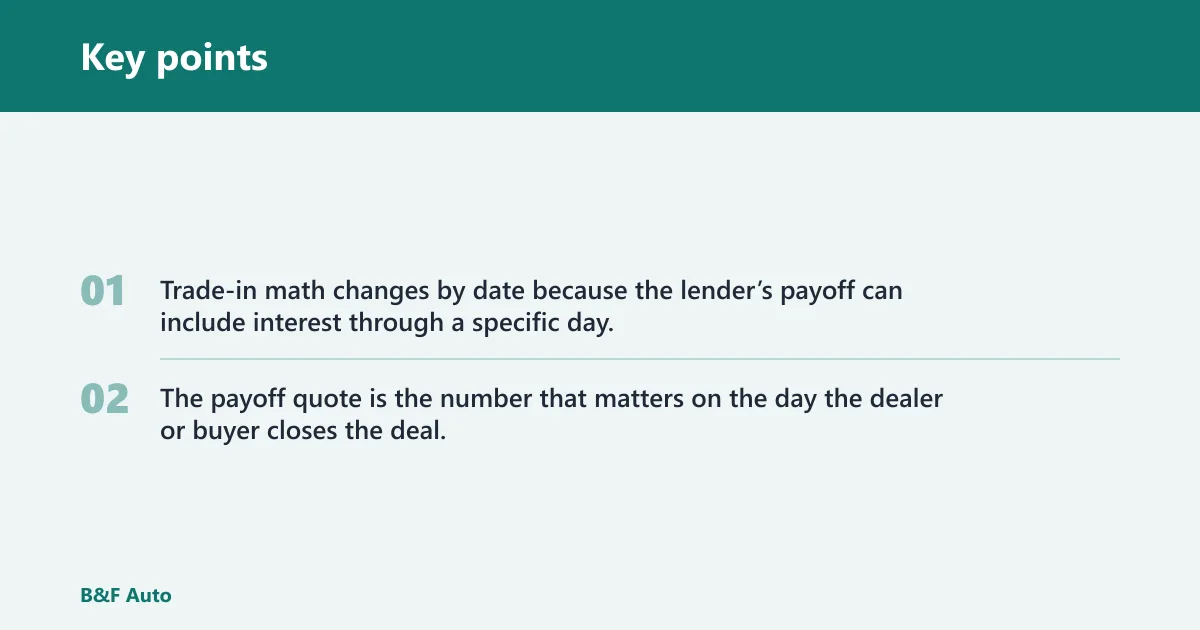
Trade-in math changes by date because the lender’s payoff can include interest through a specific day. A dashboard balance is only a snapshot. The payoff quote is the number that matters on the day the dealer or buyer closes the deal.
What you’ll need
- The vehicle’s year, make, model, trim, and mileage
- A current trade-in value from KBB or Edmunds
- The lender’s exact 10-day payoff amount
- The payoff quote date and expiration date
- A sales tax estimate for your state
- Dealer fee, title, and registration estimates
- A blank worksheet or calculator
How do you calculate negative equity?
Use the current trade-in value and the lender’s dated payoff amount, then subtract trade-in value from payoff. If payoff is higher, the difference is the shortfall you must cover. If trade-in value is higher, the difference is positive equity. Add fees only when they change the total amount you must bring to the deal.
-
Find trade-in value.
Look up the vehicle on KBB or Edmunds using the exact year, make, model, trim, and mileage. Use current market trade-in value, not retail asking price. Dealer trade-in value is often below private-sale value. -
Get the payoff quote.
Ask the lender for the exact 10-day payoff amount and write down the quote date and expiration date. Do not use the statement balance if the lender can quote payoff through a specific date. -
Subtract the numbers.
Use this equation: trade-in value minus payoff amount = equity. If the answer is negative, flip the sign and call it negative equity or a shortfall. If the answer is positive, that is positive equity. -
Add deal costs.
Add sales tax, title, registration, and dealer fees only if they apply to the transaction and affect the amount you must bring to the deal. If the lender payoff has increased or you have late fees, include those too. Recheck the math after every added charge.
Say your SUV has about an $18,200 trade-in value and about a $20,600 payoff quote. The gap is about $2,400 before fees. If title and dealer fees add about $450, the cash-to-close can rise to about $2,850 unless the dealer offsets part of it with stronger trade-in credit or lower fees.
What payoff amount should you use?
Use the lender’s exact payoff amount, not the balance shown on the monthly statement. Interest can accrue daily, and the payoff quote can change after the expiration date. That is why a quote with a date attached is more reliable than the number on a screen.
If you make an extra principal payment before trade-in, ask for a fresh payoff quote. The new quote should reflect the lower balance, but only if the lender has processed the payment. Late fees can also push the amount up, so check both sides of the timing window.
Recent quotes and timing
If the quote is near expiration, request a new one before you sign. A quote that expires in 10 days can become stale after a weekend, a holiday, or a delay in the dealer’s paperwork. One extra day can change the payoff by enough to matter on a thin deal.
What if your trade-in is underwater?
If payoff exceeds trade-in value, you have to cover the shortfall in cash or roll it into the next auto loan. Rolling negative equity raises the new loan balance and monthly payment, and it can keep you underwater longer. That does not erase the debt; it moves it forward.
Cash-to-close versus rolled-in debt
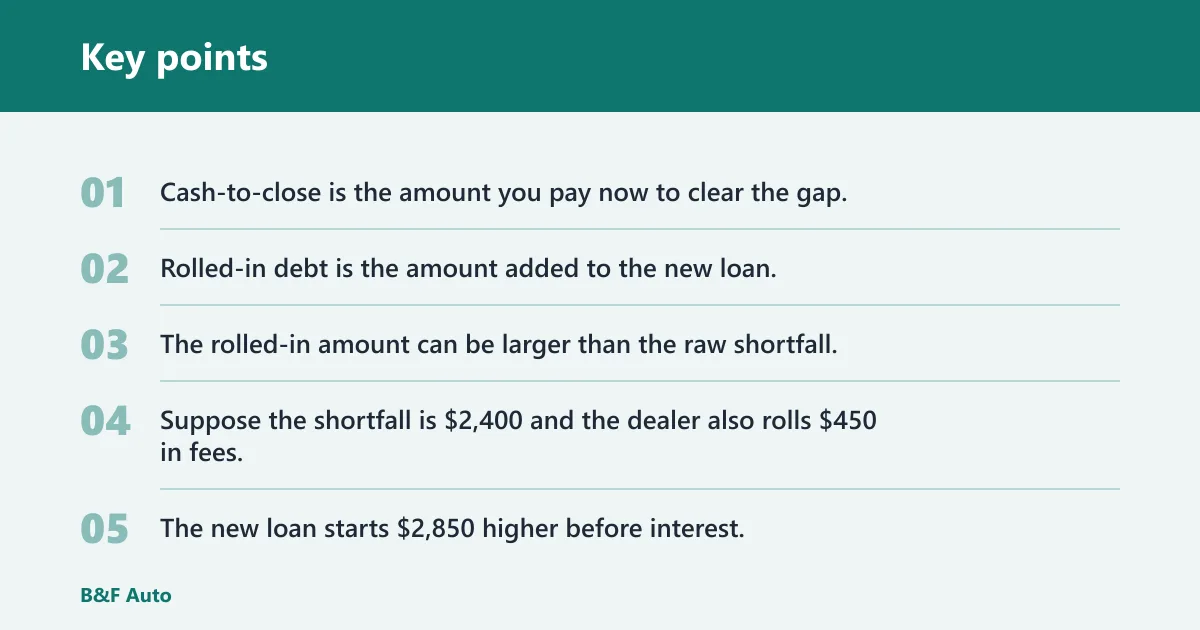
Cash-to-close is the amount you pay now to clear the gap. Rolled-in debt is the amount added to the new loan. Those are not the same number, because some fees may be financed too. The rolled-in amount can be larger than the raw shortfall.
Suppose the shortfall is $2,400 and the dealer also rolls $450 in fees. The new loan starts $2,850 higher before interest. A higher balance means more interest over time, especially on a longer term.
When a small gap is easier to absorb
A gap that is only slightly negative can be easier to cover in cash if you can do so without stretching the next loan. A small amount paid up front avoids interest on that amount. It also keeps the next vehicle closer to true market value on day one.
When a large gap calls for a different plan
When the shortfall is deep, compare the cost of paying cash now with the cost of financing it over about 36, 48, or 60 months. A larger gap can make the next loan expensive enough that keeping the current vehicle, waiting for more principal reduction, or selling privately makes more sense.
Trade-in equity worksheet
This worksheet separates the pieces people often mix together: trade-in value, payoff, cash-to-close, and the amount rolled into the next loan. Use one row for each figure so you can see where the money goes.
| Worksheet item | Example value | Notes |
|---|---|---|
| Payoff quote date | 2026-10-14 | Date the lender calculated the payoff |
| Payoff expiration | 2026-10-24 | Use a fresh quote after this date |
| Trade-in estimate | $18,200 | Current market trade-in value from KBB or Edmunds |
| Lender payoff amount | $20,600 | Exact 10-day payoff quote |
| Cash-to-close gap | $2,400 | Payoff minus trade-in value |
| Fees added to deal | $450 | Title, registration, dealer fees, if applicable |
| Estimated rolled-in amount | $2,850 | Gap plus fees added to the next loan |
Cash versus financing comparison
| Option | Amount financed or paid now | Monthly impact | What to watch |
|---|---|---|---|
| Pay cash now | $2,850 | $0 added to the new loan | No interest on the shortfall |
| Finance over 36 months | $2,850 | About $79/month before interest rate effects | Higher total cost than cash |
| Finance over 48 months | $2,850 | About $59/month before interest rate effects | Longer time underwater |
| Finance over 60 months | $2,850 | About $48/month before interest rate effects | Lowest monthly hit, longest payoff drag |
How can equity be negative?
Equity turns negative when depreciation outruns principal reduction. Vehicle depreciation can be steep early on and varies by model, mileage, and market conditions, so the exact amount is not the same for every car. A new vehicle can lose value quickly, especially in the first year, which can leave a buyer underwater even while making payments.
Loan term length matters too. With a shorter term, a larger share of each payment goes toward principal sooner. With a longer term, principal falls more slowly, which can keep the loan underwater for longer.
Common mistakes
Most errors come from using the wrong value, the wrong payoff date, or the wrong comparison. Fix those first, and the math usually becomes clear.
- Using retail asking price instead of trade-in value
- Using the statement balance instead of the lender’s payoff quote
- Ignoring quote expiration, late fees, or daily interest
- Mixing the shortfall with sales tax and registration without labeling them
- Assuming rolled negative equity disappears in the next loan
- Skipping a private-sale comparison when the gap is large
A common first-timer mistake is treating dealer trade-in as the same as private sale. If private-sale value is $1,500 higher, that can shrink a $2,400 shortfall to $900 before fees. That is a meaningful difference when you are deciding whether to pay cash or finance the gap.
If that didn’t work, try this next
If the number still feels off, get a fresh payoff quote and recalculate with the date attached. Then ask the dealer to itemize trade-in value, payoff, fees, and any tax credit separately. If the shortfall remains deep, compare the current offer with a private sale before you sign anything.
What does negative total equity mean?
Negative total equity means the total amount tied to the vehicle is still underwater after you count the payoff and the trade-in value. In a trade, that usually means the car cannot fully cover the loan, so the difference must be paid in cash or added to the next loan.
If the vehicle is only slightly negative, the fix may be as simple as paying the difference and moving on. If it is deeply underwater, the safer choice is often to wait, reduce the balance with extra principal, or sell privately if that produces a better number.
What if my trade-in value is lower than my loan balance?
When the trade-in value is lower than the loan balance, you have negative equity and must cover the shortfall. The dealership can apply positive equity to the next purchase, and if you have negative equity it may be rolled into the new loan as part of the same transaction. That is why the lender quote matters.
GAP insurance matters only in total-loss cases. If the vehicle is totaled and the actual cash value is below the loan balance, GAP can help cover that difference. It does not pay off a trade-in shortfall in a normal sale.
Frequently asked questions
What is a negative equity?
Negative equity means the loan payoff exceeds the vehicle’s trade-in value. It is also called being upside down or underwater. The gap must be paid in cash or rolled into another loan if you trade the vehicle.
How do I calculate negative equity on a vehicle trade-in?
Get a trade-in estimate from KBB or Edmunds, then request the lender’s 10-day payoff amount. Subtract trade-in value from payoff. Add fees only if they will be part of the transaction, such as title, registration, or dealer fees.
What payoff amount should I use for my trade-in?
Use the lender’s exact payoff quote with an expiration date. The statement balance can be too low because daily interest may still accrue. If the quote expires before closing, request a new one before signing.
How does negative equity work?
The lender wants the full payoff, but the vehicle only covers part of it. The remaining amount becomes a shortfall. If you roll it into a new loan, the new balance rises, the payment usually rises, and you can stay underwater longer.