What Is Trade-In Value for a Car?
Trade-in value for a car is the amount a dealer offers for your vehicle, usually based on wholesale market data, condition, mileage, and reconditioning costs. If you misread that number, you can overestimate what you can put toward your next car and misjudge your deal by thousands. This guide explains how trade-in value is set and how dealer math turns that offer into your actual credit at the dealership.
What trade-in value means
Trade-in value is the dealer offer tied to your car when you use it as part exchange on another vehicle. It is the amount the dealer deducts from the price of the next car, not the same thing as a sticker price or a private sale price. That is why the number often feels lower than owners expect.
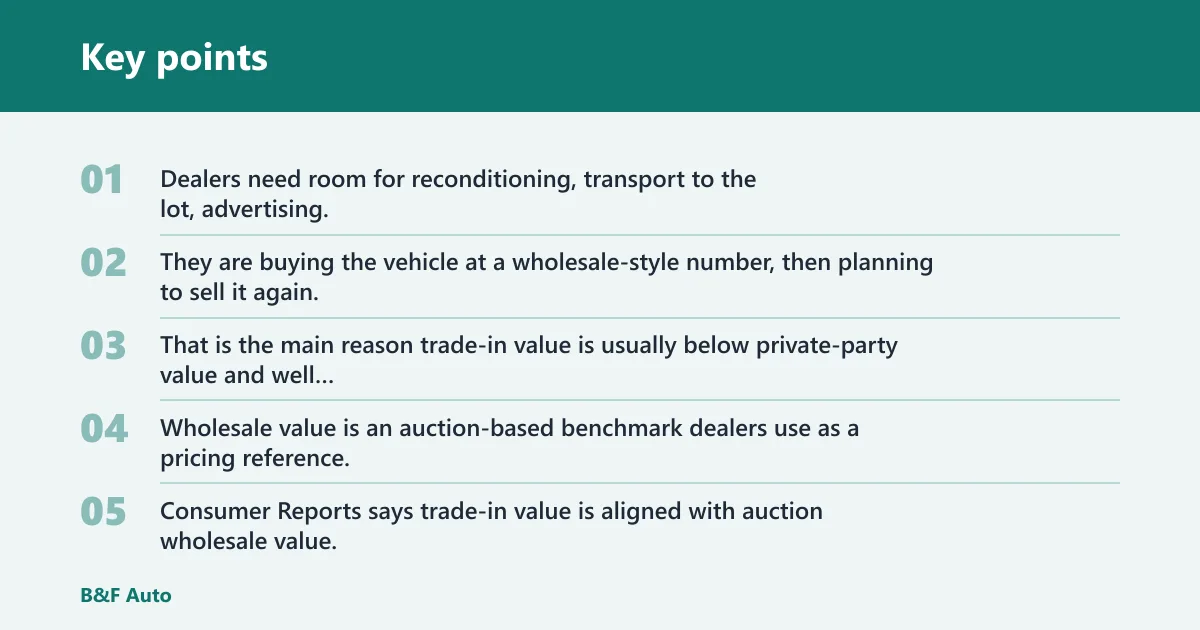
Dealers need room for reconditioning, transport to the lot, advertising, and the profit they expect on resale. They are buying the vehicle at a wholesale-style number, then planning to sell it again. That is the main reason trade-in value is usually below private-party value and well below retail asking price.
Trade-in value vs. wholesale and private party
Wholesale value is an auction-based benchmark dealers use as a pricing reference. Consumer Reports says trade-in value is aligned with auction wholesale value, which is why dealer offers usually track that lower price band rather than the retail number shoppers see on dealer lots. (Consumerreports)
Private-party value is the sale price between consumers. It is typically above trade-in value because there is no dealer margin built in, but it is usually below retail because the buyer is still taking on the work and risk of a direct sale.
Black Book is one of the dealer-facing valuation sources appraisers use, and MotorTrend notes that its tool uses Black Book data dealers rely on. That matters because different calculators may read the same market through similar dealer-oriented data, yet still produce different estimates once inventory levels and local demand are added. (Motortrend)
What changes a trade-in offer?
Dealers do not arrive at a trade-in number from one factor alone. Age, mileage, condition, service history, accident history, options, and local market demand all shape the offer. A clean, popular vehicle in a strong local market can land above a weak online estimate. The reverse is also true.
Mileage and age
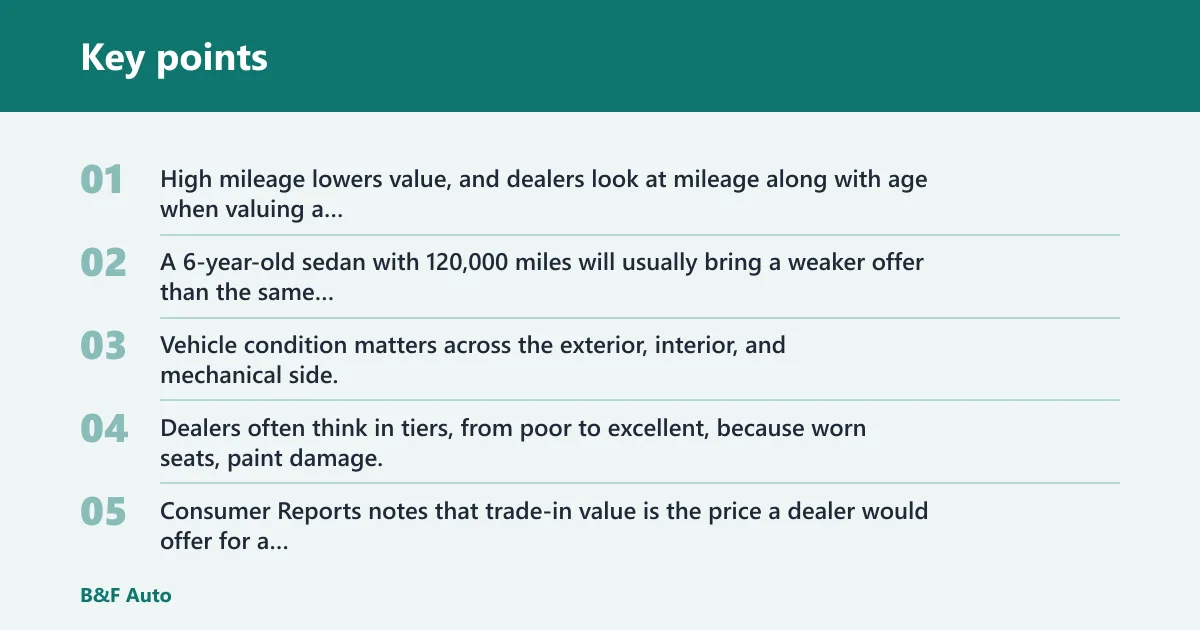
Mileage is a core valuation input. High mileage lowers value, and dealers look at mileage along with age when valuing a trade-in. A 6-year-old sedan with 120,000 miles will usually bring a weaker offer than the same model with 60,000 miles, even if both start the day in decent cosmetic shape.
Condition, service history, and accident history
Vehicle condition matters across the exterior, interior, and mechanical side. Dealers often think in tiers, from poor to excellent, because worn seats, paint damage, tire wear, and mechanical issues can all turn into reconditioning cost. The same source notes that trade-in value is the price a dealer would offer for a consumer’s vehicle.
Service history can support a higher offer when maintenance is documented. Oil changes, brake work, and major services do not guarantee a premium, but records reduce uncertainty. Accident history can pull the number down even after repairs, because damage history affects resale confidence and often changes the dealer’s expected margin.
Options, packages, and market demand
Optional equipment and packages can affect the estimate, but they may add little or no resale value on some vehicles. A sunroof, premium audio, or a convenience package might help on one model and barely move the number on another. Dealers care most about what the next buyer will pay for that exact trim in that exact market.
Dealer inventory and local market conditions can shift the final offer away from an online estimate. A truck may trade better in a region that prefers trucks. A fuel-efficient sedan may bring more when supply is thin. That is why the same car can appraise differently at two stores with different inventory and buyer demand.
What does a dealer look at first?
Dealers usually start with the details that affect reconditioning fastest: exterior condition, interior condition, mechanical condition, tire wear, warning lights, title status, and recall status. That is the quickest path to estimating what the car will cost to retail again.
Common appraisal knockdowns
- Mileage
- Condition
- Accident history
- Service history
- Tires
- Warning lights
- Title or recall issues
Some of those are serious, and some are not worth overpaying to fix before the appointment. A small scratch usually matters less than bald tires or a check-engine light. A branded title or unresolved recall can also cut deep because it affects resale and the dealer’s risk.
Picture a compact SUV with 78,000 miles, clean paint, and a full service file, but it has two worn tires and an illuminated warning light. The dealer is likely to deduct for the tires and diagnose the light before making a final number. The paperwork helps; the dashboard light hurts.
Trade-in value walkthrough
The practical math starts with the dealer offer, then subtracts any loan payoff or negative equity. The remaining amount is the net equity you can apply to the next car. If the payoff is larger than the trade-in amount, the shortfall rolls into the new deal unless you cover it another way.
| Dealer offer | Loan payoff / negative equity | Net equity to apply to the next car |
|---|---|---|
| $18,500 | $13,200 payoff | $5,300 toward the next car |
| $18,500 | $20,000 payoff | -$1,500 negative equity |
In a worked example, if a dealer offers about $18,500 on your car and the payoff is about $13,200, the difference is positive equity. The net equity is $5,300, which can reduce the amount you finance on the next vehicle. In a worked example, if the payoff is about $20,000, there is no equity to carry forward; there is negative equity that must be paid or rolled in.
This is where many buyers misread the deal. The trade-in number is not the same as cash in your hand. It is a credit applied against the next transaction, and the payoff step can shrink that credit fast.
Taxes and fees
In some states, trade-in value can reduce the taxable amount on the new purchase because the dealer applies the trade credit to the deal. That can improve the out-the-door math even when the trade offer itself looks modest. You still need to read the purchase worksheet carefully, because tax treatment varies by location.
How can you avoid a low offer?
You cannot force a dealer to ignore condition, mileage, or market data, but you can make the appraisal easier to verify. Bring records and title documents, clean the car, handle low-cost issues that the dealer will notice anyway, and check online estimates before the appointment. That keeps you from walking in blind.
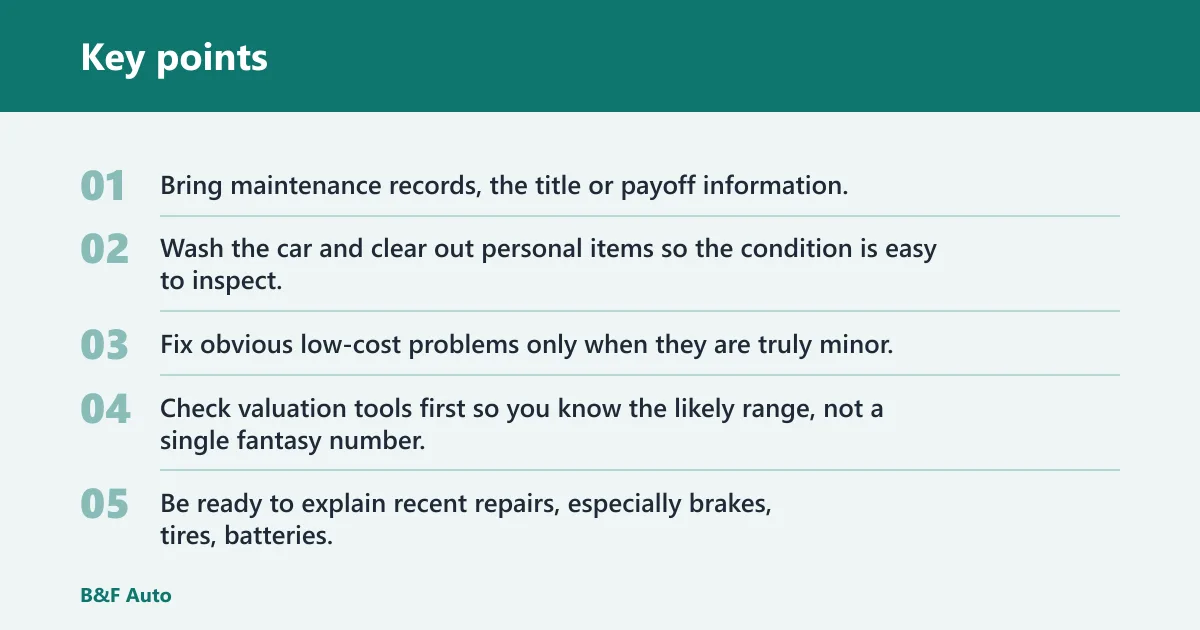
- Bring maintenance records, the title or payoff information, and both keys if you have them.
- Wash the car and clear out personal items so the condition is easy to inspect.
- Fix obvious low-cost problems only when they are truly minor, such as a dead key fob battery or a missing floor mat.
- Check valuation tools first so you know the likely range, not a single fantasy number.
- Be ready to explain recent repairs, especially brakes, tires, batteries, and major service.
- Ask the dealer what specific items are hurting the number.
- Compare more than one offer if the car is worth enough to justify the time.
A common first-timer mistake is spending a lot on bodywork before an appraisal. A large cosmetic repair rarely returns dollar-for-dollar value at trade-in. By contrast, a car with obvious maintenance proof and clean presentation is easier for the dealer to price quickly and confidently.
Suppose two identical midsize sedans arrive on the same day. One has a stamped service book, clean wheels, and no warning lights. The other has no records, a cracked mirror, and a tire-pressure light on. The first car is easier to retail, so the dealer has less uncertainty and may offer more.
Trade-in value by vehicle situation
The answer changes with the kind of vehicle you are bringing in. Financed cars, leased cars, and cars with major mechanical issues all need special attention because the headline offer is only part of the story. The dealer still has to account for payoff, contract limits, or repair cost.
Financed cars
If you still owe money, the dealer pays the lender from the trade proceeds. If the trade-in value is higher than the payoff, the difference becomes equity for the next car. If the payoff is higher, the shortfall is negative equity, and that amount has to be handled in the new deal or paid separately.
Leased cars
With a leased car, you need the lease payoff, the buyout terms, and any early termination costs. The dealer may buy the vehicle from the leasing company if the numbers work. If the market value is below the lease payoff, you may owe money to close the deal, so get the payoff figure before you assume the trade will cover everything.
Cars with major mechanical issues
Major mechanical problems can push the offer far below a clean example because the dealer must either repair the car or send it to auction. A vehicle with transmission trouble, overheating, or a severe electrical fault may still have trade-in value, but the number can move close to scrap-level territory depending on the car and market.
Frequently asked questions
What is trade in value for a car?
Trade-in value is the dealer offer for your car when you apply it toward another purchase. It is usually based on wholesale market data, mileage, condition, service history, and likely reconditioning costs. The same source says it is the price a dealer would offer for a consumer’s vehicle.
What is a good trade in value for a car?
A good trade-in value is one that sits near the upper end of the realistic dealer range for your exact car, not just the highest online estimate. If your car is clean, well maintained, lightly worn, and in demand locally, the offer may be stronger. Comparing multiple appraisals helps you judge that range.
What is the lowest trade in value for a car?
The lowest trade-in value is the point where the dealer still sees resale or parts value after subtracting reconditioning and risk. For a car with severe mechanical problems, accident damage, title problems, or very poor condition, the offer can drop sharply. In some cases, it may be little more than salvage value.
What is trade in value when buying a car?
When you are buying a car, trade-in value is the credit the dealer applies from your old vehicle toward the new deal. It reduces the purchase amount, and it can also affect taxes in some states. It is not the same as the price the dealer will later retail your car for.
Do I need a VIN to get a trade-in value?
You do not always need a VIN to get a rough estimate. MotorTrend says its tool uses Black Book data dealers rely on, and MotorTrend also says a VIN is not necessary for an estimate. Still, a VIN helps tighten the quote because it confirms trim, engine, and equipment more precisely.
Why is trade-in value usually lower than private party value?
Trade-in value is usually lower because the dealer has to inspect, recondition, market, and resell the car at a profit. Private-party value is what one consumer may pay another consumer, so there is no dealer margin built in. That is why private-party prices are often higher than trade-in offers.