Upside-Down Trade-In: What to Do If You Owe More
If your trade-in is upside down, the cheapest move is usually to keep the car and pay down the gap until your loan payoff is at or below the vehicle’s market value; trade now only when you can cover the negative equity in cash or your car costs are no longer workable. Roll that gap into another loan and you can end up paying interest on old debt for years, with a higher payment and a car worth less than the balance. This guide shows you how to calculate the payoff-to-value gap, compare trade-in, private sale, refinance, and keep-it options, and choose the lowest-total-cost path.
What you’ll need
- Your lender payoff quote with the good-through date
- Your latest loan statement for balance comparison
- Two or three dealer trade-in offers
- A realistic private-party sale estimate for your exact trim, mileage, and condition
- A worksheet or calculator for taxes, registration, dealer fees, and add-ons
- Details on any cash down payment available
- Your credit score range or recent financing terms, if known
What an upside-down trade-in really means
Payoff, value, and equity position
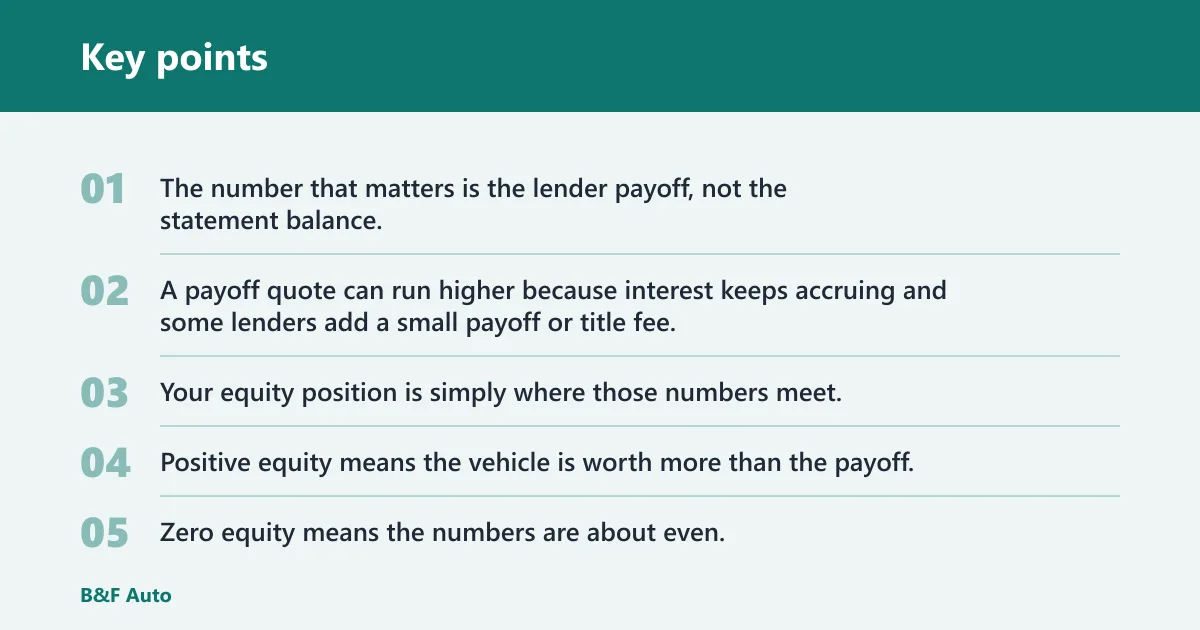
The number that matters is the lender payoff, not the statement balance. A payoff quote can run higher because interest keeps accruing and some lenders add a small payoff or title fee. That is why a gap that looks like $1,800 from the statement can become $2,050 at closing.
Trade-in value is a dealer offer based on condition, mileage, market demand, auction results, and expected reconditioning cost. It is usually lower than what a private buyer may pay because the dealer has to leave room for transport, cleanup, repairs, and resale risk.
Your equity position is simply where those numbers meet. Positive equity means the vehicle is worth more than the payoff. Zero equity means the numbers are about even. A negative position means the payoff is higher, and that gap has to be paid somehow.
Why the shortfall changes before closing
Shortfalls move for ordinary reasons. Interest builds daily. Offers expire. A vehicle inspection may catch tire wear, paintwork, warning lights, or excess mileage. If a replacement purchase adds sales tax, registration, dealer documentation fees, service contracts, wheel-and-tire coverage, or credit insurance, the amount financed can jump well beyond the original gap.
Suppose the payoff is about $24,150 and a dealer offers about $21,000. The raw shortfall is $3,150. Add a $1,500 service contract and a $799 dealer fee to the next deal, and that transaction asks the next loan to absorb about $5,449 before counting tax and registration.
How to confirm the trade-in gap
The quickest way to tell whether you’re upside down is to compare your current loan payoff to what the car is worth on trade-in. If the payoff is higher, the difference is negative equity, and that amount can follow you into your next loan. The supporting guide breaks down the exact numbers to gather, a simple check sheet, and what to do if the gap is small, large, or changing fast. For a step-by-step breakdown, see upside-down trade-in check.
That matters because the wrong move can raise your monthly payment, stretch your loan term, or leave you starting the next car loan already behind. Knowing the gap early gives you more options, including paying it down before you trade.
How much upside down are you?
Use the lender’s exact payoff quote and real offers on your current vehicle, then calculate two gaps: one against the best trade-in and one against a likely private-party sale. The smaller of those gaps is the real decision point, because statement balances and online estimates often miss accrued interest, inspection changes, and closing costs.
Measure the shortfall the right way
- Get the payoff quote. Ask the lender for a 10-day or 15-day payoff amount and write down the date it expires. This is the amount needed to satisfy the old loan, and it may be higher than the monthly statement balance because of daily interest and fees.
- Collect dealer offers. Get at least two trade-in bids for the same car, on the same week, with the same mileage and condition disclosed. A fresh in-person appraisal is better than a generic online estimate because worn tires, glass damage, or warning lights can change the number fast.
- Estimate private-sale proceeds. Check realistic asking prices for the same year, trim, mileage, and condition, then subtract what a buyer will likely negotiate off. Use a conservative figure because private-party sale value is often higher than trade-in, but closing one still takes time and coordination.
- Subtract and compare. Subtract each offer from the payoff amount. If payoff is about $24,150, the best trade offer is about $21,000, and the likely private-sale price is about $23,200, the trade gap is about $3,150 and the private-sale gap is about $950.
- Recheck after each $500. If you plan to pay the loan down, recalculate every additional $500 applied to principal. That increment is large enough to change a lender approval decision or remove the need to roll a small balance into the next loan.
Use both value tracks
Do not compare the payoff only to trade-in. A private-party sale can shrink or erase the gap, especially on clean, desirable used vehicles where dealer margin is wider. On the other hand, if the car has title issues, accident history, heavy wear, or urgent replacement needs, the time cost of selling it privately may outweigh the extra dollars.
Say your lender payoff is $18,400. Dealer offers come in at $16,800 and $17,100, but a realistic private-party sale looks closer to $18,000. That turns a $1,300 trade gap into a $400 sale gap, which can be covered in cash far more easily than financing the full difference.
What happens to your old loan when you trade in?
The dealer does not make the old loan disappear; it sends payoff funds to the lender, and any gap left over must be covered by cash at closing or added to the next loan if the lender allows it. If the trade value exceeds payoff, the excess becomes equity toward the replacement purchase.
When the trade covers the payoff
If the dealer offers more than the payoff, the old lender gets paid in full and the remaining amount becomes credit in the deal. That credit can reduce the next vehicle’s price, taxes in some states, or the total amount financed.
When you must pay cash
If there is a shortfall and the next lender will not finance it, the owner brings cash to closing. This usually happens when the gap is large compared with the replacement car’s value, the credit profile is thin, or the loan-to-value ratio would be too high after taxes and fees.
When the balance is rolled over
Negative equity rollover means the remaining old balance is added to the next auto loan. This is common, but it is expensive. The new lender is financing the replacement car, plus old debt, plus taxes, title, registration, documentation fees, and any add-ons included in the contract.
Picture a replacement car priced at $27,000. Add a trade gap of about $3,150, sales tax at 7% of about $1,890, a $699 documentation fee, about $420 for registration, and a $1,200 service contract. The amount financed becomes $34,359 before any down payment. The trade shortfall looked manageable by itself, but the final loan is $7,359 above the vehicle price.
Equity decision matrix
Upside-down trade-in decision table
| Negative equity band | Typical example | Best next move | Estimated payment impact if rolled into 60-month loan at 8% APR | Risk level | When to choose it |
|---|---|---|---|---|---|
| $0 to $1,500 | Payoff $22,400; best trade $21,300 | Pay down in cash or sell privately first | About $20 per month per $1,000 rolled | Low to moderate | Choose pay down if cash is available and the next car is needed soon; choose private sale if it can erase most of the gap within a few weeks |
| $1,501 to $4,000 | Payoff $24,150; best trade $21,000 | Keep the car, pay principal down, or refinance if rate is high; private sale can still win | About $30 to $80 per month | Moderate | Choose waiting if the current car is dependable; choose refinance only if it lowers APR or payment enough to buy time without stretching too far |
| $4,001 to $7,500 | Payoff $28,900; best trade $23,800 | Avoid rollover if possible; sell privately, make a larger down payment, or delay replacement | About $80 to $150 per month | High | Choose this path only if there is a strong reason to replace now and the next car is priced low enough to keep total financed cost under control |
| More than $7,500 | Payoff $31,600; best trade $22,900 | Deep paydown, keep and wait, or restructure through refinance if available | More than $150 per month | Very high | Choose rollover only as a last resort when the current vehicle is no longer workable and a lender will approve without loading the next loan with costly add-ons |
| Any band, immediate replacement needed | Total loss risk, repeated major repairs, or family-size change | Use cash to shrink gap, buy less replacement car, skip add-ons, compare lenders | Depends on how much of the gap remains after cash down | Moderate to very high | Choose this only when the current vehicle cannot reasonably stay in service and the full deal sheet has been checked line by line |
How to read the table
The payment effect above uses a straightforward loan calculation, rounded to the nearest $10, for a 60-month loan at 8% APR. Different rates and terms change the monthly number, but the direction does not change: every dollar rolled from the old car is a dollar that can collect interest again on the next one.
Credit score matters here. Better credit can reduce APR and improve approval odds on a rollover, but it does not fix an inflated amount financed. Weak credit makes the same shortfall cost more because both the old debt and the replacement vehicle get financed at a higher rate.
How should you choose the lowest-cost move?

Choose the option that produces the lowest total financed amount after payoff, down payment, taxes, fees, and any add-ons are included. Monthly payment matters, but it can hide a costly deal if the term is stretched. A lower-priced replacement, cash against the gap, and fewer extras usually beat rolling debt forward.
Decision steps
- Price the full replacement. Build the next deal from the selling price up: vehicle price, sales tax, registration, documentation fee, and every optional product. This keeps a small trade gap from turning into a much larger new loan once extras are added.
- Apply cash strategically. Put available cash first against negative equity if that is what gets the deal inside lender limits or avoids financing old debt. If the gap is already small, part of that cash may be better used as down payment on the next car to improve loan-to-value.
- Test the private-sale path. If a private buyer can cut the gap sharply, compare that result with the convenience of a trade. Handling payoff and title transfer takes more work, but a higher sale price often beats taking a low trade and financing the shortfall.
- Check refinance before replacing. If the current loan rate is high, refinancing can reduce payment or interest cost and buy time until equity improves. This works best when credit has improved and the vehicle still meets lender rules on age, mileage, and value.
- Roll only what remains. If replacement cannot wait, roll the smallest possible amount and choose the shortest practical term. Keep the replacement car modest, because borrowing old debt against another rapidly depreciating vehicle compounds the problem.
Should you pay down before trading?
Paying down first makes sense when the cash directly removes a borrowing problem, such as reducing the rollover to a level a lender will approve or cutting enough debt to avoid a high-rate, long-term loan. It makes less sense when that cash would leave no emergency reserve and the next car still needs taxes, fees, and basic startup costs covered.
A common first-timer mistake is sending $2,000 to the current lender, then arriving at the next purchase with no money for tax, title, registration, or insurance changes. The deal still rolls debt, but now there is no cash buffer for the first repair or deductible.
Private sale versus trade-in
Private-party sale is often better when the car is clean, marketable, and the owner can wait for the right buyer. If the lender holds the title, the sale usually works one of two ways: the buyer pays the lender directly and waits for title release, or the seller pays off the loan first, then signs over title once it arrives.
Trade-in is usually better when time is short, the car needs work, or the paperwork risk of a private sale is not worth the extra proceeds. The key is knowing exactly how much convenience is costing.
Can you replace the car now without making the next loan worse?
Yes, but only if the replacement deal is built to contain the damage: cut the old gap with cash, choose a cheaper vehicle, strip out optional products, and compare lender approvals before signing. Immediate replacement is where many underwater owners overborrow because they focus on monthly payment and miss the final amount financed.
If that didn’t work, try this next
- Use cash on the gap. Apply enough money to reduce or eliminate the rolled balance, then ask for updated loan terms. Even a $1,000 reduction can lower payment and total interest while improving approval odds.
- Choose less replacement car. Step down in price, trim level, or age so the next loan starts lower before negative equity is added. A less expensive replacement often does more to fix the deal than negotiating a tiny APR change.
- Delete add-on products. Remove service contracts, appearance packages, wheel coverage, alarm systems, and similar extras unless there is a clear need and room in the budget. These items often get financed for the full term, which means interest is paid on them too.
- Refinance current loan. If the present vehicle can survive a little longer, ask local banks or credit unions about refinancing the existing loan. Lower APR or a more manageable payment can buy time to reach a better equity position, though some lenders cap mileage or age.
- Sell privately first. If dealer numbers stay ugly, line up a private buyer and coordinate payoff with the lender. This takes more planning, but it can turn an unfinanceable trade into a manageable cash difference.
Urgent replacement guardrails
Gap insurance is commonly relevant when a loan balance exceeds actual cash value and the car is totaled or stolen, but it does nothing for a planned trade-in. If the next loan will start underwater because of rolled debt, gap coverage on the replacement vehicle may still be worth pricing. It protects a future total-loss shortfall, not today’s trade gap.
Prevention: on the next purchase, aim for a shorter term than 84 months if the budget allows, put enough down to avoid starting underwater, and skip financed add-ons that do not clearly solve a real need.
Common mistakes
What goes wrong and how to avoid it
Using statement balance instead of payoff is the first error. It makes the old debt look smaller than it is.
Using retail asking prices as trade value is another. Dealer trade-in numbers reflect wholesale risk, reconditioning, and resale margin, so they will not match what similar cars are listed for on dealer lots.
Focusing on monthly payment alone causes the biggest long-term damage. Extending the term can make the payment look workable while burying old debt, tax, fees, and add-ons inside a larger loan.
Assuming every refinance is a fix also causes trouble. Some owners refinance into a longer term at a similar rate and simply delay the problem while paying more interest overall.
Ignoring immediate-replacement math is costly. When a car must be replaced now, the safest move is usually a cheaper replacement with fewer extras, not a similarly priced upgrade that relies on long-term financing to hide the rollover.
Frequently asked questions
What should I do if my trade-in is worth less than I owe?
Start with the exact payoff and the best real offer on the car, then compare three paths: keep and pay down, sell privately, or trade with cash covering the gap. In most cases, keeping the car a bit longer or shrinking the shortfall in cash costs less than rolling it into a new loan.
Can I trade in a car if I still have a loan on it?
Yes. The dealer contacts the lender and pays the payoff amount when the deal closes. If the trade value is lower than payoff, the remaining balance must be paid in cash or added to the next loan if the lender approves the higher amount financed.
How do I know how much negative equity I have?
Subtract the current vehicle offer from the lender’s payoff quote, not from the monthly statement balance. Run that math twice: once with the best dealer trade offer and once with a realistic private-party sale estimate. The difference between those results often changes the best next move.
Should I pay down my loan before trading in my car?
Pay down first when the cash clearly reduces the amount that would otherwise be rolled into the next loan or helps you qualify for better financing. Keep some reserve if trading now will also require taxes, registration, insurance changes, and an emergency cushion for the replacement car.
Can a dealer roll negative equity into a new loan?
Yes, if the next lender accepts the total loan amount after adding old debt, taxes, fees, and any add-ons. Approval depends heavily on credit score, vehicle price, and loan-to-value limits. The danger is paying interest on old debt again while starting the next car underwater.
What options do I have if I need a car now but owe more than it’s worth?
Use cash to reduce the gap, choose a cheaper replacement vehicle, remove optional products, and compare lender terms before signing. If the current car can last a little longer, refinancing the existing loan may buy time. If it cannot, sell privately or trade only after reviewing the full amount financed.