Can You Deduct a Donated Car Without a Donation Receipt?
Yes, but only if you still have the proof the IRS requires: for a donated car deduction over $500, you generally need a contemporaneous written acknowledgment, often Form 1098-C, from the charity by the earlier of the return filing date or the return due date. A missing receipt can turn a valid donation into a denied deduction, plus penalties if the IRS audits your return. Here’s how to decide what to claim, what records can substitute, and when to skip the deduction.
Can you deduct a donated car without a receipt?
Usually no, if the receipt means the IRS acknowledgment the law expects and you cannot replace it. If the charity can still send a compliant statement, the deduction may still be available. If you have no substantiation at all, leave the deduction off rather than guess.
The key issue is timing and completeness. A late document can still help if you receive it before the earlier of the filing date or the return due date and it is valid and matches the donation, but a missing acknowledgment at filing time is a different problem from a receipt that simply has not arrived yet.
What the IRS expects as proof
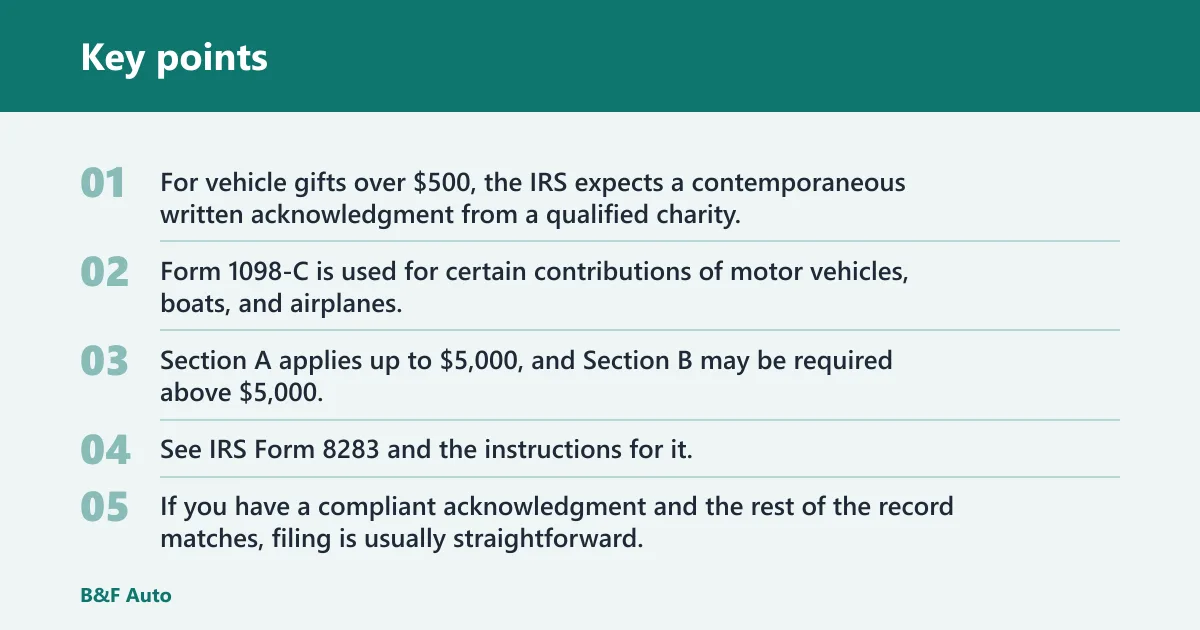
For vehicle gifts over $500, the IRS expects a contemporaneous written acknowledgment from a qualified charity. That acknowledgment can be Form 1098-C or another compliant statement that includes the required vehicle and disposition details. A tow slip, pickup record, or title copy may support the trail, but those items usually do not replace the charity’s acknowledgment.
Form 1098-C is used for certain contributions of motor vehicles, boats, and airplanes. For qualified vehicle donations over $500, the charity must furnish the required acknowledgment, and Form 1098-C is one way to do that. The form is generally furnished within about 30 days of the sale date or contribution date, depending on how the charity disposes of the vehicle.
Form 8283 also matters. It is used for noncash charitable contributions over $500. Section A applies up to $5,000, and Section B may be required above $5,000. It does not replace the charity acknowledgment; it works alongside it. See IRS Form 8283 and the instructions for it (IRS) (IRS).
When paperwork is strong enough to claim
If you have a compliant acknowledgment and the rest of the record matches, filing is usually straightforward. That is true even when the charity later sells the vehicle for less than you expected, because the deduction is commonly tied to gross proceeds when the sale rule applies. If the vehicle sold for $500 or less, the deduction may be up to $500 if the acknowledgment is compliant.
Can a tow slip or title copy replace the receipt?
No, not by itself. A tow slip or title copy can help reconstruct the donation trail, but it usually does not satisfy the IRS requirement for a contemporaneous written acknowledgment. Those records prove movement or transfer steps, not the charity’s tax reporting details.
That said, those records are still worth keeping. They can show the pickup date, the vehicle identity, and that the title moved to the charity or its agent. If the charity later issues a proper Form 1098-C or equivalent statement, those backup records help match the donation to the right vehicle.
Say your 2012 sedan was picked up on June 4 and the tow company gave you a slip, but the charity never sent a tax receipt. The slip supports the handoff. It does not tell the IRS whether the charity sold the car, what the sale produced, or whether the charity was qualified.
What those records can support
- Vehicle identity, through the VIN or title copy.
- Pickup date and location, through the tow slip or dispatch record.
- Title transfer, if you kept the signed title copy or release paperwork.
- Contact details for follow-up with the charity or towing agent.
What they usually cannot prove
- That the charity is a qualified charity.
- That the charity issued the required acknowledgment.
- That the disposition details on Form 1098-C are correct.
- That gross proceeds or fair market value can be claimed without the needed proof.
How car donation value is limited
The deduction ceiling depends on how the charity handled the vehicle. If the charity sells the vehicle, gross proceeds usually control and the deduction is often limited to the sale price shown in the acknowledgment. If a fair market value exception applies, the value rules can be different, but the proof rules do not go away.
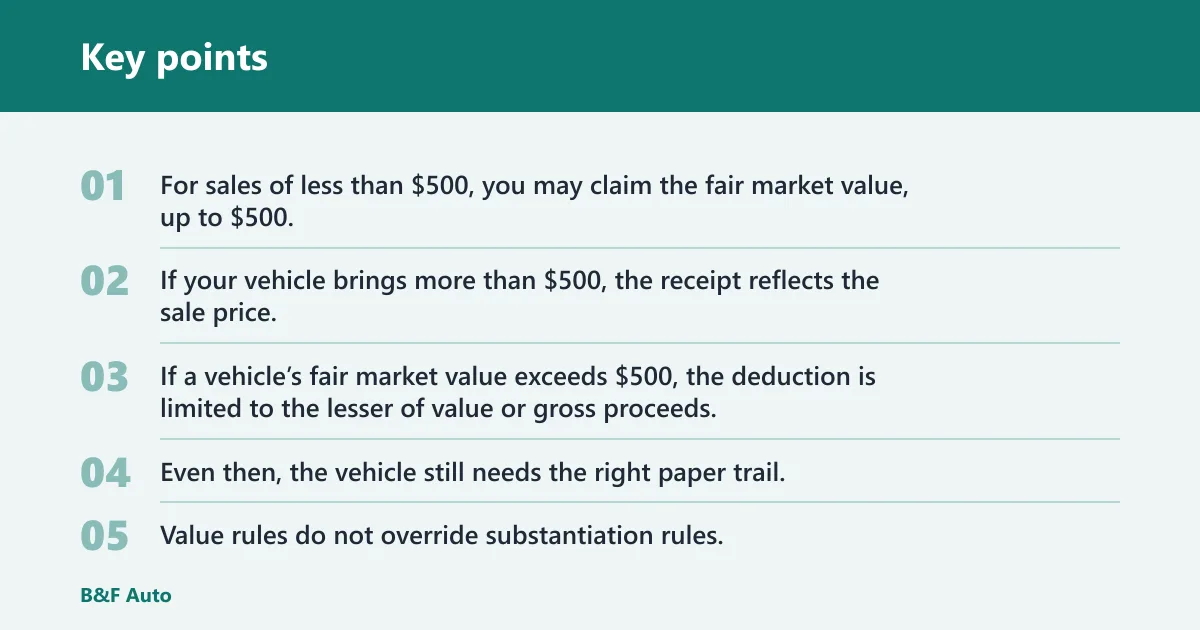
For sales of less than $500, you may claim the fair market value, up to $500. If your vehicle brings more than $500, the receipt reflects the sale price. If a vehicle’s fair market value exceeds $500, the deduction is limited to the lesser of value or gross proceeds.
Gross proceeds versus fair market value
| Value rule | When it matters | What usually controls the deduction |
|---|---|---|
| Gross proceeds | When the charity sells the vehicle | The sale amount shown on the acknowledgment |
| Fair market value | When a sale exception applies | The vehicle’s condition, mileage, and market, subject to IRS limits |
| $500 ceiling | When the vehicle sells for $500 or less | Fair market value, up to $500, if the acknowledgment is compliant |
| Over $5,000 claims | When the claimed value is above $5,000 in certain cases | A qualified appraisal may be required |
A fair market value exception may apply if the charity uses the vehicle, materially improves it, or transfers it for needy-individual purposes. Even then, the vehicle still needs the right paper trail. Value rules do not override substantiation rules.
A qualified appraisal may be required when the claimed deduction exceeds $5,000 in certain cases. That is especially relevant when the fair market value exception is in play. Form 8283 Section B may also be required in that range.
What to do if the receipt is missing
If the receipt has not arrived, start by chasing it. If no compliant acknowledgment can be obtained, the deduction is too risky to claim. The correct response depends on whether the problem is a late document, a lost document, or no proof at all.
-
Request a duplicate.
Contact the charity and ask for a replacement Form 1098-C or equivalent written acknowledgment. Use the VIN, pickup date, and donor name so the charity can match the record quickly. -
Check email and portals.
Look for an electronic copy, donor portal message, or mailed notice that may have been missed. A late copy can still support the return if it is compliant and complete. -
Verify the charity.
Confirm the recipient is a qualified charity. A donation to a non-qualifying group produces no deduction, even if paperwork exists. -
Rebuild the paper trail.
Gather the tow slip, title copy, pickup confirmation, and any charity emails. These records help prove the donation happened, but they do not cure missing IRS acknowledgment rules on their own. -
Skip the deduction if needed.
If no compliant proof can be obtained before filing, leave the deduction off. That is safer than claiming a vehicle donation with no substantiation and hoping the IRS accepts the backup trail.
Suppose the charity says it sold your truck for $1,200 and the email receipt arrives three weeks later with the VIN, date, and gross proceeds. That late receipt may still be usable if you receive it before the earlier of the filing date or the return due date and it is a proper acknowledgment. If the charity never issues anything, the record is much weaker.
Missing car donation receipt: claim, chase, or skip
This decision table separates a late receipt from no proof at all. That difference matters. A late but compliant acknowledgment can still make the deduction possible, while no substantiation usually makes the claim too risky to take.
| Scenario | Likely IRS substantiation status | Recommended next step | Filing-risk note |
|---|---|---|---|
| Receipt received | Generally compliant if it includes the required vehicle and disposition details | File with Form 8283 if required and keep the acknowledgment with your return records | Lowest risk, assuming the charity is qualified and the figures match |
| Receipt late | Potentially compliant if it arrives before filing and is complete | Wait for the document or request a duplicate before filing | Moderate risk if you file before the acknowledgment is in hand |
| Receipt lost | May still be compliant if the charity can reissue it | Ask the charity for a duplicate and save any email or portal copy | Risk rises if you cannot obtain a replacement with the required details |
| Charity unresponsive | Unclear; substantiation is not established until a compliant acknowledgment is obtained | Document follow-up attempts, then decide whether to exclude the deduction | High risk if you claim without the acknowledgment |
| Only tow slip/title copy available | Supportive, but usually not enough by itself | Use those records to reconstruct the donation and keep asking for the charity form | High risk unless a proper acknowledgment is later obtained |
| No proof at all | No substantiation | Skip the deduction and gather records for next year’s filing only if the charity later responds | Too risky to claim |
Is the charity qualified and was the title transferred?
First, verify the charity’s eligibility and EIN, and make sure it is a qualified 170(c) charity. A qualified charity is required; a donation to a non-qualifying group produces no deduction. Second, keep title-transfer records separate from tax substantiation. Title transfer protects you from vehicle liability issues, but it is not the same thing as the IRS acknowledgment.
The charity says it will sell the vehicle once it holds the title, and that makes the title step important. The donor may need to provide title-transfer paperwork at pickup, depending on state rules and the donation program. Those steps matter for ownership cleanup, not just taxes.
Keep the federal tax file and the state file separate. One answers whether the IRS will allow the deduction. The other answers whether the vehicle left your name and whether later parking tickets, toll charges, or other liability problems can attach to you.
Frequently asked questions
Can I still deduct a donated car if I never got the receipt?
Usually not safely. If the charity can still provide a proper contemporaneous written acknowledgment, the deduction may remain available. If you have no compliant proof at filing time, skip the deduction rather than claim it with missing substantiation.
What counts as proof of a car donation for taxes?
The main proof is a contemporaneous written acknowledgment from a qualified charity, often Form 1098-C or an equivalent compliant statement. Form 8283 may also be needed for noncash gifts over $500. Tow slips, title copies, and emails can support the record, but they usually do not replace the charity’s acknowledgment.
Can a tow receipt or pickup slip replace a donation receipt?
Usually no. A tow receipt can help show that the vehicle was picked up, and a title copy can help show transfer, but neither one usually satisfies the IRS rule for vehicle donation records by itself. If the charity later sends a proper acknowledgment, those records become useful support.
What if the charity sold my car but never sent Form 1098-C?
Ask for a duplicate right away and check whether the charity has a donor portal or email delivery record. If the form never arrives, do not assume the sale alone makes the deduction safe. The IRS still expects the proper written acknowledgment, and missing it raises audit risk.
How do I get a replacement donation receipt after the fact?
Contact the charity’s donor services or tax department and give the VIN, your name, and the pickup date. Ask for a duplicate Form 1098-C or equivalent statement. If the charity responds, keep that copy with your records and make sure it includes the key vehicle and disposition details.
Can I claim any deduction if I lost the title copy and receipt?
Maybe, but only if the charity can reissue a compliant acknowledgment and you can confirm the donation details another way. Without both the title trail and the required charity proof, the claim becomes hard to defend. If no substantiation can be rebuilt, leaving the deduction off is the safer filing choice.
Does the IRS require a receipt for every donated car?
For most deductible vehicle gifts over $500, yes, the IRS expects the proper written acknowledgment. The exact form can vary, but the proof requirement does not disappear because the car was donated in good faith. A missing receipt is a filing problem, not just a paperwork annoyance.
What should I do before filing if my car donation paperwork is incomplete?
Pause and sort the record before filing. Confirm the charity is qualified, request a duplicate acknowledgment, check whether Form 1098-C is still pending, and gather any tow or title records. If the charity cannot provide compliant proof, omit the deduction and avoid claiming a number you cannot support.