When Should a Charity Send Your Car Donation Tax Receipt?
For a car donation deduction, the charity should generally send Form 1098-C within about 30 days after the donation if it keeps the car for qualified use, and that acknowledgment is needed before you file your return. Miss the deadline, and the IRS can disallow the deduction or require an amended return. This guide explains which receipt counts, how pickup stubs differ from the 1098-C, and what to do if the paperwork arrives too late.
Car donation timing matrix
This matrix separates the pickup receipt from the final IRS paperwork. Use it to match the paperwork to the value level, then check whether you can file before the document arrives. A pickup slip may help you track the donation, but it does not always satisfy the IRS substantiation rules.
| Donation value threshold | Document type | Expected timing | Can you file without it? |
|---|---|---|---|
| Under $250 | Pickup receipt or charity record | At pickup or soon after; timing varies by charity | Often yes for substantiation, but keep records that show the transfer and date |
| $250 or more | IRS written acknowledgment or Form 1098-C | Before you file, or by the filing deadline, whichever comes first | No, not if you need the deduction and the acknowledgment is required |
| Over $500 | Written acknowledgment plus IRS Form 8283 for the tax return | Acknowledgment before filing; Form 8283 is prepared with your return | No for the acknowledgment; Form 8283 may also be needed when you file |
| Over $5,000 | Written acknowledgment, Form 8283, and appraisal rules may apply | Acknowledgment before filing; appraisal and signatures must be in place with your return | No, not if the higher-value reporting rules apply |
The $250 threshold is commonly the main timing benchmark. That is when the IRS written acknowledgment rule generally starts, and it is the point at which a pickup stub stops being enough by itself.
The sale amount can change what you may deduct. For many donated vehicles, the auction sale or gavel price controls the deduction, and the charity should inform you of that sale amount.
When should a charity send your receipt?
For a car donation, the charity should send the final IRS acknowledgment before you file your return, or by the filing deadline if you file early. If the charity sells the vehicle, the final paperwork often follows the sale. If the charity keeps the car for qualified use, the timing can run from the donation date instead.
What should arrive at pickup?
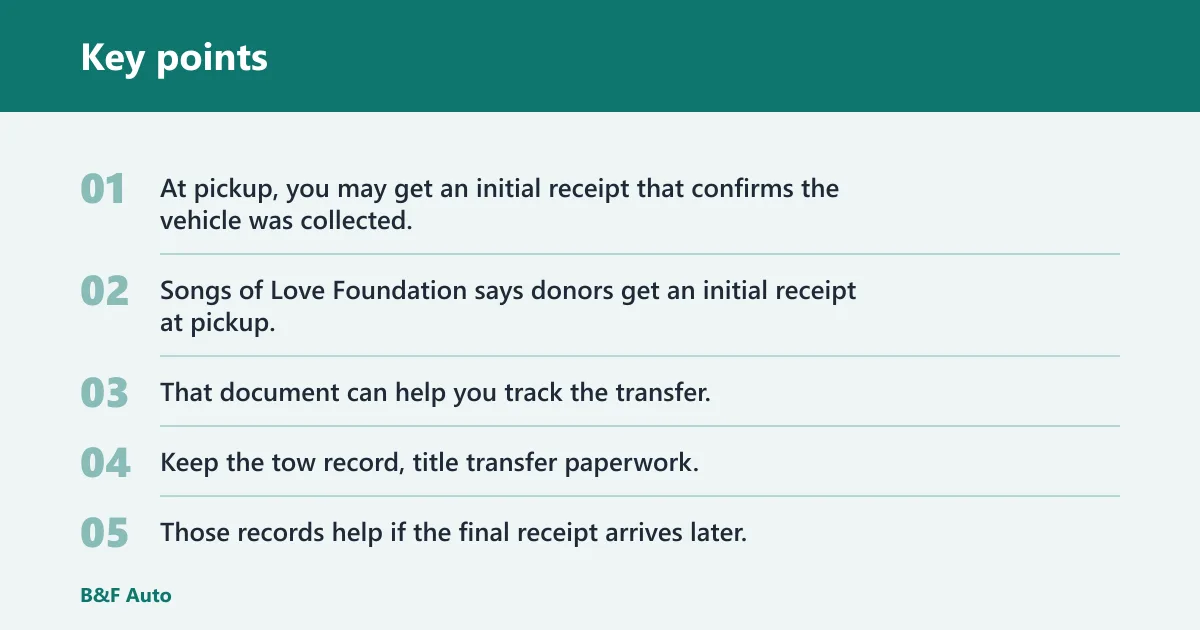
At pickup, you may get an initial receipt that confirms the vehicle was collected. Songs of Love Foundation says donors get an initial receipt at pickup. That document can help you track the transfer, but it may not contain the IRS details needed for a deduction.
Keep the tow record, title transfer paperwork, and any written confirmation of the date and location of pickup. Those records help if the final receipt arrives later.
What usually comes after the sale
After sale, the charity should send the final written acknowledgment or Form 1098-C. Songs of Love Foundation says the final IRS Form 1098-C is usually mailed within 30 days of sale. That timing can change by charity, especially if a third-party processor handles the sale or auction process.
Action Against Hunger uses Charitable Adult Rides and Services (CARS) for vehicle donations. That kind of partner setup can change who mails the final paperwork and how fast it moves.
How the filing deadline controls your timing
For donations of $250 or more, the acknowledgment must arrive before you file, or by the filing deadline, whichever comes first. GoFundMe Pro says donors giving $250 or more need a receipt before filing taxes or by the filing deadline. If you file early, you still need the receipt in hand first.
Say your car is picked up on March 4 and the charity does not sell it until April 20. If you plan to file in mid-April, you still need the final acknowledgment before you submit the return. A pickup stub alone does not fix missing IRS paperwork.
What counts as a valid IRS acknowledgment?
A valid IRS acknowledgment is the document that supports your deduction. For vehicle gifts, that can be Form 1098-C or a contemporaneous written acknowledgment with the required information. The key point is timing and content, not the paper title alone.
Written acknowledgment requirements for $250 or more
For a deduction tied to a donated vehicle, the acknowledgment should identify the vehicle and include the certification the IRS requires about sale, use, improvement, or transfer. A simple pickup slip usually does not satisfy that standard.
The charity should also tell you the vehicle’s sale amount. That number matters because, in many cases, the deduction follows the charity’s gross proceeds rather than an estimated private-sale value.
How Form 1098-C fits
Form 1098-C is the IRS form used for vehicle donation reporting. A charity may mail Form 1098-C after the vehicle is sold, or it may provide a contemporaneous written acknowledgment instead when allowed. Either way, the document should support the deduction before you file.
Do not treat Form 1098-C and a pickup receipt as the same thing. The pickup receipt starts the paper trail. The 1098-C or qualifying written acknowledgment is the substantiation document.
When a pickup receipt is not enough
A pickup receipt is not enough when you need IRS substantiation and the final acknowledgment has not arrived. If the donation is $250 or more, you should wait for the qualifying document before filing. If it never comes, contact the charity quickly and do not guess at the missing details.
A common first-timer mistake is to assume the tow driver’s receipt is the tax receipt. It is not, unless it contains the required IRS information and the charity issues it as the proper acknowledgment.
Does the sale price change your deduction?
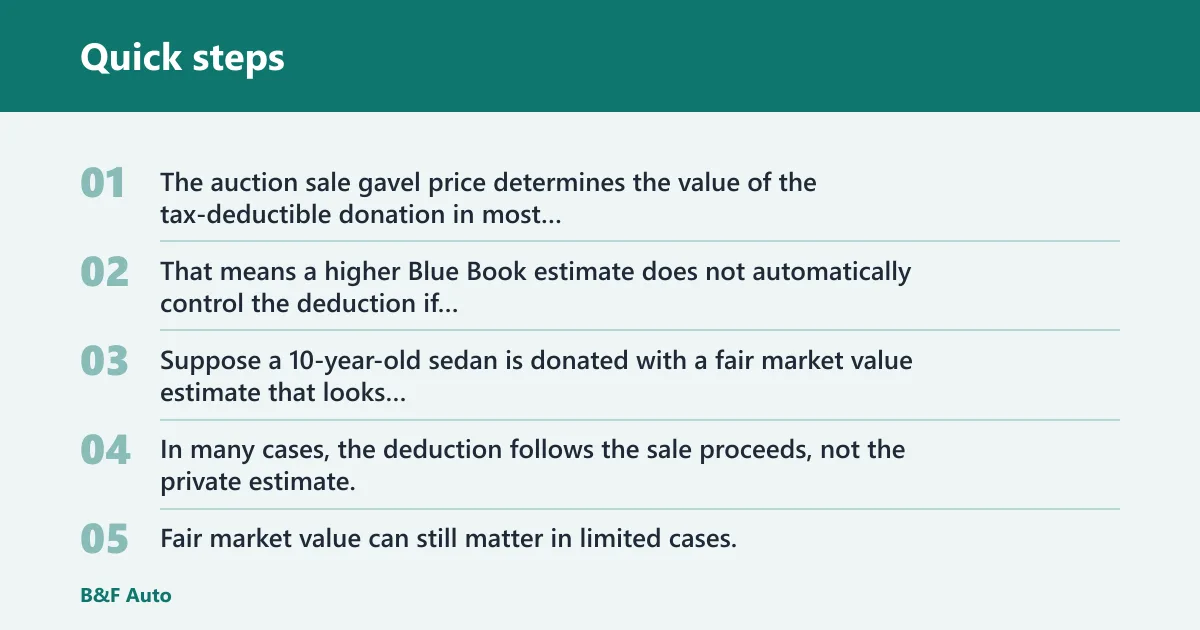
Yes. For many vehicle donations, the sale price changes the deduction because the auction sale or gavel price determines the value of the tax-deductible donation in most cases. If the charity sells the car, the gross proceeds often set the ceiling for the deduction.
How auction proceeds can set the deduction
The auction sale gavel price determines the value of the tax-deductible donation in most cases. That means a higher Blue Book estimate does not automatically control the deduction if the qualified vehicle rules tie the claim to what the charity actually received from the sale.
Suppose a 10-year-old sedan is donated with a fair market value estimate that looks decent on paper, but the charity sells it at auction for a much lower amount. In many cases, the deduction follows the sale proceeds, not the private estimate.
When fair market value still matters
Fair market value can still matter in limited cases, especially when the vehicle is used by the charity, materially improved, or transferred in a way that fits an IRS exception. Some charities use the vehicle to help people served or give it away to a needy family.
That is why you should not assume every donated car follows the same math. The use or disposition of the vehicle changes the paperwork and the number you can claim.
Why qualified vehicle rules can limit the claim
Many vehicle deductions are limited to the charity’s gross proceeds from sale. That can cap the deduction even if the car would sell for more in a private transaction. Check the charity’s written acknowledgment for the sales number and the related certification.
Always compare the document you receive with the vehicle’s final disposition. If the charity says it repaired, used, or transferred the car rather than selling it, the substantiation language should match that path.
What paperwork do you need for higher-value donations?
For higher-value car donations, the IRS may require more than the charity’s acknowledgment. Form 8283 is required when filing annual federal income taxes for some car donations, and the higher the claimed value, the more carefully you need to match the form to the supporting records.
When Form 8283 is needed
For donations over $500, Form 8283 may be required with your tax return. That form is completed by you, the donor. The charity does not simply mail Form 8283 as if it were its own receipt. (IRS)
Keep the charity’s written acknowledgment nearby when you prepare the return, because the figures and dates on the tax form should line up with the acknowledgment.
When Section B applies
If the car value is over $5,000, a written appraisal is needed with tax forms. Songs of Love Foundation says vehicle donations over $5,000 need Form 8283 Section B. That means the donor has extra reporting steps, and the appraiser and charity may need to sign the form where required.
Do not treat that rule as automatic for every car over $5,000. The exact reporting path depends on how the IRS classifies the vehicle and what the charity did with it.
What the donor must complete versus what the charity signs
You complete Form 8283. When the rules call for it, the appraiser signs the appraisal section and the charity signs the donee acknowledgment section. The charity’s role is to confirm the gift details, not to fill out your entire return.
That separation matters if the paperwork is late. A charity can still send the vehicle acknowledgment after pickup, while you remain responsible for attaching the right tax forms when you file.
What if the receipt comes late or never arrives?
If the receipt is late, contact the charity right away and ask when the final acknowledgment or Form 1098-C will be issued. If it never arrives, do not claim the deduction without the required paperwork. The IRS can disallow the deduction, and you may need an amended return if you already filed.
Steps to take before you file
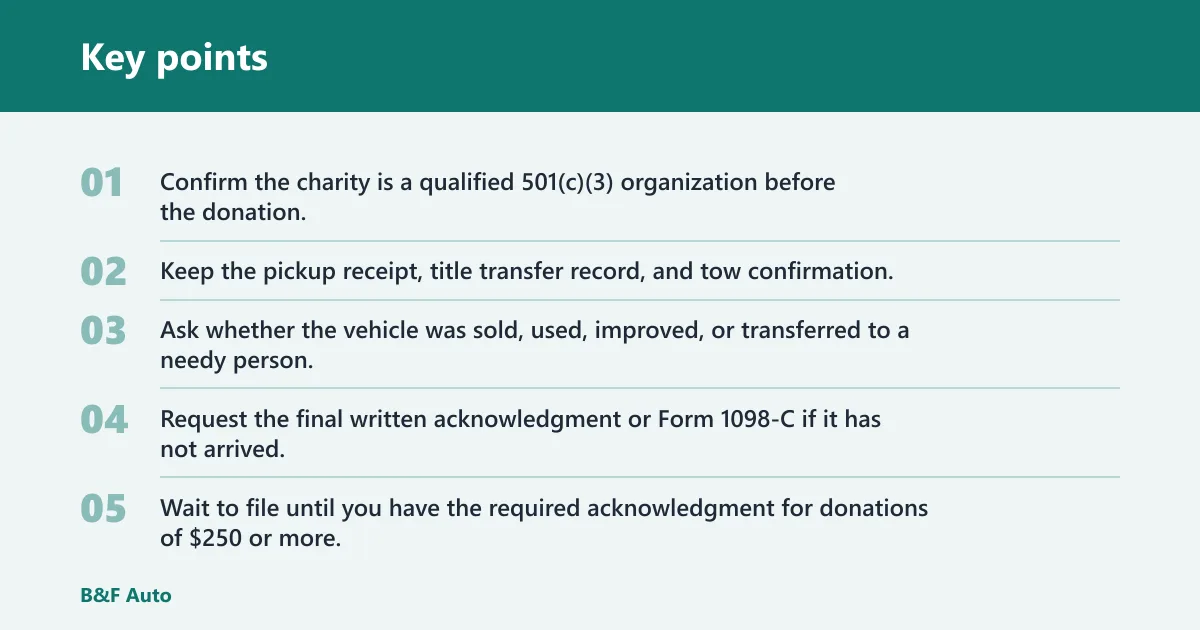
- Confirm the charity is a qualified 501(c)(3) organization before the donation.
- Keep the pickup receipt, title transfer record, and tow confirmation.
- Ask whether the vehicle was sold, used, improved, or transferred to a needy person.
- Request the final written acknowledgment or Form 1098-C if it has not arrived.
- Wait to file until you have the required acknowledgment for donations of $250 or more.
If the charity says the receipt will come after the car sells, that can be normal. The key is whether the final document arrives before your filing deadline.
What to do after the filing deadline
If the deadline passes and the paperwork still has not arrived, contact the charity again and document the request. If you already filed without the required receipt, talk with a tax professional about whether an amended return is needed.
Do not backfill the missing document with your own estimate. The IRS wants the charity’s acknowledgment, not a substitute note from you.
When to avoid claiming the deduction
Avoid claiming the deduction if you do not have the required acknowledgment, if the charity is not a qualified 501(c)(3), or if the title transfer was never completed properly. The donation is not complete for tax purposes until the paperwork and transfer line up.
That caution is especially important when the car was towed quickly. Free towing is common, but free pickup does not make the deduction automatic.
How title transfer and pickup affect the donation
The vehicle title should be signed over correctly, because title transfer affects when the donation is complete and may affect liability. The donation process can require a title transfer to the charity, and your state’s rules can affect what happens if the title is incomplete.
Why the title should be signed over correctly
If the title is not signed over the right way, the charity may not be able to process the vehicle, sell it, or issue clean final paperwork. That can delay the acknowledgment and create liability questions if the car remains in your name.
Check the charity’s transfer instructions before the tow truck arrives. Some organizations need the title signed at pickup. Others need additional release forms.
Why pickup confirmation does not end the tax job
Pickup confirms that the car left your possession. It does not, by itself, prove the charity’s final sale, use, or transfer path. The tax job ends when the proper acknowledgment arrives and the forms line up with the way the charity handled the vehicle.
Keep every page you receive. A pickup slip, a title copy, and the final acknowledgment belong together in the same file.
What to keep for your records
Keep the donation date, vehicle identification number, title copy, pickup record, final acknowledgment, and any form showing the sale amount. If the charity gave the vehicle to someone or used it directly, keep that written explanation too.
That record set is what protects you if the IRS asks how you calculated the deduction.
Frequently asked questions
When should a charity send your car donation tax receipt?
For a vehicle donation, the final IRS acknowledgment should arrive before you file your return, or by the filing deadline if you file early. If the charity sells the car, many charities send it after the sale. If it keeps the car for qualified use, the timing can run from the donation date.
How long does a charity have to send a car donation receipt?
There is no single universal pickup-to-mailing rule for every charity, but the IRS timing standard still applies: for donations of $250 or more, you need the acknowledgment before filing or by the filing deadline, whichever comes first. Some charities mail quickly after sale; others move more slowly.
Can you claim a car donation tax deduction if the receipt comes late?
Only if the required acknowledgment arrives in time for your filing. If it shows up after you file, the deduction may be disallowed and you may need an amended return. If it never arrives, do not claim the deduction until you get the proper paperwork.
What if the charity says the receipt will come after the car sells?
That is common when the charity waits to learn the sale amount. The key is not the pickup date but the final acknowledgment date. For a deduction of $250 or more, wait until the receipt arrives if you have not yet filed.
Do you get a receipt at pickup or after the auction sale?
You may get both. A pickup receipt can confirm the tow or transfer, while the final IRS receipt or Form 1098-C usually comes after the sale. The pickup document is useful, but it does not always replace the post-sale acknowledgment.
What paperwork should arrive with a donated car receipt?
Expect the vehicle identification, the date of the donation or sale, and the charity’s certification about how the vehicle was handled. If the claim is based on sale proceeds, the charity should tell you the sale amount. For higher-value claims, you may also need Form 8283 with your return.
Is Form 1098-C the same as a donation receipt?
It can function as the IRS receipt for a vehicle donation, but it is not the same thing as a simple pickup stub. Form 1098-C is the reporting form used for vehicle donations, and a qualifying written acknowledgment may sometimes substitute for it. The content and timing still have to fit IRS rules.
What if the charity never sends the car donation tax receipt?
Contact the charity immediately and ask for the final acknowledgment in writing. If it never comes, you should avoid claiming the deduction without the required document. If you already filed, ask a tax professional whether an amended return is needed and keep records of your follow-up.