What Is a Car Donation Form, and Who Fills It Out?
A car donation form is the intake and authorization document a charity uses to collect donor and vehicle details; you complete your section, and the charity completes its review fields. If you fill it out poorly, pickup can stall, title errors can follow, or your tax receipt may lack support. This guide separates donor fields, charity fields, title transfer items, and the tax paperwork tied to the donation.
What details are needed and how the process begins

A car donation form is the starting document for a vehicle gift. It collects your contact details, basic vehicle information, pickup location, and permission for the charity to arrange the donation. It is not the title, and it is not the tax return form. In IRS terms, the donation itself is separate from the documentation that supports your deduction, including the charity’s acknowledgment and, in some cases, Form 8283 or Form 1098-C.
That split matters. The donation form starts the process; the title transfers legal ownership; the tax forms document the charitable deduction or charity reporting after the vehicle is processed or sold.
What it collects
The form commonly asks for your name, phone number, email, vehicle year, make, model, VIN, mileage, and where the car can be picked up. It may also ask whether the vehicle runs, whether keys are available, and whether a lien exists. Charities use those details to decide whether they can accept the vehicle and to route the right tow or pickup service.
How it starts the donation process
Charities use the form to confirm the vehicle is eligible, line up towing, and check title and lien details before pickup. IRS guidance for charitable vehicle donations makes the paperwork sequence important: the charity’s acknowledgment and the title transfer are distinct steps, and the vehicle cannot be treated as properly donated until ownership and documentation are handled correctly. [IRS Pub. 4303; IRS Form 1098-C instructions; charity donor intake guidance]
How it differs from the title and tax forms
The intake form is operational. The title is legal. The tax forms are reporting documents. If you treat the donation form like the title, or the title like the tax receipt, errors can follow: stalled pickup, mismatched owner names, or a missing receipt trail.
Who fills out the car donation form?
You usually start the car donation form, because the charity needs current contact details and vehicle information before it can arrange pickup. The charity then adds its own processing, acknowledgment, and receipt details after the vehicle is received or sold. The donor handles donor fields; the charity handles charity fields; the tow provider usually confirms logistics only.
Donor fields
You normally fill in your name, phone number, email, pickup address, and vehicle specifics. If the car has a lien or co-owner, disclose that early so the charity can verify what happens next.
Charity fields
The charity fills in internal processing notes, pickup confirmation, donation status, and tax acknowledgment details. A charity acknowledgment is not usually completed at the moment you submit the form. Under IRS rules, the written acknowledgment comes from the donee organization after the gift is received or otherwise substantiated in the manner required for vehicle donations. [IRS Pub. 1771; IRS Form 1098-C instructions]
Tow or pickup details
The tow provider may confirm location access, gate codes, or timing, but the tow company is not the same as the charity for paperwork purposes. If a tow driver asks for a title or signature, follow the charity’s instructions rather than guessing.
Donation paperwork matrix
The table below separates the intake form, title paperwork, and tax paperwork so you can see who completes each part, when it happens, and what goes wrong if a field is missing.
| Field / form section | Who completes it | When completed | Consequence if missing | Troubleshooting contact |
|---|---|---|---|---|
| Donor contact info | You | At intake, before pickup is scheduled | The charity may not be able to confirm the donation or schedule towing. | The charity intake line |
| Vehicle details | You | At intake, before pickup is booked | The wrong tow equipment may be sent, or the charity may reject incomplete details. | The charity scheduler |
| VIN | You, then the charity verifies it | At intake and during title review | Vehicle identity and title processing can stall if the VIN is missing or inconsistent. | The charity intake team, then the title holder if needed |
| Pickup location | You | At intake | Pickup cannot be scheduled without access details and a clear location. | The charity or dispatch contact listed in the confirmation |
| Title owner signature | The titled owner, or all required owners under state law | Before the vehicle is released, or as directed by the charity | Legal ownership may not transfer, and the charity may be unable to accept the vehicle. | The charity title desk or your state motor vehicle agency guidance |
| Odometer reading | The titled owner or signer, when the state title requires it | On the title transfer paperwork | The transfer can be rejected or delayed if the state requires an odometer disclosure and it is omitted. | The charity title specialist or state motor vehicle agency instructions |
| Lien release | The lender or lienholder | Before title transfer, if a lien is shown on the title | The charity usually cannot process the transfer until the lien is cleared or released. | The lienholder first, then the charity title team |
| Charity acknowledgment | The charity | After receipt, sale, or other required substantiation step | Your tax file may lack the written acknowledgment needed for IRS support. | The charity donor services or tax reporting team |
| IRS Form 8283 | You, if your filing requires it | With your annual federal income tax return, when required by IRS rules | Your deduction filing may be incomplete if the form is required and omitted. | Your tax preparer or the charity if a signature section is needed |
| IRS Form 1098-C | The charity | When the vehicle donation meets the IRS 1098-C reporting trigger | Your tax file may lack the charity’s reporting document if the form is expected but not received. | The charity donor services or tax reporting contact (IRS) |
| Tax receipt | The charity | After the vehicle is processed, sold, or otherwise documented per charity procedure | You may not have the receipt trail needed to support your deduction. | The charity donor services team |
| Lost title troubleshooting | The donor and charity, with the state title office as needed | Before pickup, if the title cannot be located | Pickup may be paused until duplicate-title or other ownership proof is resolved. | The charity title team, then the state motor vehicle agency |
| Deceased owner troubleshooting | The estate representative and charity | Before transfer, if the titled owner is deceased | Donation may stall until estate authority or probate documentation is verified. | The charity title team, then the estate representative or probate contact |
| Co-owner troubleshooting | All required title owners, as state law requires | Before release or transfer | One missing signature can stop the donation even if the vehicle is ready. | The charity title team to confirm the state signature rule |
| Out-of-state transfer troubleshooting | The donor and charity, using the issuing state’s title rules | Before title release and sometimes before pickup | The title transfer can stall if the issuing state and receiving-state rules are mixed up. | The charity title team and the state DMV/BMV instructions for the title’s state |
What information do you need to finish it?
You need the owner details, vehicle identity, title status, and pickup information before the form can be completed cleanly. The more complete the intake information is, the faster the charity can confirm pickup and title handling. The key items are the titleholder name, VIN, mileage, lien status, and any state-specific transfer requirements.
Title and owner details
Have the name on the title, any co-owner names, and the exact title status ready. Most charities require a transferable title or a state-approved substitute before they can accept a vehicle, although the exact rule depends on the issuing state and the charity’s procedures. If a lien appears on the title, you need the bank’s release before the transfer can move forward.
Mileage, VIN, and condition
The VIN identifies the car on donation records, and the mileage and condition help the charity decide how it can be used. Charity programs may inspect, resell, repair, or recycle the vehicle based on condition, but the intake form still needs accurate vehicle facts. If the mileage is unknown or the car is nonrunning, say so plainly rather than guessing.
Lien and co-owner checks
Check whether a lender is listed and whether another person must sign. A missing lien release or missing co-owner signature can stop the title transfer even if the car is ready for pickup. Say your sedan has a bank lien and one owner on the title lives in another state; the charity will usually wait until the lender release and the second signature are handled before sending a tow truck.
Car donation form and checklist
- Check whether your state title requires a notarized signature before release.
- Check whether your state requires an odometer disclosure on the title or a separate odometer statement.
- Check whether the title can be signed over without a duplicate-title process if the original is missing.
- Check whether an out-of-state title needs a different signing order or supporting documentation.
How does the title transfer work?
The title transfer is the legal ownership step, and it belongs on the title paperwork rather than the intake form. The donor signs the title as required by the state, the charity follows its transfer procedure, and the vehicle should not be handed off until the paperwork is ready. State DMV/BMV instructions control the mechanics, while the charity controls its acceptance process. Use the out-of-state titles guidance early if the vehicle was titled elsewhere.
What the donor signs
The donor signs the title according to the issuing state’s instructions. That may include buyer or transferee fields, release language, or a mileage statement, but the exact completion method varies by state and charity. Do not guess at the blank lines; follow the charity’s instructions for your title. If the title is signed incorrectly, the DMV may reject the transfer or the charity may need a corrected title before it can continue.
When a notary may be needed
Some states require notarized signatures for a title transfer, while others do not. If your title instructions mention notarization, complete it before pickup so the vehicle does not sit while paperwork is fixed. The safest rule is to follow the title state’s DMV/BMV directions and the charity’s transfer checklist rather than assuming every state uses the same process.
Why state rules matter
Title rules are not identical from one state to another. A form that works in one jurisdiction can fail in another if the signature line, odometer statement, or notarization step is handled incorrectly. If you are unsure, ask the charity title desk before the tow is scheduled. For out-of-state donations, the title-issuing state’s DMV/BMV instructions should be checked alongside the receiving charity’s acceptance rules.
What tax forms come after the donation?
After the vehicle is picked up and processed, the charity issues the tax paperwork that supports your records. The charity acknowledgment letter is the core receipt, while IRS forms come into play depending on the vehicle’s value, the amount claimed, and whether the charity sells the vehicle. The IRS treats the donation acknowledgment, Form 8283, and Form 1098-C as different documents with different roles.
Charity acknowledgment letter
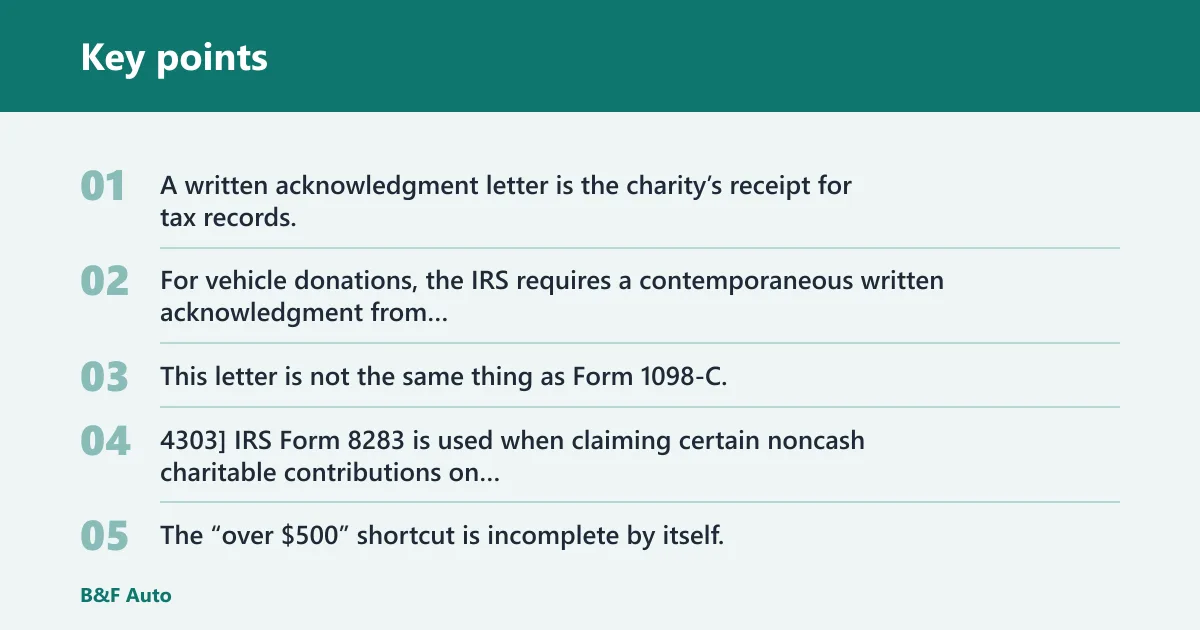
A written acknowledgment letter is the charity’s receipt for tax records. For vehicle donations, the IRS requires a contemporaneous written acknowledgment from the donee organization that includes certain information, such as whether goods or services were provided in exchange for the gift. This letter is not the same thing as Form 1098-C, and it is not the same thing as Form 8283. [IRS Pub. 1771; IRS Pub. 4303]
IRS Form 8283
IRS Form 8283 is used when claiming certain noncash charitable contributions on your federal return, including vehicle donations that meet the form’s thresholds and attachment rules. The “over $500” shortcut is incomplete by itself; the actual filing requirement depends on the amount claimed and the IRS instructions for noncash gifts. Keep the charity acknowledgment with your deduction records, and complete Form 8283 only when the IRS rules for your return require it. [IRS Form 8283 instructions]
IRS Form 1098-C
IRS Form 1098-C is the charity’s reporting form for certain vehicle donations, including motor vehicles, boats, and airplanes, when the IRS trigger conditions are met. It is not issued merely because a vehicle was donated or because the vehicle had some estimated value. Under IRS rules, the form is tied to the vehicle being sold, used, or otherwise disposed of in a reportable way, and the form is generally sent within the IRS reporting window after the trigger event. [IRS Form 1098-C instructions]
Suppose you donate a hatchback that is picked up on Monday and the charity does not process it right away. The tax receipt may not arrive the same week, because charities often need time to inspect, document, and finalize the file. Processing time varies by program and state, so the receipt usually follows the donation workflow rather than the tow date.
What if the title is missing or the owner changed?
These cases need extra attention because the donation form alone cannot fix ownership problems. If the title is missing, if the owner has died, if there is a co-owner, or if the car is titled out of state, the charity needs the right legal documents before pickup or transfer can move ahead. The form captures the problem, but the title rules resolve it.
Lost title
If you cannot find the title, ask the charity what it accepts before you schedule towing. Some states allow a duplicate title process, but the donation cannot be treated like a normal pickup if ownership cannot be verified. The title question comes first. State DMV or BMV guidance is the source of truth here, because the charity cannot create ownership proof on its own.
Deceased owner
If the titled owner has died, the estate may need to act as the donor. The charity may ask for probate papers, executor authority, or another proof of authority before it will accept the vehicle. Do not sign the deceased owner’s name on the title or intake form. The right document depends on the state and the status of the estate.
Co-owner
If two names are on the title, both may need to approve the transfer depending on the state and title wording. A missing co-owner signature can stop the donation even when the car is already scheduled for pickup. Confirm the signature requirement before releasing the car. This is especially important when the title uses “and” versus “or” language, because the required signatures may differ.
Out-of-state transfer
If the title came from another state, ask the charity whether it needs a different signing order, a notarization, or a specific release form. Out-of-state titles are a common place for avoidable delays because the donor may follow the wrong state’s rules. Check both the issuing state’s DMV/BMV guidance and the charity’s title team before pickup if the title was not issued locally.
A common first-timer mistake is treating the donation form like the title transfer. The form starts the file; the title proves ownership; the receipt and IRS paperwork come later. Keep those steps separate, and most delays stay away.
Frequently asked questions
What is a car donation form?
A car donation form is the intake and authorization document a charity uses to gather donor contact information, vehicle details, and pickup location. It starts the donation process, but it does not replace the title transfer or tax forms. Those are separate documents handled at different times.
What information do I need to complete a car donation form?
You usually need your contact information, the vehicle’s year, make, model, VIN, mileage, condition, and pickup location. It also helps to know whether there is a lien and whether the title has one owner or more than one. Have the title in front of you before you begin.
Does the charity or the donor fill out the title transfer?
The donor usually signs the title where the state requires, while the charity follows its transfer procedure and handles any required processing on its side. The exact completion method varies by state. Do not fill in title boxes that the charity has instructed you to leave blank.
Do I need a notarized signature to donate a car?
Sometimes. Some states require a notarized signature to complete a title transfer, while others do not. If your title instructions mention notarization, or the charity requests it, sign in front of a notary before the vehicle is released. If not, the transfer may be rejected or delayed.
What paperwork do I need if my car donation is over $500?
For donations over $500, keep the charity acknowledgment letter, and expect IRS Form 8283 to matter for your federal tax filing in many cases. The actual filing requirement depends on the IRS noncash contribution rules and the amount claimed. The “over $500” threshold is not the only factor, so use the IRS instructions for your return.
What form do I use for a tax deduction after donating a car?
Use the charity acknowledgment letter for your records, and use IRS Form 8283 when your tax filing requires it. If the vehicle and tax rules call for it, the charity may also issue Form 1098-C. The donation form itself is not the deduction form.
What happens if I don’t have the car title?
Do not assume the charity can take the car anyway. Ask the charity whether a duplicate title, estate document, or other ownership proof is needed in your state. Most transfer problems begin with the title, so this is the first thing to resolve before scheduling pickup.
When do I get the tax receipt after donating a car?
The receipt usually arrives after the vehicle is processed or sold, not at the moment the car is towed away. Timing depends on the charity’s workflow and IRS reporting obligations. If it is late, contact the charity’s donor services team first.
Can the charity fill out the donation paperwork for me?
The charity can complete its own sections, but it cannot reliably complete the donor’s personal information or sign the title for you. You still need to review the details, sign where required, and provide accurate vehicle information. The charity can guide the process, but it cannot replace your authority as the owner.