Lost Car Title: How to Replace It Step by Step
To replace a lost car title, apply for a duplicate title through the state that last issued it unless ownership, lien status, your name, or your titling state has changed. Use the duplicate-title application from that issuing state, include the required fee, and do not skip a lien release if the DMV still shows a lien. If you use the wrong form or miss a lien release, your sale, registration, or payoff can stall for weeks. This guide points you to the correct filing route, required documents, submission method, and the fallback when a standard duplicate request will not work.
What you’ll need
- The duplicate title application required by the state that last issued the title
- Current owner name exactly as shown in DMV records
- Vehicle identification number (VIN)
- License plate number, if your state asks for it
- Vehicle registration, if available
- Government-issued photo ID that matches DMV records
- Proof of address, where required
- Reason the title is unavailable, if the form asks for it
- Lien release, payoff letter, or lender paperwork, if any lien was involved
- Co-owner signatures or consent documents, if more than one owner is listed
- Business authorization papers, if the vehicle is company-owned
- Estate or probate documents, if an owner is deceased
- The state’s duplicate-title replacement fee
- Notary access, if your state or submission method requires notarization
- Police report details, if the title was stolen and your state requests them
Lost car title replacement at a glance
A missing title is not always a duplicate-title problem. The first question is whether the state can reissue the same ownership record, or whether that record must be corrected first because of a lien, transfer, co-owner issue, estate paperwork, or unclear title history.
Duplicate title applications are state-specific forms. They usually ask for owner details, vehicle details, the VIN, and the reason the title is unavailable. Many states also ask for the plate number, and both identifiers must match the DMV database so the record can be found without manual correction.
Craig Scott Capital notes that a lost title can block selling or transferring a vehicle. The fastest route is usually the accurate one, not the shortest form.
Do you need a duplicate title or a different fix?
You need a standard duplicate title only when the DMV already has a clean ownership record in the right name, with the right lien status, and the title was simply lost, damaged, destroyed, or stolen. If the record is wrong or incomplete, fix that first or the duplicate request may be rejected.
When a standard duplicate title request is the right path
Use the duplicate-title path when the titled owner has not changed, the vehicle is already titled in the correct state, and the DMV record does not show an unresolved lien or ownership dispute. This is the usual route for a title that was lost during a move, damaged in storage, or destroyed by water or shredding.
Picture a title folded into a file box that gets soaked during a basement leak. If the owner name, address, and lien status still match DMV records, that is usually a straight duplicate request, even if the paper title is unreadable.
When the real problem is lien status, transfer, or ownership proof
If a loan was paid off recently, the lender release may not yet be posted to DMV records. That is one of the most common reasons a duplicate request stalls: the owner thinks the lien is gone, but the record still shows an active lienholder that controls title issuance.
If the vehicle was inherited, gifted, bought without a proper title transfer, or moved from another state without retitling, the answer may be an ownership transfer rather than a duplicate title. Estate paperwork, transfer documents, or a record correction can come before any duplicate request.
When a bonded title is more likely than a duplicate
A bonded title becomes likely when the DMV cannot confirm ownership cleanly enough to reprint the existing record. That happens when title history is incomplete, prior assignments are missing, the seller never transferred the vehicle correctly, or state records do not line up well enough to support a standard duplicate.
A bonded title is a fallback, not a shortcut. It often requires a surety bond and added review because the state is dealing with uncertainty in the ownership chain, not just a missing piece of paper.
Which replacement path applies to you?
| Situation | Likely form | Police report or lien release needed? | Online filing usually possible? | Main delay risk |
|---|---|---|---|---|
| Lost title | State duplicate title application | Usually neither | Sometimes, if record is clean | Name, VIN, or address mismatch with DMV record |
| Stolen title | State duplicate title application marked stolen if the form allows it | Police report sometimes requested; some states ask for the report number | Sometimes, but theft details can push it to mail or in-person review | Skipping theft documentation when the state expects it |
| Damaged or destroyed title | State duplicate title application | Usually neither; damaged original may need to be surrendered | Often yes if no lien and no record issues | Unreadable title details or failure to surrender remaining paper when required |
| Paid-off loan | Duplicate title application plus lien-release paperwork if DMV still shows the lien | Lien release may be required | Often no until lien record updates | Lender payoff completed but DMV lien status not updated yet |
| Joint ownership | Duplicate title application signed according to title wording | No police report; lien release only if lien exists | Sometimes, but less often | Wrong signatures because the title reads “and” instead of “or” |
| Lien still active | Lienholder-requested duplicate or owner request with lender involvement, depending on state | Lien release not available until payoff; lender may control issuance | Usually no | Applying as if the owner controls the title when the lender still does |
| Company-owned vehicle | Duplicate title application plus business authorization documents | No police report unless stolen; lien release if applicable | Less common | Business name or signer authority not matching state records |
| Unclear ownership history | Ownership review, correction, or bonded-title paperwork instead of a standard duplicate | Usually no police report; lien release may still matter | Usually no | DMV cannot reconstruct title chain well enough to reissue a duplicate |
How do you replace a lost car title step by step?
Replace a lost car title by confirming that the DMV record is clean, gathering the exact identity and vehicle details on file, using the duplicate-title form for the state that last issued the title, and choosing the submission method your record qualifies for. The checks before filing stop most avoidable delays.
- Confirm the title state. File through the state that last issued the title, not necessarily the state where the vehicle is now parked. If you moved but never retitled the vehicle, the old state usually controls the duplicate request.
- Classify the problem. Decide whether the title is lost, stolen, damaged, destroyed, tied to a lien, or blocked by an ownership-history issue. This tells you whether a plain duplicate request will work or whether you need a lien correction, transfer, estate document, or bonded-title path.
- Match the DMV record. Check the owner name, address, VIN, and lien status exactly as the DMV has them. A duplicate title is often easiest when the application mirrors the existing record without guesses, abbreviations, or outdated names.
- Pull the vehicle identifiers. Copy the full VIN from the vehicle or registration and add the plate number if your state asks for it. The VIN is used to locate DMV records, and many states use the plate number as a second match point.
- Gather identity documents. Use a government-issued photo ID that matches DMV records and proof of address where required. If the address on file is stale, update it through the state’s allowed process before or during the duplicate request if the state permits both together.
- Resolve lien status first. If the title was paid off, confirm whether the DMV still shows a lienholder. If it does, get the lender’s release letter or electronic release posted before expecting a clear duplicate title.
- Check ownership signatures. Review whether the title lists owners with “and” or “or,” because signature requirements often differ. If the vehicle belongs to a company or estate, gather signer authority or probate papers before touching the duplicate form.
- Get the state form. Use the duplicate title application required by that state. These forms usually ask for owner details, vehicle details, the VIN, and the reason the title is unavailable, and some states may require a notarized signature depending on ownership format or submission method.
- Choose the filing method. Submit online, by mail, or in person only if your ownership situation fits that method. Online filing tends to work best for clean, no-lien records; mail works when notarization is required; in-person filing helps when a clerk needs to review paperwork on the spot.
- Pay the replacement fee. Pay the duplicate-title fee required by the issuing state. It is separate from the original title fee, and optional rush or premium processing may exist in some states.
- Track the application. Save copies of the form, payment record, lien release, and any police report details. If the state offers status tracking, check it after the normal review window rather than refiling too early and creating duplicate records.
- Escalate if it stalls. If the duplicate request does not move because ownership cannot be verified, go in this order: correct the DMV record, submit missing lien or transfer paperwork, request manual review, then ask whether a bonded-title process is required.
Lost car title checklist
- Verify the owner name. Match spelling, suffixes, and business names to the DMV record.
- Verify the VIN. Recheck every character against the registration or vehicle plate area where shown.
- Verify lien status. Do not assume payoff means the lien has cleared in the state database.
- Verify signatures. Confirm whether one owner can sign or all owners must sign.
- Verify your address. Use the mailing address the state allows for title delivery.
- Verify notarization. Check whether the state, ownership type, or mail method requires it.
After filing follow-up
- Save your receipt. Keep proof of payment and a copy of the application.
- Watch for mail timing. Mailing and identity verification can add delay even after approval.
- Respond to defects fast. If the state asks for a lien release or corrected signature, send it back in one packet.
- Recheck after 7 days. If no status appears after about 7 days, check the state’s title status tool or contact the title unit with the VIN and submission date.
Say your lender mailed a payoff confirmation, but the state record still shows the bank as lienholder two weeks later. Filing the duplicate request before that lien release posts often leads to a rejection or a title printed with the lien still attached.
Can you file online, by mail, or in person?
The best submission method depends on how clean the title record is. Online filing is usually reserved for straightforward cases, mail works when signatures or notarization can be handled ahead of time, and in-person filing earns its keep when lien, ownership, or identity questions could stop the application.
When online filing is usually possible
Online replacement is most common when the vehicle is already titled in that state, the owner information matches perfectly, and no active lien or special ownership review is involved. Maine can replace a lost car title online in some cases, but that option is limited to vehicles not older than 1995 and requires a valid driving license and card payment.
Maine also does not offer that online route if a lien is still listed, and the online replacement can arrive within 10 business days. Those limits show the larger pattern: online is fastest when the record needs no human untangling.
When mail works best
Mail works well when the state accepts paper duplicate requests and the record is otherwise clean. It is often the right choice when a notarized signature is required, because you can complete the form carefully, attach the ID copies or supporting records the state requests, and send one complete packet.
Alaska requires only one form for a duplicate title request, but mail applications must be notarized before sending. That is a good reminder to check signing rules before the envelope is sealed.
When in-person filing is worth the trip
In-person filing makes sense when a clerk may need to inspect documents, explain a defect, or confirm whether the issue is really a duplicate title at all. This is often the safest route for recent payoffs, joint owners who are unsure about signatures, company vehicles, estate paperwork, and out-of-state record mismatches.
Suppose the registration shows “ABC Heating LLC,” but the duplicate-title request is signed by an employee without a business authorization letter. In-person filing can surface that problem immediately instead of losing two weeks to a mail rejection.
What if the title was stolen, damaged, or tied to a lien?
These are separate situations. A stolen title may need theft documentation, a damaged title may need the remaining paper surrendered, a paid-off loan may still require a lien release to clear the record, and an active lien may mean the lender still controls title issuance.
If the title was stolen
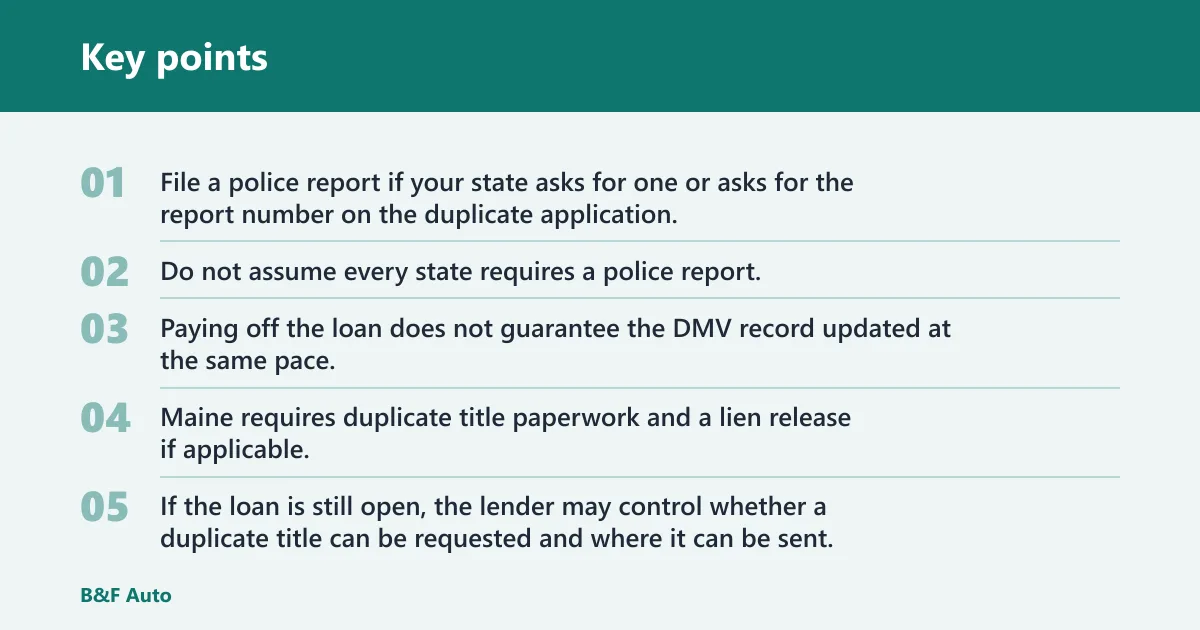
File a police report if your state asks for one or asks for the report number on the duplicate application. The same source says some states request a police report number for stolen titles, and that detail can matter because theft creates a fraud risk that simple loss does not.
Do not assume every state requires a police report. The safe move is to classify the case as theft, gather the report details if available, and use the form section or affidavit language the state provides for stolen titles.
If the title is damaged or partially destroyed
Use the duplicate-title path if the title is torn, burned, water-damaged, or otherwise unreadable but the ownership record is still correct. Some states want the damaged original surrendered with the application so two negotiable title papers are not left in circulation.
If the title was fully destroyed and no paper remains, treat it as a duplicate request unless another issue, such as an unresolved lien or transfer gap, is also present.
If you paid off the loan but the lien still shows
This is the failure point many guides skip. Paying off the loan does not guarantee the DMV record updated at the same pace. If the lender release has not posted yet, the state may still treat the vehicle as encumbered and refuse to issue a clean duplicate title.
Maine requires duplicate title paperwork and a lien release if applicable. That captures the broader rule: when the state still shows a lien, send the release letter or get the lender’s electronic release completed before expecting a clean reissue.
If the lien is still active
If the loan is still open, the lender may control whether a duplicate title can be requested and where it can be sent. In many states, the title is held electronically or by the lienholder until payoff, so the owner cannot act as if the title is free and clear.
Ask three exact questions before filing: who is listed as lienholder, whether the state uses electronic titles, and whether the owner or lender must request the duplicate. Those answers change the whole process.
What if ownership details make the request harder?
Ownership details change both the paperwork and the signature rules. Joint owners may both need to sign, companies usually need proof of signer authority, estates often need probate or transfer documents first, and out-of-state moves can expose record mismatches that a normal duplicate request will not fix.
Joint owners and signature rules
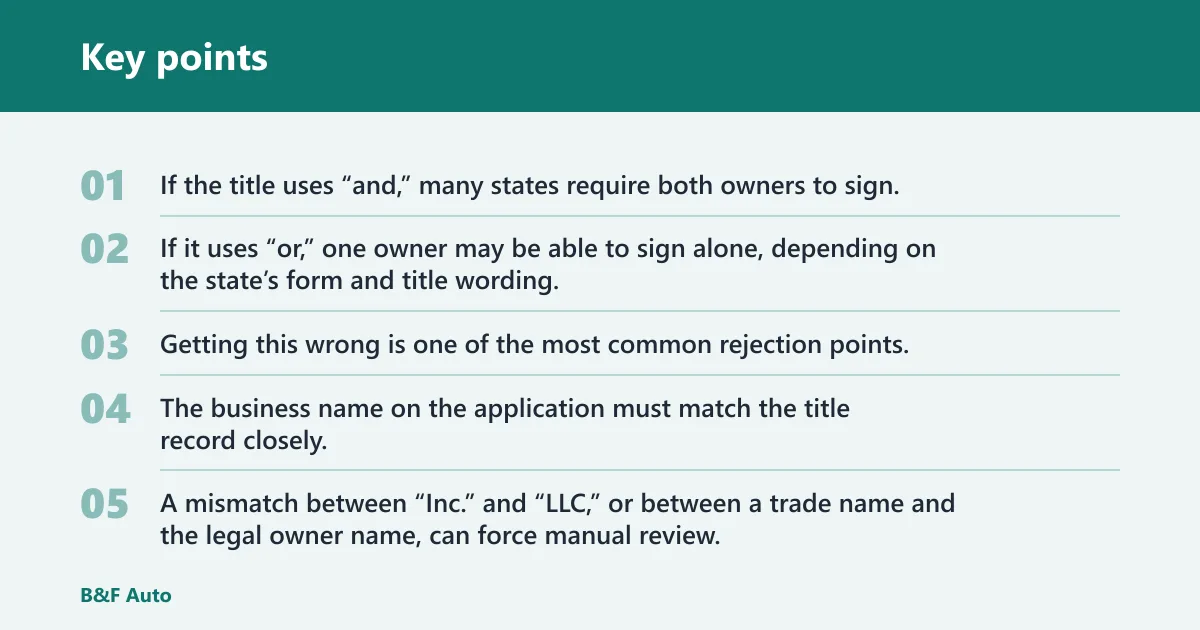
If the title uses “and,” many states require both owners to sign. If it uses “or,” one owner may be able to sign alone, depending on the state’s form and title wording. Getting this wrong is one of the most common rejection points.
A common first-timer mistake is using the surviving spouse’s signature alone because the household always handled the car that way. If the title record still shows two living joint owners joined by “and,” the state may reject the request until both signatures appear.
Company-owned vehicles
A company vehicle usually needs the exact business name shown in DMV records plus proof that the signer is authorized to act for the business. That can mean a company resolution, power of attorney, or another business authorization record accepted by the state.
The business name on the application must match the title record closely. A mismatch between “Inc.” and “LLC,” or between a trade name and the legal owner name, can force manual review.
Estate ownership and deceased owners
If a titled owner is deceased, a duplicate title may not be available until the estate has authority to act. Depending on the state and the value or status of the estate, that can mean probate papers, letters of administration, a small-estate process, or a transfer form before any duplicate can issue.
Do not file a routine duplicate request under the deceased owner’s name unless the state specifically allows that step through an estate representative.
Out-of-state moves and record mismatches
If the vehicle was titled in one state and the owner moved without retitling it, the duplicate usually comes from the old state. If the owner already retitled the vehicle in the new state, the old title record may no longer be the active one, and the answer may be with the current state record instead.
Address changes also matter. Proof of address may need to match DMV records, especially for mailed titles, so update stale records before filing where the state requires it.
Common mistakes that delay duplicate titles
Most duplicate-title delays are preventable. The pattern is simple: the application treats the problem as a missing document when the state sees a record problem, a lien problem, or a signature problem.
- Using the wrong state form. The duplicate request belongs to the state that last issued the active title.
- Applying before checking lien status. A paid-off loan can still appear active in DMV records.
- Ignoring title wording. “And” versus “or” can decide whose signatures are required.
- Submitting stale identity details. Name and address mismatches trigger verification holds.
- Leaving the reason blank. Some forms ask why the title is unavailable, and an incomplete explanation can kick the form back.
- Skipping notarization. States differ, and mail requests often have stricter signing rules.
- Trying for a duplicate when the real issue is transfer. Estate, gift, purchase, and ownership-chain problems often need transfer or bonded-title steps first.
- Guessing at the VIN. One wrong character can stop the record match cold.
Georgia lists a $8 replacement fee and requires a Motor Vehicle Title/Tag Application. Georgia also warns that false information can bring a $5,000 fine. Even where the fee is small, accuracy matters more than speed.
If that did not work, try this next: first correct the owner name or address on file, then clear any lien release defect, then ask the title unit whether the vehicle needs transfer documents instead of a duplicate, and only after that ask whether a bonded-title process is the proper fallback.
Prevention: once the replacement arrives, store a paper copy in a dry document sleeve and keep the title state, VIN, and lien-release records together so the next move or sale does not turn into a record hunt.
Frequently asked questions
What documents do I need to replace a lost car title?
Most applicants need the duplicate title application from the state that issued the current title, the full owner name, VIN, plate number if requested, registration if available, government-issued photo ID, proof of address where required, and payment. Add a lien release for paid-off loans, co-owner signatures for joint titles, or estate or business papers when ownership is less straightforward.
Can I replace a lost car title online, by mail, or in person?
Yes, but availability depends on the state and the record. Online filing usually fits clean records with no active lien. Mail works when paper forms and notarization are accepted. In-person filing is often best for recent payoffs, signature doubts, company vehicles, estates, and record mismatches.
What if my car title was stolen instead of lost?
Use the duplicate-title process, but treat theft as its own branch. Some states ask for a police report or the report number, especially to document fraud risk. Mark the title as stolen wherever the form allows it, and attach any theft paperwork the state requests before filing.
How long does it take to get a duplicate car title?
Processing time varies by state, filing method, mailing time, identity checks, and whether the record needs manual review. Online can be faster when allowed. Maine says some online replacements can arrive within 10 business days. Delays grow when lien records are wrong, signatures are missing, or the address on file does not match.
What if I lost the title after paying off my car loan?
First confirm whether the DMV still shows the lender as lienholder. If it does, get the lender’s release letter or electronic release posted before expecting a clear duplicate title. A paid loan and a cleared lien record are often separate events, and that gap causes many duplicate-title rejections.