Lost or Stolen Car Title: What Changes?
A lost car title is usually replaced through your state DMV or title agency with an application, ID, and fee. If it was stolen, file a police report first and check whether your state wants a theft report or waiting period before it issues a duplicate. Skip that step, and you can make title fraud, lien errors, or a bad sale harder to stop. This guide shows what changes for lost versus stolen titles, including security checks, paperwork, and timing.
Car title decision table
The quickest way to sort this out is to separate lost, stolen, and unknown title cases. A missing title can be a simple duplicate filing, or it can become an ownership and security issue if someone may have taken it from your mail, glove box, or home records.
| Scenario | Likely extra step | Risk level and timing impact |
|---|---|---|
| Lost | Affidavit if your state asks for one | Lower fraud risk; usually a standard duplicate-title filing and normal processing time |
| Stolen | Police report, affidavit of loss or theft, and possible fraud check | Higher fraud risk; the state may pause review, ask for extra proof, or slow issuance |
| Unknown or mailed-title case | Lienholder notice or account review if the title was never received | Medium risk; timing depends on whether the title was already issued, mailed, or intercepted |
Say your replacement title was mailed three weeks ago, but the envelope never showed up. That is not the same as a stolen title in a car break-in. The practical next step is to confirm whether the state already issued it, because that decides whether you need a duplicate request, a mailing trace, or a fraud review.
What changes if your title was stolen?
If your title was stolen, the process shifts from replacement to fraud prevention. Many states still use the same duplicate-title application, but they may also want a police report, an affidavit of theft, or extra identity checks before they issue a new title.
Police report and affidavit
Some states require a police report when the title was stolen. Others may accept a sworn affidavit of loss or theft, sometimes on a separate form from the duplicate-title application. The point is to create a record that the missing title was not just misplaced and that no one should try to use it for a transfer.
If the title was stolen from a vehicle, mailbox, or residence, write down when you last saw it, where it was kept, and whether anything else went missing. That timeline can help the police report and can also help the DMV spot a suspicious transfer attempt later.
When to watch for unauthorized transfer
Stolen-title cases matter because the paper itself can be used to fake a sale, mask a lien problem, or move ownership without permission. Watch for mail from the DMV about a transfer, release, or replacement request you did not start. If a thief already used the title, you may need to dispute the filing through the state agency and law enforcement.
What changes if your title was lost?
If your title was lost, you are usually dealing with a standard duplicate-title request rather than a theft report. The core filing is often an application for duplicate title, plus your identity, vehicle details, and fee payment. The process is simpler because the state is only verifying ownership, not investigating a possible crime.
What you usually do not need
You usually do not need a police report for a routine loss unless your state asks for one or the circumstances suggest theft. You also usually do not need a fraud hold or special investigation. That means the timing is often closer to the normal duplicate-title window, not the slower theft path.
How timing differs from theft cases
Lost-title cases are often faster because the state is checking that you are the owner and that no one else has a better claim on the title. Even then, timing still varies by filing method and state. Processing times can range from a few days to several weeks.
How do you replace a car title?
A car title may need to be replaced through the state DMV or equivalent title agency. The form name, filing method, and timing vary by jurisdiction, but the basic path is the same: identify the vehicle, prove your connection to it, pay the fee, and request a duplicate or replacement title.
File online, by mail, or in person
Many states offer online, mail, and in-person filing, but not every state offers all three. New York duplicate-title online applications cost $20.00, and they are unavailable if the title was issued within the last 15 days. New York mailed or in-person titles are printed in Albany, not at the DMV office. Texas duplicate-title fee is $2 by mail and $5.45 in person, but Texas requires a 30-day wait after the last title was issued.
Enter the VIN and owner details exactly
The VIN, make, model, year, and owner information must match DMV records. A mistyped VIN can stall the request, and a mismatch in owner names can trigger a rejection or a request for more proof. If there are joint owners, the DMV may want both names on the request or both signatures, depending on state rules.
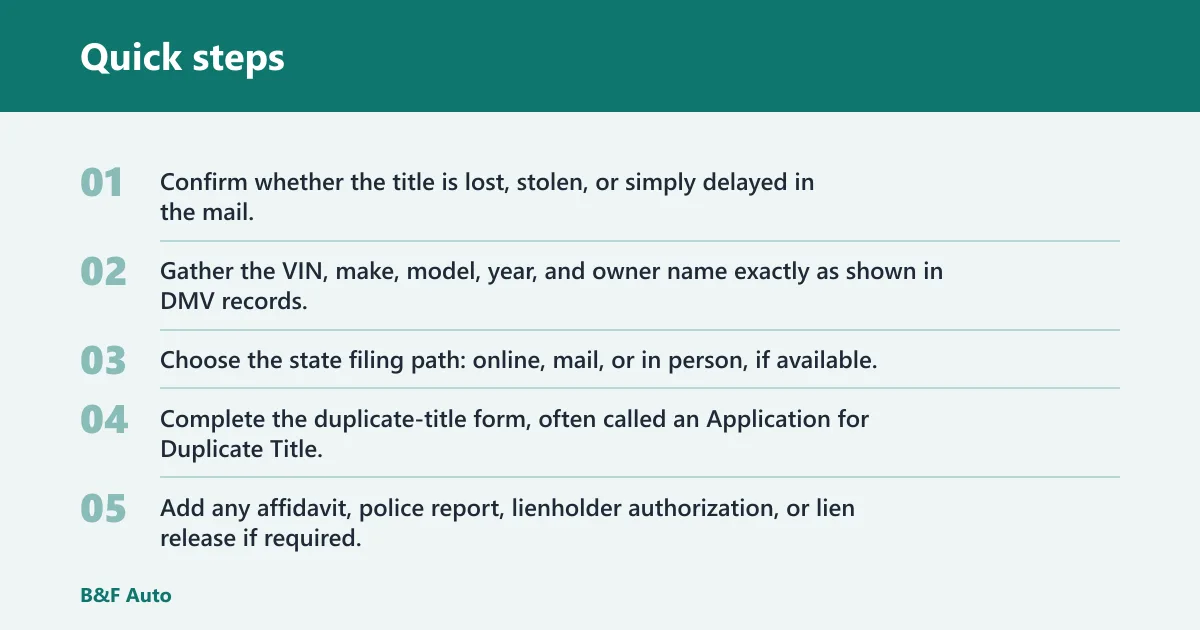
- Confirm whether the title is lost, stolen, or simply delayed in the mail.
- Gather the VIN, make, model, year, and owner name exactly as shown in DMV records.
- Choose the state filing path: online, mail, or in person, if available.
- Complete the duplicate-title form, often called an Application for Duplicate Title.
- Add any affidavit, police report, lienholder authorization, or lien release if required.
- Pay the state fee and keep copies of everything you file.
What documents do you need?
Most states ask for ID, vehicle information, proof of ownership or account details, and fee payment. If the title was stolen, you may also need an affidavit of loss or theft and, in some states, a police report. If there is a loan, the lender may need to sign the request or provide a lien release.
ID and vehicle information
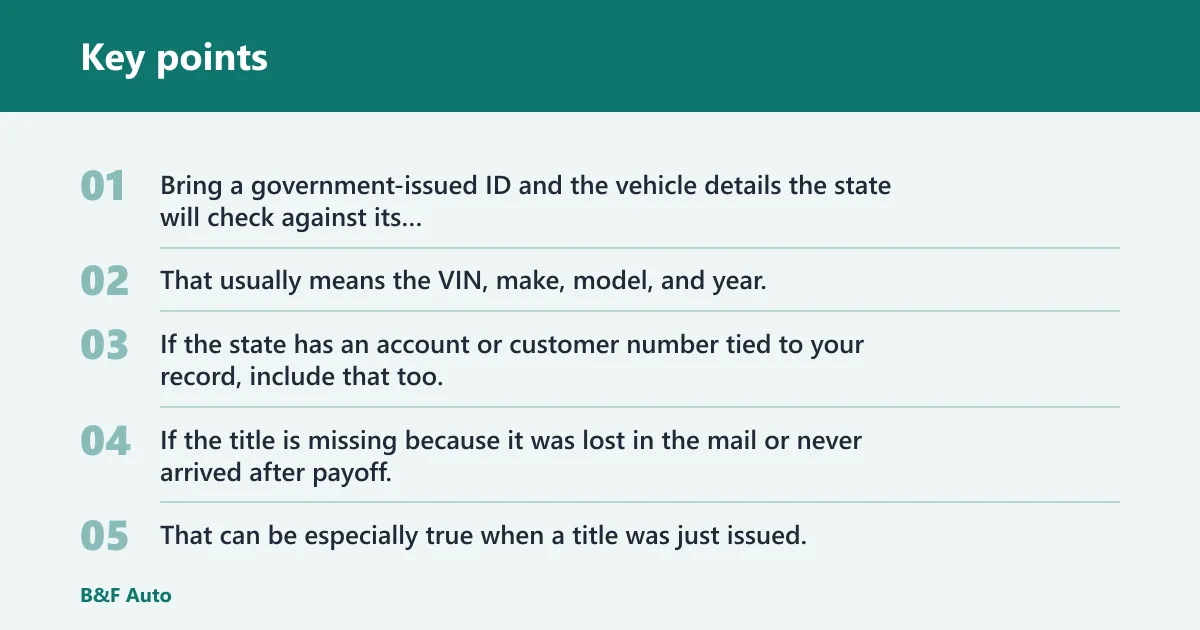
Bring a government-issued ID and the vehicle details the state will check against its records. That usually means the VIN, make, model, and year. If the state has an account or customer number tied to your record, include that too.
Proof of ownership or account details
If the title is missing because it was lost in the mail or never arrived after payoff, the state may ask for the delivery or account history that supports the request. That can be especially true when a title was just issued, because some states may impose a waiting period before a second copy can be sent.
Fee payment and any extra form
Replacement title fees vary by state. Typical duplicate-title fees range from $15 to $60, Pennsylvania duplicate-title fee is $72, and expedited processing can add $25 to $100. Processing times can range from a few days to several weeks, so an extra fee may shorten the wait, but it does not guarantee immediate issuance.
How does a lien change the process?
A lien changes the process because the lender may still control the title. If there is a loan, the lienholder may need to sign the request or provide a lien release. That can turn a normal duplicate-title request into a three-party process between you, the DMV, and the lender.
Loan still open
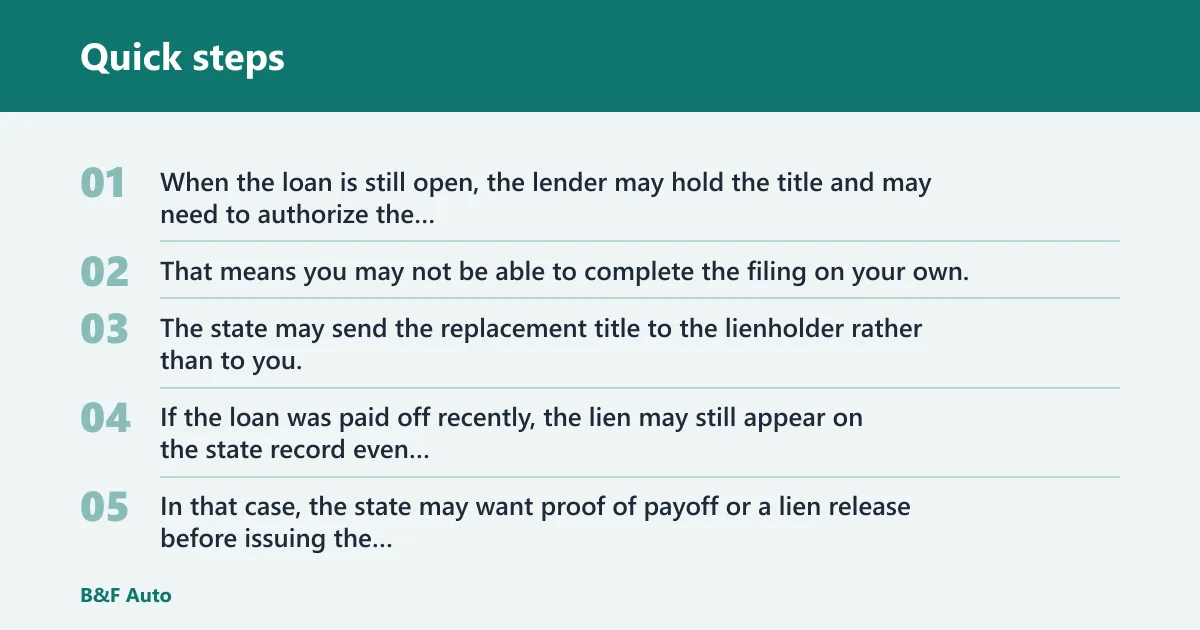
When the loan is still open, the lender may hold the title and may need to authorize the replacement. That means you may not be able to complete the filing on your own. The state may send the replacement title to the lienholder rather than to you.
Paid off but not updated yet
If the loan was paid off recently, the lien may still appear on the state record even though the balance is gone. In that case, the state may want proof of payoff or a lien release before issuing the replacement title. This is a common delay point because the records and the real-world payoff date do not always match right away.
Jointly owned and financed
Joint ownership adds another layer. If two owners are listed, the DMV may need both signatures, especially if one name changed or one owner is unavailable. If the vehicle is also financed, the lender’s role can override a simple one-owner filing and slow the request further.
Suppose a couple jointly owns a sedan, one owner moved out, and the title was lost during a refinance. That is not a routine duplicate-title filing. The state may need both owners, the lender, and the updated payoff record before it issues a clean replacement.
Common title failure cases
Some title problems are not really lost-title problems at all. The title may already be in the mail, may still be tied to a lien, or may be part of a sale that has already started. These cases change the steps and can change who must sign.
| Failure case | What usually changes | Why it matters |
|---|---|---|
| Title already mailed | Check issuance date and mailing status before filing a duplicate request | Prevents duplicate requests that can slow or confuse the record |
| Joint owners | Both owners may need to sign or approve the request | One owner’s signature may not be enough for transfer or replacement |
| Transfer already started | Stop and confirm whether the buyer, dealer, or DMV already has the original | A duplicate filed at the wrong time can interfere with the sale |
| Title needed during a sale or payoff | Prioritize the replacement and confirm any lien release timing | Missing title paperwork can delay closing, registration, or funding |
A common first-timer mistake is filing a duplicate request the same day a buyer asks for the title, without checking whether the original is already in transit. That can create two active paper trails for one vehicle. If the title is needed for a sale, keep the buyer, lender, and DMV steps aligned before you file.
Frequently asked questions
How do I replace a stolen car title?
Start with a police report if theft is suspected, then file your state’s duplicate-title application with the VIN, owner details, and fee. Some states also want an affidavit of loss or theft. Expect more review time than a routine lost-title request because theft can trigger fraud checks.
What if I lost my vehicle title?
Use the state DMV or title agency’s duplicate-title process. In most cases, you need ID, the VIN, proof of ownership or account details, and the fee. A routine loss usually does not need a police report unless your state specifically asks for one.
How do I replace a car title if it was lost in the mail?
First confirm whether the title was already issued and mailed, since some states have waiting periods before a second copy can be requested. If it never arrived, you may need the duplicate-title form, identity documents, and possibly a mailing or account record that shows the original was never received.
What documents do I need for a lost title replacement?
Most states ask for a duplicate-title application, government ID, VIN, make, model, year, and fee payment. If the vehicle is financed, add lienholder information or a lien release. If the title was stolen, be ready to add a police report or affidavit if your state requires it.
How long does a duplicate title take to arrive?
Processing times can range from a few days to several weeks, depending on the state, filing method, and whether a lien or theft issue is involved. Expedited service may cost extra, but it does not remove every delay. A mailed or in-person filing can also follow different internal printing steps.
Can I replace the title online, by mail, or in person?
Often yes, but not everywhere and not for every case. States vary on online, mail, and in-person filing, and some block certain methods for very recent title issuances or theft-related requests. Check the filing path your state accepts before you prepare the duplicate-title form.
What if I lost my vehicle title: if you lost the title?
If you lost the title, start with the standard duplicate-title filing through your state DMV or title agency. Gather ID, VIN, and fee payment, then file online, by mail, or in person if your state allows it. The process is usually simpler than a theft case.