Registration Renewal: How to Renew Your Car Registration
Renew your car registration through the channel your state allows fastest: online if your renewal notice or plate record is eligible, by kiosk if your state offers same-day stickers, or in person when you have an inspection, insurance, title, or address issue. Miss the deadline and you can face late fees, tickets, towing risk, or a registration hold that turns a five-minute renewal into a longer fix. This guide shows the fastest renewal path, what to gather first, and how to clear the blockers that stop most renewals.
The quickest path usually comes down to four checks before you start: whether your notice arrived, whether inspection or emissions is already on file, whether the registration is still within your state’s renewal window, and whether the vehicle record matches your insurance and ID details. Start there, then use the channel with the fewest blockers.
Registration renewal rules, fees, deadlines, eligibility, and required documents are state-specific and sometimes county-specific. Use the examples below as illustrations, then verify your own state’s portal, notice, or office instructions before you submit payment or drive on an expired registration.
How do you choose the fastest renewal method?
Choose the method that matches your record status. Online is usually fastest when your plate record is eligible and compliance items are already cleared. Mail makes sense when your notice or form is complete, the quoted fee matches your record, and you have enough time for delivery and processing. In-person is the safer choice when a hold, mismatch, or longer-expired registration blocks remote renewal.
When online is the fastest path
Online renewal is usually best when all of these are true: your registration is still within the renewal window, inspection or emissions has already posted if required, your insurance matches the vehicle record, and your state portal accepts your payment card.
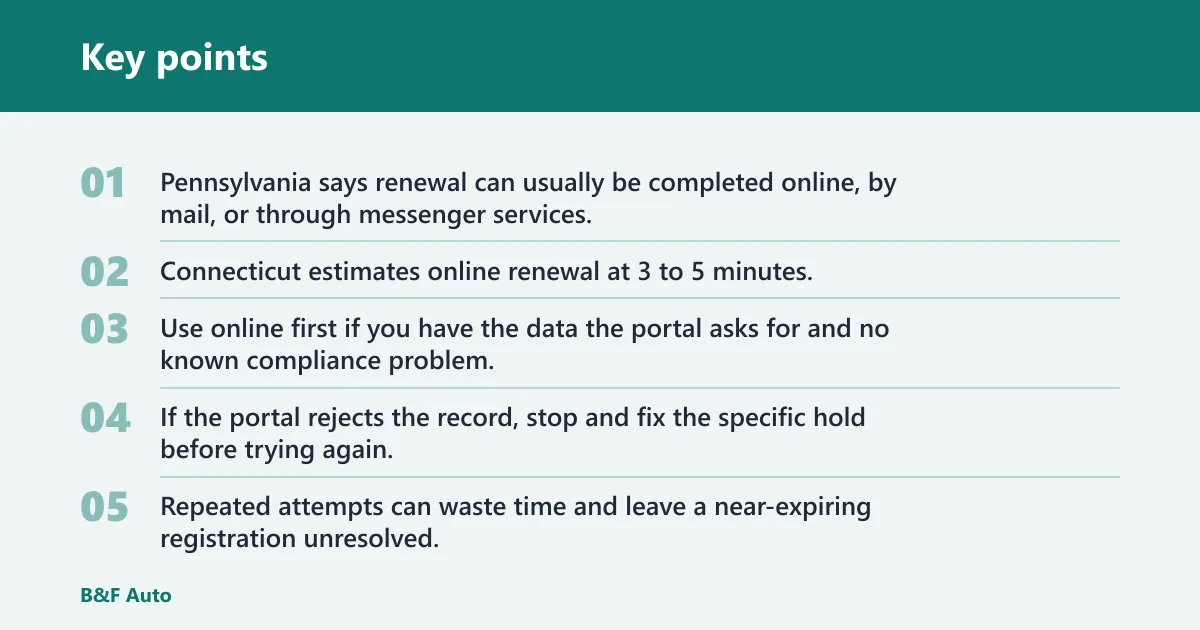
Pennsylvania says renewal can usually be completed online, by mail, or through messenger services. Connecticut estimates online renewal at 3 to 5 minutes. Texas allows online renewal 90 days before expiration or up to 12 months after expiration if no citation was issued, and it offers a $1.00 discount for online registration renewal.
Use online first if you have the data the portal asks for and no known compliance problem. If the portal rejects the record, stop and fix the specific hold before trying again. Repeated attempts can waste time and leave a near-expiring registration unresolved.
When mail still makes sense
Mail renewal is a reasonable choice when your state accepts it, your renewal notice includes the right fee and any required certifications, and you have enough time for delivery and processing. It is slower, but it avoids an office visit when the record is straightforward.
Mail can also work well if your state requires the mailed notice or voucher to match the vehicle record. Some states still treat that notice as the cleanest way to route payment and issue the next sticker or card. If the envelope is going out close to expiration, plan for mailing delays and keep proof of when you sent it.
When in-person renewal is the safer choice
Use an office, county tax office, DMV branch, or approved agent when the registration is expired beyond the online window, an inspection has not posted, the system cannot match insurance, or the state requires identity review. In-person service is also the fallback when a mailed sticker or card is delayed and you need a same-day answer.
Say your sticker expires this week, your insurer recently changed policy numbers, and the portal says coverage cannot be verified. That is usually not an online payment problem. It is a record-match problem, and an office visit with your insurance proof is often faster than waiting for the next overnight system update.
📊 Texas registration requirements are state- and county-specific: non-commercial vehicles no longer need a statewide safety inspection before renewal, while emissions requirements still apply only in certain counties. Source: Txdmv.
What do you need before you start?
Gather the details your renewal path calls for: the notice if you have it, the expiration date, plate number, current registration, driver license or ID if requested, insurance details, and payment method. Add inspection or emissions proof only if your state requires paper proof or the portal cannot find the record automatically.
Core information for any channel
- Renewal notice, if one arrived. It often lists the fee, deadline, plate details, and any extra step such as inspection or emissions.
- Vehicle registration expiration date. This determines whether you are early, on time, late, or forced into a different channel.
- License plate number and current registration.
- Driver license or state ID details if the portal or clerk asks for identity matching.
- Title number or VIN if your state uses one of those fields to locate the vehicle record.
- Insurance information. Some states verify electronically, but the details still need to match.
- Odometer reading where required.
- Credit card or debit card if paying online, or check or money order if paying by mail where allowed.
What the renewal notice usually tells you
A mailed or emailed reminder often does more than remind you. It may include the amount due, county or vehicle-class fees, whether inspection is required first, whether mail renewal needs the original notice, and where to send payment if mail is allowed. Connecticut sends a renewal invitation 45 days before expiration.
Do not treat a missing notice as a dead end. In many states, the notice helps, but the record can still be renewed with plate, registration, title, VIN, or driver ID details if the portal or office allows it.
Renewal checklist table
| Situation | Best renewal method | What to gather | Common blocker | What to do next |
|---|---|---|---|---|
| On-time renewal with notice in hand | Online first | Renewal notice, plate number, payment card, insurance details, printer if required | Inspection or emissions not yet posted | Check compliance status, complete inspection if needed, then return to the portal |
| Lost notice | Online or in person | Plate number, current registration, title number or VIN, driver ID, insurance information | Portal requires a detail from the notice or cannot match identity | Use alternate record fields if offered, or visit an office with ID and registration |
| Expired registration | Online if still eligible, otherwise in person | Expiration date, plate, registration, insurance, inspection status, payment method | Late fee, citation, or state limit on remote renewal after longer expiration | Check late rules first, then use the allowed channel before driving again |
| Online denial | In person after diagnosis | Error message, registration details, insurance proof, ID, any notice or compliance receipt | Insurance mismatch, unpaid taxes or tolls, address mismatch, expired too long | Resolve the exact hold, then renew at the office or retry online if the state allows |
| Inspection hold | Inspection first, then online or in person | Inspection appointment details, current registration, emissions paperwork if your state uses paper proof | Test not completed or not yet transmitted to the registration system | Wait for posting if transmission is delayed, then renew through the fastest open channel |
| Mail renewal | Mail when time is not tight | Signed notice or form, check or money order if required, return envelope, current address | Missing signature, wrong fee, mailing delay, notice required but omitted | Track mailing time, keep copies, and switch to in person if expiration is close |
How do you renew your registration online?
Online renewal works best when your state portal confirms eligibility and your record has no open hold. Before opening the site, confirm the expiration date, inspection or emissions status, insurance match, and payment method. Then enter the exact vehicle and identity details the portal asks for, save the confirmation, and check whether the final credential is printable or mailed later.
Who is usually eligible for portal renewal?
Most online portals screen for four things: timing, vehicle status, compliance, and identity match. Timing means you are inside the state’s early-renewal window and not too far past expiration. Vehicle status means the plate and class are eligible. Compliance means inspection, emissions, and insurance are current. Identity match means the portal can tie your submitted details to the record.
Texas gives a clear example of timing rules: online renewal can start 90 days before expiration, and some vehicles can still renew online up to 12 months after expiration if no citation was issued. Texas registration is valid through the last day of the month shown on the sticker, so a month-end deadline matters there.
Information and payment details to have ready
- Confirm your eligibility. Check the expiration date and any state message about inspection, emissions, or insurance before entering payment details. This prevents a failed transaction on a record that cannot renew yet.
- Gather the exact identifiers. Have the plate number, current registration, and any title, VIN, or driver ID detail your state asks for. Pennsylvania’s online renewal requires a plate number, title number, insurance information, odometer reading, credit card, and printer.
- Match insurance information. Enter policy details exactly as they appear in the insurer and state record if the portal requests them. Small mismatches in policy number, company code, or vehicle assignment can trigger a denial even when coverage is active.
- Submit payment carefully. Use an accepted credit card or debit card if the portal allows it, then save the payment confirmation page. Some states place processing holds before printing a sticker, so payment approval does not always mean same-day mailing.
What confirmation, receipt, or temporary credential to expect
After payment, you may get one of three outcomes: a printable receipt, a temporary credential, or only a portal confirmation while the sticker or card is mailed later. Some states still mail a physical registration card or sticker after online payment. Others have changed what arrives by mail. Pennsylvania no longer mails a registration card for online renewals.
The same source says there is a two-business-day payment processing hold before a sticker is printed, and it says processing and mailing may take up to three weeks. That is a Texas example, not a universal mailing timeline.
What car registration renewal actually does
Car registration renewal is the step that keeps your vehicle’s registration current with the state, usually on a yearly or every-other-year schedule. It does not replace title ownership, but it does update the records tied to your vehicle so you can keep driving legally. The renewal process can also reveal what fees, documents, or emissions-related requirements apply before approval.
The supporting guide on car registration renewal explains what changes when you renew, what stays the same, and what can stop the process from going through. That matters because missing the deadline or skipping a required step can lead to late fees, tickets, or an expired registration that puts your vehicle out of compliance.
How do you renew by mail or in person?
Renew by mail when your form is complete and you have enough time for delivery and processing. Renew in person when the deadline is close, a portal denial points to a record hold, or the state requires identity or document review. The right choice depends less on convenience and more on whether your record is clear for remote processing.
Mail renewal requirements and mailing delays
- Read the notice first. Check whether your state requires the original notice or coupon, a signature, and a specific payment type such as check or money order. Mail renewals often fail for missing signatures or the wrong enclosed amount.
- Include the matching details. Add the plate number, registration reference, and any insurance or emissions certification the form asks for. If the fee depends on county or vehicle class, use the amount printed on the notice rather than guessing.
- Mail with time to spare. Send the packet early enough to cover both postal travel and agency processing. Keep copies of the form and payment stub so you can trace what was sent if the record does not update.
Picture a notice that says inspection is required first, but the envelope is mailed anyway because the fee looks correct. The state can cash the payment and still hold the renewal until the inspection record posts, which makes the delay look like a mailing problem when it is really a compliance problem.
In-person renewal when time is tight or a hold exists
- Bring the failure clue. Take the denial message, expired card, renewal notice, or status screen if online renewal failed. That gives the clerk a direct starting point instead of a generic search.
- Carry your core documents. Bring ID, current registration, insurance proof, plate details, and any inspection or emissions receipt you were given. If an address changed, bring the document your state accepts to update it.
- Ask for the exact hold. If the office cannot renew immediately, ask whether the block is inspection, insurance, taxes, tolls, title, address, or expired-too-long status. That single label tells you what must be cleared before trying again.
What if you did not get a renewal notice or your registration is expired?
Missing a notice does not automatically stop renewal, and expiration does not always force an office visit. Start with the expiration date and the state portal or office lookup options, then use your plate, current registration, title, VIN, or ID to find the record. What changes after expiration is usually the fee, channel, or hold risk.
Renewing without the mailed notice
If the notice never arrived, use the record details your state accepts instead. Many portals can find the vehicle by plate number plus title, VIN, driver ID, or registration reference. If the site insists on a notice-specific number, move to phone support or an office visit rather than guessing fields that can trigger lockouts.
A notice often arrives roughly 30 to 45 days before expiration, but timing varies. Connecticut’s 45-day invitation is a useful example of how early some reminders are sent. If nothing arrives by then in a state with a similar schedule, check the address on file and do not wait for another mailing.
What changes after the expiration date
After expiration, three things can change fast: a late fee may apply, online eligibility may narrow, and the chance of a citation rises if the vehicle is driven. Connecticut applies a $10 late fee if renewal is more than five days late. Other states may use a different grace period, no grace period, or a longer expired cutoff that forces in-person renewal.
When expired-too-long status can force an office visit
Long-expired records are more likely to be routed out of online renewal and into office review. That can happen because the state wants fresh identity checks, updated insurance verification, or a new inspection on file before issuing another credential. If the portal says the record is ineligible due to time since expiration, treat that as a channel change, not a website glitch.
Why can registration renewal be blocked?
Registration renewal is usually blocked by a short list of issues: inspection or emissions not on file, insurance mismatch, identity or address mismatch, unpaid taxes or tolls where a state ties those debts to registration, or expiration that has gone beyond the online limit. The fastest fix is to identify the exact hold before retrying.
Inspection or emissions not on file
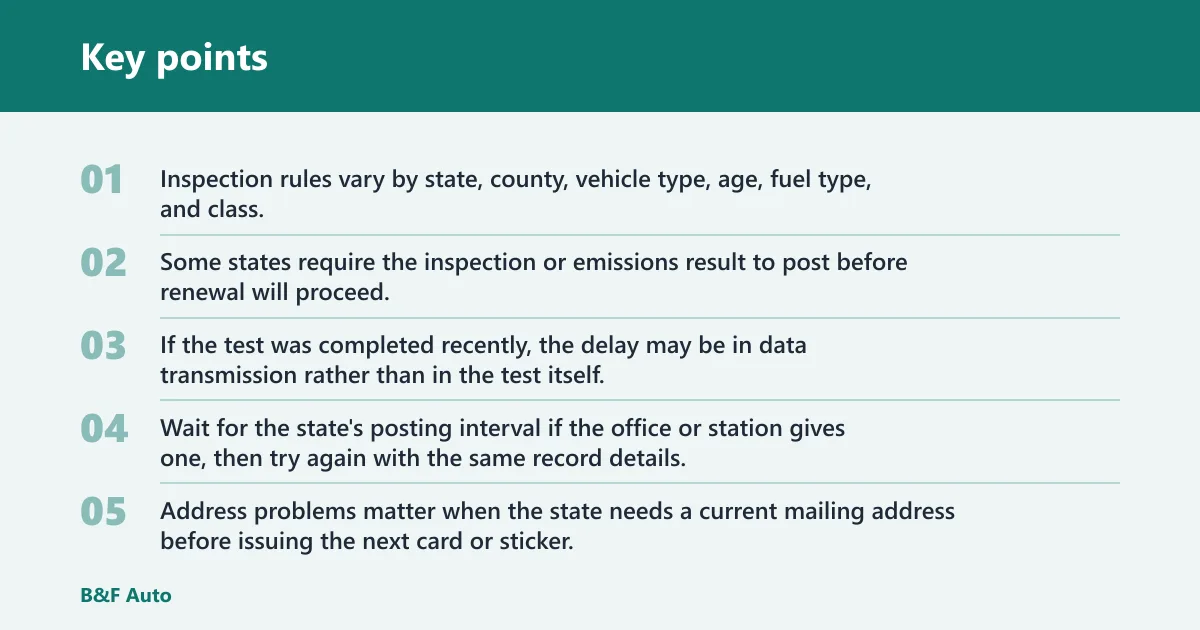
Inspection rules vary by state, county, vehicle type, age, fuel type, and class. Some states require the inspection or emissions result to post before renewal will proceed. The same source shows how specific these rules can be: non-commercial vehicles no longer need a statewide safety inspection before registration renewal, while emissions requirements still apply only in certain counties.
If the test was completed recently, the delay may be in data transmission rather than in the test itself. Wait for the state’s posting interval if the office or station gives one, then try again with the same record details.
Insurance, identity, or address mismatches
Insurance blockers often come from mismatched policy data, recently changed carriers, or a vehicle not correctly tied to the policy record. Identity blockers can come from a wrong title number, a typo in the plate, or a portal that expects the registered owner’s driver ID. Address problems matter when the state needs a current mailing address before issuing the next card or sticker.
A common first-timer mistake is entering a nickname, dropping a middle initial that the state record uses, or selecting the wrong plate type from a portal menu. Those small errors can look like a broken website when the problem is a simple record mismatch.
Unpaid taxes, tolls, or other state holds
Some states connect registration renewal to unpaid tolls, property taxes, parking obligations, or other agency holds. The portal may only say the renewal cannot be completed online. If that happens, look for a notice code, office message, or clerk explanation that names the blocking agency. Payment or release usually has to post there before registration can move forward.
How early can you renew and how do you track the status?
Renew as early as your state allows, especially if inspection, mail service, or a recent insurance change could slow things down. Track status in two parts: whether payment posted and whether the physical sticker or card was printed or mailed. A confirmation number proves submission, but it does not always mean the final credential is already on the way.
Typical renewal windows before expiration
Early-renewal windows differ, so use the notice or state portal rather than assuming a standard schedule. Texas permits online renewal 90 days before expiration. In states that send notices first, the mailing date often signals the practical start of the process even when formal eligibility begins earlier.
Grace periods, late fees, and end-of-month validity in some states
Do not assume a grace period exists. Some states apply a fee soon after the due date, and some make late operation citable immediately even if renewal can still be processed later. Texas uses end-of-month validity, meaning the registration expires on the last day of the month shown on the sticker. That is a Texas timing rule, not a nationwide standard.
How to check whether the payment, sticker, or card is still processing
- Save the confirmation number. Keep the portal receipt, email, or office printout as soon as payment is accepted. That number is usually the fastest way to trace a pending renewal.
- Check status in the right place. Use the renewal-status tool, phone line, or office that matches the channel you used. Ask whether the system shows payment received, renewal approved, sticker printed, or item mailed.
- Separate payment from delivery. If payment posted but the credential has not arrived, ask whether a processing hold or mailing window applies. Texas, for example, notes a two-business-day payment hold before printing and allows up to three weeks for processing and mailing.
How early can you renew your registration, and why does timing matter?
Most drivers can renew before the expiration date, but the exact window depends on your state and whether your renewal notice has opened. This matters because renewing too soon can be rejected, while waiting too long can lead to late fees, a lapse in registration, or even a citation. The safest approach is to check the timing rules before you submit anything.
The registration timing guide explains the common early-renewal windows, what can block an early renewal, and the basic checklist to use before you pay so you can avoid preventable delays.
Frequently asked questions
Can I renew my registration online?
Usually yes, if your state offers portal renewal and your record is eligible. Common requirements are a valid timing window, no unresolved inspection or emissions hold, matching insurance and identity details, and an accepted payment card. If the portal denies the renewal, the message usually points to a fixable hold or a required office visit.
What do I need to renew my vehicle registration?
You usually need the renewal notice if available, the plate number, current registration, expiration date, insurance details, and a payment method. Some states also ask for a title number, VIN, driver ID details, or an odometer reading. If renewing by mail, check whether the signed notice or a specific form must be enclosed.
How early can I renew my registration?
The allowed window depends on the state and sometimes the channel. Texas permits online renewal 90 days before expiration, while other states tie timing to the notice or portal rules. Renew early if inspection, emissions, mail delivery, or recent insurance changes could slow approval or mailing.
What if I did not receive my renewal notice?
You can often still renew by using your plate number, current registration, title number, VIN, or driver ID if the state portal or office accepts those fields. The notice helps with fee and deadline details, but it is not always required. If the portal demands notice-specific information, move to in person or phone support.
Why can’t I renew my registration online?
Online renewal is commonly blocked by inspection or emissions not on file, insurance mismatches, address or identity mismatches, unpaid tolls or taxes where applicable, or a registration that has been expired too long for portal renewal. Use the exact denial message to identify the hold before trying again.
What happens if I renew after the expiration date?
You may owe a late fee, lose access to online or mail renewal, or risk a citation if the vehicle is driven while expired. Connecticut applies a $10 late fee if renewal is more than five days late. Longer expiration can also trigger extra review, making in-person renewal the only available path.