Can You Register a Car in Another State?
Yes, sometimes you can register a car in a different state than your license, but only if that state accepts your residency or garaging status and no exception rule blocks it. Ignoring the wrong-state rules can lead to denied registration, fines, insurance problems, or a ticket. This guide explains the residency, garaging, student, military, and temporary-living cases that decide where you can register.
Can you register a car in a different state than your license?
Sometimes, yes. The license state is not always the deciding factor; residency and where the car is kept usually matter more. A state may let you register a vehicle even if your driver’s license was issued elsewhere, often within a short move window or under a narrow exception such as school or active-duty military status.
When the license state and registration state can differ
A mismatch can be lawful when you have not finished a move yet, when you qualify for a student or military exception, or when a state allows a temporary stay without local registration. The question is whether the state sees you as a resident and whether the car is primarily garaged there.
That split is common during transitions. A driver may move first, update insurance later, then swap the license and registration on different dates, since DMV and license deadlines do not always match.
When the mismatch becomes a problem
The mismatch becomes risky when you have already become a resident of the new state but keep the old registration past the deadline. It also becomes a problem if the car lives in one state while the registration and insurance still point to another state. That can trigger fees, late penalties, or a citation.
Say your license is still from Illinois, but you now sleep, park, and insure the car in Colorado after a job move. If Colorado treats you as a resident, the old plate can become the issue even before you update the license.
What controls registration: residency and garaging
Residency and primary garaging usually control registration. States and insurers often care less about the mailing address on a form and more about where the vehicle is kept overnight and used most of the time. If those facts point to a different state, the registration rule may change with them.
Residency signals states look
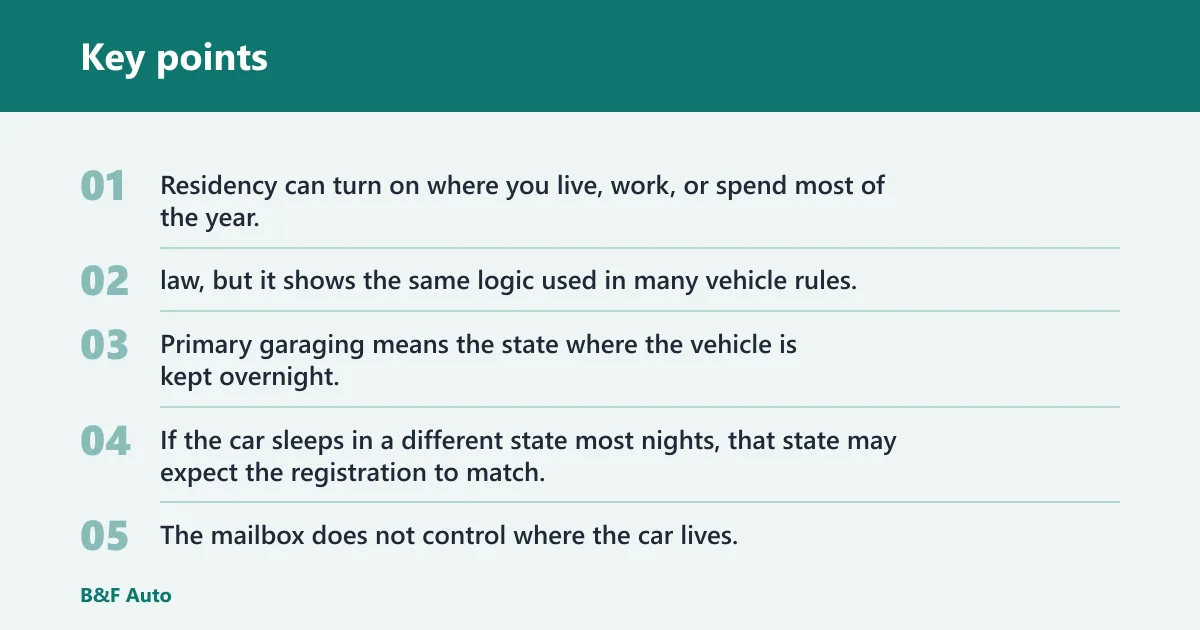
Residency can turn on where you live, work, or spend most of the year. It can also be triggered by life events such as a job, lease, or school enrollment. Those facts matter because a state may expect local registration once you stop being a temporary visitor.
The EU guidance uses a similar idea: normal residence is where you usually live, work, or have family for more than 185 days a year. That is not U.S. law, but it shows the same logic used in many vehicle rules.
Primary garaging location and overnight parking
Primary garaging means the state where the vehicle is kept overnight. That location often matters more than the mailing address on file, because it affects registration, tax treatment, inspection rules, and insurance rating. If the car sleeps in a different state most nights, that state may expect the registration to match.
A common first-timer mistake is using a relative’s mailing address in one state while the car is parked every night in another. The mailbox does not control where the car lives.
Why a mailing address is not enough
A mailing address can help you receive notices, but it usually does not prove residency or garaging. DMVs look for the place where the car is actually kept, not just where paperwork lands. Insurance companies also care because the garaging address changes the risk profile.
Out-of-state registration decision matrix
Use these scenarios to narrow the answer before you fill out forms, schedule an inspection, or buy a plate. The key questions are where the car is garaged, whether you are a resident there, and whether a legal exception applies.
| License state | Car garaged state | Residency status | Likely registration outcome | What to check next |
|---|---|---|---|---|
| Same as garaged state | Same as license state | Resident | Usually register in that state | Confirm title, inspection, tax, and fee steps with the DMV |
| Different from garaged state | New state | Resident in new state | Usually must register in the new state | Check the move deadline and the license update timing |
| Different from garaged state | Old state | Temporary stay only | May keep old registration for a limited time | Confirm whether the stay is truly temporary and how long it lasts |
| Different from garaged state | School state | Student, not a resident | Sometimes may keep home-state registration | Check student rules, insurance, and dorm or apartment garaging rules |
| Different from garaged state | School state | Student who became a resident | Often must register locally | See whether enrollment, lease, or work changed residency status |
| Home state license | New duty station state | Active-duty military | Often may keep home-state registration | Read the orders, base rules, and local DMV guidance together |
| Different from garaged state | Two-state household | One resident, one nonresident use | Depends on who owns and primarily uses the car | Check ownership, where the car sleeps, and who the insurer lists |
| Old state license | New state | Moved and became resident | Old registration usually cannot continue past the deadline | Look up the new-resident deadline and any title transfer step |
Can students keep registration in another state?
Sometimes they can, but only if the student remains a nonresident or qualifies for a student exception. School attendance alone does not always change residency. If the student becomes a resident through lease, work, or other ties, the car may need local registration even if the home-state license is still valid for the moment.
When school attendance does not change residency
Many students keep their home-state status while attending school out of state. In that case, the student exception may allow out-of-state registration to continue, especially for temporary study. The insurer still needs the correct garaging address, because a campus parking lot or off-campus apartment can change the rating state.
When a student may need local registration
If the student takes a local job, signs a long-term lease, or otherwise becomes a resident, the state may expect local registration. A school address does not cancel residency rules. The DMV will care about the vehicle’s actual home base, not just the student ID card.
Suppose a college student keeps a car in a campus garage in New York for the semester but still lives and votes at home in another state. If the student stays a temporary occupant, the home-state registration may still fit. If the student’s other ties point to New York residency, the answer can flip.
Insurance and garaging checks for students
Students should confirm that the insurer has the right overnight address and that any campus parking rules allow the plate and state combination. A policy written for one garaging state can become inaccurate if the car is kept somewhere else most nights. That mismatch can complicate a claim.
Can active-duty military keep home-state registration?
Many states allow service members to keep home-state registration while stationed elsewhere. Active-duty military is a common exception category, and many states allow service members to keep home-state registration while stationed elsewhere. That does not happen automatically in every case, though. Orders, base rules, insurance, and the destination state’s DMV rules still have to line up.
How orders and duty stations affect the answer
Orders matter because they show that the move is work-related and may be temporary. Some states give service members special registration treatment when they are stationed outside their home state. Others require specific paperwork, and some rules differ for dependents or jointly owned vehicles.
The EU guidance says temporary movers do not have to register the car or pay registration taxes there. U.S. military rules are not the same everywhere, but the same idea shows why a temporary assignment can be treated differently from a permanent move.
Base rules, DMV rules, and insurance
Base parking policies can affect whether a vehicle may stay on base with out-of-state plates. Insurance still matters too, because the garaging address and duty station can change the policy rating even if the plate stays from the home state. The safest move is to check all three: orders, DMV, and insurer.
When a spouse or family member may face different rules
Family members do not always get the same treatment as the active-duty service member. A spouse who becomes a resident through work, school, or other local ties may need different registration. Do not assume the service member’s exception automatically covers everyone on the policy or title.
What happens during a move or short-term stay?
A short window with different license and registration states can be lawful. That can happen while you are moving, waiting on documents, or using a specific exception. The problem starts when the temporary period becomes a long-term mismatch after residency has changed and the deadline passes.
Short windows where license and registration may differ
Many drivers update one record before the other. A DMV may require the registration change first, while another state may tell you to update the driver’s license first. The exact order depends on local rules, so the temporary mismatch is only safe if you are still within the allowed window.
State deadlines can be short. California uses a 20-day registration example for new residents, New York uses a 30-day example, and Colorado uses a 90-day example after becoming a resident. Those numbers are examples, not a nationwide rule, which is why the local DMV matters.
How long can you usually wait before deadlines apply?
There is no single national clock. Some states give a narrow window after residency begins, and others allow more time. If you miss the deadline, late fees, taxes, or registration penalties can follow, and the car can be ticketed if it is treated as improperly registered.
-
Confirm your residency date.
Identify the date you became a resident under the new state’s rules. That date usually starts the registration clock, not the date you changed your mailing address. -
Check the garaging state first.
Find out where the vehicle is kept overnight most of the time. If that state is different from the plate state, ask whether a resident registration is due now. -
Match the insurance address.
Update the garaging address with the insurer before or at the same time as registration. A mismatched policy can complicate a claim and may contradict the DMV file. -
Set the license deadline separately.
Look up the driver’s license deadline in the new state. Some states treat license and registration as separate tasks, so one update does not satisfy the other.
What to check before you register
Start with the title, insurance, and inspection rules before you submit forms. Then compare tax and fee requirements for the new state. A correct registration usually depends on ownership records, proof of insurance, and whatever inspection or emissions steps the state requires.
Title and ownership records
Check who is named on the title and whether a lienholder must approve the change. Some states need title work when you move, while others only need proof of ownership. If the car is co-owned, both owners may need to sign.
Insurance and garaging address
Verify that the insurer lists the state where the car sleeps most nights. The wrong garaging address can change the premium and can create a problem if the claim file says the car lives in a different state than the registration or the policy.
Inspection, tax, and fee rules
Some states require an inspection before registration, while others focus on emissions or safety checks. Fees and taxes also vary, and a state may charge more when a vehicle is brought in from elsewhere. Do not assume the old state’s sticker or inspection carries over.
-
Gather ownership papers.
Bring the title, lienholder documents if needed, and any bill of sale or prior registration. The DMV uses these to confirm the vehicle belongs to the person registering it. -
Update insurance details.
Tell the insurer the correct garaging state and overnight address. This reduces the chance of a policy mismatch when the new plate is issued. -
Complete required inspections.
Schedule any safety or emissions inspection the state requires before registration. Skipping this step can delay the plate and push you past the deadline. -
Pay the state-specific fees.
Expect taxes, title charges, and registration fees to differ by state. Late filing can add penalties, so do not wait if the move deadline is close.
Frequently asked questions
Can you register a car in a different state than your driver’s license?
Sometimes, yes. The license state is not always the controlling factor. If you are a resident in the registration state, or you fit a narrow exception such as military or student status, the state may allow it. If not, the mismatch can cause denial, fees, or a citation.
Is it legal to register a car where you don’t have a driver’s license?
In some cases, yes. A state may let you register a vehicle even if your driver’s license was issued elsewhere, as long as the residency, ownership, and insurance rules are satisfied. The exact answer depends on local DMV rules, and some states want the license updated soon after the move.
Do you have to change your license before registering your car in another state?
Not always. Some states let you handle registration first, while others expect the driver’s license update soon after residency begins. The order can vary, so check the local DMV deadline instead of assuming one step must come before the other everywhere.
Can students register a car in a state different from their license?
Yes, sometimes. A student may keep home-state registration if school attendance does not change residency and the student exception applies. If the student becomes a resident through a lease, job, or longer-term stay, the state may require local registration and local insurance treatment.
Can active-duty military register a car in a different state than their license?
Often, yes. Active-duty military is a common exception, and many states allow home-state registration while the service member is stationed elsewhere. Orders, base rules, insurance, and the local DMV still matter, and dependents may face different rules from the service member.
What happens if your registration and license state do not match?
Nothing may happen during a short, lawful transition. If the mismatch continues after you become a resident in the new state, the car can face late fees, tax issues, or a ticket for improper registration. Insurance problems can also appear if the garaging address is wrong.
What counts as residency for vehicle registration?
Residency usually means the state where you live, work, or spend most of your time. A job, lease, or school enrollment can trigger that status. Once residency changes, the state may expect local registration even if your mailing address or driver’s license still points elsewhere.
How long can you keep an out-of-state registration after moving?
Only as long as your new state allows after you become a resident. Deadlines vary, and examples include 20 days in California, 30 days in New York, and 90 days in Colorado. Missing the deadline can bring fees, taxes, or penalties, so check the local rule immediately.
What if the car is garaged in one state but the license is from another?
That can be fine for a temporary stay or a valid exception, but the garaging state often matters more than the license state. If the car lives overnight in one state and you have become a resident there, that state may expect registration, insurance, and possibly inspection there too.