What Is Car Registration Renewal?
Car registration renewal updates your vehicle’s legal registration with the state, usually once a year or every two years, so the registration remains valid. If you miss the deadline or skip a required step, you can face late fees, tickets, towing, or an expired registration that can keep you off the road legally. This guide explains what renewal changes, what it does not change, what documents or fees may be required, and the common blocks that stop approval.
What renewal covers and what it doesn’t
Car registration renewal extends the vehicle’s legal registration period with the state. It updates registration status, not title ownership and not insurance. Many states let you renew online, by mail, or in person, and the due date is usually before the expiration date.
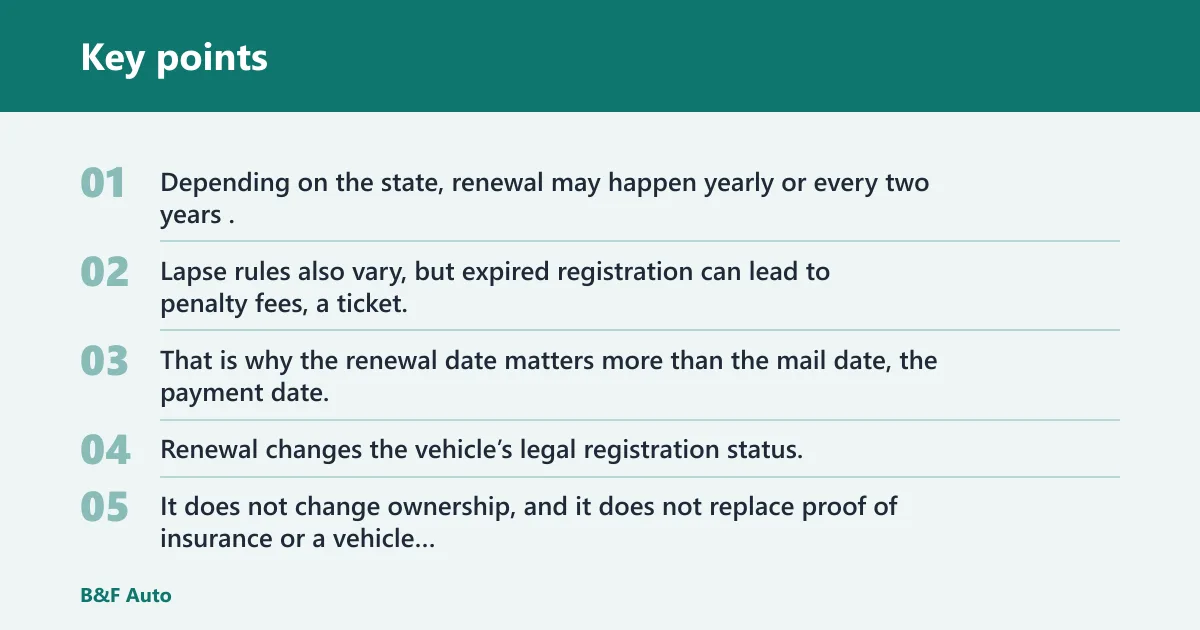
Depending on the state, renewal may happen yearly or every two years. Lapse rules also vary, but expired registration can lead to penalty fees, a ticket, and impoundment. That is why the renewal date matters more than the mail date, the payment date, or the date you last inspected the car.
What renewal changes and what it does not
Renewal changes the vehicle’s legal registration status. It does not change ownership, and it does not replace proof of insurance or a vehicle inspection. If a state requires insurance or inspection first, those are separate steps and can block approval until they are current.
Think of renewal as the state allowing the vehicle to stay on public roads for another registration cycle. Title work changes ownership records. Insurance covers loss and liability. Inspection checks roadworthiness or emissions compliance. Renewal uses some of that information, but it is its own legal process.
📊 New Jersey online renewal requires the 9-digit PIN from the notice. Source: NJ.
What changes after renewal?
After renewal, many states issue a new registration card and may send a new sticker. The card and sticker are proof that the registration is current, and the effective date should cover the next registration period. In some states, the sticker is the visible proof placed on the plate.
Picture a driver who renews before the expiration date and gets a fresh card in the mail. The vehicle’s legal status changes as soon as the renewal is approved, but the driver still needs the new proof in the car or on the plate if the state requires it.
What stays the same
The vehicle itself does not change. The VIN stays the same, the plate number usually stays the same, and the owner record does not change unless a separate title transaction happens. Renewal keeps the current registration active; it does not start a new ownership record.
Renewal meaning vs renewal action
| Term | What it means | What a driver actually needs to do |
|---|---|---|
| Renewal notice | A courtesy reminder mailed in advance in some states. It may include a PIN, plate data, or renewal details. | Use it if you have it, but do not assume it is the only way to renew. |
| VIN | The vehicle identification number used to look up records or renewal eligibility. | Enter the full VIN, or in some states the last five digits may work for lookup. |
| Plate number | The license plate number used to identify the vehicle in renewal systems. | Have the plate number ready, especially for online or in-person renewal. |
| Insurance | Proof of current coverage, required in some states. | Make sure the policy is current and matches the vehicle or owner information the state asks for. |
| Inspection | A smog or technical check required in some states or for some vehicles. | Complete the inspection first if the state links it to renewal eligibility. |
| Fee | The amount due for the renewal, often with base fees and extras. | Pay the full amount, including any late fees or surcharges that apply. |
| Sticker | A decal issued in some states as proof of current registration. | Place it as directed and keep the old one only if the state tells you to. |
| Registration card | The paper or card proof of current registration. | Keep the updated card in the vehicle if your state requires it. |
What do you need to renew?
What you need depends on the state and the renewal method. Common items include a renewal notice, plate number, VIN, proof of insurance, inspection completion, and payment. Some states also ask for a PIN from the notice, especially for online renewal.
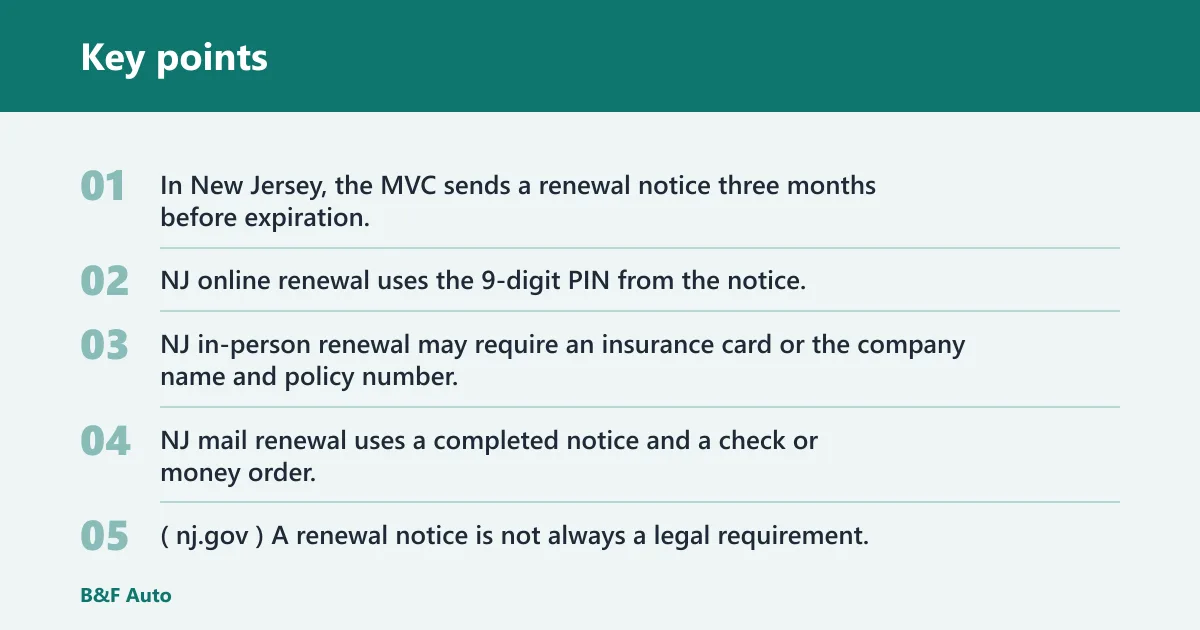
In New Jersey, the MVC sends a renewal notice three months before expiration. NJ online renewal uses the 9-digit PIN from the notice, and same-day online renewal is available. NJ in-person renewal may require an insurance card or the company name and policy number. NJ mail renewal uses a completed notice and a check or money order. (NJ)
How notice, VIN, and plate number work together
A renewal notice is not always a legal requirement. It is often a convenience notice. If you do not have it, some states still let you renew using a plate number, a VIN, or both. California renewal eligibility can include the last five digits of the VIN or HIN.
That matters because the notice is about access, not ownership. The VIN and plate number are the identifiers that let the state match your vehicle record to the renewal request. If the record cannot be matched, the transaction may stop until the details are corrected.
Insurance and inspection checks
Some states require proof of insurance before renewal. Others require an inspection or smog check first. California renewal eligibility can require electronic smog certification on file. If the system does not show current coverage or a completed inspection, renewal can be blocked until those records clear.
Say your notice is missing, but your plate number and VIN are available. You may still be able to renew online if the state accepts those details. Suppose the state also needs a smog certification on file and it has not posted yet. The renewal can stop there even though the car details are correct.
How do you renew your registration?
You can usually renew online, by mail, or in person. The state decides which methods are available, which identity details are required, and whether your vehicle qualifies for each option. Online renewal is common, but it is not available for every case.
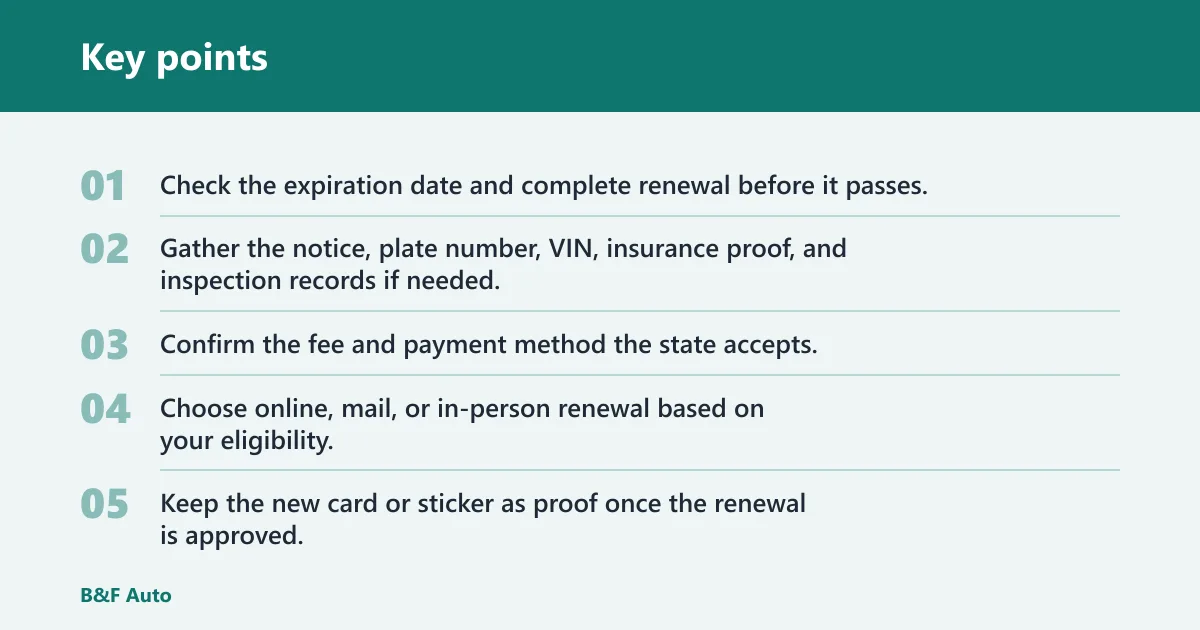
- Check the expiration date and complete renewal before it passes.
- Gather the notice, plate number, VIN, insurance proof, and inspection records if needed.
- Confirm the fee and payment method the state accepts.
- Choose online, mail, or in-person renewal based on your eligibility.
- Keep the new card or sticker as proof once the renewal is approved.
Online renewal
Online renewal is the fastest option when the state allows it. Vehicle registration can be renewed online, by mail, or in person. Some states ask for a notice PIN, while others let you use the plate number, VIN, or renewal details from the record.
California renewal eligibility can use the last five digits of the VIN or HIN. That helps when the mailed notice is missing. But online renewal can still fail if the vehicle needs smog certification, if the fee is unpaid, or if the record shows a block.
Mail renewal
Mail renewal is common when the state sends a paper notice and wants a completed form returned with payment. NJ mail renewal uses a completed notice and a check or money order. This method can take longer, so it is best used before the expiration date rather than after it.
In-person renewal
In-person renewal is common when the record needs review or when the state does not allow another method for your case. It may be used when insurance must be verified, when a notice is missing, or when the system flags a problem. Bring the documents the state requests, not just a payment method.
What blocks renewal?
Renewal can stop when a required record is missing, expired, or not matched to the vehicle. Common blockers can include expired insurance, a failed inspection or smog check, incorrect plate or VIN details, and unpaid fees. In some states, the issue is a simple record mismatch rather than a vehicle problem.
- Expired or missing insurance
- Failed inspection or smog check
- Wrong VIN, plate number, or notice details
- Unpaid fees, including late fees or surcharges
- No posted renewal eligibility in the state system
Renewal fee amounts also vary. LapseGuard says every state charges a base renewal fee, and the total can rise with state add-ons or vehicle-specific charges. The same source gives Ohio EV surcharges of $100, $150, or $200 depending on vehicle type. California late fees can include a late registration fee, percentage of the vehicle license fee, and CHP fee.
What happens if it expires?
If registration expires, the vehicle may no longer be legally current for road use, and the state can add fees or penalties. Expired registration can lead to penalty fees, a ticket, and impoundment. The longer the lapse continues, the more likely extra charges or enforcement problems become.
The next step is usually to renew as soon as possible and clear the block that caused the lapse. If the issue is insurance, update that first. If the issue is inspection or smog compliance, complete that requirement before trying again. If the issue is a notice or PIN, use the plate number or VIN if the state allows it.
Grace periods vary
Do not assume every state gives the same grace period. Some states are strict. Others allow limited late renewal, but the rules, fees, and enforcement dates differ. The safest rule is simple: renew before the expiration date unless your state says otherwise in writing.
What is DMV registration renewal?
DMV registration renewal is the state agency term for the same process. Some states use DMV, others use MVC, RMV, or another motor vehicle agency name. The process still extends the vehicle’s legal registration period and may require notice details, insurance, inspection, and payment.
Frequently asked questions
What is vehicle registration renewal?
Vehicle registration renewal is the state process that extends a vehicle’s legal registration period after it is about to expire. It usually happens yearly or every two years, depending on the state. The result is updated registration status, often with a new card or sticker as proof.
What is a vehicle registration renewal notice?
A vehicle registration renewal notice is a courtesy reminder that may be mailed before expiration. It can include a PIN, plate details, and payment instructions. It is helpful, but it is not always required to renew, because some states let you use a plate number or VIN instead.
What is needed for car registration renewal?
Most drivers need the plate number, VIN, renewal notice if available, proof of insurance in some states, inspection or smog records where required, and payment for the fee. The exact list depends on the state and on whether you renew online, by mail, or in person.
What is the cost for car registration renewal?
The cost varies by state, vehicle type, and added surcharges. The same source says every state charges a base renewal fee. Some states also add late fees, special vehicle fees, or EV surcharges. California late fees can include a late registration fee, percentage of the vehicle license fee, and CHP fee.
What is the grace period for car registration renewal?
Grace periods vary by state, and some states do not give one that helps avoid penalties. Expired registration can still lead to fees, a ticket, or impoundment. The safest move is to renew before the expiration date instead of assuming a late window will protect you.
Can I renew registration online without a notice?
Often yes, if the state lets you use other identifiers such as the plate number or VIN. California renewal eligibility can use the last five digits of the VIN or HIN. If the state needs a PIN, current insurance, or a smog record, those items still have to clear before the online renewal goes through.
What happens if I don’t renew my registration?
If you do not renew, the registration can lapse and the vehicle may no longer be legally current for road use. That can bring penalty fees, a ticket, and possible impoundment. It can also complicate roadside stops and delay later renewal until the missing requirement is fixed.