Auto Loan Preapproval: How It Works and How to Get It
Auto loan preapproval is a lender’s conditional offer that typically sets your maximum amount, estimated APR, and term after a hard credit pull, and it is usually valid for about 30 to 60 days. Skip it, and you can shop above your real budget, burn a credit inquiry on a file that was not ready, or lose a deal when the lender declines the exact car. This guide explains preapproval vs. pre-qualification, how lenders and dealers use it, how credit is affected, and why an approved buyer can still be declined later.
Used correctly, preapproval does two jobs. It sets a shopping budget before you visit a dealer, and it shows how a lender is likely to view the borrower, the requested term, and the vehicle that ends up on the contract.
What auto loan preapproval actually means
What a lender reviews before issuing a preapproval
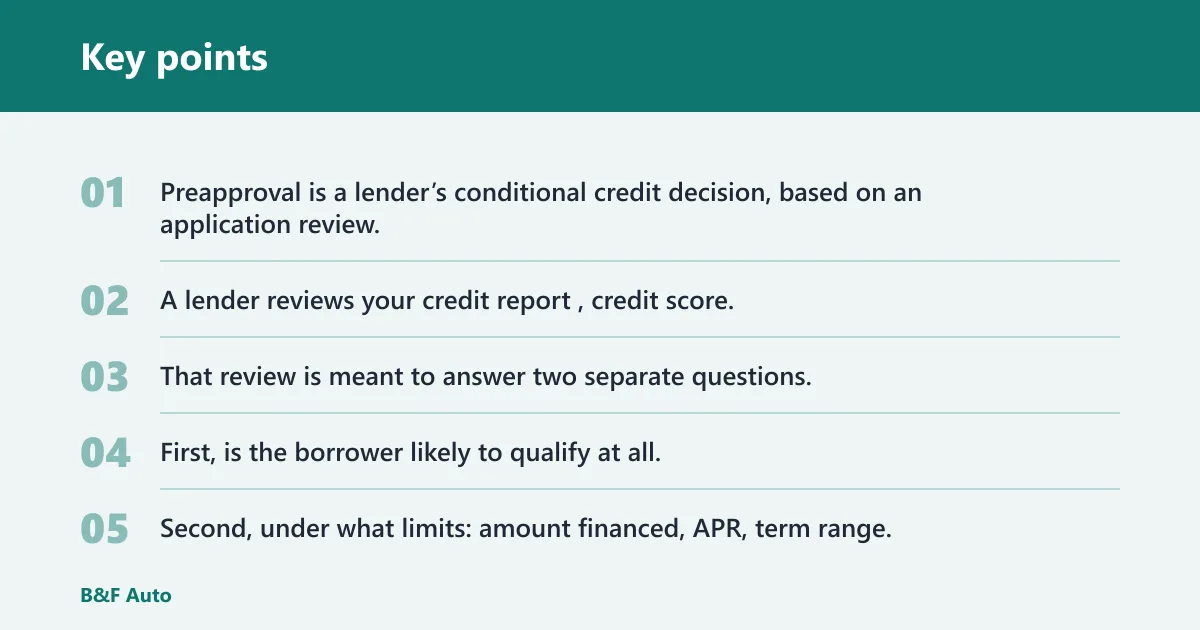
Preapproval is a lender’s conditional credit decision, based on an application review, not a ballpark payment quote. A lender reviews your credit report, credit score, and other information for preapproval, often including stated income, housing cost, current debts, employment details, and the loan structure you want.
That review is meant to answer two separate questions. First, is the borrower likely to qualify at all. Second, under what limits: amount financed, APR, term range, and sometimes vehicle restrictions.
Experian notes that preapproval can help identify whether a borrower will qualify for an auto loan at all. That matters before shopping, because vehicle choice can change fast once taxes, fees, and add-ons are included.
What you usually receive
Preapproved car loans show a maximum loan amount. Many lenders also provide an estimated APR or APR range, an approved term or term range, and conditions that still need to be met before funding.
Those conditions often include final identity checks, proof of income, proof of residence, insurance details, and confirmation that the chosen vehicle fits lender rules for age, mileage, value, and title status.
Launch CU says pre-approval lets shoppers know how much they can spend and helps them know their monthly loan payment. That helps only if the borrower turns the approved amount into an all-in purchase budget instead of treating the loan cap as the sticker-price cap.
Why preapproval is stronger than an estimate but still conditional
Preapproval is stronger than pre-qualification because the lender has reviewed more data and often used a hard credit inquiry. But it is still conditional. The lender has not yet seen the exact car, exact deal structure, or every document needed to fund the loan.
That is why the final deal can shift at the dealership. Change the vehicle, term, down payment, trade equity, or verified income, and the lender may change the approval, the APR, or the amount financed.
How is preapproval different from pre-qualification?
Pre-qualification is usually an early estimate based on limited information and typically uses a soft inquiry, while preapproval is a deeper lender review that often uses a hard inquiry and gives a more reliable shopping limit. Start with pre-qualification when comparing lenders broadly, then move to preapproval when the purchase window is close.
Soft inquiry versus hard inquiry
Pre-qualification typically uses a soft inquiry and won’t affect credit scores. That makes it useful when comparing several lenders before making a real application.
Preapproval often requires a hard credit inquiry because the lender is reviewing your file for a conditional lending decision, not simply generating a rate estimate. A hard credit inquiry can slightly lower your credit scores, so confirm the lender’s inquiry type before applying instead of assuming every lender handles preapproval the same way.
Estimate versus conditional approval
Pre-qualification usually asks for less information upfront. It may rely on self-reported income, rough debt figures, and a broad credit profile rather than a full underwriting review.
Preapproval is a stronger step because the lender is closer to an actual lending decision. It can still fail later, but it is more useful for setting a real budget and comparing dealer financing against an outside offer.
The same source says preapproval or prequalification can help compare estimated loan offers. For early shopping, pre-qualification is often enough. For a dealership visit next week, preapproval is usually the better tool.
When to use each one
Use pre-qualification early if the buyer is still comparing lender channels, rebuilding credit, or unsure whether to buy this month or three months from now. Use preapproval when the buyer has chosen a real shopping window, checked the budget, and expects to submit a deal within the lender’s about 30- to 60-day validity period.
A practical rule is simple: do not spend a hard inquiry until the purchase timing is real. If the vehicle search may run past the approval window, start with soft-pull comparisons first.
Why online preapproval is worth doing early
Getting pre-approved online helps you know your likely budget before you visit a dealership, so you can compare vehicles with a real loan amount in mind instead of guessing. The process is straightforward: pick a lender, complete the application, submit the required documents, and wait for the credit decision. A strong application can speed things up and improve your position when it’s time to negotiate.
This auto loan preapproval guide explains the online steps, what information lenders usually ask for, how long approval can take, and what to do after you receive it. That matters because missing documents or avoidable errors can slow approval or change the amount you qualify for.
How do lenders decide your preapproved amount?
Lenders decide the preapproved amount by combining credit risk, payment capacity, and collateral rules. They review credit score, payment history, recent credit activity, income, debts, requested term, down payment, and the vehicle standards they will accept. The result is not only about credit score; it is about whether the full deal fits lender limits.
Credit profile and recent credit activity
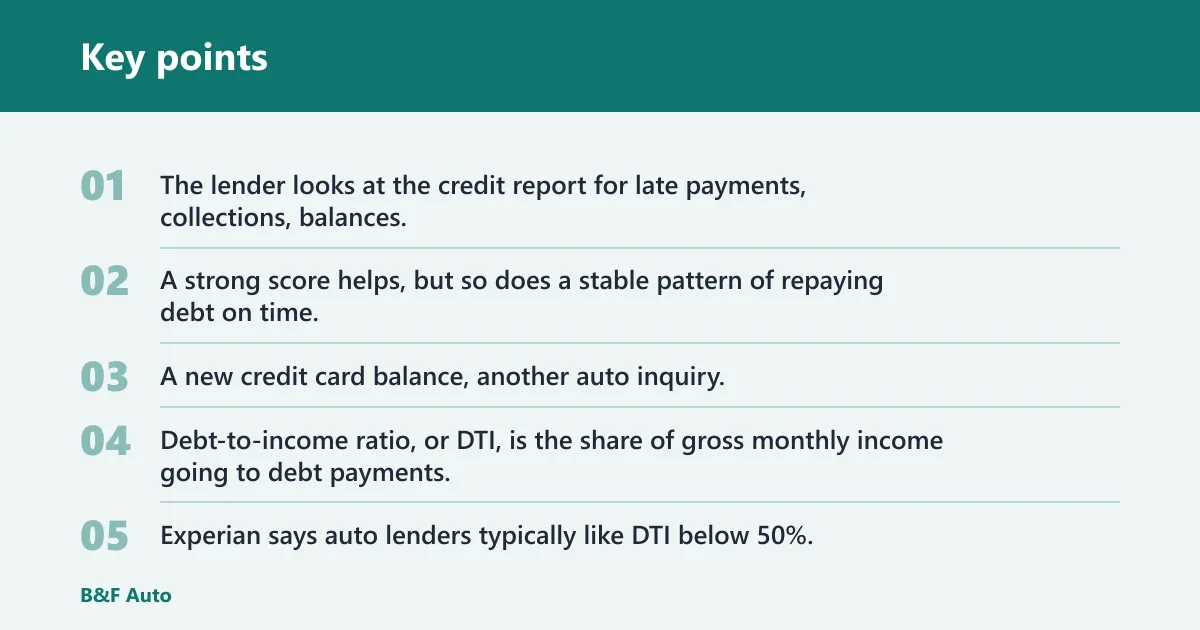
The lender looks at the credit report for late payments, collections, balances, open accounts, and recent borrowing. A strong score helps, but so does a stable pattern of repaying debt on time.
Recent changes matter. A new credit card balance, another auto inquiry, or a fresh personal loan can shift the lender’s view even if the score itself has not moved much yet.
Income, debt-to-income ratio, and payment capacity
Debt-to-income ratio, or DTI, is the share of gross monthly income going to debt payments. The same source says auto lenders typically like DTI below 50%.
DTI affects the payment the lender thinks the borrower can carry. A borrower with strong income but heavy card or student-loan payments may be approved for less than someone with the same credit score and fewer monthly obligations.
Suppose a shopper earns $5,000 gross each month and already has $1,900 in debt payments. That is a 38% DTI before the car loan. Add a projected auto payment of $450, and DTI rises to 47%. Add $700 instead, and DTI hits 52%, which can push the deal outside many lenders’ comfort range.
How term length and down payment change the number
Longer terms lower the monthly payment, which can make a larger amount look affordable on paper. A bigger down payment reduces the financed amount and lender risk, which can also help approval.
Those two levers work in different ways. Extending the term changes monthly payment. Increasing the down payment changes both payment and loan-to-value, which matters when the vehicle price is high relative to the car’s value.
Picture the same $30,000 vehicle with the same borrower profile. Put $0 down and finance taxes and fees, and the amount financed may push the deal above the lender’s value cap. Put $4,000 down instead, and the borrower may fit the same lender without changing credit or income.
Vehicle rules that can limit approval before and after shopping
Many borrowers focus on themselves and miss the collateral rules. Lenders may limit model year, mileage, title history, loan-to-value, or the maximum term allowed on an older used vehicle.
That means a borrower can be preapproved and still lose the exact car. The approval may fit a newer vehicle at 60 months but fail on a high-mileage unit that the lender will finance only for a shorter term, or not at all.
What amount can you really shop for?
Your real shopping budget is the preapproved loan amount adjusted for down payment, trade equity, taxes, registration, dealer fees, and any products rolled into the loan. The lender’s maximum is not the same as the vehicle’s advertised price, and confusing the two is a common way to overshoot the budget.
Turning a loan amount into a vehicle price budget
Start with the approved loan amount, then work backward. If the lender approves up to $28,000, that $28,000 may need to cover the vehicle, sales tax, title and registration, documentation fees, and any financed extras.
If the buyer plans to put cash down or has positive trade equity, add that money to the shopping ceiling. If the trade is upside down, subtract the negative equity because it must be covered somewhere in the deal.
Adding taxes, registration, dealer fees, and add-ons
Dealer paperwork changes the math quickly. Taxes and state fees vary, and dealer documentation fees can be material depending on the state and store. Service contracts, GAP coverage, accessories, and protection packages can also increase the financed amount if rolled into the contract.
For example, if a lender preapproves $25,000 and the dealer’s out-the-door total on a car is $24,300 before any products, adding a $1,200 service contract can push the amount financed above the approval unless the down payment increases or the lender revises the approval.
How trade-in equity and cash down change the ceiling
Cash down and trade equity do more than lower the monthly payment. They can move a deal from declined to approved by reducing financed amount and loan-to-value.
A common first-timer mistake is treating a trade-in offer as extra shopping money without checking the payoff. If the vehicle is worth $10,000 but the payoff is $12,500, there is negative equity, not a $10,000 down payment.
Loan workflow table
From application to dealer signing
| Step | Input requested | Credit pull type | What the lender decides | What the shopper receives | Where approval can change at the dealership |
|---|---|---|---|---|---|
| 1. Early comparison | Name, address, estimated income, estimated monthly housing payment, rough vehicle budget | Usually soft inquiry | Whether the borrower appears to fit broad credit tiers and estimated APR bands | Pre-qualification estimate from one or more lenders | Estimate can change sharply after a full application, exact debts, or vehicle details are reviewed |
| 2. Preapproval application | Full identity, Social Security number, stated income, employer, housing cost, requested term, down payment plan | Often hard inquiry | Whether to issue a conditional preapproval and at what maximum amount | Preapproval amount, estimated APR or range, term range, expiration window such as 30 to 60 days | Approval may later depend on proof of income, identity, residence, and unchanged credit |
| 3. Lender conditions | Pay stubs, W-2 or tax returns, bank statements, proof of residence, insurance details if requested | No new pull in many cases, but lender practice varies | Whether conditions are satisfied before or after the vehicle is chosen | Conditional approval details and any missing-document list | Income that cannot be verified or bank activity that conflicts with the application can stop funding |
| 4. Vehicle selection | VIN, year, mileage, sale price, taxes, fees, add-ons, trade payoff, cash down | Usually no new pull just for VIN review, but lender practice varies | Whether the exact vehicle meets age, mileage, title, loan-to-value, and term rules | A yes or no on the exact car and a revised structure if needed | Older or high-mileage vehicles may force a shorter term, lower amount, or denial |
| 5. Dealer submission | Buyer’s order, credit application, lender approval code if outside financing is used | Dealer may submit to partner lenders; pull type depends on the lender used | Whether the dealer can match or beat the outside offer, or whether the outside approval is accepted as written | Competing finance offers or a contract built around the preapproval | Dealer-arranged financing may include a higher APR than the lender buy rate where allowed, so line-by-line comparison matters |
| 6. Final verification and signing | Signed contract, final odometer disclosure, identity check, insurance, stipulations | Possible refresh or final review if the approval window is near expiration | Whether to fund the contract on final terms | Final retail installment contract or loan agreement | Deal can still change if documents do not match, debts increased, approval expired, or the contract structure changed |
How do you get preapproved for an auto loan?
Get preapproved by checking your credit and budget first, comparing lender channels, confirming whether the application uses a hard inquiry, and then submitting a full application close enough to your shopping date that the approval will still be valid. Review the amount, APR, term, and conditions before visiting a dealer.
Check your credit and set a purchase timeline
Review the credit file for errors, missed payments, and current balances before applying. Then decide when the vehicle purchase will actually happen. This timing step matters because many preapprovals expire within 30 to 60 days.
If the buyer is still several months away, broad pre-qualification is usually the better starting point. If the buyer plans to visit dealers next weekend, preapproval is the stronger move.
Compare lender channels
Common lender channels include banks, credit unions, online lenders, dealer-arranged financing, and captive finance companies tied to specific manufacturers. Each channel may weigh income, credit tiers, vehicle age, and mileage somewhat differently.
Credit unions can be competitive on rate. Online lenders can move fast and may ask for bank statements or digital income verification. Captive lenders may have special terms on new vehicles but usually only for that brand. Dealer-arranged financing can give access to multiple partner lenders in one place.
Submit the application and confirm inquiry type
- Gather the information the lender asks for: identity, address, income, employer, housing payment, desired term, and estimated down payment.
- Ask whether the application uses a soft inquiry or a hard inquiry.
- Submit the application only when the buyer is ready to shop within the likely approval window.
- Respond quickly if the lender asks for pay stubs, tax returns, bank statements, or residence proof.
The same source says pre-approval can save time at the dealership and reduce paperwork at the dealer. That benefit is real only if the buyer arrives with the approval details and the requested supporting documents already organized.
Review the offer terms before shopping
Read the approval details line by line. The amount alone is not enough. Check the APR, whether the rate is fixed to a narrow credit tier, the maximum term, required down payment, and any vehicle restrictions.
The same source notes that getting preapproved before visiting the dealership may help a buyer get a better interest rate. It may also keep the buyer from accepting a weaker dealer offer simply because the monthly payment is framed attractively.
What documents do you need for auto loan preapproval?
Most lenders ask for identity, address, income, employment, and housing information first, then request supporting documents if the file needs verification. Self-employed borrowers, first-time buyers, and some online-lender applicants often need more paperwork. Even with preapproval, the dealer may still need insurance, trade payoff, and final vehicle documents.
Basic documents most lenders request
Common requests include a driver’s license or other identity document, Social Security number, recent pay stubs, proof of residence, employer information, and insurance details once a vehicle is chosen. Some lenders also ask for bank statements.
The exact list varies because some lenders verify income electronically while others require uploaded or printed documents.
Document checklist by borrower type
| Borrower type or channel | Usually needed early | Often requested later |
|---|---|---|
| W-2 employee | License or ID, address, employer name, gross income, housing payment | Recent pay stubs, W-2, proof of residence, insurance card |
| Self-employed borrower | ID, business name, stated income, housing payment | Recent tax returns, bank statements, profit-and-loss statement, proof of residence |
| First-time buyer or thin credit file | ID, address, employer, income details | Extra proof of income, residence history, references if requested by the lender, larger down payment documentation |
| Online lender with document-heavy review | Full application and consent forms | Bank statements, identity selfie check, account verification, insurance, buyer’s order |
| Buyer with trade-in or payoff | Trade VIN and payoff estimate | Official payoff letter, registration, title status, odometer details |
What dealers may still need even with a preapproval
The dealer still needs the paperwork that turns lender approval into a fundable contract. That can include the buyer’s order, VIN, odometer statement, proof of insurance, title and registration details, trade payoff, and signatures matching the lender’s requirements.
Preapproval reduces repeated back-and-forth, but it does not eliminate final documentation.
Can you use a preapproved loan at the dealership?
Yes. A preapproved outside loan can be used at the dealership as a baseline or direct payment method, and the dealer may also try to beat it with partner-lender offers. The key is to compare total financed amount, APR, term, and fees line by line, because approval and price negotiation are separate parts of the deal.
How the dealer works with outside financing
The buyer can bring the approval details, lender contact information, and any approval code to the dealer. The store then structures the purchase order around that outside financing or asks whether it can submit the deal to its own lenders for comparison.
The same source says pre-approval can save time at the dealership. In practice, that often means fewer surprises about the target payment range and less time filling out repeat applications.
When dealer-arranged financing can beat your offer
Dealer-arranged financing can sometimes beat an outside preapproval because the dealer has access to several banks or captive programs. That is especially true when a manufacturer is supporting rates on a new model.
Still, outside preapproval remains useful because it gives the buyer a real comparison point. Dealer-arranged financing may include a rate markup above the lender’s buy rate where allowed, so the buyer should compare APR and total financed amount rather than focus only on monthly payment.
How to compare offers at the finance desk
Bring the preapproval and verify that the exact vehicle qualifies. Then compare these items on each version of the contract: sale price, trade value, payoff, cash down, taxes and fees, financed add-ons, APR, term, and final amount financed.
If the dealer matches the payment by stretching the term, the offer is not equivalent. If the dealer lowers the APR but adds products into the loan, the total cost can still rise.
When preapproval falls apart or changes
Vehicle age, mileage, and loan-to-value problems
A preapproval often assumes a vehicle that fits lender standards. Choose a car outside those rules, and the lender may reduce the term, require more cash down, or decline the deal entirely.
This happens often with older used vehicles, high-mileage inventory, branded-title vehicles, or deals with too much negative equity rolled in.
Income, identity, and document verification issues
Conditional approval can fail if the lender cannot verify income, employment, residence, or identity. Stated income that does not match pay stubs or bank statements is a common problem.
Another issue is timing. If the approval expires before the contract reaches the lender, updated documents or even a new credit pull may be required.
Credit changes, added debt, and expired approvals
Preapproval is based on a snapshot. If the borrower takes on new debt, misses a payment, or otherwise changes the credit profile after applying, the lender can rework the deal or decline funding.
The same goes for structural changes. A different term, a smaller down payment, a higher selling price, or rolled-in aftermarket products can all move the contract outside the original approval.
Frequently asked questions
What is auto loan preapproval and how does it work?
Auto loan preapproval is a lender’s conditional decision on how much a borrower may finance, at what estimated APR, and for what term range before the borrower picks the exact vehicle. The lender reviews credit, income, debts, and other application details, then checks the chosen car and final documents before funding.
Does auto loan preapproval use a hard inquiry?
Many auto loan preapprovals use a hard credit inquiry. A hard inquiry can slightly lower credit scores, which is why borrowers should confirm the inquiry type before submitting the application. Pre-qualification usually uses a soft inquiry instead, and a soft inquiry generally does not affect credit scores.
What amount can I get preapproved for on a car loan?
The amount depends on credit profile, income, debt-to-income ratio, requested term, down payment, and lender rules for the vehicle itself. Preapproved car loans show a maximum loan amount, but that figure must also cover taxes, registration, fees, and any financed extras, not only the advertised vehicle price.
Can I use a preapproved auto loan at the dealership?
Yes. A buyer can bring an outside preapproval to the dealership and use it as the finance plan or as a benchmark against dealer-arranged offers. The dealer may still submit the contract to partner lenders, and the final terms can change if the vehicle, down payment, term, or verification documents change.
How long does a car loan preapproval last?
Preapproval periods vary by lender, but many are valid for 30 to 60 days. Once that window closes, the lender may require updated income documents, a fresh review of the chosen vehicle, or a new credit pull before issuing another approval.