Test Drive Checklist PDF: What Should It Include?
A good test drive checklist PDF should fit on about one page, group checks by drive stage, and use a simple score such as 0 = no issue, 1 = minor, 2 = major; totals can then point to buy, inspect further, negotiate, or walk away. Without that structure, you forget symptoms, compare cars unevenly, and miss problems that become repair bills later. Here’s what the checklist should include, plus a practical layout you can print and use in the seat.
What to put on the checklist form
The best version is a one-page form that follows the drive in order: before driving, city streets, highway, and after the drive. It should leave room for a 0–2 score on each line, plus short symptom prompts that connect what you feel or hear to a likely risk and a final decision box.
That format keeps the page easy to scan. iSeeCars says its checklist uses 14 key things to look for during a test drive, and it offers a downloadable PDF. Bumper organizes its guide into 23 items and recommends a minimum 20-minute drive, with 30 minutes budgeted for a proper one.
| Drive stage | Check item | 0–2 score | Symptom prompt |
|---|---|---|---|
| Before driving | Cold start, warning lights, gauge sweep, idle, Park-to-Drive engagement | 0 / 1 / 2 | Hesitation, rough idle, smoke, delayed engagement, warning light, gauge that does not settle |
| City streets | Brakes, steering, alignment, noise, vibration, suspension | 0 / 1 / 2 | Pull, drift, vibration, squeak, grind, clunk, weak braking, poor centering |
| Highway | 65–70 mph cruise, acceleration, passing, temperature gauge | 0 / 1 / 2 | Shudder, wandering, delay, rough shift, rising temperature, fluctuating gauge |
| After the drive | Hot restart, note summary, final outcome | 0 / 1 / 2 | Hot-start delay, lingering smell, fluid leak, repeated warning light |
A printable PDF should also include a final decision box with four outcomes: buy, inspect, negotiate, or walk away. That last step turns the sheet into a decision tool, not a memory aid.
How many items should be on a used car test drive checklist
Keep it short enough to scan at a stoplight or in a parking lot. A one-page checklist usually works best when it groups checks by stage and keeps each line focused on a symptom, not a part number or a long repair lesson.
Too many lines turn the sheet into clutter. Too few hide the details that matter. A practical target is enough items to cover cold start, brakes, transmission, steering and alignment, noise and vibration, suspension, highway behavior, and the after-drive review without crowding the page.
Group checks by symptom, not by component lists that look neat but slow you down. For example, one line can cover “brake feel, stopping response, noise, and vibration,” while another covers “drift, pull, centering, and steering effort.”
Leave space for notes that help a mechanic later. A useful note says when the symptom happened, at what speed, and under what load.
How the page should flow
- Before driving: cold start, warning lights, gauge behavior, transmission engagement.
- City streets: brakes, steering, alignment, low-speed noise, suspension over bumps.
- Highway: 65–70 mph cruise, passing response, vibration, temperature gauge stability.
- After the drive: hot restart, leaks, smells, summary score, final decision.
What should you check before moving the car?
Before the car moves, check the cold start, warning lights, idle quality, and how the transmission engages from Park to Drive. The engine should be cold enough to reveal startup hesitation, rough idle, smoke, or delayed engagement, because warm-up can hide those problems.
Bumper says the car should be cold at the start of the drive. In its guide, a rough idle that clears within 60 seconds is acceptable on a cold engine, while rough idle beyond 90 seconds is not acceptable. It also says a delay of more than two seconds in Park-to-Drive engagement can point to a problem.
Look at the instrument cluster before you roll. A warning light that stays on, a gauge that does not sweep normally, or a temperature needle that behaves oddly from the start deserves a higher score and a closer inspection later.
Say the route begins at a dealer lot on a 50-degree morning. The engine starts with a brief shudder, the idle smooths out within a minute, but Drive engages with a one-second pause. That is less serious than a delay past two seconds, yet it still belongs in the notes for later review.
Before-driving checklist items
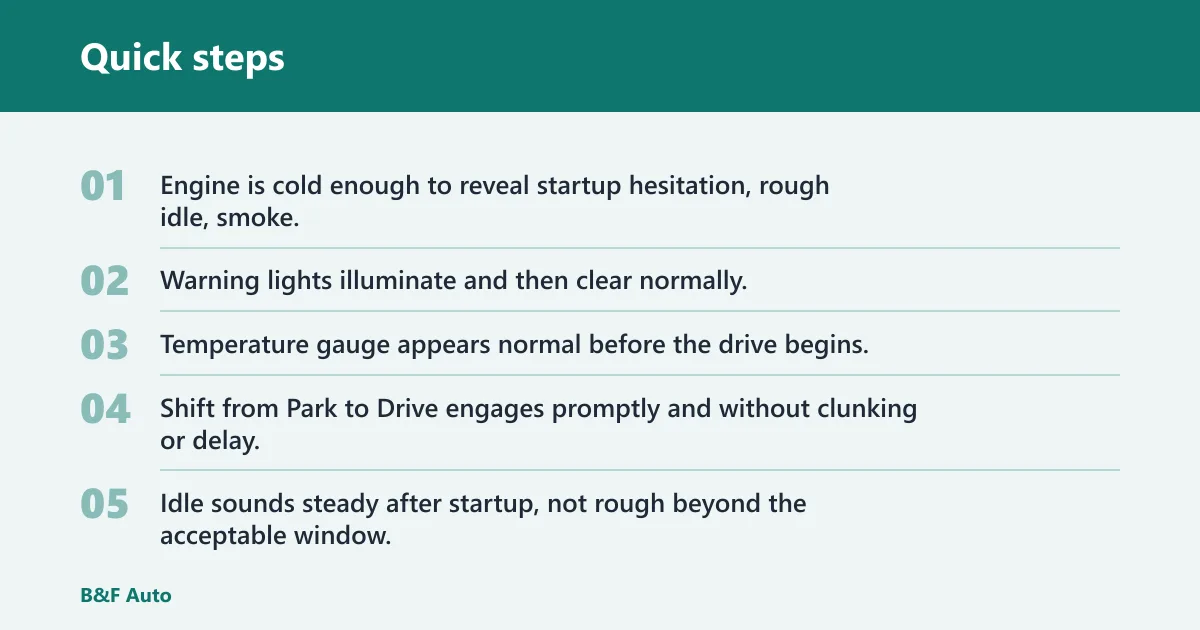
- Engine is cold enough to reveal startup hesitation, rough idle, smoke, or delayed engagement.
- Warning lights illuminate and then clear normally, unless a known issue is already documented.
- Temperature gauge appears normal before the drive begins.
- Shift from Park to Drive engages promptly and without clunking or delay.
- Idle sounds steady after startup, not rough beyond the acceptable window.
What should you check while driving?
While driving, focus on braking, steering, alignment, transmission shifts, noise, vibration, and suspension response. These are the checks that reveal how the car behaves under load, at low speed, and over real pavement, which is where many used-car problems show up.
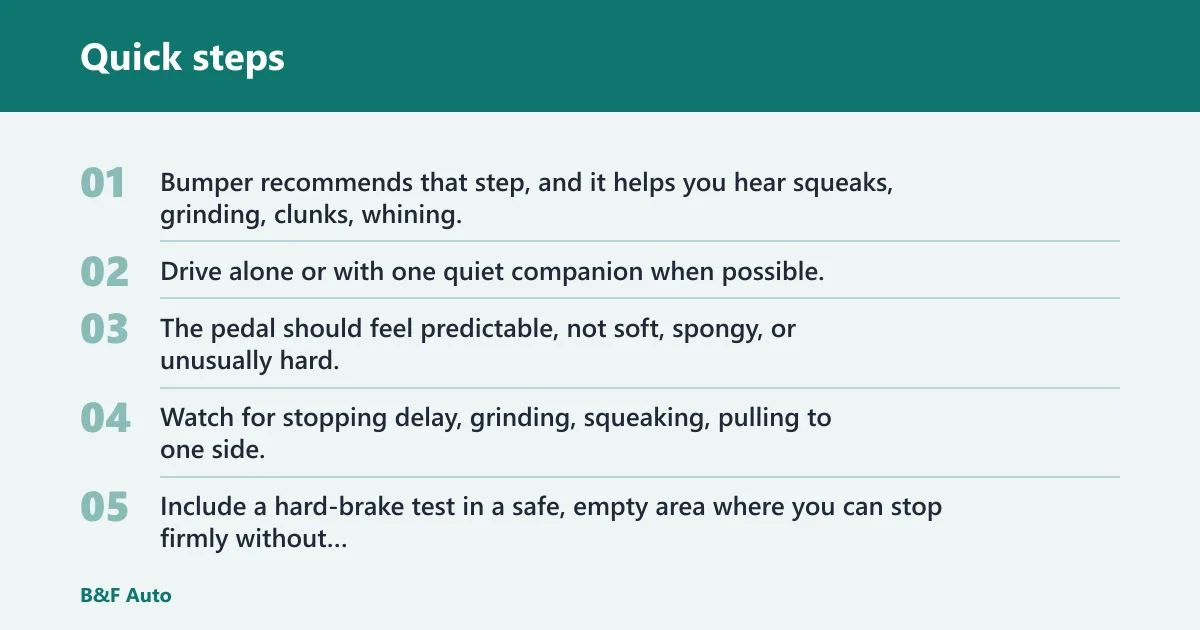
Turn the radio off immediately. The same source recommends that step, and it helps you hear squeaks, grinding, clunks, whining, and other sounds that can disappear under music or conversation. Drive alone or with one quiet companion when possible, and choose your own route instead of the seller’s route.
Braking and hard-stop testing
Check pedal feel first. The pedal should feel predictable, not soft, spongy, or unusually hard. Watch for stopping delay, grinding, squeaking, pulling to one side, or vibration through the pedal or steering wheel.
Include a hard-brake test in a safe, empty area where you can stop firmly without risking other traffic. A hard stop can expose brake fade, vibration, or ABS behavior that a gentle stop may not show.
Use a higher score for any brake noise that repeats, any vibration that shows up under firm pressure, or any pull that makes the car drift out of line during braking.
Steering, alignment, and straight-line tracking
Check for drift, pull, steering resistance, and wheel centering. On a straight road, keep a light grip and see whether the car tracks straight or drifts to one side.
If the wheel sits off-center while the car is moving straight, note it. If the vehicle needs constant correction, that can point to alignment trouble, tire issues, or steering wear.
A common first-timer mistake is to blame a slight pull on road crown and move on. If the pull is strong, repeatable on a flat road, or paired with tire wear or vibration, it deserves a higher score and likely a closer look.
Noise, vibration, and suspension
Listen for clunks, whining, grinding, squeaks, wobble, and seat or steering vibration. These symptoms can point to suspension wear, wheel issues, drivetrain trouble, or a loose component that only shows up in motion.
Then take the car over bumps and uneven pavement. Watch for excessive bounce, knocking, or poor settling after a dip or speed bump. A suspension that keeps moving after the road input ends is not behaving normally.
What should you check at highway speed?
At highway speed, hold a sustained 65–70 mph cruise and watch for vibration, acceleration quality, passing response, and temperature-gauge behavior. This is where wheel balance, drivetrain smoothness, and cooling issues often become easier to spot than they are at low speed.
Bumper uses 65–70 mph as the highway cruise speed to evaluate smoothness, and it says the temperature gauge should stabilize within 5–10 minutes of driving. If the gauge rises above normal or fluctuates, score it as a major concern.
Check how the car accelerates back into speed after slowing for traffic. Delay, rough shifts, slipping, or a surge-and-hunt feeling can point to transmission trouble. If the car shudders only at highway speed, write that down with the speed and road condition.
Say a midsize sedan feels fine around town but develops a steering wheel tremor at 68 mph and the temperature gauge creeps upward after several minutes. That belongs in the notes exactly as it happened, because the speed and the gauge behavior matter as much as the vibration itself.
Highway checklist items
- Hold 65–70 mph long enough to judge smoothness.
- Check for steering wheel, seat, or floor vibration.
- Test acceleration and passing response without harshness or delay.
- Watch the temperature gauge for stable normal behavior after warm-up.
- Note any wandering, pull, or correction needed at speed.
How should you score and note problems?
Use a 0–2 score for each line: 0 means no issue, 1 means minor concern, and 2 means major concern. That keeps the sheet fast to complete and makes it easier to compare one car against another without writing a full report in the driver’s seat.
Write down when the symptom happened, at what speed, and under what load. For example, note whether a noise happened only on turn-in, only under braking, only during hard acceleration, or only at highway speed. Those details matter more than a vague “felt off” note.
A helpful final box can translate the total into action. Low totals point toward buy, a middle range points toward inspect or negotiate, and repeated major concerns should push the result toward walk away.
For dealer test drives, you may have less control over the route and time, so a compact page with clear scoring is especially useful. For private-seller drives, expect more freedom to choose the route and more reason to insist on a cold start before the engine is warmed up.
What to write in the notes box
- Exact symptom: rough idle, clunk, pull, squeak, shudder, vibration, delay, or warning light.
- When it happened: start-up, low speed, braking, cornering, hard acceleration, or highway cruise.
- Speed and load: city pace, 45 mph, 65–70 mph, light throttle, or heavy throttle.
- What it may mean for follow-up: inspect, ask for records, negotiate, or walk away.
Printable test drive checklist PDF
This is the one-page structure the PDF should follow. It keeps the order aligned with a real drive and gives you room to score, note symptoms, and circle a final decision.
One-page PDF preview
| Drive stage | Score | Symptom-to-risk prompt | Outcome threshold |
|---|---|---|---|
| Before driving | □ 0 □ 1 □ 2 | Cold idle, warning light, delayed Drive engagement, smoke | 2 = inspect or walk away |
| City streets | □ 0 □ 1 □ 2 | Brake pull, grind, clunk, drift, off-center wheel | Repeated 2s = negotiate or walk away |
| Highway | □ 0 □ 1 □ 2 | Shudder at speed, vibration, rough shift, wandering, rising temp gauge | Any major highway fault = inspect further |
| After the drive | □ 0 □ 1 □ 2 | Hot-start delay, odor, leak, warning light, repeat fault | Repeat fault = walk away unless documented |
Decision box: buy / inspect / negotiate / walk away
| Section | Checklist line | 0 | 1 | 2 | Notes |
|---|---|---|---|---|---|
| Before driving | Cold start behavior, idle, smoke, warning lights, gauge sweep | □ | □ | □ | |
| Before driving | Park-to-Drive engagement, delay, clunking, rough engagement | □ | □ | □ | |
| City streets | Brake feel, stopping response, grinding, squeaking, vibration | □ | □ | □ | |
| City streets | Hands-light straight-line tracking, drift, pull, steering centering | □ | □ | □ | |
| City streets | Noise, vibration, harshness with radio off; clunks, squeaks, whine | □ | □ | □ | |
| City streets | Suspension over bumps and uneven pavement; bounce, knocking, settling | □ | □ | □ | |
| Highway | 65–70 mph cruise, vibration, acceleration, passing response | □ | □ | □ | |
| Highway | Temperature gauge stable in normal range after warm-up | □ | □ | □ | |
| After the drive | Hot restart, odor, leaks, repeat warning lights, final summary | □ | □ | □ |
Final decision: buy / inspect / negotiate / walk away
Frequently asked questions
What should a test drive checklist PDF include?
used car inspection checklist PDF should include a one-page layout, a drive order that matches real use, a 0–2 score column, symptom prompts, and a final decision box. The page should cover before driving, city streets, highway, and after the drive so you can score the car in a consistent sequence instead of relying on memory.
Should a test drive checklist include highway and braking tests?
Yes. Highway and braking checks belong on the sheet because some problems only show up at speed or under firm stopping force. A proper checklist should include a safe hard-brake test, a sustained 65–70 mph cruise, and notes for vibration, pull, stopping response, and temperature-gauge behavior.
What should I write down during a test drive?
Write down the symptom, the speed, and the condition when it happened. Note whether it appeared at startup, during braking, on a straight road, over bumps, or at highway speed. Those details help a mechanic or inspector narrow the cause and tell the difference between a minor issue and a major one.
How long should a proper test drive be?
Plan for at least 20 minutes, and 30 minutes is a better target for a how long a proper test drive should be. That gives enough time to feel cold-start behavior, city driving, a highway stretch, and the after-drive check. Short loops often miss transmission delays, heat-related issues, and vibration that appears only after the car warms up.
What should I check for in a cold-start test drive?
Check for startup hesitation, rough idle, smoke, warning lights, gauge behavior, and delayed transmission engagement. The engine should be cold enough to expose those symptoms. If rough idle lasts beyond 90 seconds, or if Park-to-Drive engagement takes more than two seconds, that should move the score toward major concern.
What symptoms point to the biggest risks?
Some symptoms are more diagnostic than others. A shudder at highway speed often points toward balance, tire, or driveline issues, while a delayed Drive engagement more often suggests a transmission concern. Treat repeated or speed-specific symptoms as stronger evidence than vague noise alone.
| Symptom | Likely risk | What to do next |
|---|---|---|
| Shudder at 65–70 mph | Wheel balance, tire issue, driveline vibration | Inspect further before buying |
| Delayed Drive engagement | Transmission or fluid-pressure concern | Negotiate or walk away if repeated |
| Pull or drift on a flat road | Alignment, tire wear, steering wear | Check tires and alignment records |
| Grinding under braking | Brake wear or rotor issue | Inspect brakes before purchase |
| Rough idle that lingers | Engine tune, air/fuel, ignition, or vacuum issue | Consider a pre-purchase inspection |
| Temperature gauge rises or fluctuates | Cooling-system concern | Walk away if the issue repeats |
What to check for in a cold-start test drive?
Check for startup hesitation, rough idle, smoke, warning lights, gauge behavior, and delayed transmission engagement. The engine should be cold enough to expose those symptoms. If rough idle lasts beyond 90 seconds, or if Park-to-Drive engagement takes more than two seconds, that should move the score toward major concern.