What Should You Bring on a Test Drive?
Bring your driver’s license, and be ready to show proof of insurance if the seller asks or local rules require it. If you may buy the car today, add proof of address, payment details, and any insurance documents the seller accepts for drive-away paperwork. If you need to judge fit, bring a phone charger, a notes app, and the cargo items that matter in your daily life. This guide separates legal must-haves from same-day purchase paperwork and real-world fit checks for dealership, private-seller, EV, family-car, and trade-in visits.
What you need before the drive
For most test drives, the non-negotiable item is a valid, current driver’s license. Dealer staff and private sellers use it to confirm identity, and you need it to legally operate the vehicle. Proof of insurance may also be requested, but that depends on the seller, the dealership, your insurer, and local rules.
Driver’s license first
Start with the license. If it is expired, suspended, or not accepted by the seller, the drive may stop before it starts. MINI UK says you need your driving license for a test drive, and that basic point carries over to most sales situations: if you cannot legally drive, you cannot evaluate the car on the road.
When proof of insurance matters
Bring insurance policy documents if the dealer or seller asks for them, and check ahead of time if you plan to drive away after buying. Coverage proof can substitute for dealer-arranged temporary insurance in some cases, but that depends on the retailer, the insurer, and local rules. Do not assume the same rule applies everywhere.
- Confirm whether your own policy is enough for a test drive.
- Ask whether the seller offers temporary coverage for same-day purchases.
- Have your policy details accessible on paper or in your phone.
What to ask before you arrive
Ask who can drive, if you can go solo, and what documents they want to see before the keys change hands. That short phone call can save a return trip. It also helps you avoid mixing test-drive paperwork with purchase paperwork, which are often treated differently.
- Can I drive alone?
- Will you need proof of insurance?
- Do you want proof of address if I decide to buy?
- Are there any location-specific documents, such as vehicle tax, that I should prepare?
Test drive packing matrix
This matrix separates the bare minimum from the items that help you make a better call. The first column is about legal or requested documents. The second is for a same-day purchase. The third is for judging whether the car actually fits your daily life.
| Scenario | Must bring to legally drive | Bring if buying the car today | Bring to test real-world fit |
|---|---|---|---|
| Dealership new car | Valid driver’s license; proof of insurance if the dealer asks | Proof of address; payment method; insurance policy documents if you plan to drive home; ask whether vehicle tax or registration steps are location-specific | Phone and charging cable; notes app; set your route to include traffic, parking, and a few rough surfaces |
| Dealership used car | Valid driver’s license; proof of insurance if requested | Proof of address; payment method; insurance policy documents; ask about dealer temporary coverage before arrival; vehicle tax if your location requires it for drive-away paperwork | Phone and charging cable; notes app; friend or second driver; used car inspection checklist for a private sale |
| Private seller | Valid driver’s license; proof of insurance if the seller asks or local rules require it | Proof of address if needed for paperwork; payment method; insurance policy documents if you intend to take the car immediately; vehicle tax if required where you live | Phone and charging cable; notes app; personal cargo items; used car inspection checklist for a private sale |
| EV | Valid driver’s license; proof of insurance if requested | Proof of address if final paperwork is being done; insurance policy documents for drive-away situations; vehicle tax if applicable in your location | Phone and charging cable to test Bluetooth, Apple CarPlay, Android Auto, calls, maps, and music playback; notes app |
| Family car | Valid driver’s license; proof of insurance if requested | Proof of address; payment method; insurance policy documents if you may leave with it; vehicle tax if your location requires it for immediate registration or drive-away | Stroller, child seat, baby gear, sports gear, dog crate, or camping gear; notes app; friend or second driver |
| Trade-in visit | Valid driver’s license | Title, registration, proof of address if the deal closes, and insurance policy documents if you are driving away in a different car; vehicle tax if the transfer process requires it locally | Phone and charging cable; notes app; friend or second driver; personal cargo items if the replacement car will need to fit them |
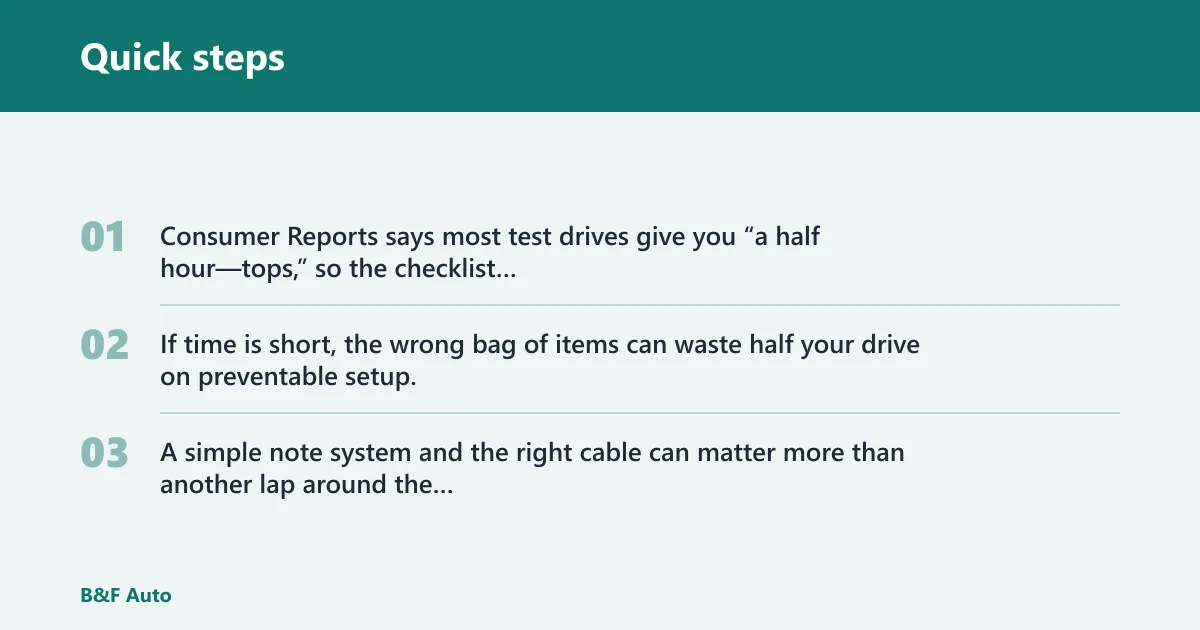
Consumer Reports says most test drives give you “a half hour—tops,” so the checklist matters. If time is short, the wrong bag of items can waste half your drive on preventable setup. A simple note system and the right cable can matter more than another lap around the block. (Consumerreports)
What should you bring if you may buy today?
If the plan includes a same-day purchase, bring more than the basics. You may need proof of address, insurance policy documents, and whatever payment method the seller accepts. In some locations, vehicle tax may be part of the drive-away paperwork, but that is location-specific and should be confirmed in advance rather than assumed.
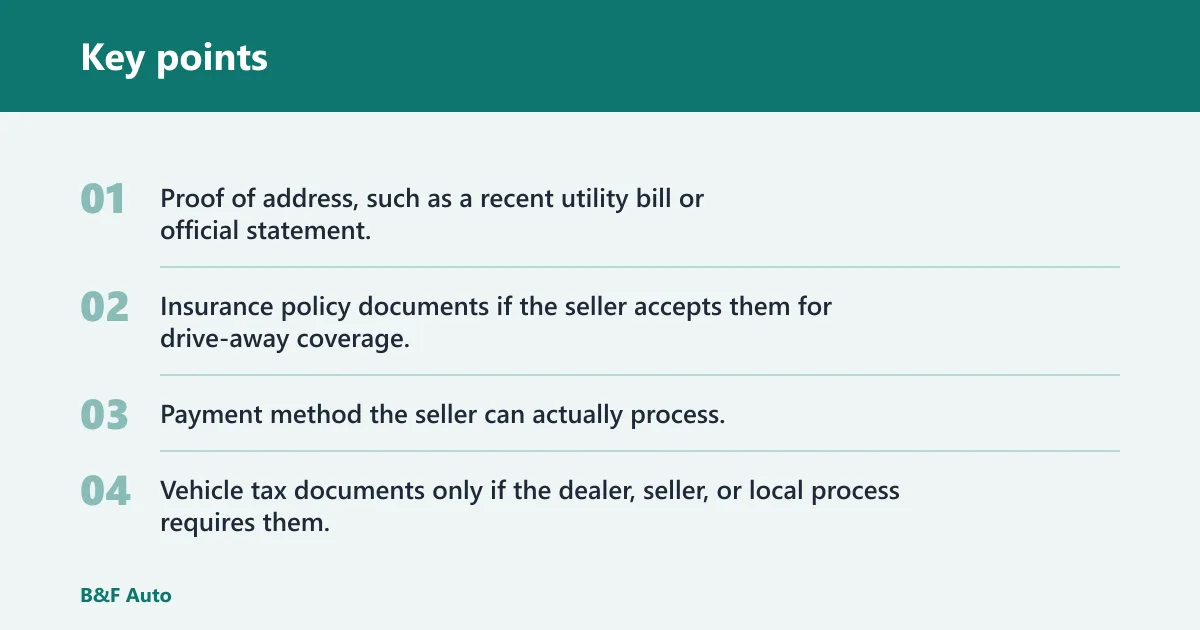
- Proof of address, such as a recent utility bill or official statement.
- Insurance policy documents if the seller accepts them for drive-away coverage.
- Payment method the seller can actually process.
- Vehicle tax documents only if the dealer, seller, or local process requires them.
Proof of address examples
Proof of address can be required to finalize an immediate purchase. Common examples include a utility bill or another official document with your current address. Keep it separate from your license so you can hand it over quickly if the office asks for it.
Insurance documents and temporary coverage
Bring insurance policy documents if the retailer says they are acceptable for same-day drive-away. The same source says insurance policy documents may be needed if you buy and drive home immediately. That is a good reminder to ask whether your own coverage is enough or whether the dealer will arrange temporary insurance.
Paperwork to ask about before you leave
Before you drive to the lot or the seller’s driveway, ask which documents they expect for an on-the-spot purchase. The answer may include identity, insurance proof, how to fill out title transfer paperwork, and a payment method. Do not assume the same bundle applies to both a test drive and a purchase.
Say your dealer says you can take the car home if the financing clears. In that case, the difference between a casual test drive and a completed purchase can be a missing utility bill. One small document can decide whether you leave in the same car or come back another day.
What should you bring to judge tech and comfort?
Bring items that let you check daily use, not just acceleration and brakes. A phone and charging cable help you verify Bluetooth and wired connectivity, including Apple CarPlay or Android Auto where equipped. A notebook or notes app keeps each car’s likes and dislikes in one place so back-to-back comparisons stay clear.
- Phone and charging cable
- Notes app or notebook
- Favorite routes, if you want to compare ride quality across different roads
Phone and charging cable
The same source says to connect your phone with both cable and Bluetooth. That lets you test calls, maps, and music playback, and it helps you see whether the infotainment system behaves the way you expect. If the car has Apple CarPlay or Android Auto, confirm that your phone works the way the seller claims.
Notes app or notebook
A checklist notebook or notes app can be used to record seat comfort, button placement, and visibility. The same source recommends scheduling test drives back-to-back for easier comparison, and notes make that comparison less fuzzy. Without written notes, cars start to blend together fast.
A route that matches your commute
Pick a route with the kind of roads you actually drive. Consumer Reports advises driving at least 30 minutes when possible and checking different road surfaces, including speed bumps and rutted parking lots. That gives you a better read on ride quality, parking, and low-speed control than a short spin around the block.
Carwow advises using the drive to test the features you will actually live with. That means trying the buttons, steering-wheel controls, climate system, and seat adjustments, not just the accelerator and brakes.
What should you bring to check real-world fit?
Bring the things the car has to carry in ordinary life. A stroller, a child seat, sports gear, a dog crate, or camping gear will tell you more about storage and access than an empty trunk. Consumer Reports specifically recommends bringing items you frequently carry, like a dog crate or stroller.
- Stroller or child seat
- Baby gear or daily-family items
- Sports gear, dog crate, or camping gear
- Personal cargo items you regularly load and unload
Stroller, child seat, or baby gear
If you have a child seat or baby stroller, bring it along. That lets you check rear-seat access, latch points, legroom, and whether the stroller fits without turning the cargo area into a puzzle. For a family car, this is one of the most useful checks you can make.
Sports gear, dog crate, or camping gear
Different cargo tells you different things. Sports gear checks long, awkward shapes. A dog crate checks height and floor space. Camping gear can show whether the rear opening, load floor, and folded seats actually work for the trips you take most often.
How to test storage and seat folding
Load the item, close the hatch or trunk, and see what remains usable. Then fold the seats the way you would at home and check whether the floor stays flat enough for your use. A car can look roomy until a stroller handle or crate edge shows otherwise.
Suppose a hatchback looks fine until your folded stroller stops the cargo cover from closing. That is the kind of problem a test drive should catch. The car may still be the right choice, but you want to know before you sign paperwork.
Should you bring a friend or family member?
Yes, if you can. A friend or second driver helps you stay focused, can compare the seating position from another angle, and can handle conversation if the salesperson is still in the car. The same source says to bring a friend on the test drive, and that advice is especially useful when you are comparing two or three vehicles in one day.
Second driver benefits
A second driver can notice mirrors, seat height, and rear visibility from a different body position. That matters when you are trying to decide whether the car works for more than one regular driver. It also helps if you want a calmer, more organized review of what changed from one car to the next.
Bringing kids or a baby seat
Bring kids only if you need to test the car as a family vehicle and the seller is comfortable with it. A child seat is often more useful than the child alone, because it lets you check installation and access without turning the drive into a distraction. Keep the focus on fit and safety, not entertainment.
When to skip extra passengers
Skip extra passengers if the route is short, the seller has limited space, or you need to judge a vehicle alone first. Too many people can blur the result. If the goal is to compare driving position, comfort, and control layout, fewer voices usually make the answer clearer.
What should you bring if you want to test drive a used car?
Used-car test drives deserve more caution than new-car drives. Carwow says used-car test drives require more rigour than new-car test drives, and that means you should bring your documents, your phone, and a used car inspection checklist for a private sale of things you want to verify. The goal is to spot wear, mismatched expectations, and missing paperwork before money changes hands.
Extra caution with paperwork
For a used car, confirm the seller’s expectations before meeting. Ask whether they want proof of insurance, whether you can drive solo, and what paperwork will be needed if you decide to buy. That reduces confusion if the vehicle condition looks right but the paperwork is incomplete.
What to confirm before meeting
Ask how long the drive can be, whether you can take a route that includes parking and stop-and-go traffic, and whether a second driver is allowed. A used car should get a more complete check than a quick loop around the block, especially if the odometer or trim level makes the car a closer fit than it first appears.
What to record during the drive
Write down steering feel, brake response, seat comfort, visibility, and any warning lights or noises you notice. That way, a used car with a quieter cabin does not win simply because the last car felt louder for unrelated reasons. Notes also help you remember which car had the better seat or the easier controls.
Test drive vs. driver’s test
A test drive is for evaluating a car you may buy. A driver’s test is for proving you can legally earn a license. The terms sound similar, but the goals are different, so the packing list is different too. Use the answers below if you landed here looking for licensing exam help instead of car-shopping advice.
What should I bring to a driver’s test?
Bring the documents your licensing office requires, which usually means identification, any permit or appointment paperwork, and any required glasses or corrective lenses if your license process calls for them. Check the official rules for your location before you go, because driver’s test paperwork varies by state or country.
Do I need my driver’s license for a driver’s test?
Not usually as a full license, since the purpose of the exam is to earn that license. What you typically need is the permit, identification, and any required test appointment papers. Because requirements differ by jurisdiction, confirm the exact list with your licensing authority before the exam day.
What should you bring on a test drive?
Bring your driver’s license first, then add the documents and items that match your situation. For many shoppers, that means proof of insurance, a phone charger, and a note app. If you might buy today, add proof of address and confirm the payment and insurance paperwork before you leave.
- Valid driver’s license
- Proof of insurance or insurance policy documents, if requested
- Proof of address, if buying today
- Phone and charging cable
- Notes app or notebook
- Friend or second driver, if helpful
- Personal cargo items, if you need to check fit
Frequently asked questions
What do I need to bring for a test drive?
Bring a valid, current driver’s license first. Add proof of insurance if the dealer or seller asks for it, plus a phone and charging cable if you want to test Bluetooth or wired phone features. If you are shopping for a family car, bring the cargo items that matter in your daily life.
Do I need my driver’s license for a test drive?
Yes. You need a valid driver’s license to legally operate the vehicle, and MINI UK specifically says you need your driving license for a test drive. If your license is expired or unavailable, the drive may not happen, even if the car is otherwise ready to go.
Should I bring my insurance documents to a test drive?
Sometimes. Proof of insurance may be requested by the dealer or seller, and it can matter more if you might drive home after buying. Requirements vary by dealer, seller, insurer, and location, so confirm ahead of time instead of assuming your policy document will always be enough.
Can I bring a friend on a test drive?
Yes, and Consumer Reports recommends it. A friend or second driver can help you compare vehicles back-to-back, check visibility from another seating position, and keep the conversation moving if the salesperson is present. That extra set of eyes is especially useful on a long comparison day.
Can I bring my kids or baby on a test drive?
You can if the seller agrees and the situation makes sense, but a child seat is often more useful than bringing the child. That lets you check installation, rear access, and space without adding distractions. For a family vehicle, a stroller or baby gear can tell you even more.
What should I bring if I’m test driving a private seller’s car?
Bring your driver’s license, and ask ahead of time whether the seller wants proof of insurance or any other documents. A private sale can be more flexible than a dealership visit, but it can also be less scripted. Bring your phone, notes, and any cargo item you need to fit.