How Long Does a Lost Car Title Replacement Take?
A lost car title replacement usually takes about 1 to 6 weeks, depending on when the issuing agency accepts the filing, how long it takes to process and print the duplicate, and how long mail delivery adds after that. In the usual sequence, the request is filed, the DMV/BMV/title office accepts it, the agency processes and prints the title, and then it is mailed. Most drivers: about 2–6 weeks after acceptance, then mail time. If the title is missing when you need it, a sale, trade-in, or registration renewal can stall. This guide breaks the timeline into those steps so you can estimate arrival more accurately.
Lost title timeline at a glance
The issuing state’s DMV, BMV, or title office handles the replacement. In many states, duplicate title processing time falls in the two to six weeks range after the request is accepted and paid, then mail time can add extra days or weeks. Online filing is usually the fastest option where it exists.
Mail-in requests usually take longer because they add manual handling and postal transit. Some states offer express service for an additional cost, and some set extra eligibility rules for online filing, such as vehicle age or lien status. That means the same request can move quickly in one state and slowly in another. For example, Maine says online replacement is the fastest method and lists online replacement copies as arriving within 10 business days, while Nevada does not allow online replacement title requests. Maine BMV Nevada DMV
What do you need before you file?
Have the state form, your identity documents, any lien paperwork, and the filing fee ready before you send anything. Most delays start with missing details, not with printing.
- Application for Duplicate Title or the state’s equivalent form
- Driver license or other proof of identity
- Current registration, if your state asks for it
- Lien release, if a lender is listed on the title record
- Payment for the replacement-title fee
- Mailing address or return envelope, if required
- Notarization, if your state requires a signed and notarized form
- Confirm the issuing state. File with the state that issued the original title, not the state where you now live. That agency controls the duplicate record and decides which filing methods are allowed.
- Gather the required documents. Complete the Application for Duplicate Title carefully and attach identity, registration, and lien paperwork if the state asks for them. If the form needs notarization, sign it in front of the notary before you send it.
- Choose the fastest allowed method. Use online filing if your state allows it and you qualify. If online filing is not available, mail or in-person filing are the next options, but both usually take longer than online submission.
- Pay the fee correctly. Include the state fee when you file. Duplicate-title fees vary by state, and some processing fees are non-refundable even if the request is delayed or rejected for missing information.
- Track the mailing address. Use the address on file or the approved mailing address the state accepts. A wrong, incomplete, or out-of-state address can slow delivery even after the title is printed.
Where do you apply for a duplicate title?
Apply through the state agency that issued the original title, usually the DMV, BMV, or title office. Some states let you file online, some accept mail, and some also take in-person requests. The best choice depends on what the state allows for your vehicle and ownership type.
Maine says online replacement is the fastest method, and online replacement title copies arrive within 10 business days. Maine also limits online replacement to certain applicants and requires a valid driver’s license and a credit or debit card. Nevada does not allow online replacement title requests, but it does allow in-person or mail requests. Maine BMV duplicate title Nevada DMV duplicate title
Texas allows replacement title filing by mail or in person at different costs. Alaska allows replacement by in person or by mail, and mail requests require a notarized signature. Texas DMV duplicate title Alaska DMV title replacement
How does the lost title timeline calculator work?
This table gives a practical arrival estimate by splitting the process into filing method, agency processing, and mail time. Use it to judge best case, normal case, and delay case without guessing.
| Filing method | Typical agency processing window | Expected total wait including mail time |
|---|---|---|
| Online, where allowed | Two to six weeks after the request is processed and paid | About two to six weeks, plus a few extra days for mailing; Maine lists 10 business days for online replacement copies |
| In person | Two to six weeks after acceptance, unless the state offers an express option | Usually two to six weeks, with mail time added if the title is not issued over the counter |
| Two to six weeks after the state receives and accepts the packet | Often longer than online or in-person filing because postal transit adds extra days or weeks | |
| Express service, where offered | Shorter than standard processing, but only in some states | Faster than standard service, though the exact total depends on the state’s rules and mail delivery |
How long does replacement take?
For most drivers, the answer is two to six weeks after the request is processed and paid, with mailing time on top of that. If your state offers online filing and you qualify, that is often the fastest path. If you file by mail, expect the longer end of the range because the state still has to open, verify, print, and post the title.
Best case is a state with online filing, complete paperwork, and a clean record. Normal case is a standard duplicate-title request that moves through intake, printing, and postal delivery without errors. Delay case is a request that needs a lien release, correction, or extra identity check.
Say your state prints the title in the standard two to six weeks, and the mailing step adds another week. That puts the total wait closer to the middle of the range than the best case, even though the office processed it on time. For a loan payoff or title transfer deadline, the timeline details matter as much as the processing queue, especially when a lien release is involved.
What affects how fast a duplicate title is issued?
Processing speed depends on the state, the filing method, and whether the record is clean. A lien on the title, a missing signature, a notarization requirement, or a wrong mailing address can stop the request from moving forward. Online eligibility also varies by state, vehicle age, lien status, and owner type.
Can you speed up the request?
Start with the fastest method your state allows. If online filing is available and you qualify, use it; if not, file in person if your state permits that option and you need the shortest route. Some states offer express service for an additional cost, but it is not available everywhere.
- Check online eligibility. Review the state title office’s filing rules before you submit anything. Maine, for example, allows online replacement only for certain vehicles and applicants, while Nevada does not allow online replacement title requests at all.
- Submit a complete packet. Include the form, fee, identity document, and any lien release in one filing. A complete first submission avoids a second round of review.
- Ask about express options. If your state offers express service, choose it when the title is needed for a sale, trade-in, or deadline. That extra fee can reduce waiting time compared with standard processing.
Suppose you need the title for a dealer payoff deadline. An in-person filing with a complete packet is often a better choice than mailing the form and waiting for postal transit to add another layer of delay.
Common delays to avoid
The slowdowns below are the ones that most often stretch a routine replacement into a much longer wait. Check them before filing, then check them again if the request seems stuck.
| Delay trigger | What slows the request | How to avoid it |
|---|---|---|
| Lien release | The agency may need a lien release before it can issue the duplicate title | Get the release from the lender before you file; some states want the original |
| Notarization | Unsigned or improperly notarized forms stop mail requests in some states | Sign where required and use a notary if the state asks for one |
| Wrong address | The title can be printed, then delayed in the mail | Use the address on file or the approved mailing address, and verify every line |
| Missing ID | The office may hold the request until identity is verified | Include the requested driver license copy or other proof of identity |
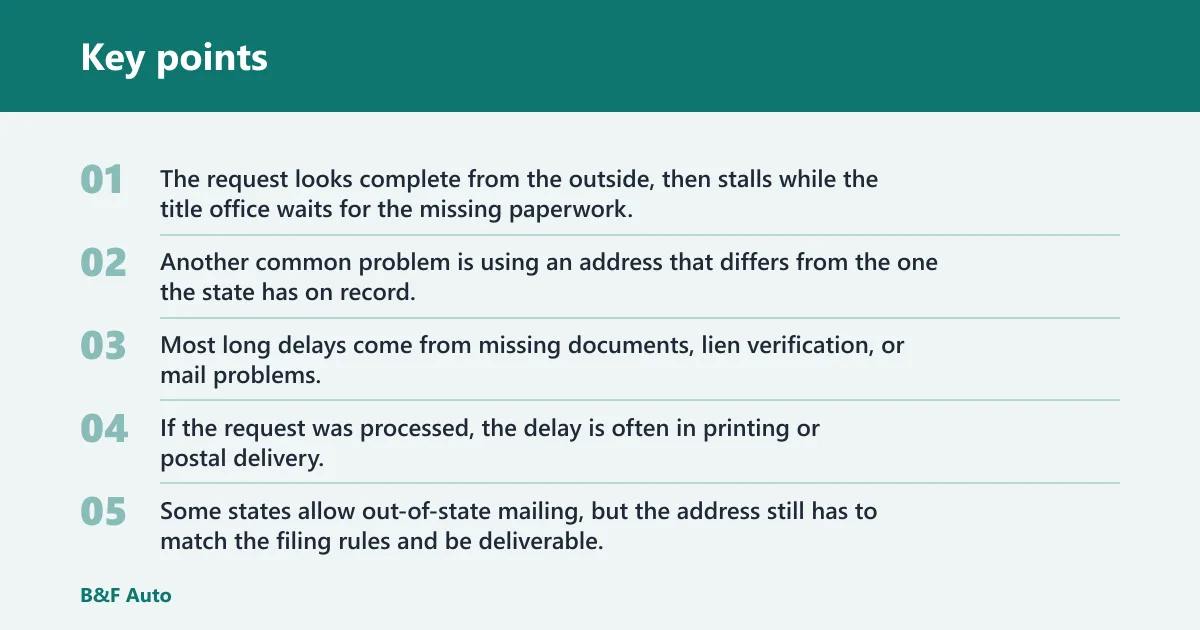
A common first-timer mistake is submitting the replacement application before checking whether the lender has already cleared the loan record, which can add days or weeks to the wait. The request looks complete from the outside, then stalls while the title office waits for the missing paperwork.
Another common problem is using an address that differs from the one the state has on record. That can be fine in some states, but in others it creates an extra review step or sends the title to the wrong place.
Why is my replacement title taking longer than expected?
Most long delays come from missing documents, lien verification, or mail problems. If the state says the request was received but not processed, check for a missing signature, notarization issue, incomplete fee payment, or a lien release that never arrived. If the request was processed, the delay is often in printing or postal delivery.
Does an out-of-state mailing address delay a title replacement?
It can. Some states allow out-of-state mailing, but the address still has to match the filing rules and be deliverable. If the address is wrong, incomplete, or not accepted for that filing type, the title can sit after printing until the issue is corrected.
How long does it take to get a replacement car title in the mail?
Mail time is added after the state prints the duplicate title. In a clean case, that may be only a few extra days, but postal delivery can stretch longer if the address is out of state or entered incorrectly. That is why the total wait can exceed the agency’s internal processing window.
Frequently asked questions
How long does it take to get a lost car title replaced?
Plan on 1 to 6 weeks in many cases, with two to six weeks after the request is processed and paid being the most common duplicate-title window. Add mailing time if the title is sent by post. State rules, filing method, and document accuracy can move that estimate up or down.
How long does it take to get a replacement car title?
The usual answer is two to six weeks for processing, then extra time for delivery. If your state offers online filing and you qualify, the wait can be shorter. If the request needs a lien release, notarization, or correction, the timeline can run longer than the standard range.
How long does it take to get a replacement title?
It depends on the state agency, but the practical estimate is still two to six weeks after the request is accepted and paid. The title office may finish printing before the mail gets there, so do not use the processing window alone to judge when the paper will arrive.
Can I speed up a lost title replacement?
Yes, if your state offers faster service or online filing. File the correct form, pay the fee, include any required lien release, and choose the quickest allowed method. The same source says online replacement is the fastest method there, while some states offer express service for an additional cost.