Does It Cost Money to Donate a Nonrunning Car?
Usually no: donating a nonrunning car is often free for the donor, but title-transfer, duplicate-title, or special pickup fees can apply if the program does not cover them. IRS rules also matter if you want a tax deduction: it is only potentially available when you itemize and keep the required acknowledgement and documentation.
Does it cost money to donate a nonrunning car?
Usually, no. Many programs include pickup, and the donor pays nothing when the title is clear and the vehicle is easy to reach. Costs can still appear if paperwork is missing, access is difficult, or the program’s rules shift a charge to the donor.
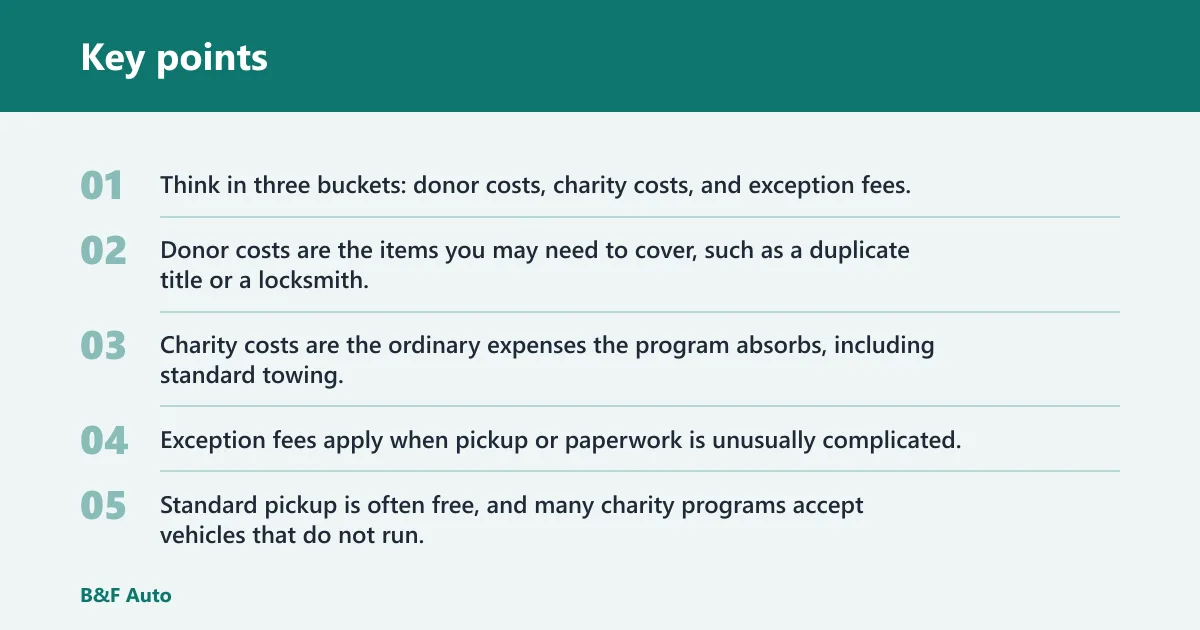
Think in three buckets: donor costs, charity costs, and exception fees. Donor costs are the items you may need to cover, such as a duplicate title or a locksmith. Charity costs are the ordinary expenses the program absorbs, including standard towing. Exception fees apply when pickup or paperwork is unusually complicated.
When the donation is usually free
Standard pickup is often free, and many charity programs accept vehicles that do not run. For example, Habitat for Humanity’s car donation process explains that donors can start online or by phone, and Habitat for Humanity’s car donation process also notes that nonrunning vehicles may be accepted through its vehicle donation program.
That means the typical donor cost is $0 when the title is in order, pickup is accessible, and the program’s normal towing rules apply. In that common scenario, the charity or its contractor handles standard removal and the donor only completes the required transfer steps.
When a fee can still happen
Fees can appear when the car cannot be loaded normally, when paperwork is incomplete, or when state rules require extra documents. A nonrunning car may still be accepted, but missing title paperwork can slow or block transfer, and locked gates, snowbanks, or other access issues can change the cost.
For example, a sedan that will not start but sits in an open driveway is often the easiest case. If the same car is behind a locked fence and there is no key or access code, the pickup can become more complex and may trigger a charge or delay.
Donor cost checklist
Use this checklist to separate typical donor costs from program-covered costs. The last column shows how to avoid the expense, and the typical scenario is $0 donor cost when title is clear and pickup is accessible.
| Possible expense | Who usually pays | When it can occur | How to avoid this cost |
|---|---|---|---|
| Towing | Usually the charity or its contractor | Standard pickup when the program includes free vehicle pickup | Confirm free pickup before scheduling and keep the car reachable |
| Title replacement | Usually the donor | When the original title is lost or unreadable and the state requires a duplicate | Locate the title before intake or ask about replacement title steps early |
| Lien release | Usually the donor, sometimes the lender handles it | When a lender still holds an interest and paperwork must be cleared | Verify lien status before scheduling and obtain release paperwork first |
| Duplicate key | Usually the donor | When the vehicle cannot be accessed or moved without a key | Have the key available or confirm whether the program can tow without it |
| Battery jump or boost | Usually the program, but sometimes the donor if required on site | When a tow driver needs the car to start briefly for loading or shifting | Tell the intake team whether the battery is dead and whether a boost may be needed |
| Inaccessible pickup location | Usually the donor if the access issue is fixable | When the car is blocked, fenced in, buried, or otherwise hard to reach | Move the vehicle to an open area if possible before pickup |
| Special equipment fees | Sometimes the donor | When the vehicle needs a winch, flatbed, dollies, or another special setup | Describe the condition accurately so the program can quote the right tow |
| Typical donor cost case | $0 | When title is clear and pickup is accessible | Keep paperwork ready and place the car where the tow truck can reach it |
Is car donation pickup free for a nonrunning vehicle?
Often yes. Many vehicle donation programs include towing at no charge, but that is market- and program-dependent rather than universal. The best way to avoid surprise charges is to confirm whether pickup is free and whether your location falls inside the program’s normal service area.
Check two details before scheduling: whether towing is included at no charge and whether the pickup location matches the program’s coverage. If the car is outside the route or needs unusual handling, the program may still accept it but quote a charge tied to the pickup condition.
How pickup is usually arranged
-
Submit the vehicle details.
Use the web form or call the toll-free number, then enter the make, model, year if requested, the vehicle type, title status, and whether it runs. That intake information helps the program decide whether it can accept the car and what truck it needs. -
Choose a pickup window.
The program or contractor schedules a time that fits the route. Some services market pickup in 24 hours, but timing depends on local volume, weekday versus weekend pickup, and whether the car is easy to reach. -
Prepare the handoff.
Leave the keys, signed paperwork, and any requested documents in the agreed place. If no-contact pickup is offered, the handoff can happen without direct contact, which is useful when the car is parked in a driveway or curbside space.
Pickup with no-contact options
Some donation programs offer no-contact pickup options. That means the tow process can happen without a face-to-face handoff, which may be useful if the donor cannot be present. Confirm where to leave the key, title, and release paperwork before the tow arrives.
Will a charity tow a car that doesn’t run?
Often yes. A nonrunning vehicle can still be accepted, including a car with an engine that will not start. Some programs can even arrange a brief boost if the vehicle only needs to move onto the truck. Acceptance still depends on condition, title status, and local rules.
A dead battery is different from seized wheels or missing parts. If the car will not start but can roll and steer, pickup is usually simpler. If the wheels are locked, the steering is damaged, or the vehicle is stuck in soft ground, the tow contractor may need special equipment.
Accepted vehicle types
- Cars
- Trucks
- Boats
- RVs
- Motorcycles
- Other vehicles
Do not assume every program takes every type in every location. Acceptance can vary by local contractor, condition, and paperwork. A motorcycle without a title may be treated very differently from an SUV with a clean title and flat tires.
Damage and missing parts
Major damage or missing parts do not automatically rule out donation. A vehicle with body damage, missing trim, or a nonworking engine may still qualify. The key question is whether it can be identified, loaded, and transferred under the program’s rules. Missing keys, stripped wheels, or a destroyed frame can change the answer.
For example, a pickup with no battery, a cracked windshield, and a flat rear tire may still be acceptable if it can be towed safely. If both front wheels are gone, the donor may still get an offer, but the pickup can require extra equipment and may come with an added fee.
Can I donate a nonrunning car if I don’t have the title?
Maybe. Some programs screen title status during intake, and a missing title can affect acceptance. In some states, a replacement title or other ownership proof may keep the donation moving, but the donor may need to pay for paperwork and wait for the state process to finish.
Title status during intake
Be ready to answer yes or no when the form asks whether you have the title. Kars4Kids asks whether the donor has the title, and it also asks whether the vehicle runs. That kind of screening helps the program decide whether the car can be accepted and how to schedule the pickup.
Missing title and replacement issues
If the title is missing, you may need a duplicate title from the state before pickup or before the transfer can close. That can mean a fee at the motor vehicle office, plus time spent waiting for the replacement. The charity may accept the car conditionally, but the paperwork still has to clear.
Lien release basics
If a lender still has a lien on the vehicle, you may need a lien release before donation can move forward. That release proves the donor has the right to transfer the vehicle. When a lien is unresolved, the charity may delay acceptance or ask the donor to fix the title record first.
What happens after pickup?
After pickup, the vehicle is typically sold, and the proceeds support the charity’s mission. The donor does not receive the sale proceeds directly. Instead, the charity uses the sale value to fund its work, then sends an acknowledgement after the vehicle is sold and processed.
This is where donation value and donor expense are easy to confuse. The sale proceeds belong to the charity, while your out-of-pocket costs are separate. A car can sell for one amount, generate a tax paper trail, and still cost you $0 if pickup and paperwork were covered.
Sale and acknowledgement timing
After sale, donors receive an acknowledgement letter with sale information. That letter matters because tax records usually depend on what happened to the vehicle after it left your possession. WHYY says the program will take care of the rest after you submit the form or call, which matches the common post-pickup process.
Can you get a tax deduction for a nonrunning car donation?
Possibly, but only if your tax situation qualifies. Under IRS rules, a deduction is only potentially available if you itemize and keep the required documentation; the car being nonrunning does not by itself create a deduction. After sale, the charity sends an acknowledgement letter, and additional IRS forms may be required.
The same source says donors can receive a tax deduction when they itemize their return. Kars4Kids frames car donation as tax deductible, but the deduction still depends on the rules that apply to your return. A receipt is not the same thing as a guaranteed deduction amount.
Itemizing and IRS forms
If you claim the standard deduction, a charitable vehicle gift may not change your federal return. If you itemize, keep the acknowledgement letter and any required IRS forms. The IRS explains that vehicle donations can require specific documentation, especially when the sale value and deduction rules trigger additional reporting.
Sale value versus donor cost
The car’s sale value is not the same as your deduction, and neither one is the same as what you paid out of pocket. A donor can owe nothing for pickup and still have a deduction issue tied to the final sale. The reverse can also happen if a title replacement or towing issue creates a fee.
How do I arrange pickup for a car that won’t start?
Start with the program’s intake form or toll-free phone line, then give the vehicle details, condition, and title status. Most programs can route the right tow truck from that information alone. If the car won’t start, mention whether it rolls, steers, and has the key, because those details affect pickup planning.
-
Gather the paperwork.
Find the title, registration if requested, and any lien release. If the title is missing, ask whether the program can still proceed or whether you need a replacement first. -
Describe the condition clearly.
Tell the intake team whether the engine starts, whether the battery is dead, and whether the car has missing parts or locked wheels. Accurate details reduce the chance of an added charge or a failed pickup. -
Confirm the pickup method.
Ask whether the pickup is free, whether no-contact handoff is available, and whether a boost or special equipment might be needed. If any extra fee is possible, get that answer before the tow is scheduled.
Frequently asked questions
What fees, if any, come with donating a junk car?
The common fees are title replacement, locksmith work, lien release paperwork, or special towing conditions. A junk car can still be accepted, but if it is blocked in, missing keys, or needs a winch or dollies, you may face a charge.
How fast can a donated nonrunning car be picked up?
Pickup timing varies by program and location. Some services market pickup in 24 hours, while others need more time because of route planning or local demand. If the car is easy to access and the paperwork is ready, pickup is usually faster than when access or title issues remain.