
How to Replace a Lost Car Title: State DMV Steps
To replace a lost car title quickly, apply through the state motor vehicle agency that last issued the title if you own the car outright. If there’s a lien, an inheritance, or an out-of-state move, you usually need extra proof. Missing the right documents can trigger rejection, delays, or a title that cannot be used for sale or registration. This guide shows the fastest legal path for each situation and the paperwork that keeps your application moving.
Which replacement-title path applies to you?
| Ownership status | Required documents | Filing channel | Likely mailing destination | Common rejection risk |
|---|---|---|---|---|
| No lien | Duplicate title application, government-issued photo ID, current vehicle registration or plate info, VIN, title number if known | Online, mail, or in person if your state allows it | Owner, unless the state mails all duplicate titles to a central record address | Missing signature, no VIN, wrong title number, or filing with the wrong state |
| Active lien | Duplicate title application, ID, VIN, registration, lender authorization if required | Usually through the issuing state DMV; some states route the duplicate to the lender | Often the lienholder or lender first | Applying as if the title were owner-held when the lender still has a security interest |
| Paid-off lien | Duplicate title application, ID, lien release, and sometimes the payoff letter or original release copy | Mail or in person, depending on state rules | Owner, after the lien release is accepted | No lien release, stale payoff record, or mismatch between release and DMV records |
| Out-of-state move | Duplicate title application, ID, VIN, registration, and proof of the issuing state if known | Issue through the state that last titled the vehicle, not the new state | Address on the issuing-state record | Filing in the current state instead of the state that issued the title |
| Missing registration | Duplicate title application, ID, VIN, plate number if available, and any insurance or tax record the DMV accepts | Mail or in person, with extra record search if needed | Owner or lender, depending on lien status | Insufficient ownership proof when registration is gone and the title is missing too |
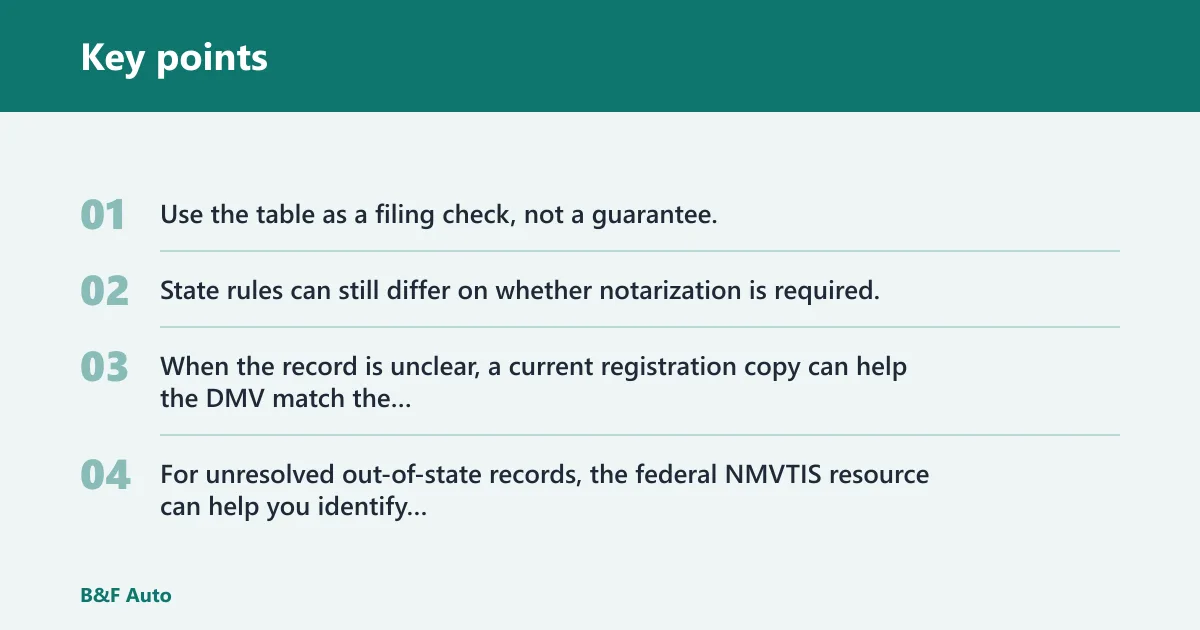
Use the table as a filing check, not a guarantee. State rules can still differ on whether notarization is required, whether a duplicate title is mailed to a lienholder first, and whether you must file with the last title-issuing state rather than the state where the car is currently parked. When the record is unclear, a current registration copy can help the DMV match the vehicle file, but the issuing-state rule still controls. For unresolved out-of-state records, the federal NMVTIS resource can help you identify the last titled state before you file: https://www.vehiclehistory.gov/nmvtis_vehiclehistory.html.
Lost title replacement steps
The fastest legal route is to file with the state’s motor vehicle department that last issued the title, not the state where the car is parked now. A title proves ownership, and the duplicate follows the issuing state’s record. That is why a move, a lien, or missing registration changes the document list and the filing channel. For state instructions, use the issuing agency’s current duplicate-title page and form instructions before you submit anything. Texas: https://www.txdmv.gov/motorists/buying-or-selling-a-vehicle/get-a-copy-of-my-title and form VTR-34, https://www.txdmv.gov/sites/default/files/form_files/VTR-34.pdf. Georgia: https://dor.georgia.gov/motor-vehicle-titles and form MV-1, https://dor.georgia.gov/document/form/mv-1-dor-motor-vehicle-titletag-application/download. Florida: https://www.flhsmv.gov/motor-vehicles-tags-titles/titles/ and form HSMV 82101, https://www.flhsmv.gov/pdf/forms/82101.pdf. California: https://www.dmv.ca.gov/portal/vehicle-registration/titles/title-transfers-and-changes/ and form REG 227, https://www.dmv.ca.gov/portal/file/application-for-duplicate-or-paperless-title-reg-227-pdf/.
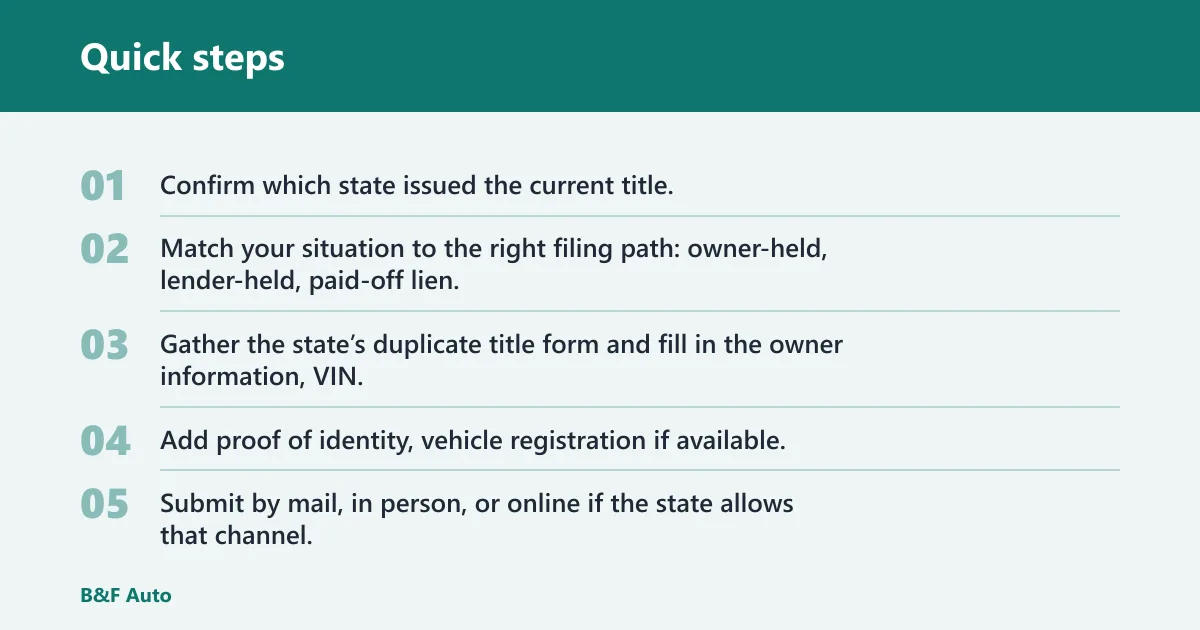
- Confirm which state issued the current title.
- Match your situation to the right filing path: owner-held, lender-held, paid-off lien, moved states, or missing registration.
- Gather the state’s duplicate title form and fill in the owner information, VIN, license plate, title number if known, reason for replacement, and any signature or notarization the form asks for.
- Add proof of identity, vehicle registration if available, and lien release or lender authorization when needed.
- Submit by mail, in person, or online if the state allows that channel.
- Pay the replacement fee and keep the receipt or confirmation number.
- Wait for processing and mailing, then verify the duplicate title details as soon as it arrives.
Say your title was issued in Georgia, but you now live in Texas and only have a current Texas registration copy. The issuing state still matters. The duplicate has to come from Georgia unless your record search shows a different last-titled state. If you are unsure, verify the last title-issuing state before mailing anything.
What you’ll need
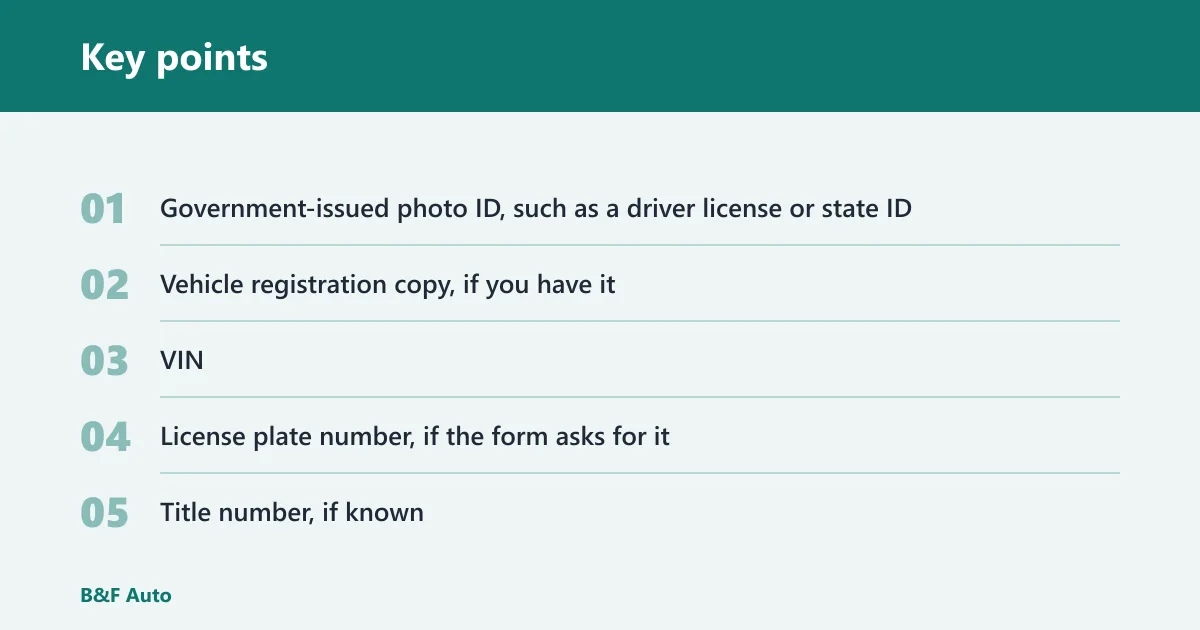
- Government-issued photo ID, such as a driver license or state ID
- Vehicle registration copy, if you have it
- VIN
- License plate number, if the form asks for it
- Title number, if known
- Duplicate title application form from the issuing state
- Lien release or lender authorization, if the vehicle was financed
- Payment for the replacement fee, in the method the DMV accepts
- Notarization, if the state form requires it
Identity and ownership proof
A government-issued photo ID is standard. Many states also ask for a current registration copy because it helps the DMV match the vehicle record to the applicant. If registration is missing, the state may ask for another ownership record or a record search before it accepts the request. Check the issuing state’s duplicate-title instructions so you know whether a copy of the registration is enough or whether the agency wants an original, a certified record, or an additional form.
Vehicle identifiers the DMV uses to match records
The VIN is the main identifier when the title is missing. The DMV may also ask for the plate number and, if known, the old title number. Those details cut down record mismatches, especially when names have changed or the vehicle has moved across states.
Extra paperwork for lien or out-of-state cases
If the car has an active lien, the lender may need to authorize the request or receive the duplicate title. If the lien was paid off, include the lien release. If the vehicle moved from another state, use that state’s record if it still issued the last title, and consider an NMVTIS title inquiry to identify the issuing state when the paperwork is unclear. If your state requires a notarized signature on the title paperwork, the notary step is part of the filing package and can cause rejection if it is skipped.
How do you replace a lost car title?
Start with the state DMV or motor vehicle department that issued the title. Complete that state’s duplicate title application, then file online, by mail, or in person if the state offers those channels. Fees and filing methods vary by state and by filing method, so verify the current instructions before you send payment. Texas, for example, publishes current duplicate-title instructions and a state form; Georgia, Florida, and California do the same on their official title pages and form PDFs.
Use the issuing state’s DMV or motor vehicle department
Duplicate titles must come from the state that issued the current title. If the vehicle was last titled elsewhere, filing in the wrong state often leads to delay or rejection. That rule matters even when your current registration is from your new home state.
Complete the duplicate title application form
Expect the form to ask for owner information, VIN, license plate number, title number if available, the reason for replacement, and the signature of the owner or all owners shown on the record. Some states also require notarization. California uses Reg 227, Florida uses HSMV 82101, and Georgia uses MV 1; Texas uses VTR-34. Use the issuing state’s current form instructions so you do not miss a required field.
Choose mail, in-person, or online filing where allowed
Online filing is not universal. Some states accept mail only for certain cases, while others allow in-person counter service for faster intake. The filing channel can also change when there is a lien, a notarization requirement, or an out-of-state record. Check the issuing state’s instructions before you print the form.
Can you replace it online, by mail, or in person?
Availability depends on the state and the ownership situation. Many states offer more than one channel, but liens, notarization, missing registration, or an out-of-state move can narrow the options. Some applications are accepted online, some must be mailed, and some are faster at a counter if your state offers same-day intake.
Online filing limits
Online filing is usually the quickest route for an owner-held title when the record is clean. If the DMV needs a lien release, a notarized signature, or extra proof of identity, the request may shift to mail or in-person handling instead. Do not assume every duplicate title can be completed online.
Mailing rules and notarization
Mail works well when the state accepts a signed form and copies of the supporting documents. If notarization is required, the signature usually has to be completed before the notary. Missing a notary seal or using the wrong version of the form is a common reason for delay.
In-person counter service and same-day intake
In-person filing can help when the record is complicated or you want the DMV to check the form before it is submitted. Bring the original ID, the completed application, payment, and any lien release. A counter clerk can often flag missing fields before the request enters the processing queue.
What documents do you need?
At minimum, plan on ID, the VIN, and the state’s title paperwork for a duplicate title request. Most states also want registration or plate information to verify the vehicle record. If the title is tied to a lender, include the lender paperwork now instead of waiting for a rejection letter.
Identity and ownership proof: use a government-issued photo ID
Use a government-issued photo ID that matches the name on the title record as closely as possible. If your name changed, include the legal name-change document the state accepts. That keeps the DMV from rejecting the request because the identity record and title record do not line up.
Vehicle identifiers the DMV uses to match records: the VIN is often required
The VIN is often required when the title is missing. If you also have the plate number, add it. Some states ask for the old title number too, especially when the vehicle has had prior transfers or the DMV needs to search older records.
Extra paperwork for lien or out-of-state cases: if a lender still holds
If a lender still holds the title, the duplicate may go to the lienholder instead of to you. If the loan is paid off, the lien release matters because it tells the DMV the lender no longer has a security interest. For a moved vehicle, an NMVTIS title inquiry can help locate the issuing state’s record when the old paperwork is gone.
How much does it cost to replace a lost car title?
Replacement title fees vary by state and filing method, so verify the current amount on the issuing DMV’s page before you apply. Texas currently lists $2 by mail and $5.45 in person on its duplicate-title instructions; Georgia lists $8 on form MV-1; Florida’s title-duplicate instructions and form fee schedule differ by filing circumstance; and California’s Reg 227 instructions specify the current duplicate-title fee. Because these amounts can change, use the official page for the latest number rather than a general estimate.
Other state examples include Alabama, Illinois, Michigan, Ohio, and Pennsylvania, but the fee amount and payment method still depend on the issuing state’s current rules. Some states accept card payments online, while mail filings may require a check or money order.
How long does a lost car title replacement take?
Processing time varies by state and filing method. Some states post faster counter intake or expedited handling, while mail filings add postal time on both ends. Incomplete forms, mismatch errors, or lien questions can extend the timeline, so verify the current processing guidance on the issuing DMV’s title page before you file.
Suppose you mail a complete application on Monday and the DMV processes it the same week. The title may still need postal time before it reaches you or the lender. If the record needs review, the clock usually starts after the DMV accepts the corrected package.
Common mistakes
The most common problems are easy to avoid. They usually come from filing in the wrong state, leaving fields blank, or forgetting a document that changes the ownership path.
- Using the current state instead of the issuing state
- Leaving out the VIN, license plate number, or title number when the form asks for them
- Skipping the signature or notarization rule on the state form
- Forgetting the lien release after the loan is paid off
- Sending the wrong payment amount or payment type
- Assuming registration alone is enough when the DMV asks for more proof
A common first-timer mistake is mailing the application with a photocopy of the registration but no title number and no lien release. That often turns a simple request into a rejected file and another round of mailing delays.
If that didn’t work, check the rejection notice line by line. Fix the exact item the DMV flagged, then resend only the corrected pages and the required payment. If the title later turns up, keep both records and ask the DMV whether the duplicate needs to be voided or replaced in the file.
Can you sell a car if you lost the title?
You usually need the title, or a state-approved replacement process, before transfer. A buyer, dealer, or DMV may accept a duplicate title application in progress only in limited situations. If a lien is active or the title is out of state, clear that issue first so the sale does not stall at transfer time.
How do I know which state should issue the replacement title?
The state that last issued the title should handle the duplicate. If the vehicle now sits in a different state, that alone does not move the record. When the paperwork is unclear, use an NMVTIS title inquiry to identify the issuing state and avoid filing in the wrong place.
Frequently asked questions
What documents do I need to replace a lost car title?
Bring a government-issued photo ID, the VIN, and any current vehicle registration you still have. Many states also want the license plate number and title number if available. If the title was financed, add a lien release or lender authorization so the DMV can match the record.
Can I replace a lost car title online, by mail, or in person?
Often yes, but only if the issuing state allows that channel for your case. Online filing is common for simple owner-held records. Mail is common when the form needs a signature or notarization. In-person filing helps when the DMV needs to check your paperwork before acceptance.
What if there is a lien on my lost car title?
Do not file as if the title were owner-held. The lender may need to receive the duplicate, or the DMV may ask for authorization. If the loan is paid off, include the lien release; without it, the state may not issue the duplicate to you.
What if I moved to another state after losing the title?
File with the state that last titled the vehicle, not the one where you live now. If you are unsure which state that is, run an NMVTIS title inquiry or check the current vehicle registration record. Filing in the wrong state is one of the fastest ways to create delay.
Do I need a notarized form to replace a lost title?
Sometimes. Some states require notarization on the duplicate title form, while others do not. Check the issuing state’s instructions before you sign, because a notarized form that is completed incorrectly can still be rejected.