What Is Needed to Transfer a Car Title?
To transfer a car title, you usually need the signed title, buyer and seller IDs, a bill of sale, the odometer disclosure for many transfers, a lien release if there was a loan, and DMV fees. Missing one item can delay the transfer or force a second DMV visit. Use this checklist to see what each person must provide and where filings most often get rejected.
Title transfer checklist
| Item | Who provides it | When it is required | Common rejection reasons |
|---|---|---|---|
| Vehicle title | Seller, then buyer for filing | Always for a title transfer; use the original title or a certified copy if your state allows it | Unsigned title, crossed-out names, wrong VIN, missing buyer information, missing seller signature, title not legible |
| Bill of sale | Seller and buyer | State-dependent; often used to show purchase price, date of sale, and both names | No date, missing purchase price, names do not match the title, incomplete vehicle description |
| Odometer disclosure statement | Seller, sometimes buyer signs too | For many transfers; may appear on the title or on a separate form | Reading missing, reading does not match the title or form, form not signed when required |
| Release of lien | Lender or lienholder | When a lender has a claim on the vehicle; it should be cleared before or during transfer, depending on state process | Lien still recorded, no release document, release does not match the VIN, electronic release not reflected in state records |
| Proof of identity | Buyer, and sometimes seller | Usually required at the DMV; a valid driver’s license or government ID is the common form | ID expired, name mismatch, no acceptable ID, photocopy offered when an original is required |
| Proof of insurance | Buyer | Often required at transfer or registration, but this depends on state DMV rules | Insurance not active, policy does not match the vehicle, state requires proof at filing and none is provided |
| Smog or emissions certificate | Seller or buyer, depending on state practice | Required in some states, not universal | Expired certificate, missing certificate, vehicle filed in a state that requires it but none is attached |
| DMV application and fees | Buyer | Always at filing; the state DMV collects documents and fees | Wrong form version, missing signatures, fee shortfall, incomplete package |
| State-sensitive item | What changes by state | Why it matters |
|---|---|---|
| Smog certificate | Some states require emissions paperwork; California is a common example, and other states may have their own rule set | The title transfer can stall if the state wants proof of emissions compliance before it will accept the file |
| Release of lien | Some states accept electronic lien release systems, while others need a paper release or a state-recorded update | A lender’s claim can block a clean transfer until the lien is cleared in the state record |
| Proof of insurance | Some DMVs ask for it at the same visit as the title transfer; others ask for it only at registration | Bringing it avoids a second trip if your state links title filing and registration |
Put every required document in one packet. Check that the names, VIN, and sale date line up on the title, bill of sale, and any disclosure forms. The DMV takes the completed package, the fees, and any state-required forms. Title transfer and registration are related, but they are not always the same step.
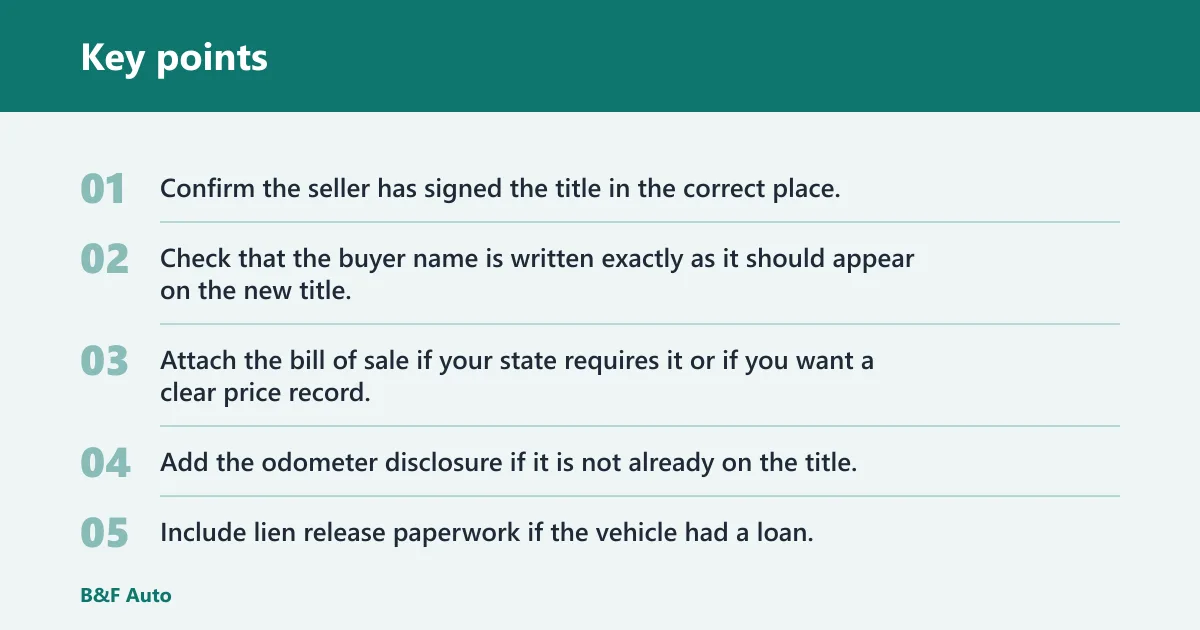
- Confirm the seller has signed the title in the correct place.
- Check that the buyer name is written exactly as it should appear on the new title.
- Attach the bill of sale if your state requires it or if you want a clear price record.
- Add the odometer disclosure if it is not already on the title.
- Include lien release paperwork if the vehicle had a loan.
- Bring ID, insurance if required, and the DMV filing fee.
Say your title lists the wrong buyer name because a middle initial was skipped. That small mismatch can be enough for a clerk to reject the packet and send you back for a corrected form. A common first-timer mistake is bringing the title alone and assuming the DMV can add missing seller signatures later.
What you need from the seller
The seller usually provides the signed title, the odometer disclosure if it is not already printed on the title, and any bill of sale details that prove the purchase. If a lender had a claim, the seller also needs to provide the lien release before the transfer can go through cleanly.
Signed original title or certified copy
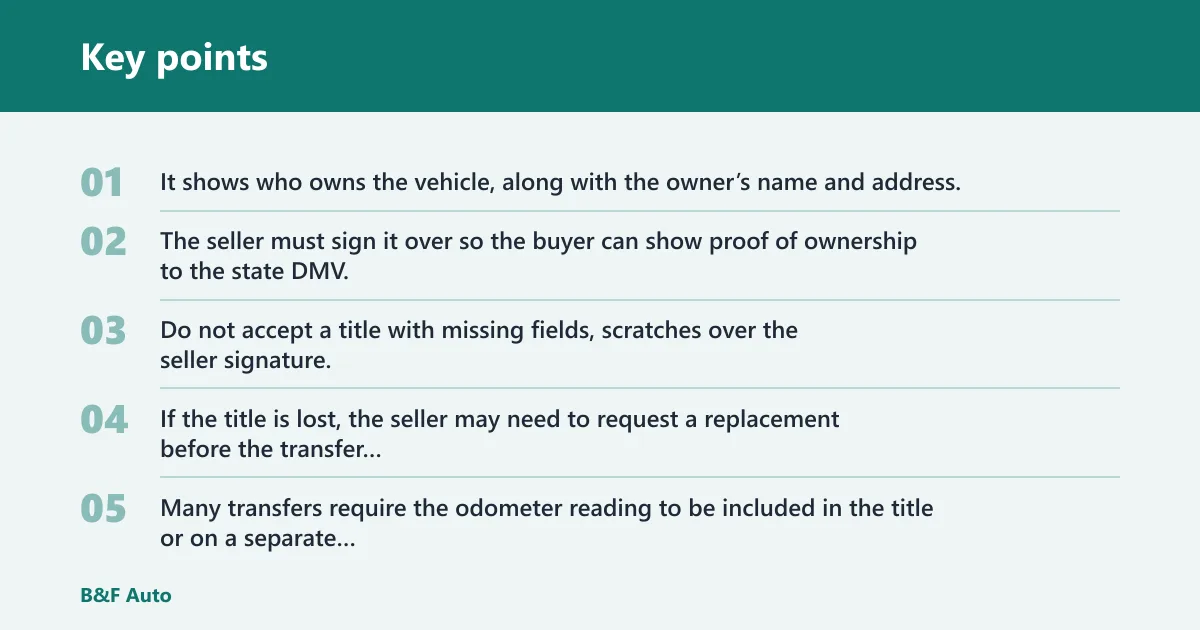
The title is the main ownership record. It shows who owns the vehicle, along with the owner’s name and address, the vehicle’s make and model, and the vehicle identification number, or VIN. The seller must sign it over so the buyer can show proof of ownership to the state DMV.
Do not accept a title with missing fields, scratches over the seller signature, or a VIN that does not match the vehicle. If the title is lost, the seller may need to request a replacement before the transfer can happen.
Odometer disclosure on the title or separate form
Many transfers require the odometer reading to be included in the title or on a separate disclosure form. The reading must be current and match the vehicle. If the title has a dedicated disclosure area, that section must be completed when the seller signs.
Suppose the title has room for the odometer reading, but the seller leaves it blank and hands over the keys anyway. The DMV can reject the file because the mileage statement is incomplete, even if every other part of the title looks fine.
Bill of sale details to confirm the sale
A bill of sale often helps prove the purchase price, date of sale, buyer name, and seller name. Some states require it, while others use it as supporting paperwork. It is useful even when it is optional, because it ties the sale terms to the title file.
If the bill of sale is required in your state, make sure the vehicle description and names match the title. A missing date or price can create a problem at the DMV, especially if the clerk needs to verify tax or fee calculations.
When a lien is involved
If the title shows a lien, the lender still has a recorded claim on the vehicle. That claim usually has to be cleared before the DMV will issue a clean title to the buyer. Some states use electronic lien systems, so the release may not come as a paper form.
How to confirm a lien is released
Check whether the lender has sent a release document, updated the state electronically, or both. The release should match the VIN and the lender name on the title record. If the title still shows a lien, the state may not be able to finish the transfer.
Why a lender’s interest can block transfer
The title can show liens or loans on the vehicle, and that means the lender’s interest is part of the ownership record. The DMV generally wants the claim cleared before it records the buyer as the new owner without restriction. That is why the release belongs in the file before submission.
What to do if the lien release is electronic or state-managed
Ask the lender how the release is sent and whether the DMV needs a printed copy, an account number, or a receipt. Some states pull lien updates directly from their own record system. If you are unsure, bring the lender paperwork and ask the DMV clerk what it needs to see.
What the DMV usually asks
The State DMV is where you file the completed title package. It collects the title, the supporting forms, and the fees. Some states process title and registration together, while others separate them, so you should confirm whether you need both sets of paperwork at the same visit.
Where to submit the completed title package
Bring the signed title, the bill of sale if needed, the odometer disclosure, the lien release if applicable, and your ID. The DMV may also want proof of insurance, tax forms, or a separate application. Keep the packet in the order your state lists it, if the DMV provides an order.
Common fees and what they cover
Fees are charged for the transfer itself, and there may also be title fees, registration fees, plate fees, or taxes depending on the state. If you are unsure about the total, ask the DMV which charges apply to title filing and which apply only to registration.
Separate registration items that may be requested at the same visit
Do not assume a title transfer automatically means the car is registered. A DMV may ask for registration forms, insurance, or emissions paperwork during the same visit, but those items can be separate from the title transfer itself. Bring them only if your state requires them.
Why title transfers get rejected
Most rejected files trace back to a missing signature, a form that does not match the title, or a document that was required by the state but never included. The DMV is usually checking for clear ownership proof, clear mileage disclosure, and any lien release that clears the record.
Unsigned or mismatched title fields
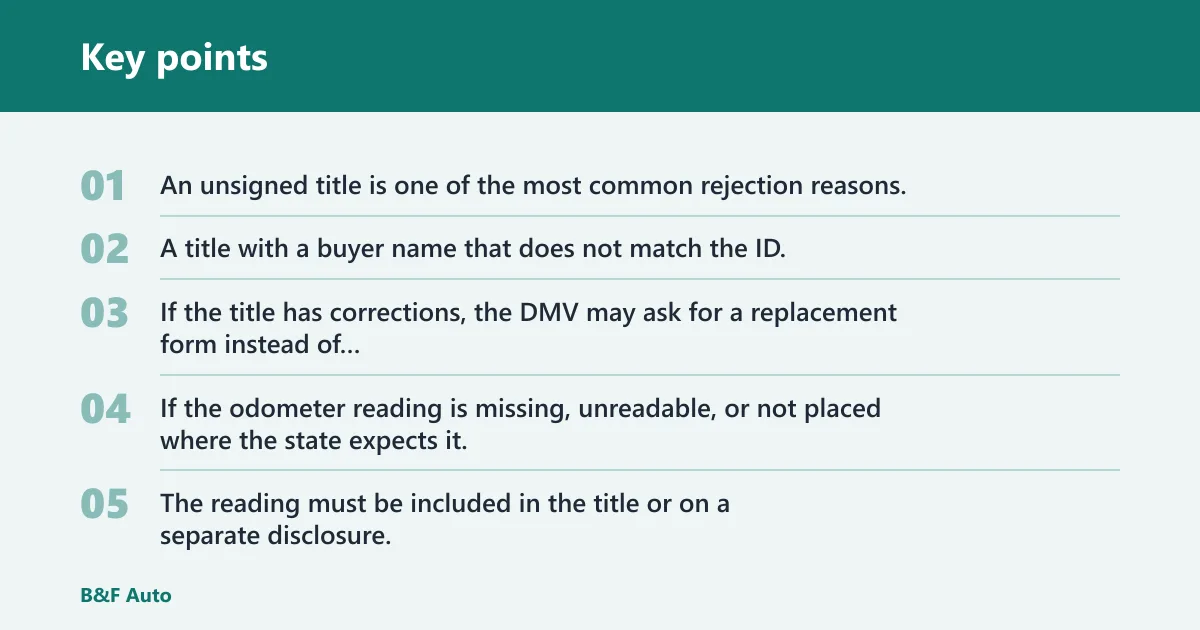
An unsigned title is one of the most common rejection reasons. A title with a buyer name that does not match the ID, or a VIN that does not match the vehicle, can also be grounds for rejection. If the title has corrections, the DMV may ask for a replacement form instead of accepting crossed-out text.
Missing or incorrect odometer statement
If the odometer reading is missing, unreadable, or not placed where the state expects it, the transfer can stop. The reading must be included in the title or on a separate disclosure. For many transfers, that paperwork is treated as a core part of the ownership file.
Lien, VIN, or buyer-name errors
A lien that is not cleared, a VIN that does not match, or a buyer name that is spelled differently from the ID can all trigger a rejection. The DMV uses these details to tie the vehicle, the sale, and the new owner together. One wrong character can send the file back.
Missing state-required forms or fees
If your state wants a bill of sale, a smog certificate, or a separate application, leaving it out can stop the transfer. The same is true for short fees or unpaid taxes. The DMV will not guess what you meant to file.
A common first-timer mistake is bringing the signed title to the counter and learning that the state also wants a separate application and fee. Another is assuming a lien release in an online lender portal automatically shows up in DMV records the same day.
State-specific rules to confirm
Rules vary by state, and the same sale can require different paperwork depending on where the vehicle is titled. That is why you should confirm the exact filing list with your state DMV before you go. Title transfer and registration are separate in many places, even when they happen on the same day.
Texas
For Texas, readers should verify the title transfer basics with the Texas DMV and confirm the form names before filing. The state commonly uses the vehicle title, a buyer application, and any supporting documents that fit the deal. If you are asking what forms are needed to transfer a car title in Texas, confirm the current title application and any county-level fee or tax steps with the DMV.
California
For California, check smog-related paperwork and timing before you file. Some states require a smog certificate for title transfer, and California is a common example. Make sure the seller and buyer know whether the emissions paper must be current before the DMV will accept the package.
Florida and Pennsylvania
Florida and Pennsylvania can differ on what supporting paperwork they want, especially for insurance, fees, and transfer timing. If you are filing in either state, confirm whether the DMV wants the transfer form, bill of sale, proof of insurance, or other supporting documents at the same appointment.
Out-of-state or gift transfers
An out-of-state transfer may need extra verification because the seller’s title came from another state record system. Gift transfers can also need different tax treatment or a different bill of sale. In both cases, the DMV may ask for forms that do not come up in a standard private-party sale.
Frequently asked questions
What do you need to transfer a car title?
You usually need the signed title, buyer ID, seller details, a bill of sale if your state requires it, the odometer disclosure, and lien release paperwork if the vehicle had a loan. Some states also ask for proof of insurance, a smog certificate, or a separate transfer form at the DMV.
What information do you need to transfer a car title?
You need the vehicle identification number, the buyer and seller names, the sale date, the purchase price if a bill of sale is used, and the odometer reading. The title itself also carries ownership details, including the owner’s name and address plus the vehicle’s make and model.
What do I need in order to transfer a car title?
Bring the completed title, your ID, and any state-required supporting papers to the DMV. Depending on the state, that can also include proof of insurance, a bill of sale, a lien release, or emissions paperwork. Fees are usually paid at filing, so be ready for those too.
What do I need to bring to a title transfer?
Bring the original title or a certified copy if your state allows it, plus the seller’s signature, the odometer disclosure, and the buyer’s ID. Add the bill of sale, lien release, insurance, and smog certificate if your state requires them. Keep every document together in one packet.
What forms are needed to transfer a car title in texas
Texas buyers should verify the current title application and the supporting title transfer steps with the Texas DMV. The exact form set can change, and county-level processing may affect what you need to file. Confirm whether the seller’s title, bill of sale, and any tax paperwork must be turned in together.
What is needed for a car title transfer?
At minimum, most transfers need a signed title, buyer identification, and the proper filing fee. From there, the state may add a bill of sale, an odometer statement, a lien release, insurance, or smog paperwork. The safest approach is to confirm the state DMV list before you go.