Title Transfer Steps: How to Transfer a Car Title
Car title transfer requirements vary materially by state and by transfer type. Before anyone signs, use your state DMV or title agency instructions and forms for the required documents, deadlines, taxes, notarization, plate rules, and signature rules. Errors can trigger a DMV rejection, tax trouble, late penalties, or a title that never legally moves into the new owner’s name. This guide explains the paperwork and common issues for private sales, gifts, inherited cars, co-owners, lien payoffs, online filing, and out-of-state transfers.
What you’ll need
- Certificate of title, the legal ownership document with the VIN, current owner details, seller signature area, and sometimes a lienholder release area
- DMV title application, completed by the buyer in most states to request a new title and, where applicable, registration
- Government-issued identification for the buyer and sometimes the seller
- Bill of sale if your state DMV or title agency requires it for your transfer type
- Odometer disclosure statement when required by the title or your state forms
- Lien release if a lender is still shown on the title or state record
- VIN access on the vehicle so the number can be matched exactly to the title and forms
- Proof of insurance if the state ties registration to the same visit; this is separate from title-only requirements in some states
- Inspection or emissions document where required for registration or for imported out-of-state vehicles
- Death certificate and probate, heirship, or court papers for inherited vehicles, if your state requires them
- Payment for title fees, sales or use tax, registration fees if handled together, plate fees, inspection fees, notary fees, duplicate title fees, and any late penalties
- Copies folder for the signed title, bill of sale, lien release, application, and any notice of sale or release of liability
What does a car title transfer do?
A title transfer is the state-recorded change in legal vehicle ownership, while registration covers road use, plates, and often insurance and inspection checks.
Title transfer and registration are not the same transaction
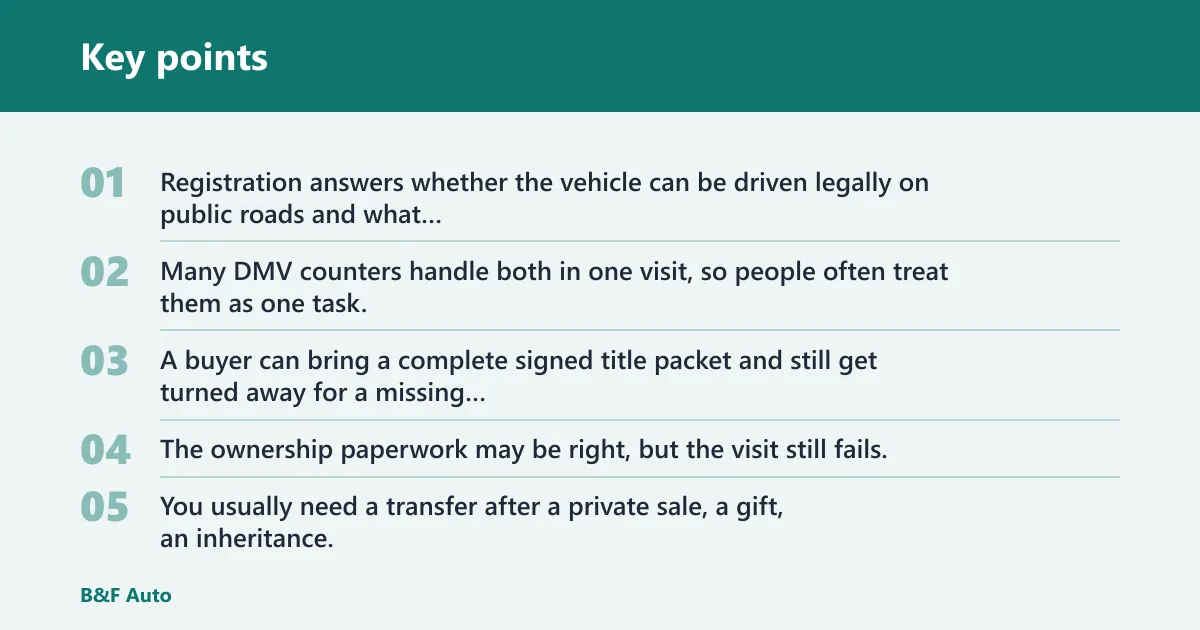
The title answers who owns the vehicle. Registration answers whether the vehicle can be driven legally on public roads and what plate is assigned to it. Many DMV counters handle both in one visit, so people often treat them as one task.
That difference matters. A buyer can bring a complete signed title packet and still get turned away for a missing insurance card or inspection report if the state combines title and registration in one appointment. The ownership paperwork may be right, but the visit still fails.
When a title transfer is required
You usually need a transfer after a private sale, a gift, an inheritance, adding or removing an owner, bringing a vehicle in from another state, correcting ownership after divorce or a court order where state law allows, or clearing records after a lien payoff when the title must be reissued.
Requirements and forms differ by state, so check your state DMV or title agency for the exact process, forms, and filing location for your transfer type.
Who signs and who files
The seller usually signs the title assignment. In most states, the buyer then files the signed title, the title application, any tax forms, and the rest of the supporting documents with the DMV or title agency. Use your state DMV or title agency instructions for the required signatures, documents, and filing steps.
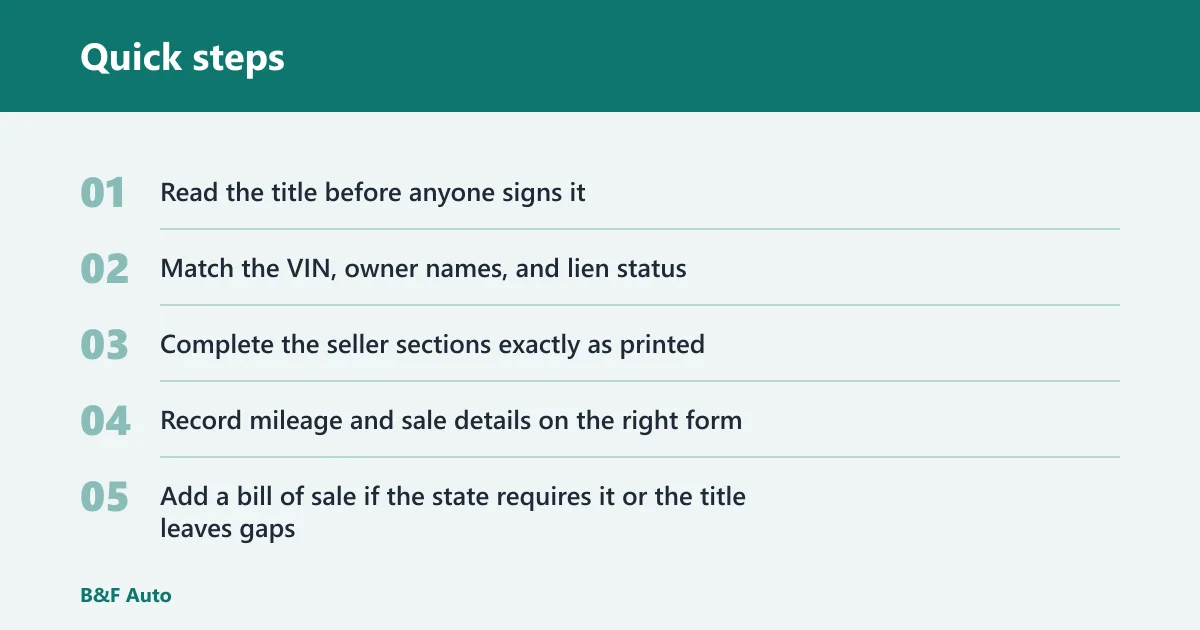
- Read the title before anyone signs it. Check the front and back for owner names, lienholder name, assignment section, odometer area, buyer area, and any notarization line.
- Match the VIN, owner names, and lien status. Compare the VIN on the title to the dashboard or door-jamb VIN and to every supporting form, character for character.
- Complete the seller sections exactly as printed. Sellers should sign only where the title and state instructions direct.
- Record mileage and sale details on the right form. Enter the odometer reading where the title or separate odometer statement requires it, and make sure the mileage agrees across all paperwork.
- Add a bill of sale if the state requires it or the title leaves gaps. It can also help document a private-party transfer or support the reported sale price where your state asks for it.
- Get a lien release before filing if a lender is still listed. An active lender interest can often block transfer until the release is in the DMV packet or updated electronically.
- Complete the buyer title application and any tax forms. Fill in legal name, address, sale date, purchase price or gift status, and the exact VIN from the title.
- Bring insurance and inspection proof if the state ties them to registration. This affects the same DMV visit even though it is separate from the ownership change itself.
- Submit the packet, pay taxes and fees, and keep copies. File the signed title, application, tax forms, and supporting documents with the DMV or title agency, pay the required charges, save a complete copy set, remove plates if your state makes the seller keep them, and file a release of liability or notice of sale where that option exists.
Why the order matters
If the title is signed before you check the lien status, co-owner rule, or notarization line, the problem may already be locked in.
What to review on the title before ink touches paper
Look at the VIN, current owner names, assignment section, seller signature area, buyer information area, odometer entry space, lienholder release area, and any notary block. A scratched-out date, overwritten mileage, missing middle initial, or unreadable buyer name can stop the transfer.
Suppose the title shows John A. Smith and Maria Smith, but only John signs because the buyer assumed one signature was enough. That is a common counter failure. The title wording can matter, but state law, the title form, and DMV instructions can also affect whether both signatures are required.
Costs: mandatory versus visit-related
Ownership-transfer costs usually mean the title fee, any sales or use tax, and a duplicate-title fee if the original is missing. The same visit may also include registration, plate, inspection, emissions, notary, and late-filing charges. Keep those buckets separate so the buyer knows what is required for ownership and what is tied to road use.
Which branch fits your transfer?
The right branch depends on how ownership is changing, not where the appointment happens. A private sale needs a signed title and sale records, a gift often needs extra tax paperwork, an inherited vehicle needs death and estate papers, and a recent lien payoff may need lender release documents before filing.
Private-party sale
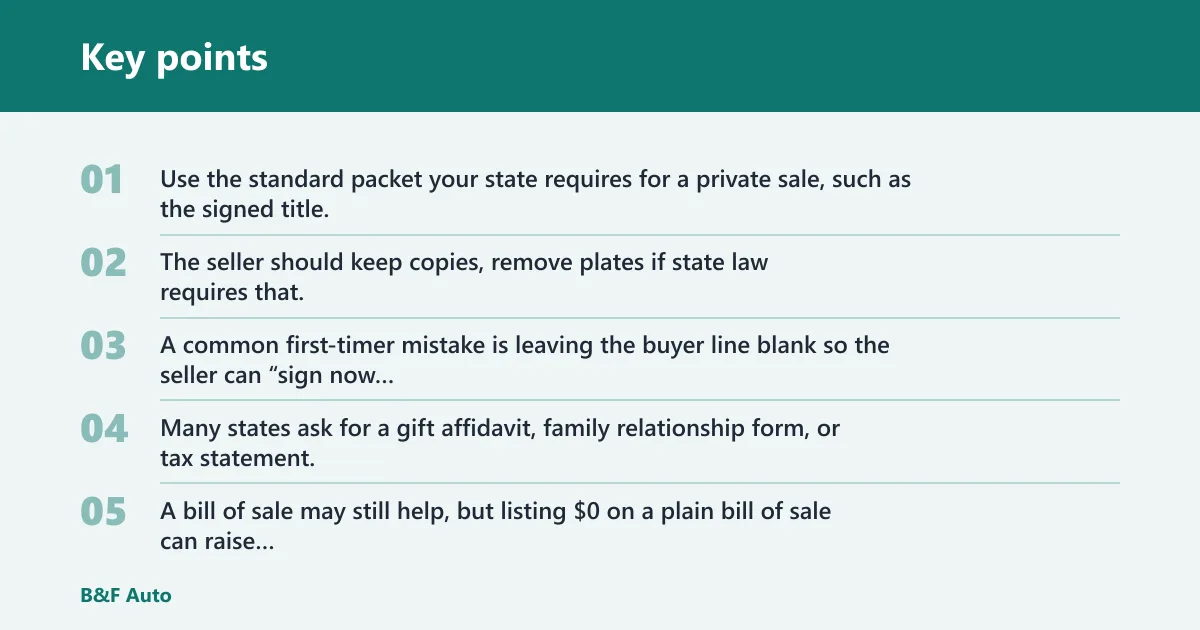
Use the standard packet your state requires for a private sale, such as the signed title, title application, buyer ID, bill of sale, odometer disclosure when required, and lien release if the title still shows a lender. The seller should keep copies, remove plates if state law requires that, and file a release of liability or notice of sale where available.
A common first-timer mistake is leaving the buyer line blank so the seller can “sign now and fill it in later.” That creates an open assignment problem in many states and can trigger rejection or fraud concerns.
Gift transfer
Many states ask for a gift affidavit, family relationship form, or tax statement. A bill of sale may still help, but listing $0 on a plain bill of sale can raise questions if the state expects a separate gift form. Tax treatment differs sharply by state, so use the state’s gift-specific document when one exists.
Inherited vehicle
Start with the current title, death certificate, and the estate document the state requires: probate papers, letters testamentary, letters of administration, affidavit of heirship, or a small-estate transfer form. Some states allow direct reassignment from an estate representative. Others require a new title in the heir’s name first.
Picture a sedan titled only in the deceased parent’s name, with one adult child keeping the car. If the child brings only the title and death certificate, the DMV may still reject the transfer until the heirship or court paper showing authority to sign is included.
Out-of-state title or recent lien payoff
An out-of-state title usually needs the same ownership documents plus a VIN inspection or emissions document where the new state requires it. A recent lien payoff can be harder: the buyer may need the original title with signed release, a separate lien release letter, or an electronic lien release already posted to the state record.
Do both owners have to sign?
The wording between owner names controls the signature rule in many states. If the title lists co-owners with and, both usually must sign. If it lists or, one signature may be enough, subject to state law and title wording. Read the title exactly as printed before the seller signs anywhere, and confirm the rule with your state DMV or title agency.
How to read “and” versus “or”
And usually means joint action. Both owners sign the assignment, and both may need to appear or provide notarized signatures if the state requires notarization. Or often lets either owner sign, but that is still limited by the exact title wording and the filing rules in that state.
When one signature is not enough
If one co-owner is unavailable, do not guess. The missing owner may need to sign before a notary, issue a power of attorney where state law allows, or have the title cleared through court or estate paperwork if that owner is deceased. Crossing out a co-owner name or attaching a handwritten note is not a substitute.
Seller and buyer check before signing
Read the owner line, the assignment line, and the notary line in one pass. Then compare the printed owner names to the identification each signer will use. That extra minute prevents the classic mismatch where the title shows a suffix or middle initial that the signature packet leaves out.
What if the title is lost, damaged, or already signed wrong?
If the original title is missing, badly damaged, or signed in the wrong place, stop the transfer and fix the title first. Once a title assignment is wrong, many states require a duplicate title or a correction form before ownership can move. (Wikihow)
Lost or missing title
The current titled owner usually applies for a duplicate title before sale or transfer. That is separate from the buyer’s new-title application. If the seller never gets the duplicate first, the buyer may arrive with a bill of sale but no transferable ownership document.
Damaged title
If the title is torn, water-damaged, or partly unreadable, treat it as suspect. The DMV clerk must be able to read the VIN, owner names, and assignment fields. If any core field is unclear, replace it before the transaction date if possible.
Signed in the wrong place or altered
Common fatal errors include the seller signing on the buyer line, buyer information written over white-out, an odometer number crossed out and rewritten, or a sale date changed after signature. Some states allow a separate correction form. Others require the seller to apply for a fresh title and sign again on the new document.
Can you transfer a car title online?
Sometimes, but full online title transfer is still state-specific and often limited to certain transaction types. Many states allow online appointment setup, form completion, fee estimates, or e-lien updates, while the actual title assignment still requires mail or in-person submission. Check your state DMV or title agency to confirm whether your exact transfer type can be completed online.
Fully online, partly online, and counter-only filing
Some DMV systems let a buyer start the application online, upload insurance, and prepay fees. That does not always mean the transfer is complete. The original title may still need to be mailed or handed over because the signed paper title is the transfer instrument.
When mail or in-person filing is still required
Mail or in-person filing is common when notarization is required, the title is from another state, the transfer involves an estate, or the lender release is not yet visible in the state system. Electronic title and e-lien programs can shorten the packet, but they do not erase signature rules.
Before relying on an online portal
Check whether the portal handles your transaction type: private sale, gift, inherited transfer, co-owner removal, out-of-state import, or lien payoff. If the answer is unclear, treat online filing as prep only and keep the paper packet ready.
Transfer rejection checklist
| Step | Required document | Common mistake | Counter-rejection risk | Who must act |
|---|---|---|---|---|
| Review title before signing | Original certificate of title | Signing before checking owner names, lien box, or notary line | Void assignment or return visit for duplicate title | Seller and buyer |
| Verify vehicle identity | Title plus VIN on vehicle | One character in the VIN does not match the car or application | Immediate rejection for mismatch | Buyer |
| Complete seller assignment | Title assignment section | Seller signs wrong line, leaves buyer blank, or uses unreadable corrections | Transfer blocked until corrected or retitled | Seller |
| Record mileage | Odometer disclosure on title or separate statement | Mileage differs from title, bill of sale, or disclosure form | Odometer rejection and fraud concern | Seller and buyer |
| Support private sale | Bill of sale | Missing date, sale price, or buyer and seller names and addresses | Tax calculation problem or rejected packet | Seller and buyer |
| Handle gift transfer | Gift affidavit or state tax form, plus title | Using a plain bill of sale with $0 and no gift document | Tax hold or request for extra proof | Seller and buyer |
| Handle inherited vehicle | Death certificate plus probate, heirship, or court paper | Bringing only the old title and death certificate | No proof of authority to sign | Heir or estate representative |
| Clear lien payoff | Lien release, released title, or e-lien confirmation | Loan paid off, but lender still appears on title record | Transfer blocked by active lien interest | Seller, lender, sometimes buyer |
| Check co-owner rule | Title owner line | Only one owner signs when title says “and” | Missing signature rejection | Seller |
| File buyer application | DMV title application and ID | Name, address, date, price, or VIN does not match title packet | Application rejection | Buyer |
| Prepare registration gate | Insurance proof and inspection document where required | Assuming title transfer alone completes the visit | Cannot finish registration or plate issue | Buyer |
| Protect seller after sale | Copies, plate receipt if removed, release of liability or notice of sale | Seller leaves plates on the car or keeps no proof of transfer date | Later toll, parking, or liability disputes | Seller |
Common mistakes that get a title transfer rejected
VIN mismatch and inconsistent names
The VIN must match the title, the car, the title application, and any supporting form exactly. The same goes for names. If the title says Robert J. Lee Jr., a buyer application for Robert Lee can still raise a mismatch question.
Missing signatures, open assignments, and unreadable fixes
Do not leave assignment blocks blank for later. Do not use correction fluid unless the state allows a correction method that says so. If a title has already been signed wrong, fix that first instead of hoping the counter will accept an explanation.
Odometer and sale-price conflicts
If the title shows 84,215 miles and the odometer statement says 84,251, expect a stop. The same issue applies to sale date and price. Keep one clean set of numbers from title to bill of sale to tax form.
Open liens, missed deadlines, and seller liability gaps
A paid loan is not the same as a released lien. Wait for the lender document or state record update. File before the deadline your state applies to that transfer type, and keep a copy set so the seller can prove the transfer date if tickets or tolls arrive later.
Prevention
Build the packet in this order: title, VIN check, lien release, odometer form, bill of sale, title application, insurance, inspection, payment method, copy set. Then recheck each handwritten field one line at a time before leaving for the DMV, and confirm the final packet against your state DMV or title agency instructions.
How to complete the title fields
If you are filling out the title itself, the safest approach is to copy every field exactly as it appears, in the same order, and use blue or black ink. The supporting guide on title transfer details explains which spaces usually need the seller, buyer, odometer, sale price, signatures, and date, and which blanks should stay empty if your state directs it. That matters because even a small mismatch can trigger a DMV delay or rejection.
The article also points out the common trouble spots, like erasures, cross-outs, and signing in the wrong place, so you can avoid errors before you submit the paperwork.
Frequently asked questions
What are the steps to transfer a car title?
The exact steps depend on your state and transfer type. In general, read the title first, verify the VIN and owner names, confirm whether a lien is still listed, complete the seller assignment exactly as printed, add the odometer disclosure and bill of sale when required, complete the buyer title application, then submit the packet with tax and fee payment before the state deadline.
What paperwork do I need to transfer a car title?
The core packet is the original certificate of title, DMV title application, government ID, and payment. Many transfers also need a bill of sale, odometer disclosure, lien release, proof of insurance, and an inspection or emissions document. In inherited cases, add a death certificate and estate paperwork. Check your state DMV or title agency to separate title-only requirements from registration requirements.
Do I need a bill of sale for a title transfer?
It depends on the state and the transfer type. Some states require a bill of sale in specific situations, while others do not. Even where it is optional, it can help when the title has no sale-price field, when tax value is questioned, or when the transfer is a gift with separate tax forms.
What happens if the title has a lien?
If a lien is still active on the title or state record, the transfer often stops until the lender’s interest is released. That release may appear as a signed title release area, a separate lien release letter, or an electronic update in the DMV system after payoff.
What documents do I need for a title transfer after someone dies?
Start with the current title and death certificate. Then add the document that proves authority to transfer the vehicle, such as probate papers, letters testamentary, letters of administration, heirship paperwork, or a small-estate affidavit where allowed. Without that authority document, the DMV may reject the transfer.