Do You Need a Correction Form for Title Mistakes?
Yes, if the title error is minor and your state allows it, a correction form is enough; if the title is already signed or the mistake changes ownership details, you usually need a replacement title or DMV correction. This guide shows when a correction form works, when to request a replacement title, and when a signed title error needs DMV escalation.
When a correction form is enough
A correction form usually works for small clerical mistakes that do not change who owns the vehicle or what vehicle the title describes. That includes a misspelled name, a wrong date, or another entry error that the DMV can verify from supporting documents. It is not the right fix for every title problem.
Minor clerical errors
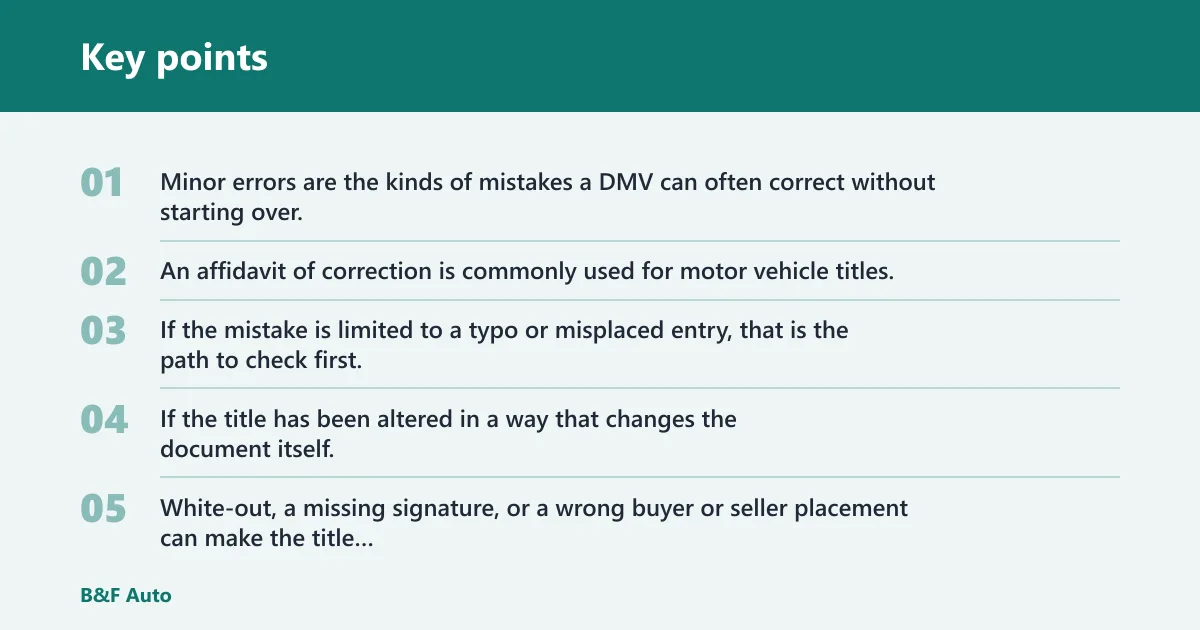
Minor errors are the kinds of mistakes a DMV can often correct without starting over. An affidavit of correction is commonly used for motor vehicle titles, and state rules decide if that affidavit is enough on its own or needs extra paperwork with it.
If the mistake is limited to a typo or misplaced entry, that is the path to check first.
When the signed title needs replacement instead
If the title has been altered in a way that changes the document itself, a correction form may not be enough. White-out, a missing signature, or a wrong buyer or seller placement can make the title unusable. In those cases, the DMV may require replacement paperwork or a new title process rather than a simple correction.
Say your title lists the buyer in the seller block and someone tried to fix it with correction fluid. That is no longer a clean clerical correction. The DMV may treat the document as damaged or altered, which can push the file into replacement-title review.
When to stop and call the DMV
Stop and contact the DMV when the mistake affects ownership, identity, odometer disclosure, or the VIN. Fees and processing rules also vary by state, so your local DMV should confirm the exact path.
A common first-timer mistake is assuming every error follows the same form. It does not. The decision turns on whether the mistake is clerical, whether the title has already been signed, and whether the correction could raise fraud concerns or require inspection.
Title mistake decision table
Use this table as a quick filter before you file anything. It separates harmless clerical errors from problems that usually need more than a correction form, especially when the title is signed or the error affects the vehicle identity or ownership chain.
| Mistake type | Correction form usually enough? | Notarized statement commonly needed? | Escalation trigger |
|---|---|---|---|
| Misspelled name | Yes, if the identity is clear and the DMV can verify the owner | Often, when the state wants an explanation for the error | Name does not match ID, or the correction changes ownership records |
| Wrong VIN | Usually no, or not by itself | Often yes | VIN mismatch, possible fraud review, or physical inspection required |
| Wrong line | Sometimes, if the error is clearly clerical | Often yes | Title was released or assigned on the wrong line |
| Wrong buyer/seller placement | Usually no | Often yes | Ownership flow is unclear or the signed title is not valid as completed |
| Odometer error | Sometimes, depending on the record and state rules | Often yes | Mismatch with federal disclosure or a corrected mileage statement is required |
| White-out | No, usually not | Possibly, but the bigger issue is title validity | White-out or correction fluid may void the title and force a new title process |
| Missing signature | Usually no | Often yes, if the DMV allows a corrective affidavit | The signed title may be invalid and need replacement or a new assignment |
What form do I use to correct a mistake on a car title?
The right form depends on the mistake and the state. Some states use one form for minor clerical errors and different paperwork for VIN issues or title corrections.
Affidavit of correction basics
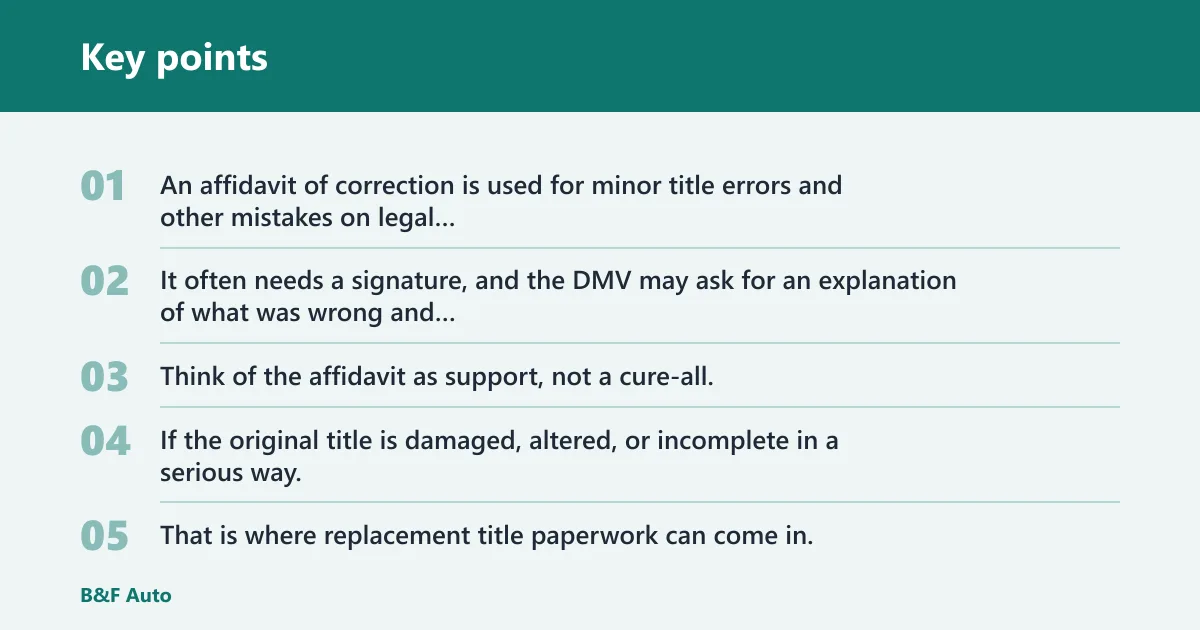
An affidavit of correction is used for minor title errors and other mistakes on legal forms, but state DMV requirements control how it must be completed. It often needs a signature, and the DMV may ask for an explanation of what was wrong and how the document should read now. That makes it useful, but not universal.
Think of the affidavit as support, not a cure-all. If the original title is damaged, altered, or incomplete in a serious way, the DMV may not accept an affidavit as the only fix. That is where replacement title paperwork can come in.
New York DMV forms: MV-83NC, MV-41A, MV-82, and MV-912
New York gives several routes depending on the error. Minor mistakes may be fixed with MV-83NC, and the form requires corrected information and a signature.
Because DMV form names and filing rules can change, check the current New York DMV instructions before you mail or bring anything in.
When a notarized statement comes into play
A notarized statement is commonly requested when the DMV needs a sworn explanation of what went wrong. It can support a correction for a minor title error, but it is especially useful when the paperwork alone does not explain why the title differs from the supporting records. Some states ask for it routinely.
If the title error involved a name change, the DMV may also want name-change paperwork such as a marriage certificate or court order. That is separate from the correction form itself. The supporting record shows why the new information belongs on the title.
Can you fix a misspelled name or wrong line?
Yes, sometimes. A misspelled name is often a clerical error if the person is the same owner and the ID matches the intended name. A wrong line or misplaced entry is more serious, because it can affect the assignment chain. In both cases, the DMV may want a correction form plus proof that the title was completed in error.
Name corrections with supporting ID
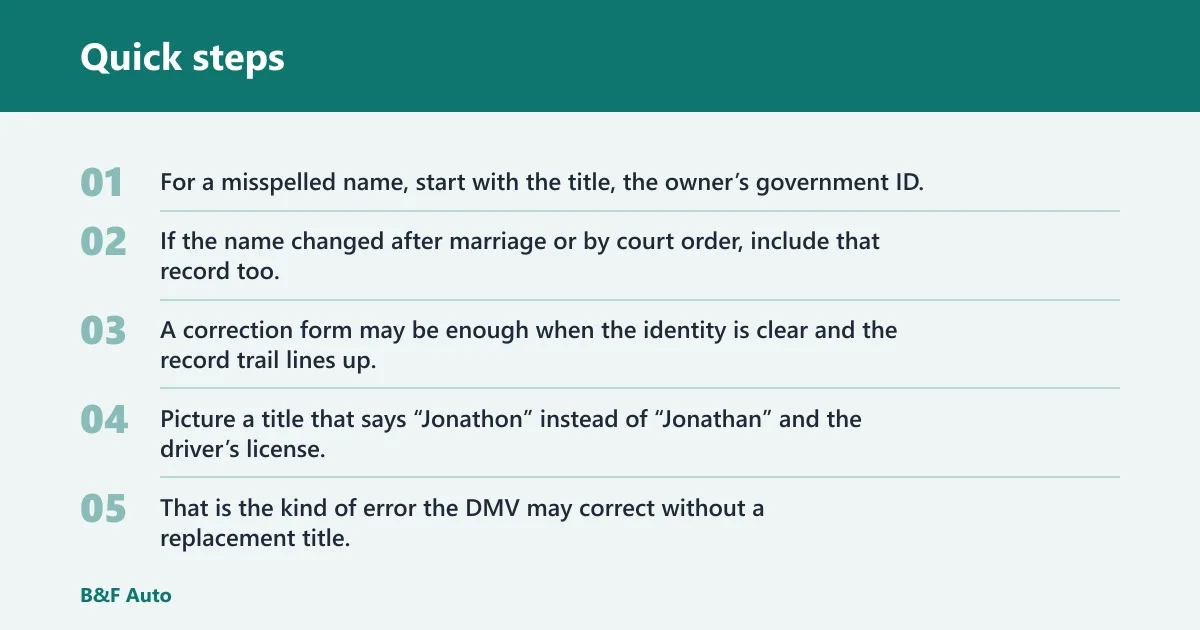
For a misspelled name, start with the title, the owner’s government ID, and any document showing the correct spelling. If the name changed after marriage or by court order, include that record too. A correction form may be enough when the identity is clear and the record trail lines up.
Picture a title that says “Jonathon” instead of “Jonathan” and the driver’s license, registration, and bill of sale all use the shorter spelling. That is the kind of error the DMV may correct without a replacement title, as long as the documentation matches and the state form is completed properly.
Wrong buyer or seller placement
Wrong buyer/seller placement is not the same as a small typo. It can change the legal flow of the assignment, so the DMV may require a notarized statement, a corrected title, or a new title process. The problem is not the spelling; it is the placement of the signature and assignment.
If the title was signed in the wrong place and ownership is unclear, the DMV may still require a new document package.
Wrong line or misplaced entry
A wrong line often means the seller wrote information where the buyer should have signed, or vice versa. That can be fixable only if the DMV accepts a correction affidavit and the underlying title still shows a valid chain. If the title has been completed in a way that makes the assignment ambiguous, escalation is the safer assumption.
Do both buyer and seller need to sign a title correction form? Often, yes, when the mistake touches the transfer itself. If only one party signs and the correction concerns both sides of the sale, the DMV may reject the filing or request more proof.
What if the VIN is wrong?
VIN errors get more scrutiny than simple typos. A vehicle identification number ties the title to a specific vehicle, so a mismatch can suggest a data entry mistake, a filing error, or a bigger problem.
Why VIN errors get extra scrutiny
The VIN is not a casual detail. If it is wrong on the title, the DMV may need to verify whether the error came from a clerical slip or whether the title is attached to the wrong vehicle record. VIN errors may trigger a physical inspection or fraud review.
That lines up with the higher level of review these errors usually get. Even if the rest of the title looks fine, the VIN mismatch can stop the process until the vehicle identity is confirmed.
Physical inspection and fraud review triggers
If the VIN on the title differs from the VIN on the car, stop and compare the dash plate, doorjamb label, registration, and supporting ownership records. A mismatch may require DMV review before any correction is accepted. Do not guess at the number or rewrite it by hand.
A wrong VIN is a good example of where a correction form alone may not solve the problem. The DMV may want a corrected application, a physical inspection, and proof that the vehicle described in the paperwork is the same vehicle presented for review.
When Form MV-41A matters
Use the state’s VIN-related correction process when the VIN issue needs DMV handling rather than a minor title note. Check the form instructions first than to file the wrong document and wait for a rejection.
Do both buyer and seller need to sign?
Often, yes, if the correction affects the transfer of ownership or a line that both parties completed. A correction form can fix a typo, but it may not cure an assignment problem unless the correct people sign where required. The DMV may also ask for a notarized statement to explain the error.
Who signs a correction form
Who signs depends on the mistake. If the error is only in one party’s name and the DMV can verify the identity from the record, that person may be the only signer. If the correction alters the sale record, both buyer and seller may need to sign or acknowledge the change.
That is why it helps to look at the title line by line before filing. A correction that seems small can still touch the legal transfer chain, and that often changes the signature requirement.
When a notarized statement is needed
A notarized statement is commonly used when the DMV wants the parties to explain how the mistake happened and why the corrected information is accurate. It is especially common when the title was signed but entered on the wrong line, or when the application must explain a mismatch between the title and the supporting records.
What happens if one party is unavailable
If one party cannot sign, contact the DMV before filing anything. Some corrections may need a replacement title, a different affidavit, or more proof of ownership. Do not assume the other party’s signature is enough when the correction changes the transfer details.
Documents and filing steps
Gather the paperwork before you submit anything. The exact route depends on the form, the type of mistake, and whether the DMV needs extra review or an inspection.
Government ID and original title
Bring government ID and the original title. Those are the basic identity and ownership records the DMV uses to compare the corrected information against the document you are trying to fix. If the title is damaged or altered, bring it anyway unless the DMV tells you not to.
Proof of ownership and name-change records
Proof of ownership can include a bill of sale or other ownership record. If the correction involves a name change, include a marriage certificate or court order. Those documents help the DMV connect the corrected name to the person already tied to the vehicle record.
Supporting documentation is the difference between a clean correction and a rejected filing. If the title says one name, the ID says another, and there is no name-change record, the DMV may have no basis to accept the correction.
Mail-in versus in-person submission
Some corrections can be mailed, and some need an in-person visit. VIN issues are more likely to require in-person handling because inspection may be involved. Check the current instructions before you send anything.
- Identify the mistake and decide whether it is clerical or ownership-related.
- Match the error to the correct DMV form.
- Gather government ID, the original title, and ownership records.
- Add name-change proof, a bill of sale, or other support if needed.
- Check whether a notarized statement or both signatures are required.
- Submit by mail or in person based on the DMV’s current rule for that correction.
- Keep a copy of everything you file.
Can white-out on a car title void it?
Yes, white-out or correction fluid can void a vehicle title and may force a new title process. White-out or a wrong stamp placement are common title mistakes, but that does not mean they are acceptable fixes. Altering the document can make the title invalid in the DMV’s eyes.
Why correction fluid is risky
Correction fluid can hide the original entry, which makes the document look altered rather than corrected. That is a problem on a legal ownership record. If the DMV cannot read what was changed, it may reject the title and require replacement paperwork instead of a correction form.
What to do instead
If white-out has already been used, stop and ask the DMV what it wants next. The file may need a replacement title, a corrected assignment, or a sworn explanation. Do not add more correction fluid or try to rewrite the line over the old entry.
Frequently asked questions
Do you need a correction form for title mistakes?
Often, yes, but only for minor clerical errors that the DMV can verify. A correction form is usually enough for a misspelled name or a wrong date. It is not the right answer for white-out, a missing signature, or a VIN mismatch that calls for more review.
Can I fix a name misspelling on a vehicle title without a new title?
Often, yes, if the error is only a clerical misspelling and the identity is clear. Bring government ID and, if relevant, a marriage certificate or court order. If the name change is not supported by records, the DMV may require more than a correction form.
What should I do if the VIN is wrong on the title?
Stop and treat it as a serious error. Compare the VIN on the vehicle, the title, and the registration, then contact the DMV. The DMV may require physical inspection or other review before accepting the change.
Do both buyer and seller need to sign a title correction form?
Sometimes. If the correction touches the transfer or changes a buyer/seller entry, both parties may need to sign. If the mistake is limited to one person’s clerical error, the DMV may only need that person’s signature plus a supporting statement or ID.