What Should a Car Donation Tax Receipt Include for the IRS?
For a car donation deduction, keep a receipt that identifies the charity, donation date, and vehicle, and keep the charity’s written acknowledgment with your tax records; Form 8283 is required for the deduction, and a qualified appraisal may apply above $5,000. Missing the charity’s name, date, vehicle details, or the sale disclosure can slow the deduction, lower the amount you can claim, or leave the IRS with no support for the return. This guide lists the exact receipt fields the IRS expects, what belongs on Form 1098-C or Form 8283, and what records to keep with your tax file.
This guide is part of our Donation tax receipt for a car donation series.
Car donation receipt checklist table
| Field or document item | Purpose for IRS substantiation | Where it belongs |
|---|---|---|
| Charity name | Shows the recipient is the organization that received the vehicle. | Receipt; Form 1098-C |
| Charity address | Identifies the charity on the contemporaneous acknowledgment. | Receipt; Form 1098-C |
| Donor name | Links the acknowledgment to the taxpayer claiming the deduction. | Receipt; Form 1098-C |
| Date of donation | Sets the transfer date for substantiation and timing. | Receipt; Form 1098-C |
| Vehicle year, make, and model | Describes the donated vehicle in the IRS records. | Receipt; Form 1098-C |
| VIN | Identifies the specific vehicle when available. | Receipt; Form 1098-C; Form 8283 in some cases |
| Odometer reading | Supports the vehicle description when available. | Receipt; supporting records |
| Date of transfer | Shows when control of the vehicle changed hands. | Receipt; Form 1098-C |
| Gross sale proceeds or certification details | Shows the amount the IRS can compare with the claimed deduction, or the reason the deduction is not tied to sale proceeds. | Form 1098-C |
| Charity contact line or signature line | Helps show the acknowledgment came from the charity and is complete. | Receipt |
| Form 8283, Section A | Reports the noncash charitable contribution on the return. | Form 8283 |
| Qualified appraisal, when required | Supports higher-value or exception cases where fair market value is claimed above sale proceeds. | Supporting appraisal; may relate to Form 8283 |
Notice what is not on the list: the charity’s EIN is useful to have, but it is not generally a required element of the written acknowledgment for a vehicle donation. The same is true of the pickup location. Keep it if the charity includes it, but do not treat it as the core IRS receipt field.
What should a car donation tax receipt include for the IRS?
The receipt should be a contemporaneous written acknowledgment from a 501(c)(3) charity that names the charity, identifies you as the donor, shows the donation date, and describes the vehicle. For most donors, the safest receipt also includes identifying details such as the year, make, model, and VIN if available, plus the date of transfer and any sale or certification details the charity must report.
Required donor and charity details
The IRS requires the charity name on donor records, and the date of donation must appear as well. The receipt should also identify the donor by name so the paper trail matches the return. A signature or contact line helps with recordkeeping, even though the IRS point is simple: the charity must issue the acknowledgment in time for filing.
A common first-timer mistake is saving only a tow confirmation email. That may show pickup happened, but it often does not include the charity’s written acknowledgment language, the donation date in IRS terms, or the vehicle description needed for the return.
Vehicle identification details
The IRS requires a vehicle description. Add the VIN when available, because it ties the receipt to a specific car. If the charity omits the odometer reading, that does not always break the deduction, but a complete receipt is easier to match against later form entries and any sale disclosure.
Transfer and acknowledgment timing
The acknowledgment must arrive in time for tax filing. If the charity sells or otherwise disposes of the car, the donor also needs the follow-up disclosure tied to that disposition, and the timing rules depend on whether the charity sells the vehicle or transfers it to a needy individual, or whether it makes a significant intervening use or material improvement. A receipt that arrives after filing can force an amended return or delay the deduction claim.
Check charity status first. Confirm that the organization is a tax-exempt charity that can support a deduction. A 501(c)(3) status check before the tow avoids a donation that looks charitable but fails the IRS substantiation rules.
Match the vehicle record. Save the vehicle description, VIN if available, and donation date from the transfer paperwork. If the charity later uses a different vehicle description, your records should still show the exact car you gave away.
Wait for the written acknowledgment. Keep the charity’s receipt or Form 1098-C together with your return records before filing. If the charity is slow, ask for a corrected acknowledgment before the return goes out.
Which details belong on Form 1098-C?
Form 1098-C is the written acknowledgment used for contributions of motor vehicles, boats, and airplanes, and it matters in many vehicle-donation cases over $500. It is the charity’s way of telling you what happened to the vehicle, whether it sold, and whether the deduction is tied to gross sale proceeds or to a certification exception.
When 1098-C is issued
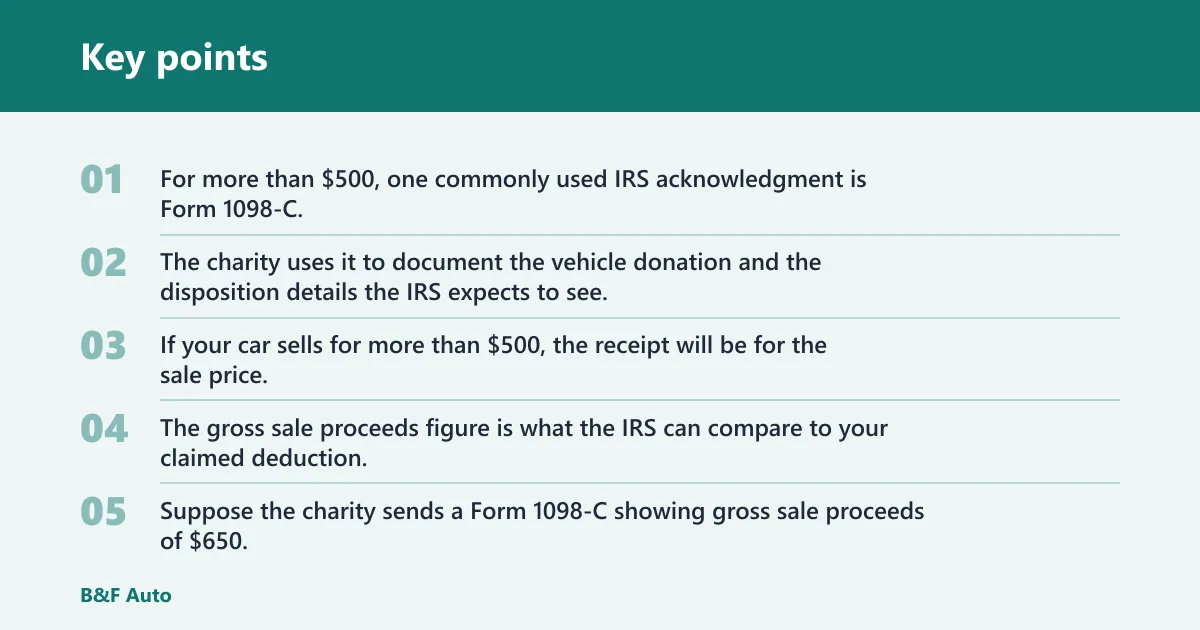
For more than $500, one commonly used IRS acknowledgment is Form 1098-C. The charity uses it to document the vehicle donation and the disposition details the IRS expects to see. If the car sold, the form should reflect that sale; if the charity claims an exception, the form should show the certification details instead.
How sale proceeds or certification show up
The gross sale proceeds figure is what the IRS can compare to your claimed deduction. If the charity used the car in a qualifying way or made a qualifying improvement, the form may instead support a deduction amount above the sale proceeds under the IRS rules.
Suppose the charity sends a Form 1098-C showing gross sale proceeds of $650. That number matters for your deduction paper trail. If the form also states that the charity had significant intervening use or made a material improvement before sale, the deduction may not be limited to the sale price in that exception case.
Why the form matters for deductions over $500
Form 1098-C is the bridge between the charity’s records and your return. For many vehicle gifts over $500, the IRS wants the charity’s written acknowledgment plus the donor’s reporting forms. If the charity never issues the form, or issues one with incomplete vehicle details, the IRS record is incomplete even if you have an email from the towing company.
Do you need Form 8283 too?
Yes, in many cases. For more than $500, Form 8283 Section A is required for vehicle donations, and the form may need to be attached to a paper return or handled through the e-filing process in the way your software or preparer specifies. Keep the vehicle details consistent with the charity’s acknowledgment, especially the VIN when available.
Section A for vehicle donations
Form 8283 reports the noncash gift on your tax return. For a donated car, Section A is the part commonly used when the deduction is over $500. The form should match the receipt and Form 1098-C on the vehicle identity, donation date, and reported value basis.
When e-filing changes the attachment process
For e-filing, Form 8453 may be needed in some situations, but that process can vary by return software and filing method. The safest approach is to follow the current e-file instructions from your preparer or software and keep the signed acknowledgment and 8283 together in your records. Do not rely on outdated attachment habits.
When a qualified appraisal may apply
Vehicle donations over $5,000 may trigger additional appraisal and reporting requirements. A qualified appraisal may also matter in exception cases where you claim fair market value above sale proceeds. That is not the standard route for a basic car donation, so check the appraisal rules before you claim a higher amount.
What if the charity sold the car?
If the charity sold your car, the sale result often controls the deduction amount. If the car sells for more than $500, the receipt will be for the sale price. The charity’s disclosure should make clear whether the deduction is tied to sale proceeds or to a qualifying exception.
Gross sale proceeds and deduction limits
The sale price is important because the IRS can compare it to what you claim. If the charity sold the car for $650, that figure is the starting point for the deduction record. If the car sold for less than $500, the deduction rules depend on the claimed amount, fair market value, and whether special vehicle-donation rules apply. The charity’s acknowledgment still needs to be kept with your records.
Exceptions for significant use or improvement
Do not assume every deduction ends at the auction result. The IRS has exceptions when the charity makes significant intervening use of the vehicle or a material improvement before resale. In those cases, the deduction may follow the exception rules rather than the bare sale figure, and Form 1098-C should reflect that basis.
When fair market value still matters
Fair market value is the donor’s value measure, and it can matter when the charity’s reporting rules allow it or when an exception lets you claim value above the sale proceeds. If you are claiming fair market value rather than the sale amount, keep the basis for that valuation and be ready to support it with appraisal or condition records if required.
What records should you keep?
Keep the charity’s written acknowledgment, Form 1098-C, Form 8283, and any donation correspondence with your tax return records. If the receipt is corrected, keep both the original and corrected versions so the paper trail stays clear. If the VIN is missing or the acknowledgment is late, document the follow-up request and save the response.
Receipt, forms, and donation correspondence
Save the acknowledgment, the donor copy of Form 1098-C, the copy of Form 8283, and any emails or letters showing the donation date or disposition update. If the charity emailed a receipt first and mailed a corrected one later, keep both. The IRS looks for consistency, not a single loose document.
What to save if the receipt is corrected
Suppose the original receipt names the charity and donation date but leaves off the VIN. Ask for a corrected written acknowledgment and keep the first version too. The correction shows you tried to fix the record promptly, which helps if the IRS ever asks why the first copy was incomplete.
How to document a missing VIN or late acknowledgment
Request a corrected receipt. Ask the charity to reissue the acknowledgment with the missing vehicle details, donation date, or sale disclosure. A corrected document is better than a note added by the donor.
Save the follow-up trail. Keep the email or letter where you requested the correction and any reply from the charity. That paper trail can explain why the final receipt differs from the first one.
Match your return to the final form. Use the corrected receipt, Form 1098-C, and Form 8283 when you file. If the acknowledgment arrived after filing, speak with a tax professional about whether an amended return is needed.
Frequently asked questions
Do I need Form 1098-C for a donated car?
For more than $500, one commonly used IRS acknowledgment is Form 1098-C in many vehicle-donation cases. It is the charity’s written acknowledgment for motor vehicles, boats, and airplanes, and it shows the sale proceeds or certification details the IRS needs to compare with your claim.
What vehicle details must be on a car donation receipt?
The receipt should include a vehicle description. Add the VIN when available, and keep the odometer reading if the charity provides it. Those details make the acknowledgment specific enough to match the car you actually donated, which matters if the IRS asks for support.
Does the receipt need the donation date and pickup location?
The donation date is a required record item. Pickup location may be helpful, but it is not a standard required element of the IRS written acknowledgment. If the charity includes the pickup site, save it, but do not rely on it in place of the actual donation date and vehicle description.
What if the charity sold my car for more than $500?
The gross sale proceeds should be shown on Form 1098-C. Keep that form with Form 8283 and your return records.
What records should I keep with my tax return after donating a car?
Keep the charity’s written acknowledgment, Form 1098-C, Form 8283, and any follow-up emails or letters about the donation or sale. If the receipt is corrected, keep both versions. If the acknowledgment arrives late, keep the dated request and reply so the filing history is clear.
When does a car donation receipt need to be issued?
The acknowledgment should be timely enough to support the return, which means it should reach you in time for filing. If the charity sells or disposes of the car, the related notice is tied to the specific reporting deadlines for sale, transfer to a needy individual, significant intervening use, or material improvement. Late paperwork can force a delay or an amended return.