Donation Tax Receipt for a Car Donation
For a car donation tax deduction, the key IRS proof is the charity’s written acknowledgment, and if the vehicle is worth more than $500, you generally also need Form 1098-C or its equivalent. Use the wrong document or the wrong amount, and the IRS can deny the deduction or cap it at the charity’s sale proceeds. This guide spells out what a towing receipt actually proves, when the acknowledgment and 1098-C should arrive, and how each document affects the amount you can deduct.
A car-donation file usually has three separate records with three separate jobs: the towing receipt confirms pickup occurred, the charity acknowledgment substantiates the gift, and Form 1098-C can set the deductible amount for many vehicle donations above $500. Title transfer sits in the middle, because the charity often cannot finish processing until the title is signed over and accepted.
What counts as a donation tax receipt for a car donation?
The document that usually matters for the IRS is the charity’s written acknowledgment, not the slip handed over by the tow driver. For vehicle donations over $500, Form 1098-C or a substantially similar statement is commonly the key tax document. The title transfer affects when the charity can issue that final record.
The pickup receipt versus the tax acknowledgment
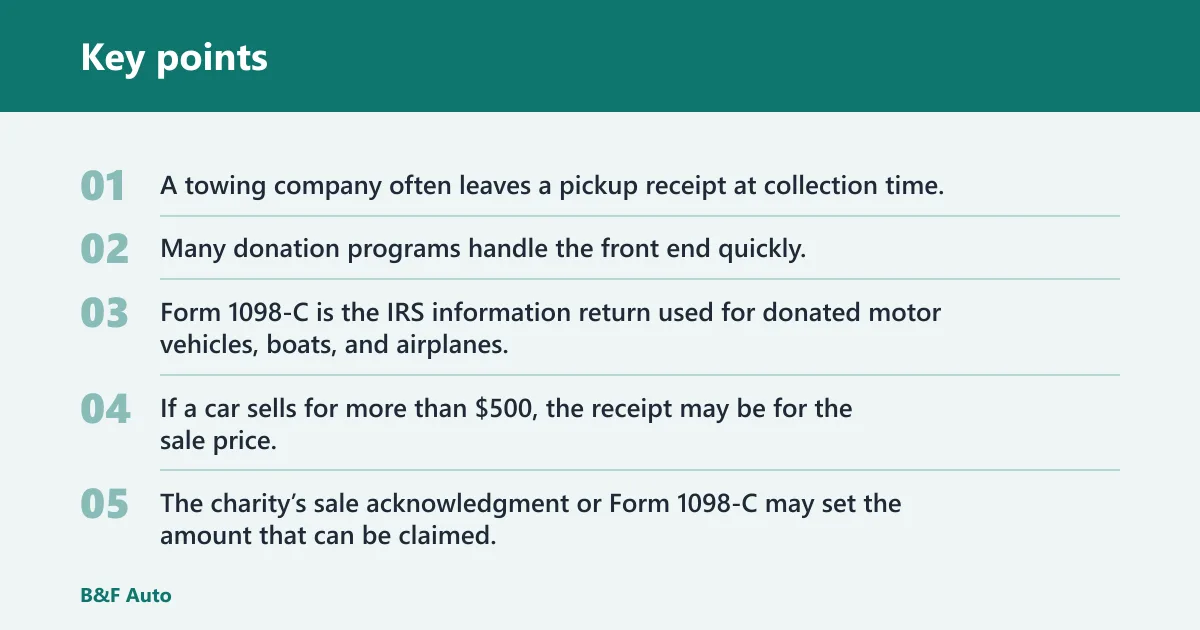
A towing company often leaves a pickup receipt at collection time. That paper shows that the vehicle was picked up on behalf of the charity. It can help later if there is a dispute over dates, storage fees, or whether the vehicle was actually surrendered.
It is not, by itself, the final substantiation for a charitable deduction. For contributions of $250 or more, the IRS generally looks to the charity’s written acknowledgment, and that acknowledgment should be in hand before the return is filed or by the filing deadline, including extensions.
Many donation programs handle the front end quickly. Pickup can happen within 24 hours, sometimes the same day, but the tax document is often not ready at that point because the charity may still need title processing and sale or use information.
Where Form 1098-C fits
Form 1098-C is the IRS information return used for donated motor vehicles, boats, and airplanes. A donor may receive it instead of a simple receipt because it can include the statements the IRS wants for vehicle donations above $500, especially when the charity sells the vehicle.
If a car sells for more than $500, the receipt may be for the sale price. That is why a plain pickup slip and a donor’s estimate are not enough in many cases. The charity’s sale acknowledgment or Form 1098-C may set the amount that can be claimed.
Why the title transfer affects the final receipt
The charity often mails the tax-deductible donation receipt after receiving the vehicle and title. Many intake forms even ask whether the title is available, because missing title work slows the legal transfer and the tax paperwork that follows.
Suppose a sedan is towed on Monday but the signed title is still in a desk drawer. The pickup receipt can show Monday’s collection date, yet the charity may hold the file open until the title arrives, and the final acknowledgment may not go out until that step is complete.
Which charities can issue a deductible car donation receipt?
A qualified 501(c)(3) charity is generally required to support a charitable deduction for a donated vehicle. The tow company cannot issue the tax substantiation, even if it handled pickup. If the organization is not eligible, the paperwork may still show a transfer, but it will not support a charitable deduction.
Qualified 501(c)(3) status and deductibility
The starting point is the recipient organization, not the vehicle. If the donation goes to a qualified 501(c)(3) charity, the acknowledgment can support a deduction if the rest of the rules are met. If it goes to a nonqualified group, the receipt does not turn it into a deductible gift.
This is where donors get tripped up by branded car-donation programs. The phone number, website, dispatcher, or local pickup vendor may be different from the legal charity. The substantiation should identify the charity itself.
Why a for-profit towing vendor cannot issue the tax substantiation
The tow operator is usually only the logistics provider. It can document pickup, mileage condition notes, keys collected, and where the vehicle was taken. It cannot stand in for the charity’s written acknowledgment, because it is not the donee organization receiving the charitable contribution.
Some donation forms ask operational questions such as whether the vehicle can drive 20 miles and whether the condition is good, fair, or poor. Those details help dispatching and auction handling. They do not decide deductibility on their own.
How to verify the charity before relying on the receipt
Check the legal name on the acknowledgment or Form 1098-C and make sure it matches the qualified charity that actually received the donation. If the pickup receipt shows only a towing company, ask for the charity’s full legal name and the donor-services contact before filing.
A common first-timer mistake is assuming the top logo on a tow slip is the charity. If the final acknowledgment later names a different organization, match the VIN, donation date, and title transfer records before relying on it.
What should the IRS receipt include?
The IRS-ready acknowledgment should identify the donor, the charity, the vehicle, and the date of contribution, and it should state whether any goods or services were provided in return. For higher-value vehicle donations, it also should state whether the charity sold, used, or materially improved the car.
Core fields in the written acknowledgment
At minimum, the charity record you keep for taxes should include these items:
- Donor name
- Charity name
- Date of contribution
- Vehicle identification details, such as year, make, model, and VIN
- A statement that no goods or services were provided, or a description and good-faith estimate if any were provided
For contributions of $250 or more, the written acknowledgment is required substantiation. Timing matters as much as content. You must receive it before filing the return or by the filing deadline, including extensions. (IRS)
Vehicle details that should appear
The more clearly the record ties the tax document to one specific vehicle, the better. Year, make, model, and VIN are the standard identifiers. The date the charity treated the vehicle as contributed should also be clear, because that date ties to the tax year of the deduction.
If the title transfer date and pickup date differ, keep both. The pickup receipt can support when the vehicle left your control, while the final acknowledgment should still carry the charity’s contribution record and the required tax statements.
Sale, use, or improvement statements
When the charity sells the vehicle, the final document should state that the vehicle was sold in an arm’s-length transaction and list the gross proceeds if that figure controls the deduction. When the charity keeps or materially improves it, the acknowledgment or Form 1098-C should say so and describe that intended use or improvement.
Those statements matter because they can change the deduction path. A donor’s estimate does not control if the charity later sells the car and the rules tie the deduction to sale proceeds.
When will you get the final tax document?
The towing receipt usually arrives at pickup, but the final tax document often comes later, after the charity receives the vehicle, completes title processing, and decides whether the car will be sold, used, or materially improved. You still must have the required acknowledgment before filing a return or by the filing deadline.
After pickup and title transfer
Most donors first see a tow slip. The charity’s tax-deductible donation receipt is commonly mailed after receiving the vehicle and title. If the title is missing, signed incorrectly, or still held by a lender, the tax paperwork can lag even though the car is already gone.
Many programs say pickup arrangements are made within 24 hours, and some offer free professional towing within 24-48 hours. Those service windows describe logistics, not the IRS document deadline.
After sale, use, or material improvement
For vehicles above $500, the charity may need to know what happened to the vehicle before sending the final tax record. If it sells the car, the sale proceeds may need to appear on the acknowledgment or Form 1098-C. If it keeps the car for a significant exempt use or materially improves it, that statement should appear instead.
Picture an older SUV picked up on Tuesday. The tow slip is immediate, but the final tax document may wait until the charity either sells the SUV or records that it will use it in operations. That later document, not the tow slip, governs the deduction path.
The deadline rule donors miss
The donor does not get extra time just because the charity is slow. If the required written acknowledgment is missing when the return is filed, or still missing by the filing deadline including extensions, the deduction can be denied even if the donation itself happened.
That makes follow-up especially useful in late winter. If the car was donated near year-end and the charity is still processing title or sale information, ask for the status well before filing.
How do deduction rules change the document you need?
The value path changes the paperwork. If the vehicle is worth $500 or less, the donor generally claims fair market value, up to $500, using a reasonable valuation method. Above that range, Form 1098-C or equivalent sale or use statements often control, and Form 8283 may also be required.
Vehicles valued at $500 or less
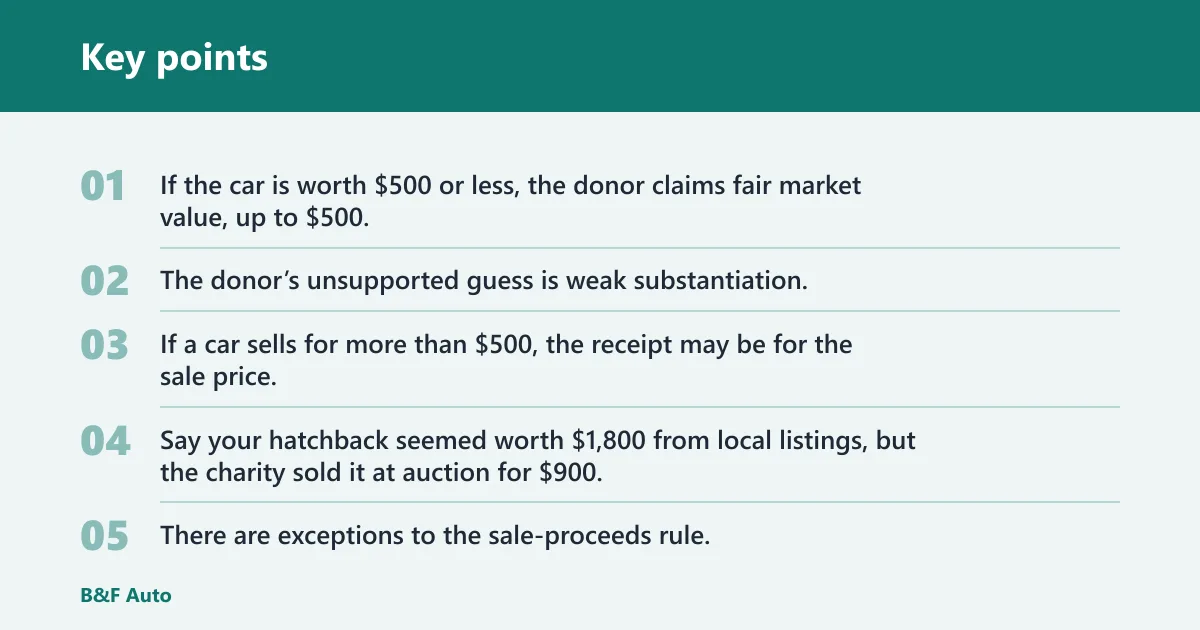
If the car is worth $500 or less, the donor claims fair market value, up to $500. In that limited lane, the donor should keep the charity acknowledgment plus valuation support showing how that fair market value was determined.
Reasonable valuation support can include condition notes, comparable private-party listings for the same model and trim, mileage, title status, and photos. The donor’s unsupported guess is weak substantiation.
Vehicles sold by the charity for more than $500
If a car sells for more than $500, the receipt may be for the sale price. That means the charity’s gross sale proceeds, shown on the acknowledgment or Form 1098-C, may determine the deduction rather than the donor’s pre-donation estimate.
Say your hatchback seemed worth $1,800 from local listings, but the charity sold it at auction for $900. If the sale-proceeds rule applies, the $900 figure on the charity document is the amount that matters, not the earlier estimate.
Vehicles the charity keeps or materially improves
There are exceptions to the sale-proceeds rule. If the charity makes a significant intervening use of the vehicle or materially improves it before transfer, the donor may be able to claim more than the immediate sale amount would otherwise allow. The acknowledgment or Form 1098-C should reflect that use or improvement.
Do not assume an exception applies because a representative mentioned repairs or program use on the phone. The file should show the required statement in writing.
When Form 8283 and a qualified appraisal matter
IRS Form 8283 generally enters the picture for noncash charitable contributions over $500. For many car donations in that range, the donor completes Form 8283 and keeps the charity acknowledgment or Form 1098-C with the return records.
For claimed values of more than $5,000, a qualified appraisal is generally required, and Form 8283 Section B can require signatures, including the charity’s acknowledgment of receipt. That is separate from the charity’s own written acknowledgment. One does not replace the other. (IRS)
Receipt paperwork decision table
| Donation value | Charity sold the car or kept it | Pickup receipt received | Form 1098-C expected | Keep for IRS substantiation |
|---|---|---|---|---|
| $500 or less | Either | Yes or no | Usually no | Charity written acknowledgment, fair-market-value support, and pickup receipt if available |
| Over $500 | Sold by charity | Yes | Usually yes | Form 1098-C or equivalent sale acknowledgment showing gross proceeds, plus pickup receipt and title records |
| Over $500 | Kept for significant use | Yes or no | Usually yes | Form 1098-C or equivalent stating intended significant use, plus written acknowledgment and title records |
| Over $500 | Materially improved | Yes or no | Usually yes | Form 1098-C or equivalent stating material improvement, plus written acknowledgment and title records |
| Over $500 and up to $5,000 claimed | Any | Any | Often yes | Written acknowledgment or 1098-C, Form 8283, valuation support as applicable, and title records |
| More than $5,000 claimed | Any | Any | Often yes | Written acknowledgment or 1098-C, qualified appraisal, Form 8283 Section B, and title records |
How do you get, replace, or correct the receipt?
The fix depends on which paper is missing. A pickup receipt can often be recovered from the towing vendor, but the tax substantiation must come from the charity. Wrong sale prices, missing VINs, and late acknowledgments should be corrected before filing when possible, because filing first can leave the deduction exposed.
Requesting the right document
- Check the charity name. Pull the pickup slip, title copy, tow dispatch email, and any donation confirmation. Confirm the legal charity that received the vehicle, because the towing company may not be the organization that can reissue the tax acknowledgment.
- Match the vehicle details. Gather the VIN, year, make, model, pickup date, and title-transfer date. Those details let the charity find the file fast and reduce the risk of a reissued record with the wrong vehicle.
- Ask for the specific paper. Request the charity’s written acknowledgment, Form 1098-C, or corrected sale statement by name. Saying only “send my receipt” often leads to another tow slip, which does not fix the substantiation problem.
- Review the tax fields. Before filing, check for donor name, charity identity, date of contribution, vehicle identifiers, the goods-or-services statement, and sale or use language if applicable. If one field is wrong or missing, ask for a corrected copy rather than annotating the form yourself.
- Hold the return if needed. If the required acknowledgment for a $250-or-more contribution is still missing, filing first can cost the deduction. It is usually better to secure the proper acknowledgment before filing than to rely on later cleanup.
If you only have the towing receipt
Contact the charity, not only the tow vendor, and ask for the final written acknowledgment or Form 1098-C. The tow slip can support that pickup occurred, but it does not by itself satisfy the IRS substantiation rules for the deduction.
If the acknowledgment never arrived
Ask whether title transfer is still pending or whether the vehicle has not yet been sold or coded for exempt use. Those two delays explain many missing-receipt cases. If the charity says the document was already issued, request a duplicate by email and by mail.
If the value or sale information is wrong
Request a corrected acknowledgment from the charity in writing. Point to the exact error, such as a bad VIN digit, wrong sale proceeds, or a missing statement about significant use. Keep the original, the correction request, and the corrected document together.
If the return was already filed
Do not assume the missing paper can simply be added later without issue. The acknowledgment timing rule still matters. If the charity corrects a clerical error on a timely document, that is one thing. If the donor filed before receiving a required acknowledgment, an amended return may not solve the underlying substantiation problem.
Can you use an email copy or duplicate receipt?
Yes, an email copy or duplicate can work if it contains the required information and the donor keeps it in readable form with the tax records. The IRS cares about whether the acknowledgment has the needed content and was received on time, not whether it arrived on paper.
When an electronic acknowledgment works
An emailed PDF, scanned letter, or electronic statement can be acceptable if it clearly shows the charity identity, donor identity, vehicle details, contribution date, and the required goods-or-services language. If sale proceeds or exempt use control the deduction, those statements should also appear.
What to keep with a reissued copy
Keep the duplicate acknowledgment together with the original request for reissue, the pickup receipt, title transfer copy, and any envelope or email header showing when the replacement was sent. Those records help show that the duplicate is a true reissue of the original tax document, not a later reconstruction.
Recordkeeping that holds up better
Save the file in more than one place. Keep the email, the attachment, and a downloaded PDF. If Form 8283 or an appraisal applies, store those in the same file so the paperwork chain stays intact from pickup through filing.
Frequently asked questions
What is a donation tax receipt for a donated car?
For tax purposes, the important receipt is usually the charity’s written acknowledgment, and for many vehicle donations above $500 it may be Form 1098-C or a similar statement. A towing receipt only proves pickup happened. It does not, by itself, establish the deductible amount.
When will I get my car donation tax receipt?
The pickup receipt often comes at collection time, but the final tax document usually comes after the charity receives the vehicle and title and then determines whether the car was sold, used, or materially improved. The donor still needs the required acknowledgment before filing or by the filing deadline.
What should a car donation tax receipt include for the IRS?
It should identify the donor, the charity, the vehicle, and the date of contribution, and it should state whether any goods or services were provided in return. If sale proceeds, significant use, or material improvement affect the deduction, that statement should appear as well.
Can I deduct a donated car without a donation receipt?
Usually no if the required written acknowledgment is missing. A tow slip alone is not enough substantiation.
Why did the charity send Form 1098-C instead of a receipt?
Because Form 1098-C is often the main IRS document for donated motor vehicles, boats, and airplanes. It can replace or supplement a simple donation letter by stating the vehicle details and the sale, use, or improvement information that can determine the deductible amount.
Do I need an appraisal for a car donation tax deduction?
Not always. Many donors do not need an appraisal, especially when the vehicle falls into the sale-proceeds rules or the claimed value does not exceed $5,000. For claimed values of more than $5,000, a qualified appraisal is generally required along with Form 8283 Section B.