How Do You Get a Donation Tax Receipt After Donating a Car?
You usually need a contemporaneous written acknowledgment from the charity, and in many vehicle-donation cases that is Form 1098-C or a comparable statement that meets IRS rules. The right document depends on how the car was used, sold, or transferred, and on whether your deduction is limited to gross proceeds, fair market value, or an exception rule. If the paperwork is missing or wrong, the deduction can shrink or disappear.
What receipt you need
The first task is separating a pickup receipt from the IRS acknowledgment. A tow slip, pickup note, or donor copy from the handoff only proves the car was collected. It does not always include the details needed for the return. For a donated vehicle, IRS Publication 526 generally requires a contemporaneous written acknowledgment from the charity, and Form 1098-C instructions explain what the charity must report when a vehicle is donated.
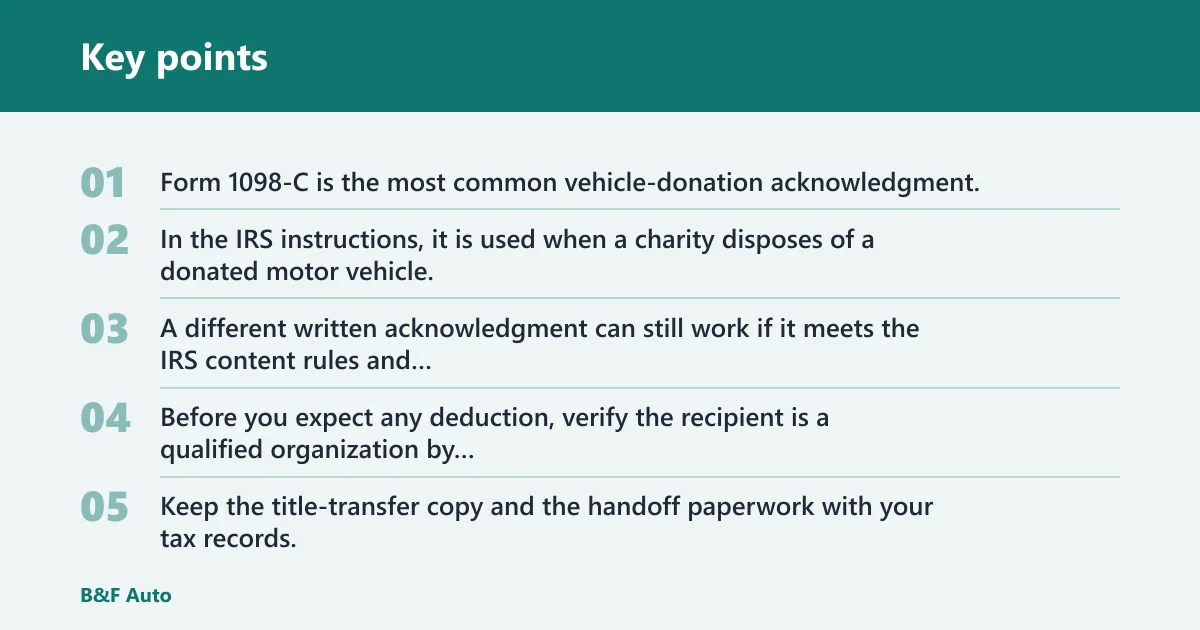
Form 1098-C is the most common vehicle-donation acknowledgment. In the IRS instructions, it is used when a charity disposes of a donated motor vehicle, boat, or airplane and must report the relevant facts, including whether the vehicle was sold and the gross proceeds from the sale. A different written acknowledgment can still work if it meets the IRS content rules and timing rules.
Before you expect any deduction, verify the recipient is a qualified organization by checking IRS Tax Exempt Organization Search. Keep the title-transfer copy and the handoff paperwork with your tax records. If the charity is not eligible, the receipt may not support a charitable deduction at all.
What the acknowledgment should show
A vehicle donation acknowledgment should identify the donor and the charity, describe the vehicle, show the date of the contribution, and state whether the charity gave goods or services in return. Under the Form 1098-C instructions, it also needs the vehicle identification number, and if the charity sells the vehicle, it must report the gross proceeds from the sale or state that the vehicle will not be used in a way that changes the deduction rule. Publication 526 and the Form 8283 instructions also tie the deduction to the proper substantiation level.
That is why a pickup receipt alone is often not enough. It can support your records, but it may not contain the gross-proceeds amount, the charity’s qualified status, or the written acknowledgment language the deduction rules require.
Which car donation document do you need?
| Donation situation | Document you need | Required IRS filing support | Does Form 1098-C apply? | What to do if it is missing or wrong |
|---|---|---|---|---|
| $500 or less | Pickup receipt plus any written acknowledgment the charity gives you | Keep records showing the donation and qualified charity; no Form 1098-C is generally required for the deduction amount alone | No, not usually required | Ask for a donor copy or email acknowledgment that identifies the vehicle and charity |
| More than $500 but not more than $5,000 | Contemporaneous written acknowledgment, often Form 1098-C | Form 8283, Section A, plus the acknowledgment for your records | Often yes, if the charity uses it to report the vehicle disposal | Request a corrected acknowledgment with the right VIN, date, and sale or use information |
| More than $5,000 | Written acknowledgment plus qualified appraisal support, unless an exception applies | Form 8283, Section B, and the appraisal rules under the Form 8283 instructions | Often yes, if the charity disposes of the vehicle and must report the disposition | Get the acknowledgment corrected and confirm the appraisal and signature requirements before filing |
| Charity uses the vehicle in its charitable work | Written acknowledgment stating the use | Schedule A with substantiation that the use exception applies | May still be used, but the deduction is not limited by gross proceeds if the use exception is met | Ask the charity to state the intended or actual use clearly in writing |
| Charity materially improves the vehicle | Written acknowledgment describing the improvement | Schedule A and, when needed, Form 8283 with appraisal support for higher-value claims | May still be used, but the exception changes the deduction rule | Request a corrected statement showing the improvement description |
| Charity gives the vehicle to a needy individual at below-market value | Written acknowledgment showing the transfer terms | Schedule A and the exception documentation required by Publication 526 | May still be used, but the charity must document the qualified transfer | Ask for a revised acknowledgment that states the recipient use and terms |
How do you get the receipt?
You get the receipt by asking for it at the time of pickup or handoff and then matching the document to the car’s details. If the charity later sends the wrong version, ask for a corrected copy that lists the same VIN, donation date, and donor name you used for the transfer. Keep every version until the return is filed.
Use the vehicle details to trigger the search
If the receipt never arrives, send the charity the VIN, donation date, your name, and the pickup location again. That narrows the search to one vehicle and one donor record. If the charity sold the car, the sale record is what often drives the final acknowledgment under the Form 1098-C instructions.
Say your sedan was picked up from your driveway on a Tuesday morning, but the receipt that arrives later lists a different VIN. Do not file it as-is. Ask for a corrected acknowledgment before you claim the deduction, because the wrong vehicle number can break the support for the return.
Keep the handoff evidence
- Save the tow receipt or pickup slip.
- Keep a copy of the title transfer.
- Save emails or letters from the charity.
- Record the VIN and the donation date in your files.
- Store any sales notice or acknowledgment with your tax records.
When will the charity send my car donation tax receipt?
The timing depends on what the charity does with the car and which acknowledgment rule applies. The key point is not a universal calendar date; it is whether the charity provides the right written acknowledgment with the required vehicle information. Under the Form 1098-C rules, the charity generally provides the donor copy after the vehicle is sold, transferred, or otherwise disposed of in the required way. If the car is kept or used by the charity, the acknowledgment still needs to support the deduction claim.
What to expect while you wait
If the car has not sold yet, do not assume the paperwork is complete just because pickup happened. Save the tow record, title copy, and any email from the charity. Those records help if the acknowledgment arrives later or the first copy is incomplete.
Picture a pickup on the first day of the month and a follow-up email two weeks later saying the car is still waiting to be sold. The handoff slip still helps your file, but it is not the same as the written acknowledgment needed for the return. Keep both until the final form arrives.
What if I did not get a car donation receipt after pickup?
Start with the charity’s donor or tax office and ask for the written acknowledgment tied to your vehicle. Send the exact VIN, donation date, and your contact information again. If the charity still does not respond, keep the pickup record, title-transfer proof, and all emails so you can show you tried to recover the document.
How to press for the right copy
Ask whether the charity issued Form 1098-C or another contemporaneous written acknowledgment. If they sent only a pickup receipt, request the full donor acknowledgment instead. If the value, VIN, or date is wrong, ask for a corrected version rather than trying to fix the charity’s document yourself.
Can I claim a deduction if I only have the pickup receipt?
A pickup receipt by itself is not a safe substitute for the charity’s written acknowledgment. It can be part of your records, but it may not prove the items the IRS needs, especially the vehicle identification, donation date, qualified charity status, and any sale information. For deductions over $500, Publication 526 and the Form 8283 instructions make the written acknowledgment part of the filing path.
Why the pickup slip falls short
The pickup document usually proves possession changed hands. It does not always prove the donation was made to a qualified 501(c)(3) charity, and it often does not show gross proceeds or the vehicle-specific statement needed for the deduction file. Keep it, but do not treat it as the whole record.
Do I need Form 1098-C to deduct a donated car?
Not always. Form 1098-C is commonly used for vehicle donation acknowledgments, but the IRS also allows another contemporaneous written acknowledgment if it contains the required information. The point is to have the charity’s written support, not necessarily one exact form in every case.
When Form 1098-C matters most
Form 1098-C matters most when the charity disposes of the vehicle and must report the sale or transfer details. The instructions require the charity to report the gross proceeds from sale if the vehicle is sold, and the donor uses that statement to determine the deduction limit. If the charity uses a different written acknowledgment, check that it still identifies the donor, charity, VIN, donation date, and the gross-proceeds or exception information needed for your filing.
How much can you claim?
The deduction is not always the car’s fair market value. Publication 526 says the deduction is generally limited to the gross proceeds from the sale when the charity sells the vehicle, unless one of the exception rules applies. If the charity uses the vehicle, materially improves it, or gives it to a needy individual at below-market value, the deduction may be based on fair market value instead of sale proceeds.
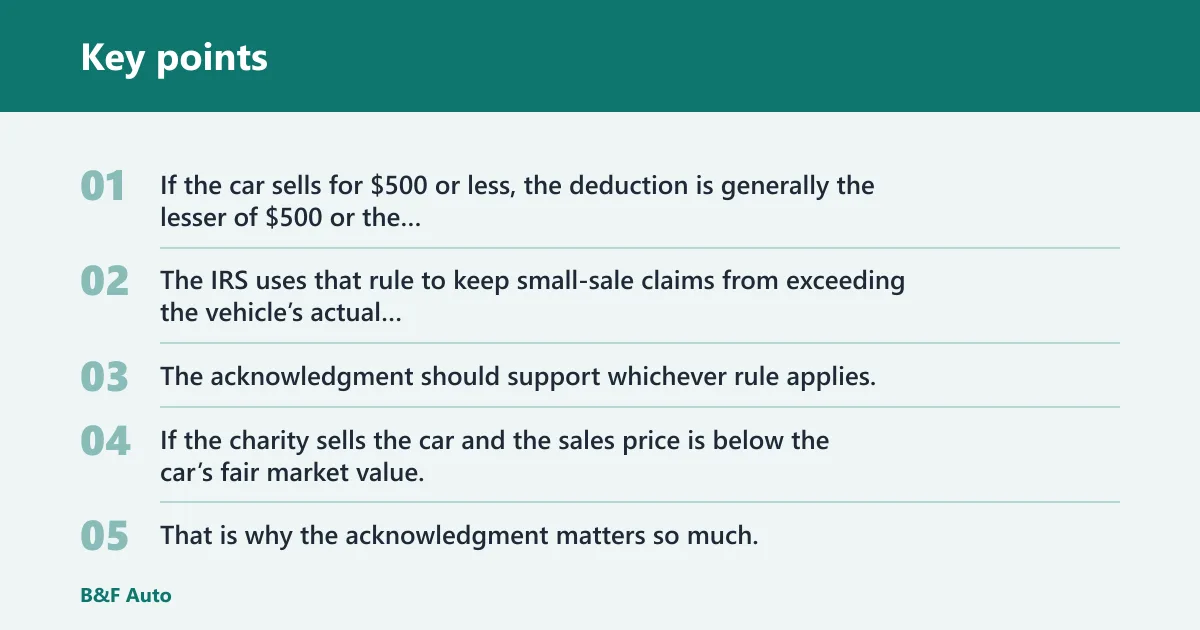
If the car sells for $500 or less, the deduction is generally the lesser of $500 or the car’s fair market value. The IRS uses that rule to keep small-sale claims from exceeding the vehicle’s actual value. The acknowledgment should support whichever rule applies.
When the sale price controls the deduction
If the charity sells the car and the sales price is below the car’s fair market value, the gross proceeds may cap the deduction. That is why the acknowledgment matters so much. It tells you whether the deduction is tied to gross proceeds or to one of the exception rules.
Suppose a pickup truck looks valuable from a used-car guide, but the charity sells it for less than that because it needs repairs. The guide may help you estimate fair market value, but the actual deduction can still be limited by the sale result unless an exception applies.
When a qualified appraisal is needed
Under the Form 8283 instructions, a qualified appraisal is generally required for noncash contributions over $5,000 unless the IRS provides a specific exception. The receipt alone is not enough for a higher-value claim.
A qualified appraisal is a written valuation prepared by a qualified appraiser in the form and timing the IRS requires. It is not the same as a dealership quote, a donation receipt, or a Kelley Blue Book printout. For a larger vehicle donation, the appraisal and the filing forms need to line up with the deduction rule you are using.
What to file on your return
The charitable deduction is generally claimed on Schedule A, and itemizing is required. That means you do not just keep the receipt in a drawer. You use it to support the itemized charitable deduction on the return, along with any required forms and the title-transfer record.
Form 8283 by threshold
For noncash gifts over $500, the Form 8283 instructions require Form 8283 with your return. For more than $5,000, you generally use Section B and follow the qualified appraisal and charity-signature rules. Keep the acknowledgment with your records even when the form is attached or filed separately as required by the software or preparer.
A common first-timer mistake is treating the email copy as optional because the charity already called the pickup complete. The email may be the only acknowledgment you get, and it still counts as part of the paper trail if it contains the required details. Save the message as a PDF and keep the attachment.
How car donation works in Richmond, VA
In Richmond, the process is the same basic document chain: verify the charity in IRS Tax Exempt Organization Search, transfer the title, save the pickup record, and wait for the written acknowledgment that matches the car. The location changes the logistics, not the tax rules. Your records should still show the VIN, donation date, and who received the vehicle.
1-800-Donate-Cars — How car donation works in richmond: Free tow to tax receipt mailed
For any donation program, “free tow” does not replace the tax paperwork. A tow pickup is only the first record. The receipt you need is the charity’s written acknowledgment, and it should line up with the title transfer, the VIN, and the final donation details before you file Schedule A. If the charity’s marketing name is not the same as the qualified organization that receives the vehicle, check the recipient in IRS Tax Exempt Organization Search before relying on the paperwork.
Frequently asked questions
How do you get a donation tax receipt after donating a car?
Ask for the charity’s written acknowledgment at pickup, then follow up with the VIN, donation date, and your contact details. Keep the tow record and title copy. If the first document is only a pickup slip, request the full acknowledgment or a corrected copy that matches the vehicle and the charity’s records.
What happens if the car donation receipt shows the wrong value?
Ask the charity for a corrected acknowledgment before filing. A wrong value can change the deduction amount, especially when gross proceeds cap the deduction or when a fair market value exception might apply. Keep the incorrect copy too, so you can show how the error was fixed.