What Is a Reasonable First Car Budget on Your Income?
A first-car budget is commonly set at about 15% of monthly take-home pay for total car costs, with the payment itself near 10% of net income. Miss that mark, and insurance, fuel, repairs, and due dates can squeeze cash flow quickly. This guide shows how to turn your take-home income into a monthly car limit and a realistic purchase price.
How much should you spend on a first car?
The right cap starts with net pay, not gross pay. Use your take-home income from every regular source, subtract fixed essentials and debt minimums, then see what remains for car payment, insurance, fuel, and maintenance. A car that fits the sticker price but breaks the cash-flow plan costs too much.
Why the sticker price is only the starting point
The purchase price does not tell you what the car will cost each month. Insurance can be a large scheduled bill, fuel changes with commute length and local prices, and repairs continue after the sale. Housing and transportation made up 50.4 percent of average U.S. household spending in 2024, so transportation needs a real budget line, not a rough guess.
The income-based cap that keeps bills manageable
Start with monthly net income, then set a ceiling for total car costs near 15 percent. Keep the payment itself nearer 10 percent of net income so the car does not crowd rent, utilities, groceries, and debt minimums. A single-income budget has no second deposit to cover a timing error, so the margin matters.
Safe, stretch, and no-go budget bands
- Safe: total car costs stay at or below 15% of monthly take-home pay, and the payment stays near 10% or lower.
- Stretch: total car costs run above 15% but still leave room for insurance, fuel, and a repair reserve without skipping other bills.
- No-go: the car budget would force you to delay essentials, use a credit card for regular driving costs, or rely on perfect timing every month.
Take-home income and bill timing
Build the budget from net pay and the dates money actually arrives. That means counting regular income sources, converting weekly or biweekly pay correctly, and matching bill due dates so you can see where cash runs short before the month ends. A household can be frugal and still overdraft because bills cluster with a car repair.
Count regular income, not gross pay
Use take-home income after taxes and payroll deductions. Include wages, benefits, partner contributions, and other regular income sources you can count on each month. If income changes from month to month, use a conservative average, then test the result against a lower month.
Convert weekly and biweekly pay to a monthly number
For weekly pay, multiply by 52/12. For fortnightly pay, multiply by 26/12. If pay is monthly, use the actual monthly amount. That lets you compare the car against rent, utilities, food, and debt minimums on the same timeline.
Map paydays against rent, utilities, and debt minimums
Put every fixed bill on a calendar with the exact date it clears. Include rent, utilities, debt minimums, and the car payment. The point is not only whether the month balances on paper; it is whether cash is available when each charge posts.
Picture a paycheck on the 1st and the 15th, rent due on the 3rd, and insurance due on the 14th. The month can look fine on paper while the middle of the month is short. If the car payment lands before the second paycheck, the calendar may reveal a gap the monthly total hides.
What belongs in a first-car budget?
A first-car budget has three parts: the purchase or payment, the recurring ownership costs, and the one-time setup costs. Do not treat the purchase price as the whole budget. A cheaper car can still be unaffordable once insurance, fuel, registration, taxes, and repairs are added.
Monthly payment or purchase savings target
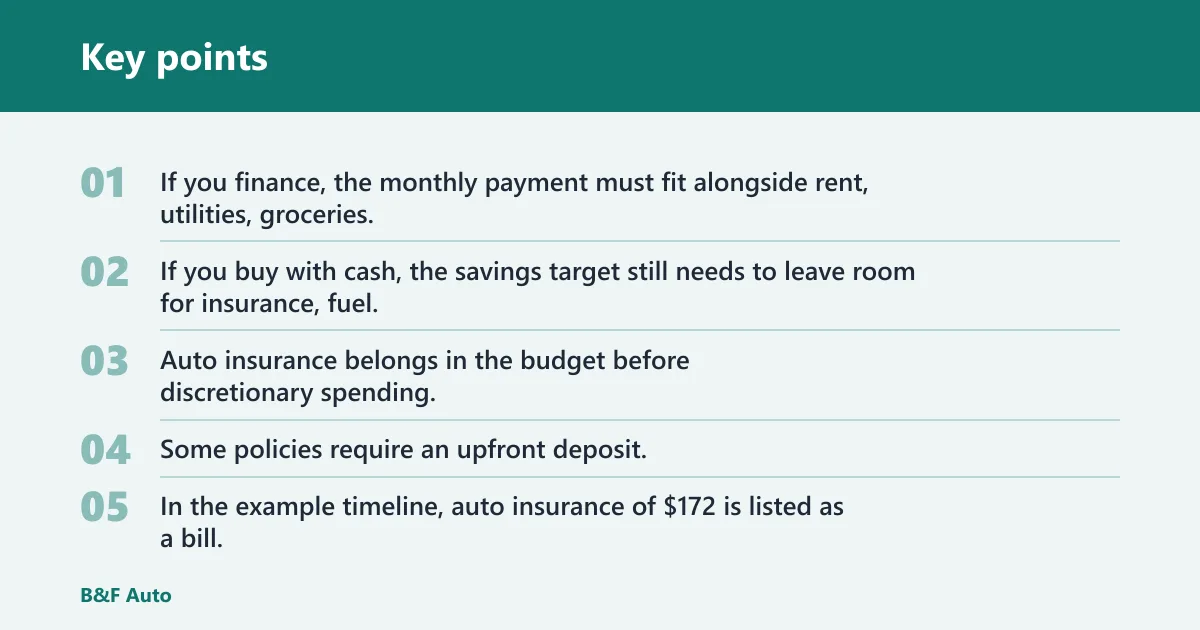
If you finance, the monthly payment must fit alongside rent, utilities, groceries, and debt minimums without taking over flexible spending. If you buy with cash, the savings target still needs to leave room for insurance, fuel, and a maintenance reserve after the sale.
Auto insurance, including deposits and annual premiums
Auto insurance belongs in the budget before discretionary spending. Some policies require an upfront deposit, and annual premiums can create a large cash-flow hit if you pay them in one lump sum. In the example timeline, auto insurance of $172 is listed as a bill, and that kind of scheduled charge needs a place in the plan.
Fuel, registration, taxes, maintenance, and repair reserves
Fuel is an essential variable expense tied to commuting distance and local driving habits. Registration, taxes, fees, and service costs should be spread across 12 months for budgeting. Maintenance and repairs are separate from the purchase price, and both should be reserved for before the car is in the driveway.
Suppose the car is cheap to buy but needs $60 a month for fuel, $40 for routine service savings, and a quarterly registration bill. The sticker price looked low. The monthly drain did not. That is why total ownership cost matters more than purchase price alone.
What is a car in budgeting?
A car in budgeting is a transportation cost that sits after essentials and debt minimums, then competes with the rest of your flexible spending. It is not a one-line purchase decision. It is a recurring claim on cash, and the budget should treat it that way from the start.
Place the car after essentials and debt minimums
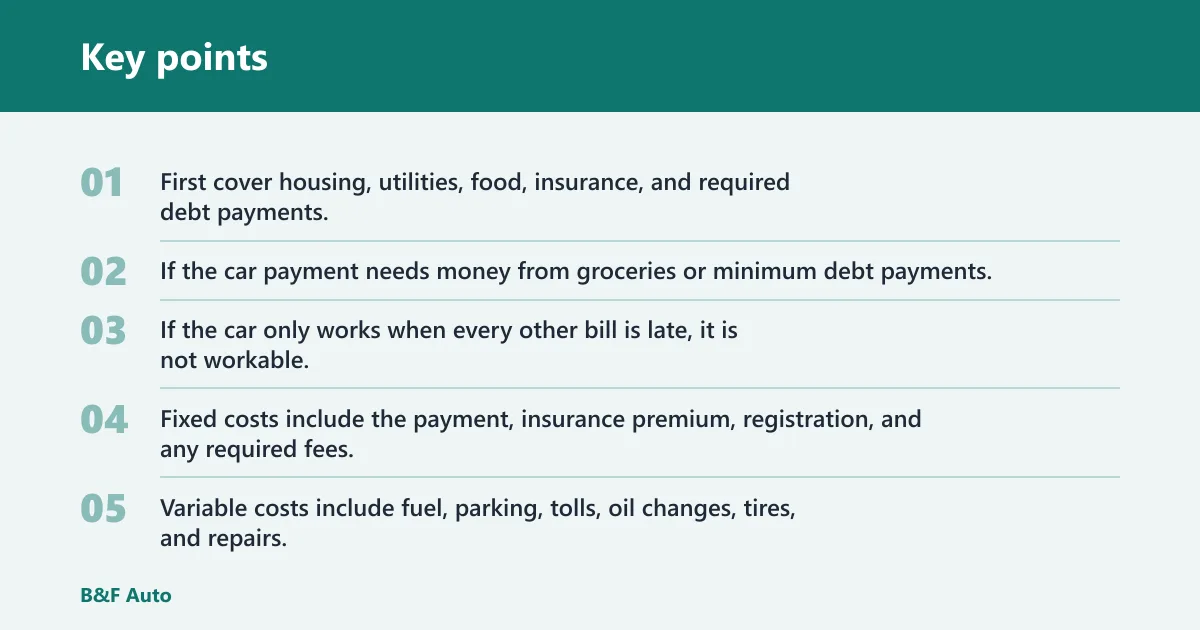
First cover housing, utilities, food, insurance, and required debt payments. Then fit the car into what remains. If the car payment needs money from groceries or minimum debt payments, the budget is too tight. If the car only works when every other bill is late, it is not workable.
Separate fixed costs from variable driving costs
Fixed costs include the payment, insurance premium, registration, and any required fees. Variable costs include fuel, parking, tolls, oil changes, tires, and repairs. Mixing them into one vague “car” line hides the true monthly burden and makes the budget harder to defend when cash gets tight.
Keep a cushion for irregular expenses
A reasonable starting buffer is the largest single bill in the month. That cushion helps when a repair lands near insurance, or when a recurring bill shows up a few days before payday. If the buffer is missing, a car that seemed affordable can trigger overdrafts fast.
How to budget monthly for auto expenses
Budget monthly by converting yearly costs into a monthly reserve, setting a fuel estimate from your real commute, and keeping a repair buffer. Then compare that number to the money left after essentials. Monthly affordability tells you whether the car is sustainable, not just whether the payment fits once.
Spread annual costs across 12 months
Insurance, registration, taxes, and regular service costs should be divided by 12 and reserved every month. That keeps large bills from wrecking the calendar when they arrive. If you pay insurance in full once a year, the monthly reserve still needs to be saved every month so the payment does not collide with rent.
Set a monthly fuel estimate from commuting needs
Use your commute length, local fuel prices, and expected weekend driving to build a monthly fuel estimate. Treat fuel as essential, not discretionary. If your driving pattern changes by season or job schedule, use the higher month as the planning number so you are not surprised later.
Build a repair buffer before you buy
Repairs are not optional, and older cars often need more room in the budget. Set aside a monthly reserve for routine maintenance and a separate amount for unexpected repairs. That reserve is what turns a “cheap” car into one you can keep on the road without skipping other bills.
First car affordability worksheet
Use this worksheet to turn income into a monthly car limit. The math starts with take-home pay, subtracts fixed essentials and debt minimums, then reserves annual ownership costs. The result gives you three thresholds: safe, stretch, and no-go.
| Item | Weekly pay example | Biweekly pay example | Monthly pay example | Failure case if costs rise |
|---|---|---|---|---|
| Net income | $800 × 52/12 = $3,466.67 | $1,600 × 26/12 = $3,466.67 | $3,450.00 | Lower net pay leaves less room for the car. |
| Fixed essentials and debt minimums | $2,550.00 | $2,550.00 | $2,550.00 | Higher rent or debt payments shrink the car budget. |
| Remaining flexible cash | $916.67 | $916.67 | $900.00 | Less flexible cash means less room for fuel and repairs. |
| Insurance reserve | $150.00 | $150.00 | $150.00 | If insurance rises, the payment cap must fall. |
| Fuel estimate | $120.00 | $120.00 | $120.00 | Longer commute or higher gas prices reduce flexibility. |
| Maintenance and repair reserve | $100.00 | $100.00 | $100.00 | A repair month can force a late payment if there is no reserve. |
| Total monthly car cost | $370.00 | $370.00 | $370.00 | A tire replacement or insurance increase can push this over budget. |
| Safe threshold | About 15% of net pay | About 15% of net pay | About 15% of net pay | Above this, other bills start to feel crowded. |
| Stretch threshold | Above 15%, but only with a strong buffer | Above 15%, but only with a strong buffer | Above 15%, but only with a strong buffer | Any increase in insurance or repairs can break the plan. |
| No-go threshold | Any amount that causes bill skipping | Any amount that causes bill skipping | Any amount that causes bill skipping | If the car needs unpaid essentials to work, it is unaffordable. |
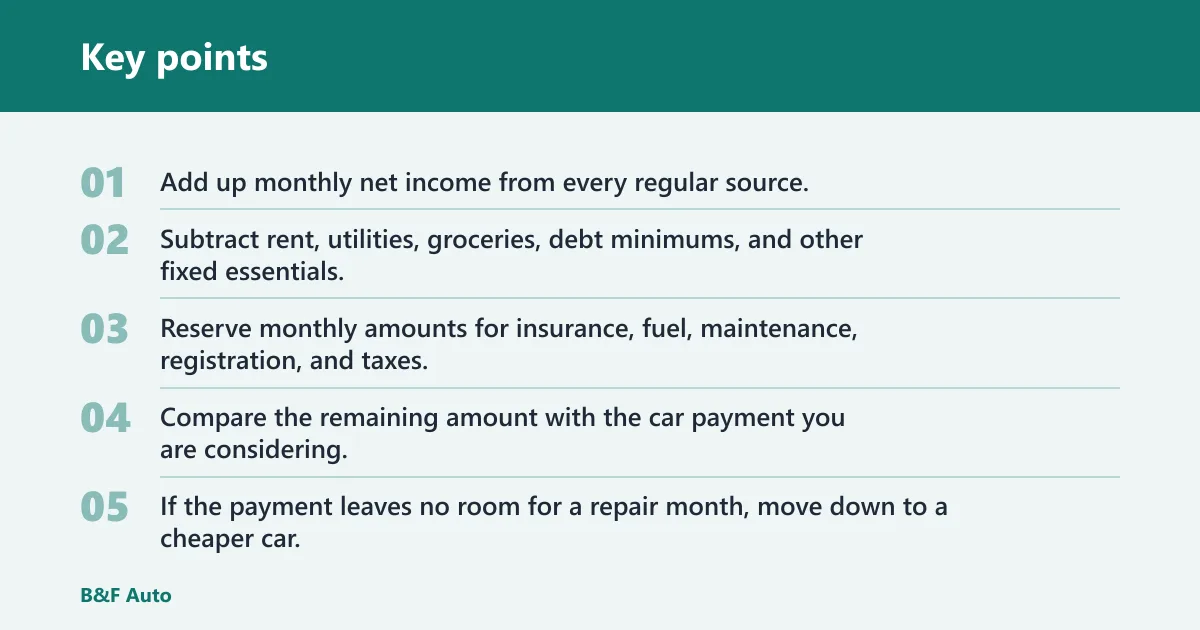
- Add up monthly net income from every regular source.
- Subtract rent, utilities, groceries, debt minimums, and other fixed essentials.
- Reserve monthly amounts for insurance, fuel, maintenance, registration, and taxes.
- Compare the remaining amount with the car payment you are considering.
- If the payment leaves no room for a repair month, move down to a cheaper car.
The example above shows how a monthly payment can look acceptable until insurance and fuel are included. If insurance rises by about $50, the total monthly car cost would be about $420. If repairs add another $80, the budget no longer fits the safe band and may move into stretch or no-go territory.
How to budget for a car if your pay dates vary
Use a pay-period view as well as a monthly view. Weekly, biweekly, and monthly pay schedules create different timing gaps, and those gaps can break a budget that looks fine on paper. The right method is to check both the monthly total and the cash available before each bill clears.
Weekly pay example
With weekly pay, map each paycheck to the exact bill dates it must cover. This works well for smaller, more frequent deposits because you can assign each week’s income to the next set of bills. The main risk is assuming the next paycheck arrives before a large car payment or insurance draft clears.
Biweekly pay example
Biweekly pay often creates two “extra” months a year, but the middle of the month can still be tight. If rent is due before the second paycheck, the car payment may need to wait for a later deposit. Do not let the larger monthly average hide a short-term shortfall.
Monthly pay example
Monthly pay is simplest on paper and hardest if several bills land before the deposit. Make sure the car payment does not absorb money needed for rent or debt minimums earlier in the month. A single large deposit can work, but only if every due date is lined up first.
Suppose insurance comes out on the 14th and the car payment hits on the 16th, but the next paycheck arrives on the 18th. The monthly total may still look positive. The cash-flow calendar says otherwise, because two bills are due before the next deposit lands.
Frequently asked questions
How much should I spend on my first car based on my income?
A practical starting point is about 15% of monthly take-home pay for total car costs, with the payment itself near 10% of net income. That works only if insurance, fuel, maintenance, and debt minimums still fit. If those costs are high, the car budget needs to come down.
How do I budget for a car payment without stretching my monthly bills?
List rent, utilities, groceries, debt minimums, and insurance first. Then see what remains for the car payment, fuel, and repairs. If the payment would use money meant for essentials or leave no buffer for a repair month, the payment is too high for your budget.
What is a car in budgeting and where does it fit in my expenses?
A car is a transportation expense that includes the payment or purchase savings target plus recurring ownership costs. It should sit after essentials and debt minimums, then compete with the rest of your flexible spending. It is not a one-time purchase line, because the cost keeps showing up.
How do I budget monthly for auto expenses like insurance, fuel, and repairs?
Split annual costs across 12 months, estimate fuel from your commute, and set aside a repair reserve every month. Then compare the total with your leftover income after essentials. If insurance or repairs would force you to skip another bill, the car is too expensive as configured.
Should I set a budget by monthly payment or by total car price?
Use both, but start with monthly cash flow. A low purchase price can still fail the budget if insurance, fuel, and repairs are high. The monthly payment tells you whether the car fits alongside your existing bills, while the total price helps with loan size or savings target.
What other costs should I include in a first car budget besides the purchase price?
Include insurance, fuel, registration, taxes, routine service, tires, oil changes, and a repair reserve. If the policy needs an upfront deposit, add that too. These costs are part of car ownership, and leaving them out can make a cheap car look affordable when it is not.