Test Drive Checklist for Buying a Used Car
Use a four-stage test drive: spend about the first 15 minutes checking cold-start, idle, steering, brakes, and transmission behavior, then add highway, parking-lot, and post-drive checks; a warning light, overheating, hard shifting, or a title mismatch is commonly treated as a walk-away flag. Skip that order and you can miss brake, transmission, suspension, or cooling faults that turn a fair price into an expensive problem. This guide breaks the drive into first-15-minute checks, highway checks, low-speed maneuvers, and after-drive inspection points, plus what each finding means for buying, negotiating, or walking away.
What to do before and during the drive

A useful used-car test drive includes a cold start, city streets, highway speeds, rough pavement, a parking-lot check, and a post-drive inspection. Give the car enough time to warm fully and enough variety in the route for heat-related and speed-related faults to show up, because a quick block loop rarely exposes delayed shifts, brake pulsation, pull, vibration, or warning lights.
How long the drive should?
A practical target is a drive long enough for the engine, transmission, and brakes to reach normal operating temperature and for the vehicle to be driven on city streets, at highway speeds, and over rough pavement. Route quality matters more than total miles. If the seller allows only a five-minute loop, that is usually too short for a confident yes.
What to bring before you go
- Bring your license. Dealers usually want it before handing over the keys. A private seller should also expect to see it before riding along or letting you drive.
- Bring insurance details. Coverage rules vary by insurer and state, and dealer test drives are often handled differently from private-party drives. Confirm what applies before you arrive instead of arguing about it in the parking lot.
- Bring a phone and flashlight. Use the phone for photos of warning lights, tire wear, and the VIN if needed. A small flashlight helps you check tire shoulders, fluid drips, and dark cargo areas.
- Bring the worksheet. Notes organized by symptom and location tell you far more than a vague “felt fine.” They also make side-by-side comparison easier if you drive two similar cars.
- Bring a tire-pressure gauge if appropriate. It is optional, but useful if the car feels floaty or harsh and the tires look badly overinflated or underinflated. Tire pressure will not explain every ride issue, but it can skew first impressions.
Why the route matters more than the total miles
Consumer Guide’s checklist is built around real use in city commuting, highway road trips, and ferrying family members. That matters because different faults show up in different places: low-speed hesitation in traffic, wind noise at highway speed, and suspension thumps over rough pavement. A good route includes city streets, highway speeds, rough pavement, and at least two road-surface changes.
Before the wheels move
Start with the cabin and startup sequence. Warning lights should usually turn on briefly at key-on and then switch off after the engine starts; a missing bulb can hide a fault, while a light that stays on is a common reason to pause the deal. Check whether the engine idles smoothly or hunts, whether the seat supports you, whether you have enough headroom and legroom, whether entry and exit feel easy, and whether rear sightlines, mirror coverage, gauge visibility, touch screen legibility, and the placement of main controls work for you.
Consumer Guide specifically includes touch screen legibility and logical placement of controls, along with front seating comfort, headroom, legroom, and driver vision. It also includes rear-seat entry, exit, comfort, and three-across space, plus cargo volume, seat folding, and lift-over height. Those checks matter because a used car can be mechanically sound and still be wrong for daily use.
Match the vehicle to the version actually being considered. Trim level, wheels and tires, and suspension tuning can change ride, noise, and braking feel enough to mislead a buyer. A base sedan on 17-inch wheels can drive very differently from the same model in a sport trim on larger wheels and lower-profile tires.
How do you spot problems in the first 15 minutes?
The first 15 minutes are where cold-start issues, delayed engagement, rough idle, low-speed shift problems, steering pull, brake grab, and early vibrations usually show themselves. Focus on what happens from a stop, under light throttle, and during the first few brake applications, because those symptoms are easy to forget once highway speed starts masking them.
From a stop: throttle response and engagement delay
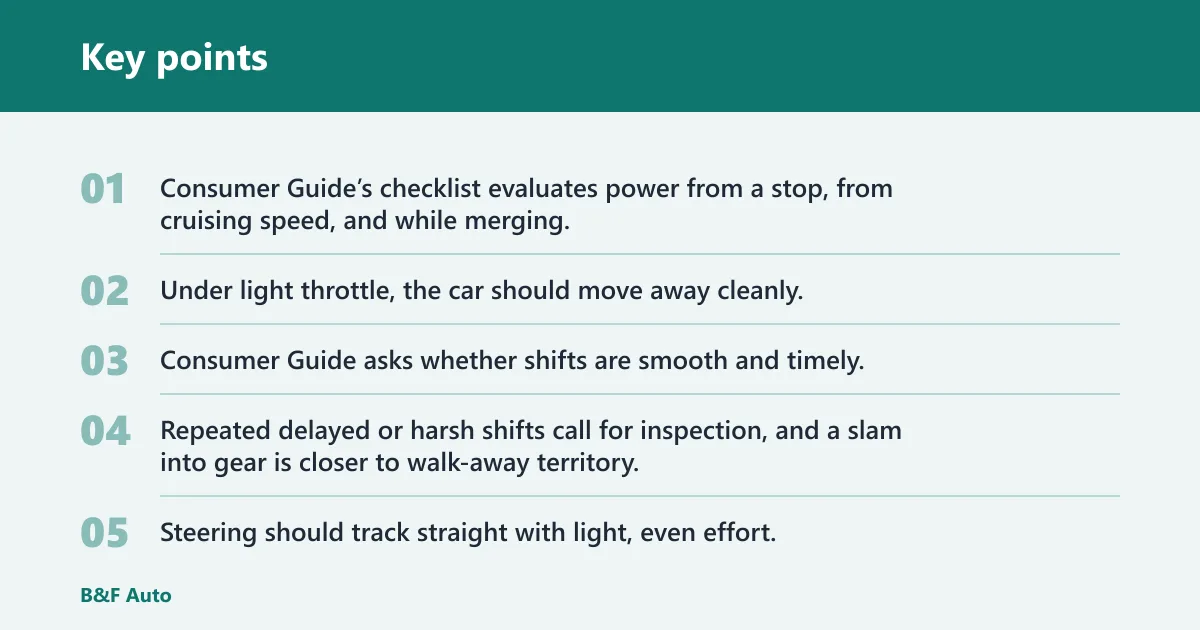
Consumer Guide’s checklist evaluates power from a stop, from cruising speed, and while merging. On a used car, the first part is especially useful: shift from Park to Drive, then Drive to Reverse, and notice whether engagement is prompt or delayed. A clear pause, harsh thunk, or engine flare before the car moves points to transmission wear, mounts, or a control issue that deserves inspection before purchase.
Under light throttle, the car should move away cleanly. Hesitation can come from transmission calibration, a dirty throttle body, fuel or ignition faults, or turbo lag on some engines, but the result for a buyer is the same: write it down, repeat it once, and treat it as more than a quirk if it happens again.
Low-speed shifts, steering feel, and brake response
Consumer Guide asks whether shifts are smooth and timely. That wording works well because used-car problems rarely announce themselves as total failure; instead, the transmission may hold a gear too long, flare between gears, downshift with a kick, or hesitate when you ask for moderate throttle. One odd shift is a note. Repeated delayed or harsh shifts call for inspection, and a slam into gear is closer to walk-away territory.
Steering should track straight with light, even effort. A pull can come from alignment, tire wear, a dragging brake, or suspension damage. Vibration through the wheel at neighborhood speeds can point to tire problems, a bent wheel, or worn front-end parts.
Brake feel matters right away. Consumer Guide includes braking pedal feel and stopping power; add progressiveness and straight tracking to that list. A wooden pedal, a long soft pedal, an abrupt initial bite, or a car that darts left or right under moderate braking all change the buy decision.
Early noises, smells, and vibrations that matter
Listen with the radio off and the climate fan on low. Clunks over the first speed bump can indicate sway-bar links, strut mounts, or other suspension wear. A ticking exhaust leak may be louder when cold. Fuel smell, burning oil smell, or sweet coolant smell should go in your notes at once because heat can make them stronger later.
Suppose a compact crossover idles smoothly, but each 1-2 upshift at low speed gives a brief rise in rpm before the next gear grabs. That single variable, repeated several times on the same road, is enough to stop calling it “driver feel” and start calling it a transmission inspection item.
What should you test on city streets?
City streets are where stop-and-go acceleration, low-speed shift timing, brake straightness, ride harshness over broken pavement, and steering effort show up best. Use ordinary traffic conditions, not a full-throttle stunt, and repeat one or two actions on the same block so you can tell whether a symptom is consistent or random.
Stop-and-go acceleration and transmission behavior
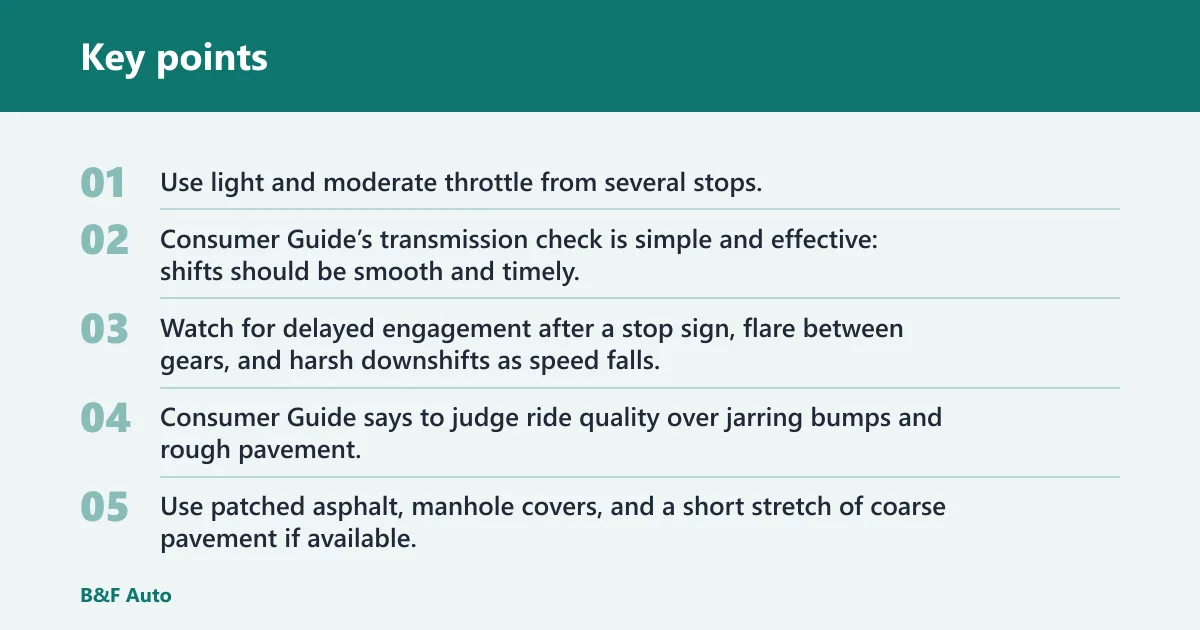
Use light and moderate throttle from several stops. Note whether the engine responds cleanly, whether the transmission upshifts smoothly, and whether kickdown happens promptly when you ask for more speed at 25 to 40 mph. Consumer Guide’s transmission check is simple and effective: shifts should be smooth and timely.
Watch for delayed engagement after a stop sign, flare between gears, and harsh downshifts as speed falls. Those are common failure patterns that buyers miss because they are easy to excuse on one short drive.
Ride quality over broken pavement and manhole covers
Consumer Guide says to judge ride quality over jarring bumps and rough pavement. Use patched asphalt, manhole covers, and a short stretch of coarse pavement if available. A floaty body motion after one bump suggests weak dampers; a sharp crash through the cabin can point to worn suspension parts, damaged tires, or simply a firm tune, which is why trim, wheel, and tire match matters.
Consumer Guide also tells shoppers to check steering feel and lean in corners. On a normal right or left turn, the car should settle predictably. Excessive lean, delayed response, or a general lack of poise can be acceptable on some tall SUVs, but compare it against what that vehicle type should reasonably feel like.
Braking straightness, pedal feel, and pull
Make several normal stops and one firmer stop where traffic and conditions allow. The car should stop straight with a pedal that builds force progressively. A pulse through the pedal often points to rotor variation or front-end issues; a steering tug under braking can mean a sticking caliper, alignment problem, or tire issue.
Picture a midsize sedan that feels quiet at 35 mph but shakes the steering wheel only when braking from 45 mph to 10 mph. That timing matters. A shake that appears only on deceleration is very different from a constant-speed vibration, and it shifts the likely cause from wheel balance toward brake or suspension faults.
What should you test on the highway?
Highway testing should confirm merging power, passing response from cruising speed, tracking stability, brake confidence at speed, and noise control. This is also where wheel-bearing hum, wind noise, road roar, and driveline vibration become easier to separate, because the load and speed stay steady long enough for patterns to appear.
Merging power and passing response from cruising speed
Consumer Guide checks power from cruising speed and while merging. Use an on-ramp or a safe opening in traffic to test moderate acceleration from highway pace. The car should respond without a long pause, a hunting transmission, or a harsh kickdown that feels out of proportion to pedal input.
For hybrids and EVs, this check is still useful, but the symptom language changes. An EV should deliver smooth, linear thrust without surging, shuddering, or warning messages. A hybrid should transition between engine and electric assistance without a coarse vibration or obvious stumble.
Wind noise, road noise, and drivetrain hum at speed
Consumer Guide includes wind noise at highway speed and road noise. Listen for a steady hum that rises with speed, which can suggest wheel bearings or tire cupping, versus a noise that changes with throttle, which points more toward drivetrain sources. Wind rush around one door or mirror can be a bad seal, prior body repair, or simply that model’s normal trait.
Engine noise matters too. A strained engine under moderate throttle is a refinement issue if the model is known to be coarse, but a new whine, drone, or vibration tied to a gear change is a buying decision issue.
Tracking, vibration, and general poise
The car should hold a lane with small corrections, not constant sawing at the wheel. On-center feel should be consistent, and the vehicle should not drift heavily on a flat section of road. Vibration through the seat at 60 to 70 mph often points to rear tires or driveline issues; vibration through the steering wheel points more toward front tires, front wheels, or front suspension.
Segment matters here. Sedans usually reveal road and tire issues clearly because the body is lower and lighter. SUVs can feel more top-heavy, so some extra lean is normal, but float, porpoising, or repeated after-bounce is not. Trucks may transmit more axle hop or bed shake on rough pavement, yet they still should not wander, clunk, or shimmy. EVs are often quieter, which makes wind noise, tire roar, and suspension knocks easier to hear.
Parking-lot checks that reveal expensive faults
Tight turns, reverse, and low-speed steering effort
Use an empty lot for full-lock turns in both directions, several reverse maneuvers, and gentle brake applications. Clicking on tight turns can indicate worn CV joints on front-drive or all-wheel-drive vehicles. Groaning at full lock can point to power-steering issues on hydraulic systems, while electric systems may reveal uneven assist or clunks instead.
Brake feel at walking speed should be smooth, not grabby. Reverse engagement should be prompt. A heavy bang going into Reverse is not normal wear.
Backup visibility, cameras, and parking sensors
Check rear sightlines the old-fashioned way with mirrors and shoulder checks, then confirm the backup camera and parking sensors work as expected. This is also the right time to judge whether the seating position gives a clear view over the hood and to the front corners, especially on trucks and tall SUVs.
A common first-timer mistake is focusing on screen sharpness and forgetting lag, angle, and blind spots. A camera that is clear but poorly aimed still leaves you guessing where the bumper ends.
Cargo access, seat folding, and storage usability
Consumer Guide includes cargo volume, seat folding, and lift-over height. Open the trunk or hatch, check cargo-area space, and fold the seats if the seller allows it. Confirm the lift-over is manageable for your use, and scan the glove box, door pockets, and cubby storage quickly enough to know whether daily items have obvious places to go.
After-drive checks before you decide
New warning lights, smells, and heat-related issues
When the drive ends, leave the engine running for a moment, then shut it off and restart if appropriate. New warning lights, a cooling fan running hard after a mild drive, or a hot coolant or oil smell can reveal issues that never appeared on the cold start. Overheating is a walk-away flag unless a professional inspection proves otherwise.
Leaks, drips, and signs under the vehicle
Look under the car after it has sat for a minute or two. Clear water from air-conditioning condensation is usually normal; oily drips, pink or orange coolant, or fresh wetness around the engine bay are different. Also look at the tires again if the car pulled or vibrated during the drive, because uneven shoulder wear can explain part of what you felt.
Turning notes into negotiate, inspect, or walk-away calls
- Acceptable wear: minor road noise, a firm ride that matches the trim, light cosmetic interior wear, or a touchscreen that is merely dated.
- Negotiation item: worn tires, slight brake pulsation, weak hatch struts, minor alignment drift, or a camera with poor image quality but normal operation.
- Inspection-required issue: repeated delayed shifts, consistent pull, speed-related hum, steering vibration, clunks over bumps, or coolant smell.
- Walk-away red flag: warning lights that stay on, overheating, title or registration mismatch, seller cannot prove the right to sell, severe hard shifts, heavy smoke, or major fluid leaks.
Buy-decision notes worksheet
Use this worksheet titled Test Drive Notes That Change the Buy Decision to tie each symptom to where it happened, a likely cause, how serious it is, and whether it should end the deal. Fill it out during the drive or right after each stage, not from memory once you get home.
| Symptom | Where it happened | Likely cause | Severity | Deal-breaker yes/no |
|---|---|---|---|---|
| Sample: rpm rises between 2-3 shift before gear engages | City street, light throttle at 20-30 mph | Transmission flare or internal wear | High | Yes |
| Warning light stays on after startup | Before moving | Stored fault or active system problem | High | Yes |
| Rough idle when cold | First 2 minutes | Ignition, vacuum, fuel, or mount issue | Medium | No |
| Delay shifting into Drive | First move-off | Transmission wear or low fluid condition | High | Yes |
| Delay shifting into Reverse | Parking-lot check | Transmission wear or control issue | High | Yes |
| Hesitation from a stop | City street | Throttle, fuel, turbo, or transmission issue | Medium | No |
| Harsh 1-2 shift | First 15 minutes | Transmission calibration or wear | Medium | No |
| Flare between gears | City street | Transmission slip | High | Yes |
| Hard downshift when slowing | Stop-and-go traffic | Transmission or software issue | Medium | No |
| Pulls left or right cruising | City or highway | Alignment, tire, or brake drag | Medium | No |
| Pulls under braking | 35-45 mph stop | Brake drag, tire, or suspension issue | High | No |
| Brake pedal pulsation | Moderate stop | Rotor variation or front-end issue | Medium | No |
| Soft or sinking brake pedal | Repeated stops | Hydraulic issue or air in system | High | Yes |
| Clunk over bumps | Rough pavement | Suspension link, mount, or bushing wear | Medium | No |
| Floaty after one bump | Rough pavement | Weak dampers | Medium | No |
| Steering-wheel vibration at speed | Highway 60-70 mph | Front tire, wheel, or suspension issue | Medium | No |
| Seat/floor vibration at speed | Highway 60-70 mph | Rear tire or driveline issue | Medium | No |
| Steady hum rising with speed | Highway cruise | Wheel bearing or tire cupping | Medium | No |
| Clicking on full-lock turns | Parking lot | CV joint wear | Medium | No |
| Power-steering groan at full lock | Parking lot | Steering system issue | Medium | No |
| Coolant smell after drive | Post-drive | Cooling-system leak | High | Yes |
| Fresh oil or coolant drip under car | Post-drive | Active leak | High | Yes |
Can you test drive a private-sale car safely?
Yes, but the safety and paperwork steps matter as much as the driving checks. Meet in a public place, bring another adult, confirm the seller has the right to sell the car, compare registration details to the seller’s identification, and settle the insurance question before anyone moves the vehicle.
Meeting location, companion, and route precautions
- Meet in public. Choose a busy daytime location with room to inspect and drive, such as a shopping center or bank parking lot. Avoid isolated addresses for the first meeting.
- Bring another adult. A companion improves safety and can take notes while you drive. If the seller refuses a reasonable public meeting or rushes the process, treat that as a warning sign.
- Set the route first. Tell the seller you need city streets, highway speeds, rough pavement, and a short parking-lot check. A seller who allows only a tiny neighborhood loop is blocking the most useful parts of the inspection.
Proof of ownership and the seller’s right to sell
The Week says a used-car checklist should cover the car itself, paperwork, and other factors, and it warns buyers to verify the seller has the right to sell the car. That means more than a quick glance at a name on a title. Check that the registration certificate, title status where applicable, and the seller’s details make sense together.
Registration, seller details, history report, and insurance questions
Run a vehicle history check and compare the VIN on the car to the paperwork. If the seller’s name does not match the registration, ask why before driving. On insurance, there is no single answer: dealer policies, personal auto policies, and state rules vary, so confirm whether your own policy, the dealer’s coverage, or the seller’s policy applies before the drive.
Frequently asked questions
What should I check on a test drive when buying a used car?
Check startup warning lights, idle quality, engagement into Drive and Reverse, low-speed shifts, throttle response, steering tracking, brake feel, ride over rough pavement, highway noise and vibration, parking-lot tight turns, and post-drive leaks or smells. Also confirm the car matches the trim, wheels, tires, and suspension setup you actually want.
What sounds should I listen for on a test drive?
Listen for engine ticking, drivetrain whine, clunks over bumps, wheel-bearing hum that rises with speed, wind noise at highway pace, and road noise over coarse pavement. A noise tied to throttle input points to a different likely cause than a noise tied only to vehicle speed, so note exactly when it appears.
What should I test on the highway during a test drive?
Test merging power, passing response from cruising speed, transmission kickdown, tracking stability, steering vibration, seat or floor vibration, brake confidence from higher speed, wind noise, road roar, and any steady hum. Highway driving is where many tire, bearing, driveline, and alignment problems become much easier to separate.
What should I check after the test drive ends?
Check for new warning lights, hot oil or coolant smells, signs of overheating, cooling-fan behavior, and fresh drips under the vehicle. Review your notes by symptom and location, then sort each item into acceptable wear, negotiation item, inspection-required issue, or walk-away red flag before discussing price.
How long should a test drive be before I buy?
A good used-car test drive lasts long enough to include a cold start, city traffic, highway speeds, rough pavement, and a parking-lot check, plus a brief post-drive inspection. The exact minutes matter less than getting the car fully warm and exposing faults that appear only under different speeds and road surfaces.
Do you need insurance to test drive a car?
Sometimes, but the answer depends on the dealer, the private seller, the insurer, and state rules. Dealer test drives are often handled differently from private-party drives. Confirm coverage before arrival, bring your insurance details, and do not assume the other party’s policy automatically covers you behind the wheel.