Car Registration Documents: What You Need
Car registration usually requires several document types, such as proof of identity, ownership, roadworthiness, and permission to use the vehicle, often shown with a photo ID, title or bill of sale, insurance, and any required inspection or emissions certificate. Missing or mismatched paperwork can delay plates, block title transfer, trigger fines, or leave you unable to drive legally. This guide explains which documents are mandatory, what each proves, and what changes by state or country for registration, renewal, transfer, and replacement.
The practical way to read registration paperwork is as a proof stack. The registration certificate ties the vehicle to the government registration record. The other papers back that record by showing who is applying, who can lawfully register the car, whether it is insured, whether it has passed any required inspection, and whether its technical specification is accepted in that market.
That difference matters later. Some documents are needed once, at first registration. Some matter again at annual renewal. Some are the papers you may need to carry, show during a stop, present at a sale, or replace if lost.
What the documents prove and why they differ
The official record and the supporting proofs
Registration documents connect a vehicle to a government registration record. The registration certificate is the record-facing document. It usually shows the registration number, vehicle identification number, vehicle descriptors, and the person or entity recorded as the registered keeper or registrant.
That certificate is not the whole file. Authorities often ask for separate proof of identity, ownership, insurance, roadworthiness, and technical conformity because one document rarely proves all of these at once. A title may show ownership rights. An insurance certificate shows cover. An inspection record shows roadworthiness. A certificate of conformity shows that the vehicle matches the safety and environmental specification accepted by that jurisdiction.
What changes by jurisdiction and what stays consistent
The categories stay fairly stable even when the labels change. One state may ask for a title and emissions certificate. Another country may ask for a purchase invoice, proof of address, insurance certificate, and roadworthiness test result. The purpose stays the same: connect the car, the applicant, and the legal right to use public roads.
EU rules show why the paperwork can look different across borders. EU drivers generally register a car in the country of normal residence, and there is no EU-wide law on vehicle registration. So the proof categories are familiar, but the issuing authority, form design, and extra steps can differ from one country to another.
What documents do you need for car registration?
Most authorities ask for a registration application, a personal identity document, proof of ownership, proof of insurance, and any inspection or technical papers required for that vehicle type or age. Imports, moves, and re-registrations often add extra records, especially if the authority must verify VIN, prior registration, or conformity status.
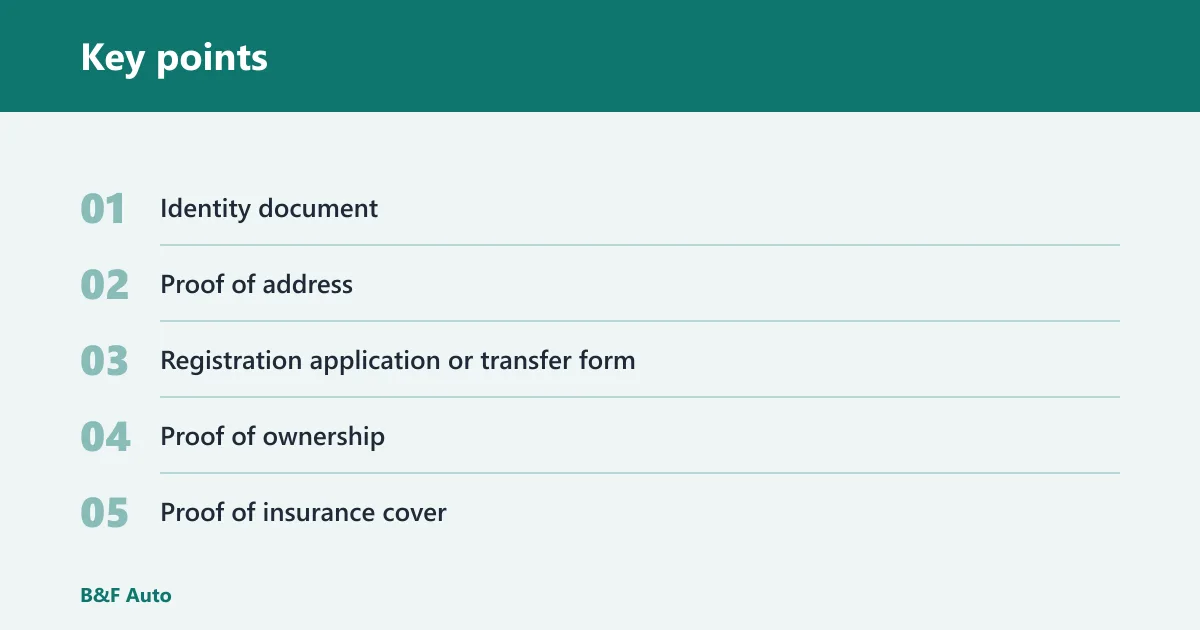
Core documents most authorities ask
- Identity document: commonly a driving licence, passport, or other government photo ID.
- Proof of address: required in many places if the registration address matters for tax, residency, or mailing.
- Registration application or transfer form: the authority’s own form for first registration, transfer, or renewal.
- Proof of ownership: title, bill of sale, purchase invoice, transfer paper, or another accepted ownership record.
- Proof of insurance cover: often required before plates or registration are issued.
- Roadworthiness or emissions proof: where inspection rules apply.
Proof of ownership documents
Ownership paperwork answers the question, “Who has the legal right to register or transfer this vehicle?” Depending on the place and transaction, that may be a title, a signed bill of sale, a dealer invoice, a purchase contract, a prior registration record, or transfer documents from the previous keeper.
Invoices matter most when a title is not the only accepted ownership evidence. The invoice or proof of purchase should clearly identify the seller, buyer, vehicle, sale date, and VIN. In some cases, authorities also expect the dealer VAT number to appear on the invoice, especially when the vehicle is being registered after a cross-border purchase.
Insurance, inspection, and technical compliance papers
Proof of insurance is often a precondition for registration. In the EU, authorities may require proof of insurance cover when a car is registered, and the insurer may need to be based locally or authorised to provide services there. That point matters when a driver buys cover from an insurer operating across borders.
Roadworthiness papers are separate from insurance. In the EU example, roadworthiness testing starts 4 years after first registration and repeats every 2 years thereafter. Another jurisdiction may use a different schedule, but the document does the same job: it shows that the vehicle passed the inspection required for its age and class.
The certificate of conformity is a technical-specification document, not a registration certificate. It is issued by the manufacturer and shows that the vehicle’s technical characteristics meet applicable safety and environmental standards. An EC certificate of conformity is valid in all EU countries. A national certificate of conformity is only valid in the country of issue.
Extra documents for imports, moves, and re-registration
Cross-border and cross-state moves usually trigger the longest document list. A vehicle already registered elsewhere may need its prior registration certificate, import or customs papers where applicable, proof of tax status, and technical documents that were never needed for routine renewal.
The vehicle registration certificate itself can also take different forms. Under national rules, a registration certificate can have one or two parts. If it has two parts, Part I is sufficient when travelling by car. That is especially relevant when driving abroad or when a relocation process is still underway.
Why do you need each document?
You need each document because no single paper proves everything the authority must check. Registration links the car to the official record, ownership shows the right to register or transfer it, insurance supports lawful road use, and inspection or conformity papers show that the vehicle is acceptable for public roads in that jurisdiction.
Registration certificate
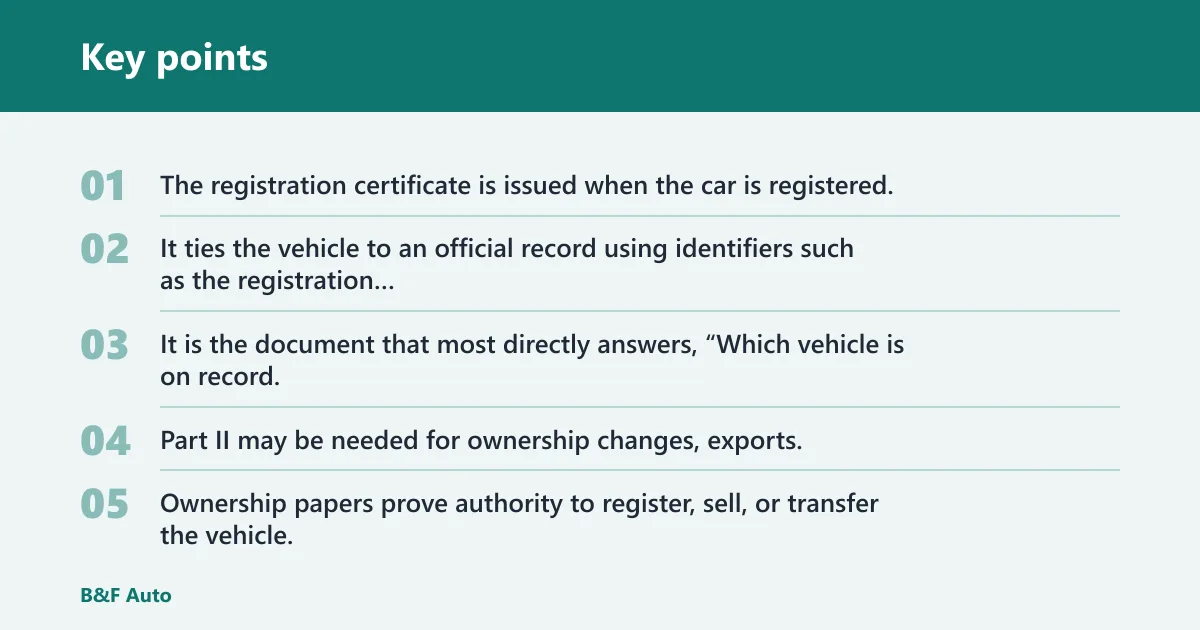
The registration certificate is issued when the car is registered. It ties the vehicle to an official record using identifiers such as the registration number and VIN. It is the document that most directly answers, “Which vehicle is on record, and under whose registered details?”
If the certificate is split into Part I and Part II, the travel and day-to-day role is usually attached to Part I. Part II may be needed for ownership changes, exports, or more formal administrative steps, depending on local rules.
Ownership documents
Ownership papers prove authority to register, sell, or transfer the vehicle. They also help stop a common problem: a seller hands over keys and a registration document, but the title transfer was never completed or the chain of sale is broken. Registration alone does not always prove legal ownership.
That is why the V5C in the UK must be read carefully. The V5C is described as the legal document that registers a car with the DVLA, and it contains vehicle details and registered keeper information. It matters in used-car checks and change-of-ownership updates, but it should not be treated as universal proof of legal ownership.
Insurance, roadworthiness, and conformity
Insurance papers support permission to use the vehicle on public roads. Roadworthiness papers support physical fitness for road use. The certificate of conformity supports technical acceptance, mainly in first registration, import, or cross-border situations rather than ordinary yearly renewal.
Suppose a buyer imports a hatchback from one EU country to another and brings only the bill of sale and prior registration certificate. The authority may still ask for conformity evidence before local registration can proceed, because ownership and prior use do not prove that the vehicle matches local acceptance rules.
Registration paperwork checklist table
| Scenario | Required document | What it proves | Common failure point |
|---|---|---|---|
| First-time registration | Photo ID; application form; proof of address if required; proof of ownership such as title, invoice, or bill of sale; insurance proof; inspection or emissions certificate if required; certificate of conformity for import or first-entry cases | Applicant identity, right to register, insured status, roadworthiness, and technical acceptance | VIN on invoice does not match VIN on vehicle; name on ID differs from ownership paper; insurance inactive on the effective date |
| Used-car purchase | Signed title or transfer paper where used; bill of sale or dealer invoice; prior registration certificate or V5C where applicable; buyer ID; insurance proof | Chain of ownership or transfer, seller authority, vehicle identity, buyer’s right to register | Missing seller signature, missing transfer section, V5C present but no ownership proof, dealer invoice without VAT number where required |
| Renewal | Current registration details; renewal notice where issued; insurance proof if checked; inspection or emissions certificate if due; payment record | Continued permission to keep the vehicle registered for road use | Expired inspection, changed address not updated, missed deadline; in the U.S. guide, most states require annual registration renewal |
| Moving country or state | Current registration certificate; ID and address proof; ownership document; insurance acceptable in the new jurisdiction; inspection or roadworthiness certificate; certificate of conformity for some cross-border moves | Prior lawful registration plus eligibility to register locally | Old insurer not accepted locally; prior address still on record; Part II missing when a full export or import file is required; national conformity certificate unusable outside issuing country |
| Replacing a lost document | Replacement application; ID; registration number or VIN; police or affidavit form if required; ownership paper if replacing both registration and title | That the applicant is entitled to a duplicate document for the correct vehicle | Applicant cannot provide the exact VIN, keeper name, or prior address; there is an unresolved lien or ownership dispute |
Is a registration document the same as a title?
No. A registration document links the vehicle to an official registration record, while a title or other ownership paper shows who has ownership rights or transfer rights. The same person may hold both, but the documents answer different legal questions, which is why authorities often ask for each separately.
Registration versus ownership
A registration certificate usually records the vehicle and the registered keeper or registrant. A title, purchase invoice, or transfer document usually records ownership or the right to transfer ownership. Those roles can overlap, but they do not automatically merge.
That distinction is easy to miss in used-car sales. A car can be registered in one person’s name while finance, title, or other ownership interests sit elsewhere. Read the paperwork field by field, not by label alone.
Where the V5C fits
For UK readers, the V5C is the registration record document tied to DVLA data. It contains vehicle details and registered keeper information, and it is a core paper for change-of-keeper updates and used-car checks. It should not be read as blanket proof that the keeper is the legal owner.
The same caution applies when taxing a newly bought car in the UK. Road tax is not transferable to a new owner, and the UK guide says the V5C 11-digit reference number is needed to tax a car. That is a registration-administration function, not an ownership shortcut.
What details should you check on the paperwork?
Check every identifier before submitting or accepting any registration paper. The key fields are the VIN, registration number, keeper or owner name, address, issue and expiry dates, vehicle descriptors, and insurance or inspection status. One wrong character can stall a transfer, trigger a rejection, or attach the wrong vehicle to the record.
Vehicle identifiers and descriptors
- VIN: compare the full VIN on the document with the VIN on the vehicle.
- Registration number or plate: confirm it matches the current record where one already exists.
- Make, model, body type, fuel type, engine size, and colour: minor coding differences can happen, but major mismatches need correction.
Names, addresses, and dates
- Registered keeper name: confirm spelling, initials, and legal suffixes.
- Owner or title holder name: if separate, verify both records.
- Address: make sure the registration address matches current filing requirements.
- Issue date and expiry date: old paperwork may not support current use.
Insurance, inspection, and transfer fields
- Insurance status: confirm policy dates, vehicle listed, and accepted insurer status.
- Inspection validity: roadworthiness or emissions documents must still be in date.
- Lien or finance details: where recorded, these can affect transfer or duplicate-document requests.
- Transfer sections and signatures: missing signatures are one of the most common reasons a used-car registration file fails.
A common first-timer mistake is checking the plate and make but not the VIN. Two silver saloons from the same model year can look identical in a driveway, yet one wrong VIN digit on the bill of sale can stop title transfer until the seller corrects the paperwork.
Which documents matter most when buying a used car?
When buying a used car, the most important documents are the registration record, proof of ownership or transfer, and any inspection history that shows whether the vehicle can stay on the road. The goal is to confirm that the seller can transfer it, the vehicle identity is consistent, and there is no hidden paperwork gap.
Registration and seller identity checks
Start with the current registration certificate or equivalent record document. Confirm the registration number, VIN, and registered keeper details. Then check the seller’s identity against the transfer paperwork. If the seller’s name does not match the transfer chain, ask why before any payment is completed.
Ownership chain and purchase papers
The cleaner the ownership chain, the better. A signed title, a complete bill of sale, and a dated purchase invoice all help. Dealer invoices should identify the dealer and vehicle clearly, and where required they should include the dealer VAT number.
Missing ownership documents do not always mean fraud, but they do mean risk. If the authority later asks for title evidence that the buyer never received, registration can stall long after the car has been delivered.
MOT certificate and MOT history for UK buyers
In the UK guide, an MOT is an annual test for vehicles over three years old. The certificate matters, but the history often matters more because it shows repeated advisories, corrosion notes, emissions failures, tyre issues, or other fault patterns that one fresh pass may hide.
Used-car buyers should read the MOT history as a pattern log, not as a pass/fail stamp. Repeated brake advisories over several annual tests can be more informative than one clean certificate shown on the day of sale.
Common red flags
- The VIN on the dashboard, door sticker, or chassis does not match the paperwork.
- The seller has a V5C or registration card but no title, invoice, or transfer proof.
- The transfer section is blank, altered, torn, or unsigned.
- The inspection certificate is expired or belongs to another registration number.
- The insurer’s proof lists a different vehicle or policy period.
Should you keep your registration in the car?
Usually, the safest answer is to keep the registration accessible but not automatically leave every original document in the vehicle. Some places expect immediate production during a stop, while others accept later production, copies, or digital proof. Storage choice should balance legal access, theft risk, and how hard each document is to replace.
What to carry
If local rules require a registration certificate to be shown during a roadside check, keep the current registration document where it can be reached quickly. When a certificate has two parts, Part I is generally the document carried for normal use and travel.
Do not assume the same carry rule applies everywhere. Some jurisdictions accept digital insurance proof but still expect the registration certificate in paper form. Others are stricter about original documents during cross-border travel.
What to store elsewhere
High-risk documents such as titles, Part II registration sections, full purchase packs, and older transfer papers are usually better stored securely away from the vehicle. If the car is stolen, those papers can make recovery and fraud prevention harder.
Picture an airport long-stay car park in midwinter. If the glovebox holds the title, old bills of sale, and a house-addressed renewal notice, a theft becomes both a vehicle problem and an identity paperwork problem.
What if a document is missing, wrong, or expired?
If a registration document is missing, incorrect, or out of date, stop and fix the paper trail before driving, selling, or submitting a transfer. The right response depends on the defect: request a duplicate for a lost certificate, correct errors with the authority, renew expired records, or rebuild ownership evidence if a title is missing.
Never received the registration document
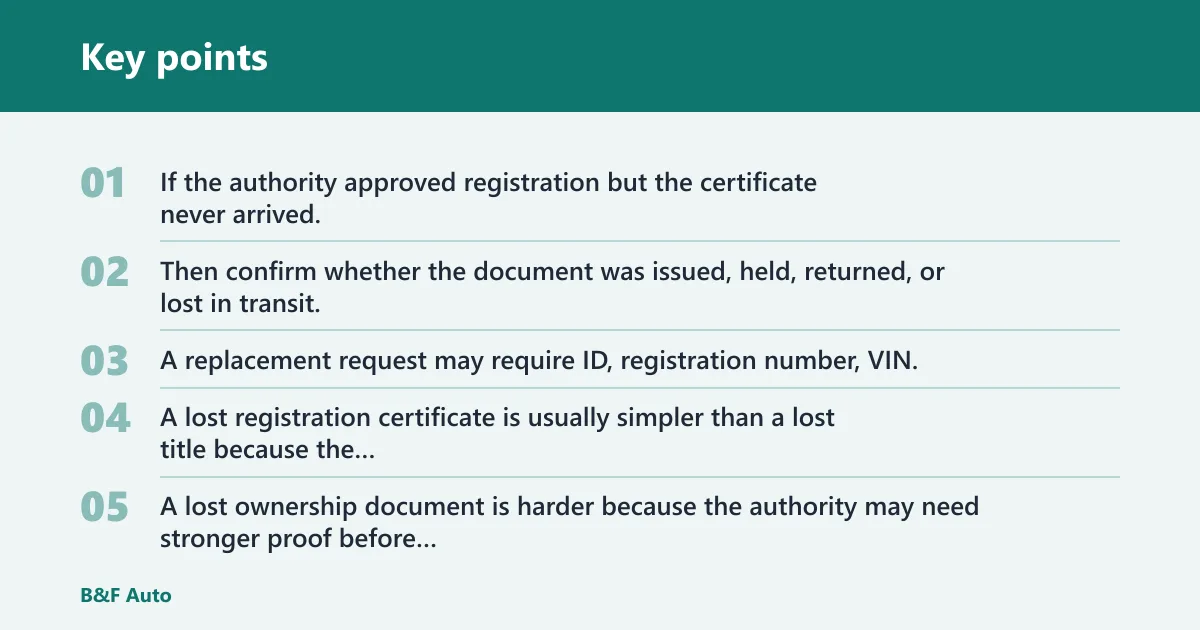
If the authority approved registration but the certificate never arrived, check the recorded address first. Then confirm whether the document was issued, held, returned, or lost in transit. A replacement request may require ID, registration number, VIN, and proof that the applicant is the recorded keeper.
Lost title, logbook, or registration certificate
A lost registration certificate is usually simpler than a lost title because the authority can often issue a duplicate from the existing record. A lost ownership document is harder because the authority may need stronger proof before allowing sale or re-registration.
Some places allow affidavit, bonded-title, or reconstructed-record processes where ownership evidence is incomplete. Those routes are real but uncommon and tightly controlled. They depend on the local authority’s rules, not on a universal shortcut.
Name, address, or VIN mismatch
A wrong address may only require an update. A wrong name can require identity matching and corrected transfer papers. A wrong VIN is the most serious mismatch because it can point to clerical error, swapped documents, or a vehicle-identity problem.
If the VIN is wrong, compare the physical VIN in every normal location and stop using the inaccurate paper for transfer. A small typo can usually be corrected, but only after the authority sees enough evidence to amend the official record.
Expired renewal, insurance, or inspection
Renewal is its own compliance line. In the U.S. guide, most states require annual registration renewal. Missing renewal can lead to fines, penalties, or invalid road use. The same logic applies to expired insurance or inspection: the car may still exist on record, but the current permission to use it can lapse.
For UK readers, also remember that vehicle tax does not roll over to the buyer. A used car can appear fully documented yet still need fresh tax action by the new owner.
Frequently asked questions
Can I drive without my registration document?
Sometimes, but it is risky and rule-dependent. Some places expect the current registration certificate to be available during a stop, while others allow later production or alternative proof. Driving without valid registration status is a bigger problem than simply misplacing the paper version, so check both the record and the carry rule.
What if I never received my registration document?
If the document was approved but never arrived, confirm the mailing address, issue date, and document status with the authority. A duplicate may be available online or by form, but the authority will usually ask for the registration number or VIN, proof of identity, and the recorded keeper details.
Can I get my car registration papers online?
Often yes for renewal, status checks, or duplicate requests, but not always as a full digital substitute for the physical certificate. Many authorities let drivers renew online or order replacements online. Whether a digital copy counts as legal proof during travel or a roadside check depends on local rules.
Are car registration documents public record?
Usually only in a limited sense. Registration systems often allow some record access for official, legal, or regulated purposes, but that does not mean full public access to personal details. Vehicle data may be shareable in narrow ways while names, addresses, or identity-linked fields remain restricted.
Can I register a vehicle without documents?
Rarely, and usually only through a replacement or exception process. If core papers are missing, the authority may require duplicate registration records, a bonded-title procedure, affidavits, inspection, or reconstructed ownership evidence. Routine registration without any supporting documents is not the normal path in most places.
What details are shown on a vehicle registration document?
Most registration documents show the registration number, VIN, make, model, body type, fuel type, and the registered keeper or registrant details. They also commonly show issue dates and administrative references. What they usually do not prove on their own is clear ownership, finance status, or current insurance validity.