What Is a Car Registration Document?
A car registration document is the official record that shows a vehicle is registered for road use and usually links the plate, VIN, and registered keeper. It is not proof of ownership. Missing it, or reading it wrong, can lead to fines, failed stops, and expensive title or insurance errors. This guide explains what it proves, what it does not, and how to read the key fields.
What is a car registration document?
A car registration document is the official paper or digital record that shows a vehicle is entered with the relevant motor authority for road use. It typically ties the vehicle to a plate, a VIN, and a registrant or keeper, depending on the jurisdiction. The document proves registration status, not ownership.
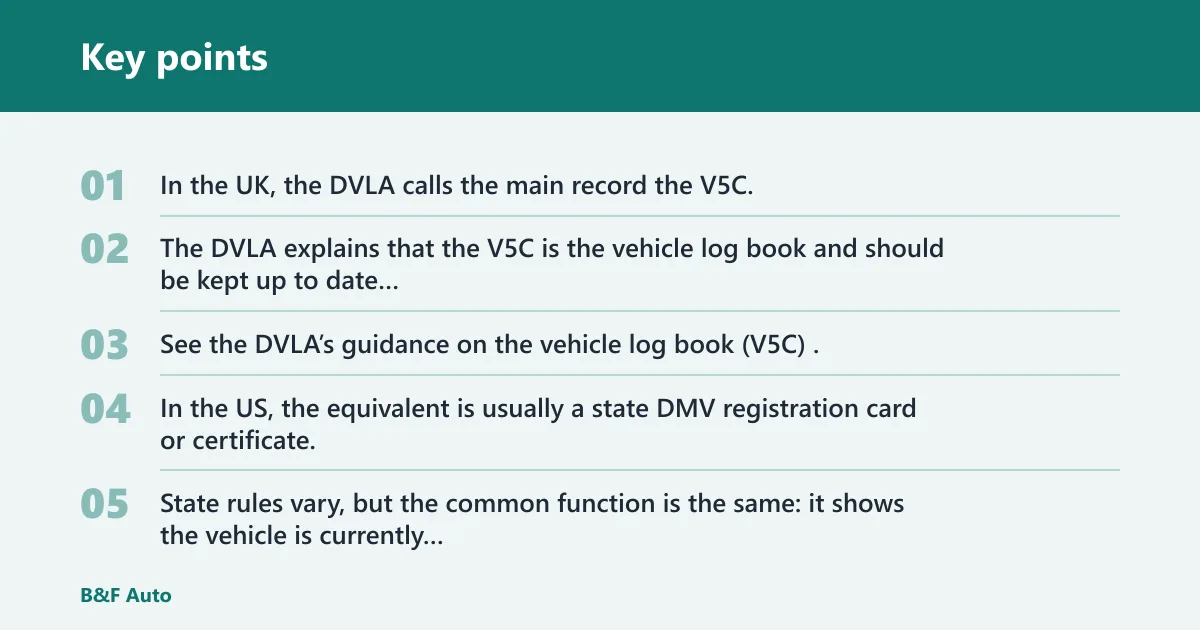
In the UK, the DVLA calls the main record the V5C, which identifies the registered keeper rather than proving title. The DVLA explains that the V5C is the vehicle log book and should be kept up to date when vehicle details or keeper details change. See the DVLA’s guidance on the vehicle log book (V5C).
In the US, the equivalent is usually a state DMV registration card or certificate. State rules vary, but the common function is the same: it shows the vehicle is currently registered and can be identified in the state record.
Registration document vs title
A registration document shows that the vehicle is registered for road use. A title is a separate ownership document in many US states and often proves who holds legal title to the vehicle. That is why a current registration card does not always mean the holder owns the car.
In UK-style systems, the registered keeper is the person responsible for keeping and taxing the vehicle, but that person may not be the legal owner. The keeper record helps with compliance and contact details. It is not the same as a full ownership chain.
In US-style systems, the title usually sits apart from the registration card. The card may let the car be driven legally, while the title matters for sale, transfer, or lien questions. Mixing those up causes avoidable delays at sale time and during insurance checks.
Does a registration document equal registration papers?
Usually, yes in everyday speech. People often use “registration document” and “registration papers” to mean the same thing: the official record showing the vehicle is registered. The exact name depends on the country or state, but the legal function is usually the same.
That said, some places issue more than one paper connected to registration, such as a receipt, sticker, or renewal notice. The key is whether the document is the actual registration record, not just proof you paid a fee.
What is a vehicle registration document in the UK?
In the UK, the common registration document is the V5C logbook issued by the Driver and Vehicle Licensing Agency. It records the registered keeper, not a blanket proof of ownership, and it links the vehicle to its number plate, VIN, make, model, and tax-related details.
The DVLA states that the V5C identifies the registered keeper and helps keep the record current after a change of name, address, keeper, or vehicle details. For the official UK source, see the DVLA’s vehicle log book (V5C) guidance.
If the paper V5C is missing, the DVLA record may still be valid, but the paper copy can still matter for a sale, export, or private handover. A buyer may ask for it because it helps them check the vehicle identity against the vehicle in front of them.
UK registered keeper vs owner
The registered keeper is the person or business responsible for the vehicle in the DVLA record. That is different from legal ownership. In many cases the keeper is also the owner, but not always. Fleet vehicles, finance agreements, and company cars can create a gap between the keeper record and ownership.
If you are checking a UK record, focus on whether the keeper details, vehicle details, and reference number are consistent with the car and the current situation. If they are not, the record may need updating before the car is sold, taxed, or transferred.
What information appears on it?
Most registration documents show enough detail to match the record to the vehicle itself. That usually includes the make, model, plate number, and VIN, plus the issuing authority and a date or status that shows whether the registration is current or due for renewal.
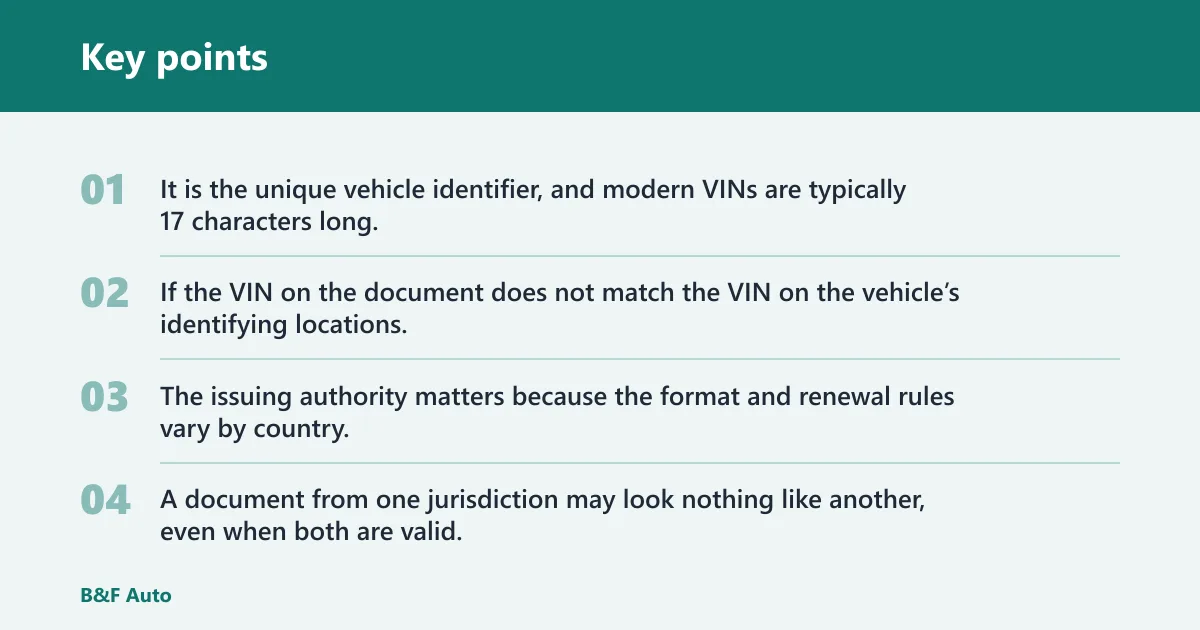
The VIN is especially important. It is the unique vehicle identifier, and modern VINs are typically 17 characters long. If the VIN on the document does not match the VIN on the vehicle’s identifying locations, stop and investigate before handing over the vehicle or submitting paperwork.
The issuing authority matters because the format and renewal rules vary by country, state, or province. A document from one jurisdiction may look nothing like another, even when both are valid.
Registration document decoder
| Field name | What it means | Common confusion point | What to check if the field is missing or does not match | What this field does NOT prove |
|---|---|---|---|---|
| UK-style: V5C document reference number | Reference used by the issuing authority to identify the record | People confuse it with the VIN or with a title number | Check whether the vehicle record is the right one and whether a newer V5C has been issued | It does not prove legal ownership, insurance, or that the car is roadworthy |
| UK-style: registered keeper name and address | The person recorded as responsible for the vehicle | Many assume this proves legal ownership | Confirm whether the keeper has changed after a sale or move, and request an update if the address is wrong | It does not prove title, finance status, or who paid for the vehicle |
| UK-style: vehicle make, model, colour, engine size | Descriptive identifiers for the car on the record | Small mismatches can be dismissed as harmless, but they may signal an outdated record | Check the physical vehicle and the authority record for transcription errors or an unreported change | It does not prove the car is insured, MOT-compliant, or mechanically sound |
| UK-style: VIN or chassis number | Unique vehicle identifier tied to the registration record | People sometimes confuse it with the plate number | Match all 17 characters on modern vehicles against the car and the document | It does not prove ownership, registration currency, or absence of a lien |
| US-style: registration card number | Record number used by the state DMV or motor vehicle agency | Often mistaken for the title number or plate number | Check the state record if the number is absent, expired, or does not belong to the current vehicle | It does not prove title, lien release, or that the vehicle passed inspection |
| US-style: registrant name and address | The person or entity tied to the registration | Can differ from the titled owner or the insurer | Confirm whether the registration was updated after a move, sale, or business name change | It does not prove that the registrant is the sole owner or free of lender interest |
| US-style: plate number and state | The current registration plate linked to that state record | Temporary tags and transferred plates create confusion | Check whether the plate has been reassigned, renewed, or replaced after a state transfer | It does not prove the driver has insurance or that the vehicle can be used in every state |
| US-style: expiration date | Date the registration stops being current unless renewed | Drivers may assume the plate stays valid until the insurance policy renews | Renew before the date shown or verify grace-period rules with the issuing state | It does not prove the vehicle is inspected, insured, or free of fines |
| Issue date | The date the current registration record or card was issued | People confuse issue date with expiry date or purchase date | Compare it to the renewal cycle and any recent change in keeper, owner, or address | It does not prove the vehicle is current today or that the data has not changed since issue |
| Plate state or jurisdiction | Which authority issued the registration | Drivers assume one state’s rules work everywhere | Check the state or country rules for renewal, display, transfer, and proof requirements | It does not prove interstate validity or that another jurisdiction will accept the same document |
| Body type or class | The vehicle category recorded by the authority | Often mistaken for trim level or model name | Verify whether the record matches the actual vehicle type and whether a correction is needed | It does not prove the vehicle is the correct trim, condition, or equipment level |
| Lien, owner, registrant distinction | Whether the record separates the lender, title holder, and registration holder | Many assume these are always the same person | Check the title record, lender paperwork, and state filing if there is a finance interest | It does not prove the lien is paid off or that the title is clean |
What if the details do not match?
If the name, address, plate, or VIN does not match, do not treat the document as ready for use. Mismatches can block a sale, delay a pickup, or cause a stop if the vehicle is checked against the record. They can also point to an unreported keeper change or a clerical error.
Address changes are common. A document may still be valid as a record, but an outdated address can slow replacement requests or send mail to the wrong place. Name mismatches can happen after marriage, business changes, or an error in the original entry.
Say your plate number matches, but the VIN on the document ends in 4821 while the windshield plate ends in 4281. That is not a small typo to ignore. A single digit swap can mean a record error, a cloned plate issue, or the wrong vehicle file.
A common first-timer mistake is handing over a car after a private sale while the registration record still shows the previous keeper. That can leave the buyer with paperwork that does not support the handover, then delay the transfer and insurance update.
Common mismatch checks
- Compare the name and address on the document with the current keeper details.
- Match the VIN on the paper record with the VIN on the vehicle itself.
- Check that the plate number is the current plate, not an old transfer plate or temporary tag.
- Confirm the make, model, and colour if the document lists them.
- Verify whether the issuing authority record has been updated after a sale, move, or correction.
Can you drive without a registration document?
Sometimes yes, but only if the vehicle itself is properly registered and local rules do not require you to carry the paper document. Some jurisdictions expect electronic proof or can verify the record digitally, while others still require you to show a paper copy on request. Check the local rule before driving.
Driving without the paper document is different from driving without a valid registration. A missing card or logbook can often be replaced, but an expired or cancelled registration is a separate problem. The government record, not just the paper, must be current.
For US drivers, state DMV rules vary. One state may allow you to keep proof on your phone, while another expects a paper card in the vehicle. For a state example, California’s DMV explains registration card and replacement procedures on its vehicle registration pages.
When you may still be stopped
You can still be challenged at a roadside stop if you cannot show valid proof when required, even if the vehicle is registered. Officers or inspectors may also look for plate validity, insurance, and inspection status separately from the registration card.
If your jurisdiction allows digital proof, make sure it is the correct document and that the screen shows the current plate, the current registrant, and the current expiry date. A screenshot of the wrong vehicle record is not a valid substitute.
What counts as valid proof of registration?
Valid proof of registration is whatever the issuing authority or local law accepts as evidence that the vehicle is currently registered. That can be a paper card, a logbook, a digital record, or a renewal certificate. The key is that it matches the vehicle and is current under that jurisdiction’s rules.
Government agencies often distinguish between registration proof and ownership proof. The registration document usually answers “is this vehicle registered?” The title answers “who owns it?” The UK DVLA and many US DMVs treat those as different records.
For a general government explanation of replacement and renewal differences, the US National Highway Traffic Safety Administration has consumer guidance on vehicle documentation and registration-related records, and many state DMVs explain whether a card, certificate, or sticker is accepted. See also the federal vehicle documentation guidance for broader context on vehicle records.
What valid proof usually includes
Valid proof usually includes the plate number, vehicle details, issuing jurisdiction, and current status or expiry date. In some systems it also includes a barcode, issue number, or security mark that lets an officer or clerk verify the record.
If the proof is digital, it should be presented exactly as the authority accepts it. If the proof is a paper record, it should be legible and match the current vehicle details. An outdated document, even if authentic, may not count as valid proof.
How replacements and renewals work
Most replacement requests ask for identity details, vehicle details, and a fee, although the exact process depends on the authority that issued the document. If the original is lost, stolen, or damaged, the replacement usually comes from the same motor licensing office, DMV, or transport agency that holds the record.
Renewal is separate from replacement. A document can be current but physically missing, or present but expired. An expired registration can create road-use problems even if you still have the paper copy.
Check whether the problem is a lost document, an outdated record, or a change-of-keeper issue. Those are different fixes. If the vehicle has changed hands, the new keeper may need to register the vehicle in their name before a replacement will make sense.
Replacement and renewal by scenario
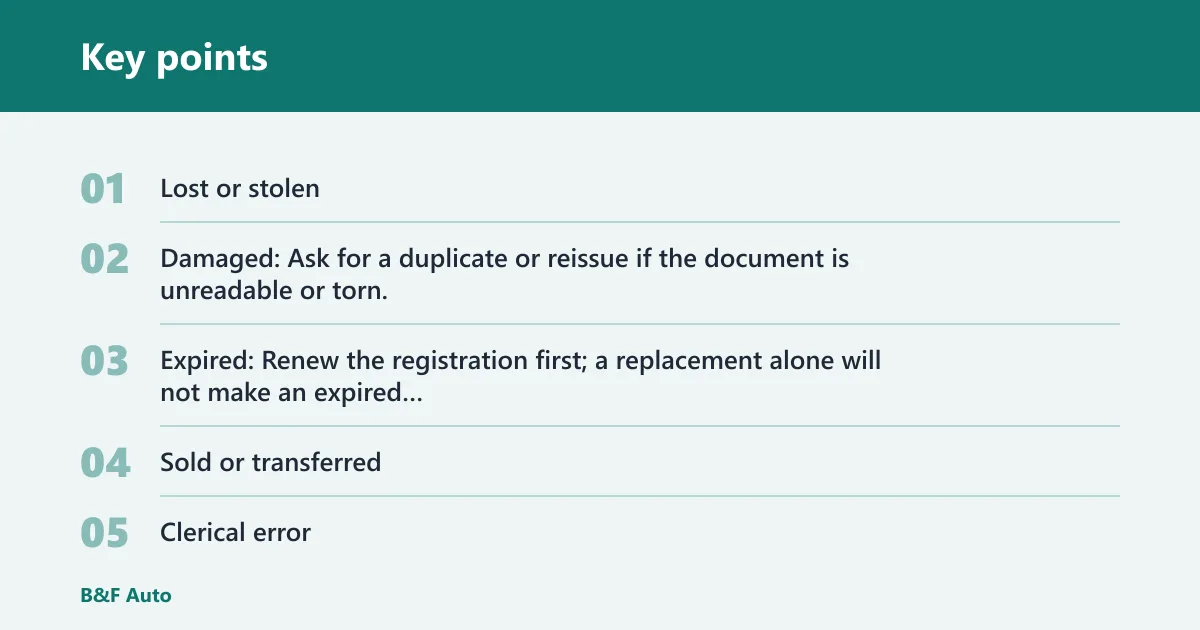
Lost, stolen, damaged, expired, and post-sale corrections do not use the same process. A replacement card request usually restores the document; a renewal extends the registration period; and a transfer or keeper update changes who is tied to the record. Pick the right path first.
- Lost or stolen: Request a replacement from the issuing authority and use the current vehicle details on file.
- Damaged: Ask for a duplicate or reissue if the document is unreadable or torn.
- Expired: Renew the registration first; a replacement alone will not make an expired record current.
- Sold or transferred: Update the keeper or registrant details before asking for a new document.
- Clerical error: Submit a correction request with evidence showing the correct vehicle or name details.
Replacement and renewal steps
- Confirm the issuing authority for the vehicle’s current jurisdiction.
- Gather the vehicle details: plate number, VIN, make, model, and current address if required.
- Check whether the document is lost, stolen, damaged, expired, or out of date after a sale or move.
- Submit the replacement or update request using the authority’s prescribed form or portal.
- Pay any required fee and keep the receipt or reference number.
- Wait for the new paper copy, digital record, or updated registration card.
Where requests can fail
Replacement requests often fail because the address on file is old, the name on the request does not match the registered record, or the vehicle has already changed keeper. Another common failure is asking for a replacement when the record actually needs a transfer or correction first.
Business fleets and gig platforms can also reject paperwork that is expired, unreadable, or inconsistent with the driver profile. Some accept digital proof, but not all do, and acceptance can depend on the jurisdiction and the platform’s rules. If a platform asks for proof of registration, match the exact name and plate before you upload anything.
How do registration, keeper, and title differ after a sale?
After a sale, the registration record, the keeper record, and the title may change on different timelines. The buyer may take possession of the vehicle immediately, but the official record still needs to be updated correctly with the relevant authority. That is why post-sale paperwork matters as much as the handover itself.
In UK-style systems, the seller usually needs to notify the authority so the keeper record is updated. In US-style systems, the title transfer and the registration update may involve separate steps. For a practical walkthrough, see the internal guide on how to fill out car title transfer correctly.
Car registration document checklist
- Confirm whether the vehicle is still shown under the old keeper or registrant.
- Check whether the title has been signed, reassigned, or released correctly.
- Verify that the plate, VIN, and buyer details match the transfer paperwork.
- Update the registration record promptly if the jurisdiction requires it.
- Keep copies of the sale record, transfer forms, and any confirmation from the authority.
Frequently asked questions
What is the difference between a car registration document and a title?
A registration document shows that the vehicle is registered for road use. A title, used in many US states, is an ownership document. A car can have a current registration while the title is held separately by the owner or a lender.
What information is shown on a vehicle registration document?
Most documents show the plate number, VIN, make, model, and some form of keeper or registrant detail. Many also show an issue date or expiry date. The exact layout depends on the issuing authority and whether the document is paper or digital.
Do I need to keep my registration document in the car?
That depends on local rules. Some places expect a paper copy to be available in the vehicle, while others allow digital proof or advise you to keep the paper document at home. Check the local requirement before you travel, because acceptance is not uniform.
What should I do if I lost my car registration document?
Start by checking whether the record is still current and whether the address on file is correct. Then request a replacement from the issuing authority using the plate number, VIN, identity details, and any fee the agency requires. If the keeper changed, update the record first.
Is a registration document the same as registration papers?
In normal use, yes. People often say “registration papers” when they mean the official document or set of documents proving the vehicle is registered. The exact name changes by country, state, or agency, but the purpose is usually the same.
What happens if the details on the document do not match the car?
Do not assume the mismatch is harmless. A wrong VIN, plate, name, or address can mean the record is outdated or incorrect. Check the vehicle, the paperwork, and the issuing authority record before you sell, drive, or insure the car.