How to Inspect a Used Car Yourself Before You Buy
Inspect the car’s body, fluids, tires, lights, electronics, and paperwork in 10 minutes. If you find structural rust, airbag faults, coolant-oil contamination, or a mismatched title, walk away. A bad inspection can turn a cheap listing into repair costs that exceed the car’s value. This guide gives you a fast DIY process for spotting cosmetic issues, checking the highest-signal warning signs, and deciding whether to negotiate, pay for a mechanic, or leave.
Before you meet the seller
Run the VIN check first
Start with a VIN-based vehicle history report before you drive out. Get accident history, service records, and recall status before you spend time on the car, because a clean-looking vehicle can still have a salvage past, repeated repairs, or open safety recalls.
Consumer Reports advises asking whether the car has been in a crash, and safety-recall work may be checked by VIN on the manufacturer or NHTSA website. If the title does not match the seller’s story, or the mileage pattern looks wrong, treat that as a major risk flag. (Consumerreports)
Set up a daylight, level-ground inspection
Inspect the car in daylight on level ground with the sun behind you when possible. That makes paint mismatch, rust, and damage easier to see, and it helps you compare the car side to side without shadows hiding uneven gaps or fluid drips.
Try to see the car cold, meaning the engine has been off long enough to cool down. A cold engine helps reveal starting problems and hidden fluid leaks.
Bring the right tools
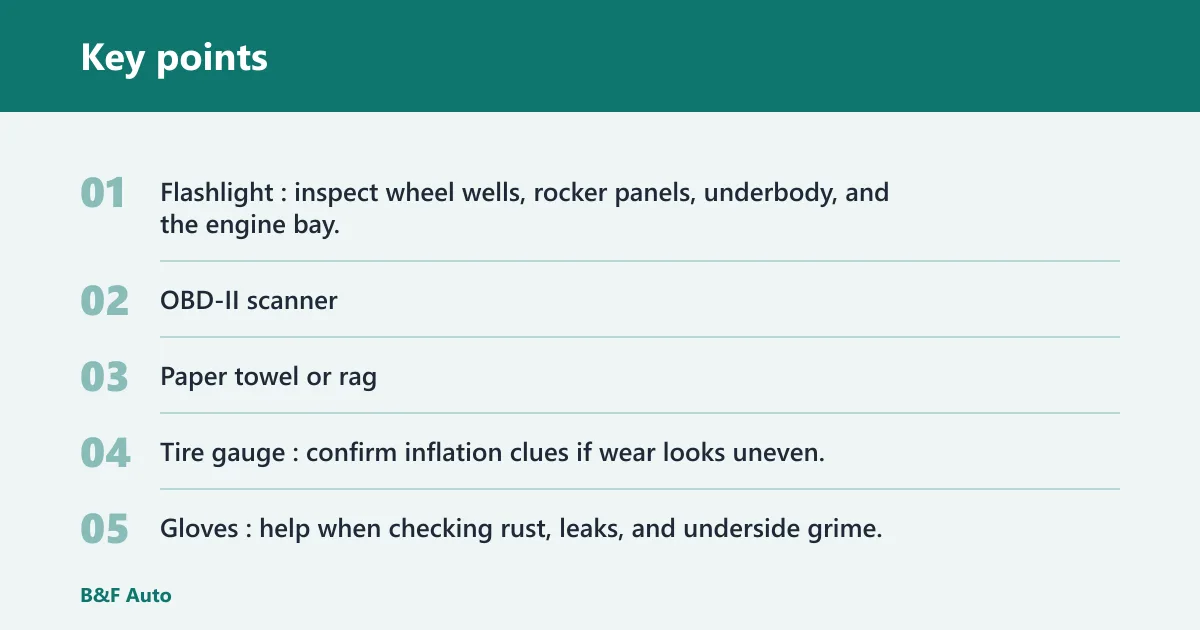
Bring a small kit tied to the checks you plan to make. Do not rely on memory alone.
- Flashlight: inspect wheel wells, rocker panels, underbody, and the engine bay.
- OBD-II scanner: read fault codes and check for warning lights or cleared codes.
- Paper towel or rag: wipe dipstick residue and inspect wet spots.
- Tire gauge: confirm inflation clues if wear looks uneven.
- Gloves: help when checking rust, leaks, and underside grime.
- Phone camera: record panel gaps, tire wear, and warning lamps.
A mechanic inspection often costs about $100-200. If the listing price is near your budget limit, that fee can be cheap compared with one hidden repair.
Private-sale versus dealer-sale checks
With a private sale, expect less paperwork and fewer answers. You need to verify the VIN, title status, history report, recalls, and the seller’s explanation for any warning light, leak, or accident repair clue.
With a dealer sale, the car may be cleaner and easier to return or finance, but the inspection standard should not drop. Used cars on dealer lots still need the same body, tire, fluid, and OBD-II checks.
What to look for on the outside
Paint mismatch and panel gaps
Walk around the car and compare the hood, doors, and trunk. Uneven gaps, misaligned edges, overspray, and different paint sheen can point to body repair after a crash or a poor repair job.
Small stone chips are normal. A fender that sits proud of the hood, or a trunk lid that closes with one side higher than the other, deserves a closer look.
Glass, lights, and trim
Check the windshield, side glass, headlights, taillights, and mirrors for cracks, moisture, or missing clips. Replacement glass is common. Mismatched date codes, cloudy headlamp lenses, or a loose bumper cover can suggest prior damage or rushed repairs.
Rust, dents, and body repair clues
Look in wheel wells, rocker panels, door bottoms, and the lower edges of the fenders. Surface rust is different from bubbling paint, holes, or flaking metal. Those deeper signs raise the risk fast, especially near structure or suspension mounting points.
If an inspection finds a clean hood but one front door has about a 4 mm wider gap at the top than the rear door, that can be a body clue worth investigating. That single clue does not prove a crash, but it does justify a closer body check, a history report review, and likely a mechanic inspection before you commit.
Used car inspection matrix
This table turns common findings into a decision. Use it to sort normal wear from problems that need a mechanic or a hard stop.
| Finding | Severity | Repair complexity | Hidden-damage risk | Best action |
|---|---|---|---|---|
| Minor stone chips on hood | Low | Low | Low | Safe to negotiate |
| Single faded trim piece | Low | Low | Low | Safe to negotiate |
| Small curb rash on one wheel | Low | Low | Low | Safe to negotiate |
| One tire with outer-edge wear | Medium | Medium | Low | Safe to negotiate |
| Center wear on both rear tires | Medium | Low | Low | Safe to negotiate |
| Cabin odor from spills or pets | Low | Low | Low | Safe to negotiate |
| One inoperative window switch | Low | Low | Low | Safe to negotiate |
| Battery terminals with light corrosion | Medium | Low | Low | Safe to negotiate |
| Loose interior trim or rattles | Low | Low | Low | Safe to negotiate |
| Old tires over 6 years old | Medium | Low | Low | Safe to negotiate |
| Check-engine light on with no code history | High | Unknown | Medium | Needs a mechanic |
| Airbag light stays on | High | High | High | Needs a mechanic |
| Cupping or scalloping on tires | High | Medium | Medium | Needs a mechanic |
| Fresh wet spot under engine or transmission | High | Unknown | High | Needs a mechanic |
| Uneven panel gaps at hood, doors, or trunk | High | High | High | Needs a mechanic |
| Slow cranking with weak battery | Medium | Medium | Low | Needs a mechanic |
| Coolant level low with no clear cause | High | Medium | High | Needs a mechanic |
| Exhaust smoke with no clear explanation | High | High | High | Needs a mechanic |
| Structural rust, holes, or bubbling in rocker/frame areas | Critical | High | High | Walk away |
| Mismatched title, flood signs, or undisclosed salvage history | Critical | High | High | Walk away |
If you are unsure where a finding lands, use this rule: cosmetic wear with low hidden-damage risk is a negotiation point; anything tied to structure, safety systems, or fluid contamination needs a mechanic; flood, frame, or title problems mean walk away.
How do you inspect the engine and fluids?
Open the hood only after the cold start if possible, then check for hard starting, warning lamps, leaks, and contamination. Under the hood, look at oil, coolant, transmission fluid, belts, hoses, battery condition, and corrosion together, because one warning can explain another.
Cold start behavior
A cold start should fire cleanly without repeated cranking, stalling, or loud knocking. A rough first start can point to weak compression, fuel delivery issues, or a battery that is near the end of its life.
Listen for ticking, rattling, and unstable idle. Then look around the engine bay and the ground for new drips.
Oil, coolant, and transmission fluid
Check the oil for proper color and consistency, and look for milky contamination on the dipstick or under the oil cap. Milky residue can point to coolant mixing with oil, which is a serious engine warning.
Check coolant level and look for crusty residue around hoses, the radiator, and the reservoir. If transmission fluid is accessible, inspect it for burnt odor, dark color, or fresh wetness near the case and cooler lines.
Belts, hoses, battery, and corrosion
Inspect belts for cracking or glazing and hoses for swelling, splits, or damp ends. Light surface dust is normal. Wetness, crust, or green-white corrosion around terminals points to maintenance needs or charging issues.
Battery corrosion and slow cranking belong in the “needs a mechanic” bucket when the seller cannot explain them. The problem may be minor, but the cause may also be a failing charging system.
How do you check the tires, brakes, and underbody?
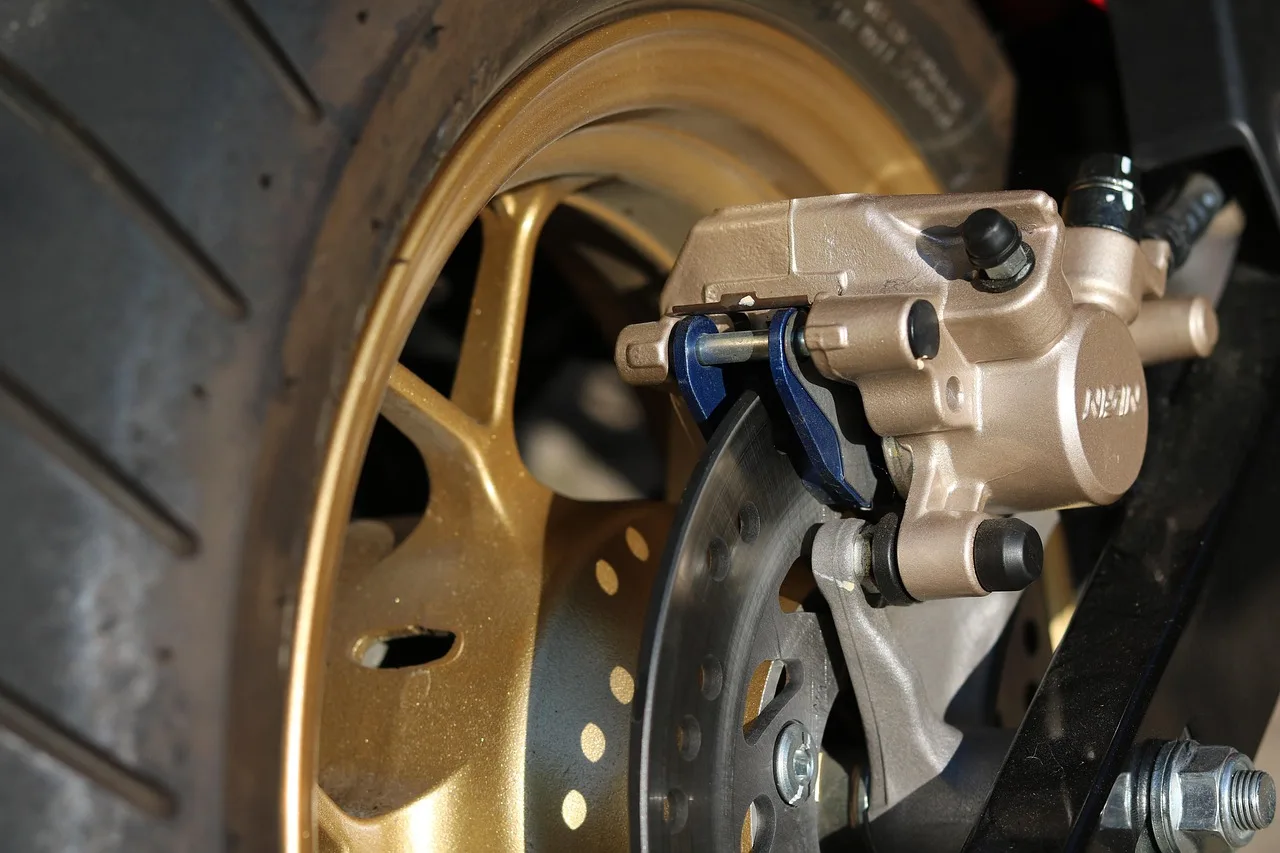
Tires and the underside tell you a lot quickly. Wear patterns, rust, and wet spots can point to alignment problems, suspension wear, brake trouble, or hidden damage that the paint cannot hide.
Tire wear patterns and age clues
Check all four tires for center wear, edge wear, and cupping or scalloping. Center wear often points to overinflation. Edge wear can suggest underinflation or alignment issues. Cupping or scalloping can indicate suspension problems.
The toonie test is suggested for tire tread depth in one guide, but tread depth alone is not enough. Tires over 6 years old should be replaced even if they still look serviceable.
Also check whether the set matches. A mixed set may be fine on an older car, but it can also suggest a cash-strapped owner who delayed maintenance.
Underbody leaks and rust
Slide a flashlight under the car and look for fresh wet spots under the engine, transmission, differential, and center of the car. Fresh fluid is more important than old stains.
Surface rust on suspension parts is common in some climates. Holes, deep flaking, and bubbling in the wheel wells, rocker panels, or frame area are not normal wear. Those signs move the car toward a walk-away decision.
Brake and suspension warning signs
Look through the wheels at the brake rotors and calipers for heavy grooves, obvious uneven pad wear, or fluid around the corners of the wheel. During the walk-around, press down on each corner of the car if the seller allows it; excessive bouncing can hint at worn shocks or struts.
Suppose the front tires show feathered edges and the steering wheel is off-center on a straight road. That combination usually points to alignment or suspension work, not a simple cosmetic issue. A mechanic should confirm the cause before you buy.
What should you test inside the car?
Inside the cabin, check for smells, moisture, comfort items, and warning lamps. Interior condition matters because water damage, failed electronics, and ignored warning lights often travel with larger repair bills.
Seats, smells, and moisture
Lift floor mats and feel the carpet for dampness. Check the headliner, seat rails, trunk lining, and spare-tire area for water staining, mildew, or silt. A stale or moldy smell can point to leaks or past water intrusion.
Windows, locks, HVAC, and infotainment
Test every window, door lock, heater, AC setting, infotainment screen, and backup camera. If one feature fails, note it. If several fail together, suspect a fuse, module, wiring issue, or low battery condition.
Warning lights and OBD-II scan
Turn the key on and watch the dash. The check-engine light and the airbag light should not stay on after startup. Consumer Reports advises checking for an airbag light that stays on.
Use an OBD-II scanner to read fault codes, look for pending codes, and check whether codes may have been cleared recently. Cleared codes are not proof of a fix; they can hide a problem that returns after a longer drive cycle.
How should the test drive change your decision?
The test drive should confirm whether the car brakes straight, steers cleanly, accelerates normally, and stays quiet over bumps. The drive is where small clues become decision points. If the car feels inconsistent, stop treating it as a simple bargain.
Braking and steering feel
Brake gently and firmly at low speed. Pulling to one side, steering shake, pulsation in the pedal, or grinding noise can point to brake wear, tire issues, or suspension damage.
At parking-lot speeds, turn the wheel fully left and right. Clicking, binding, or power steering noise deserves attention.
Acceleration and transmission behavior
Accelerate smoothly and then moderately. Hesitation, shudder, delayed shift, or flare between gears can mean transmission trouble or engine management issues. Those are rarely cosmetic.
Noise, vibration, and suspension clues
Listen for clunks over bumps, humming that changes with speed, and vibration through the seat or wheel. Tire cupping, worn bushings, wheel bearings, and suspension parts can all show up here.
A common first-timer mistake is to excuse a loud front-end clunk as “just old-car noise.” If the sound appears every time the wheel crosses a driveway lip, do not guess. Put the car in the mechanic-needed bucket until the source is identified.
Frequently asked questions
How do you inspect a used car before buying?
Start with the VIN history report, then inspect the body, tires, fluids, underbody, cabin, and warning lights in daylight. Cold-start the car, scan it with an OBD-II reader, and finish with a test drive. If you find structural rust, airbag faults, coolant-oil contamination, or title problems, walk away.
What should I check on a used car before I buy it?
Check accident history, recall status, panel gaps, rust, tire wear, leaks, battery condition, electronics, and the dash warning lights. Then test braking, steering, acceleration, and suspension noise. The goal is not a perfect car. It is separating normal wear from expensive or hidden damage.
How can I tell if a used car has accident damage?
Look for uneven panel gaps, different paint texture, overspray, missing fasteners, and glass or trim that does not match the rest of the car. Check the VIN report for accident records, and compare hood, door, and trunk alignment. If the seller cannot explain the clues, get a mechanic involved.
How do I check a used car for rust and leaks?
Inspect the wheel wells, rocker panels, and underbody with a flashlight. Surface rust is common in some climates, but holes, bubbling, and flaking near structure are serious. For leaks, look for fresh wet spots under the engine, transmission, and cooling system before and after the cold start.
What should I test inside a used car before purchase?
Test every window, lock, HVAC setting, infotainment function, and backup camera. Check for damp carpet, mildew smell, and a headliner with stains. Turn the key on and watch for warning lamps, especially the airbag light and check-engine light, then verify the codes with an OBD-II scanner.
Should I still get a mechanic inspection after I check the car myself?
Yes, when the car is expensive, the history is unclear, or your inspection finds any high-risk issue. A paid pre-purchase inspection often costs about $100-200 and can confirm whether a noise, leak, or warning light is minor or a reason to leave.