How Long Are Car Loan Terms in Months?
Most car loans are commonly offered in terms ranging from about 36 to 72 months, with 60 and 72 months often used. Pick the shortest term your budget can handle without strain. Longer terms lower the payment, but they raise total interest and can leave you owing more than the car is worth. This guide covers common loan lengths in months, how each term changes payment and interest, and how to choose one.
How long are car loans typically?
Car loans are usually quoted in months, and common term lengths include 36, 48, 60, 72, and 84 months. A practical range runs from about 24 to 84 months, with some lenders going beyond 84 months and some offering a 12-month minimum. The average new-car term was 68.94 months in Q4 2025.
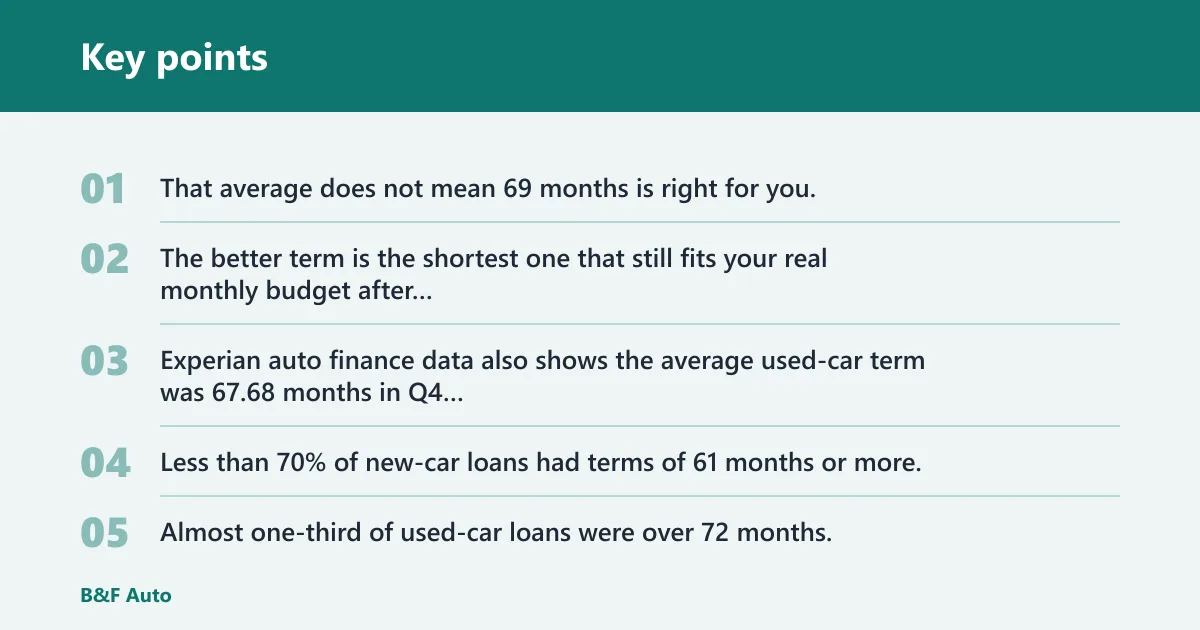
That average does not mean 69 months is right for you. It only shows where the market sits. The better term is the shortest one that still fits your real monthly budget after insurance, fuel, maintenance, and emergency savings.
Experian auto finance data also shows the average used-car term was 67.68 months in Q4 2025. Less than 70% of new-car loans had terms of 61 months or more, while 31.78% of new-car loans had 73 months or more. Almost one-third of used-car loans were over 72 months.
How lenders quote terms in months
Lenders normally quote auto loans in months on the paperwork, not years. That keeps payment math simple and keeps terms in 12-month steps. You may see 24, 36, 48, 60, 72, 84, and sometimes 96 or 108 months, depending on the lender and the vehicle.
Some lenders set a shorter ceiling for older or higher-mileage vehicles. Others will stretch farther for qualified borrowers, especially when the loan-to-value profile is strong. U.S. Bank says auto financing has a 12-month minimum term, and Credit Human offers auto-loan terms up to 84 months.
Why averages do not equal the best choice
A market average is a snapshot, not a recommendation. A 68.94-month new-car average can still be a poor fit if you want lower total interest, faster equity, or less time underwater. Your best term depends on APR, down payment, trade-in equity, and vehicle age.
Term chooser table
This table turns years into months at a glance and shows the payment, interest, and underwater-risk tradeoff for each term. Use it as a quick filter, then compare the exact quote you receive from the lender.
| Term | Years | Typical payment effect | Total-interest effect | Underwater risk | Recommendation |
|---|---|---|---|---|---|
| 24 months | 2 years | Highest monthly payment | Lowest interest cost | Low | Best for buyers with strong cash flow who want to pay off fast. |
| 36 months | 3 years | Very high payment, but less than 24 months | Low interest cost | Low | Good for total-cost-first shoppers who can handle a bigger payment. |
| 48 months | 4 years | Higher payment than 60 or 72 months | Lower interest than longer terms | Low to moderate | A strong middle ground for buyers who want balance without stretching too far. |
| 60 months | 5 years | Moderate payment | Balanced interest burden | Moderate | A standard benchmark term for many new-car buyers. |
| 72 months | 6 years | Lower payment than 60 months | Higher interest cost | High | Use only if the payment gap matters more than the extra interest. |
| 84 months | 7 years | Lowest standard monthly payment | Highest interest burden among standard terms | Very high | Last resort for payment relief, not the default choice. |
| 96 months | 8 years | Even lower payment if offered | Very high interest cost | Very high | Rarely a good fit unless the vehicle is inexpensive and the loan is well secured. |
| 108 months | 9 years | Lowest payment in this set | Extremely high interest cost | Extreme | Avoid unless the lender, vehicle, and payment plan make the total cost acceptable. |
What are the most common car loan terms?
The most common car loan terms are 36, 48, 60, 72, and 84 months. Auto loans are usually offered in 48, 60, 72, or 84 months, and 60 months is often treated as a benchmark for new cars. Forty-eight months sits in the middle, while 72 and 84 months push farther toward payment relief.
36-month loans
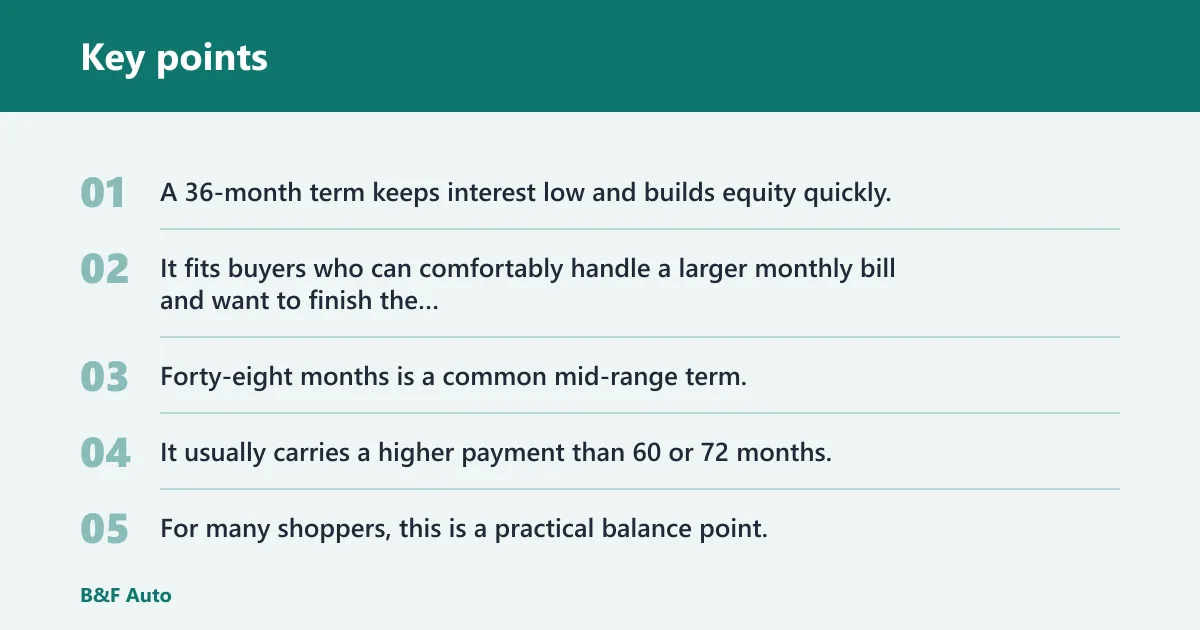
A 36-month term keeps interest low and builds equity quickly, but the payment can be much higher than longer options. It fits buyers who can comfortably handle a larger monthly bill and want to finish the loan fast.
48-month loans
Forty-eight months is a common mid-range term. It usually carries a higher payment than 60 or 72 months, but it cuts total interest compared with longer loans. For many shoppers, this is a practical balance point.
60-month loans
Sixty months is a common benchmark term and is often treated as a cap for new cars. It balances payment size and interest better than 72 or 84 months, which is why many shoppers start there when comparing options.
72-month loans
Seventy-two months lowers the monthly payment, but it usually raises total interest and negative-equity risk. It can fit a tighter budget, yet the longer payoff window means you may spend more time owing more than the vehicle is worth.
84-month loans
Eighty-four months is the longest term commonly offered by dealerships. It usually produces the lowest standard monthly payment, but it also carries the highest interest burden in standard comparisons. An 84-month loan cut the monthly payment compared with a 48-month loan by about 40%, and it added $4,905 over the 84-month term in the example.
How does loan length change payment and interest?
Monthly payment falls as the term gets longer, but total interest rises. That tradeoff is the core decision. A longer term spreads the balance over more months, which makes each payment smaller and keeps the lender earning interest for longer.
APR and amount financed change the math every time. A higher APR pushes the payment up and widens the interest gap between terms. A larger down payment or trade-in equity lowers the amount financed, which can make a shorter term more realistic.
Why a longer term is not a free discount
Picture a buyer choosing between 60 and 84 months on the same car. The 84-month loan may feel easier each month, but the lower payment comes with a longer stretch of interest charges and a longer time before the loan balance shrinks to a safer level.
Suppose the lender offers a strong APR because of good credit and a solid down payment. In that case, a 60-month term may become manageable without forcing the buyer into the higher total cost that comes with 72 or 84 months.
How long is too long for a car loan?
Too long depends on the payment, the APR, and how fast the car loses value. For many shoppers, 72 months is the point where negative-equity risk becomes much more noticeable, and 84 months is the point where the loan can stay underwater for a long time if the vehicle depreciates quickly.
Negative equity and underwater risk
Negative equity means you owe more than the vehicle is worth. The risk rises as the term gets longer because the balance falls slowly while the car value usually drops quickly at first. That gap matters most in the early and middle years of the loan.
Longer terms can leave you underwater for more months, especially on new cars with rapid early depreciation. A 60-month loan usually clears that gap sooner than a 72-month loan, and 84 months can extend the problem even further.
Why 72 and 84 months carry more risk
Seventy-two months can be workable, but it usually means you spend more time with limited equity. Eighty-four months goes further. In standard comparisons, it brings the lowest payment and the highest interest burden, so the savings are mostly short-term while the cost continues for years.
When longer terms can still make sense
Longer terms can make sense when the choice is between a manageable payment and a payment that strains the budget. They can also help when the car price is high, the buyer has strong job stability, and the down payment keeps the loan-to-value ratio in check.
What changes the term you can get?
Credit score, APR, down payment, trade-in equity, vehicle age, mileage, and lender policy all shape the term you can qualify for. A lender may offer a long term on one deal and a shorter term on another, even for the same buyer, because the risk profile changes.
Credit score and APR
Better credit often brings a lower APR, which can make a shorter term easier to afford. A weaker credit profile may push the payment up, making a longer term more tempting. The loan still costs more overall if the term stretches too far.
Down payment and trade-in equity
A bigger down payment lowers the amount financed. Trade-in equity does the same thing. Both can move a buyer from a 72-month quote to a 60-month quote, or from a 60-month quote to a 48-month quote, without changing the vehicle.
Vehicle age, mileage, and lender limits
Older cars and higher-mileage vehicles usually face tighter term caps. Some lenders will not extend the same maximum term on a used vehicle that they would on a new one. That is why the practical range is about 24 to 84 months, even though some lenders go beyond 84 months in select cases.
Loan-to-value and lender caps
Loan-to-value matters because a higher LTV can raise risk for the lender and for you. Some lenders finance up to 130% of LTV for qualified borrowers, but that does not mean the longer term is the better choice. A high LTV plus a long term can keep the loan underwater for a long time.
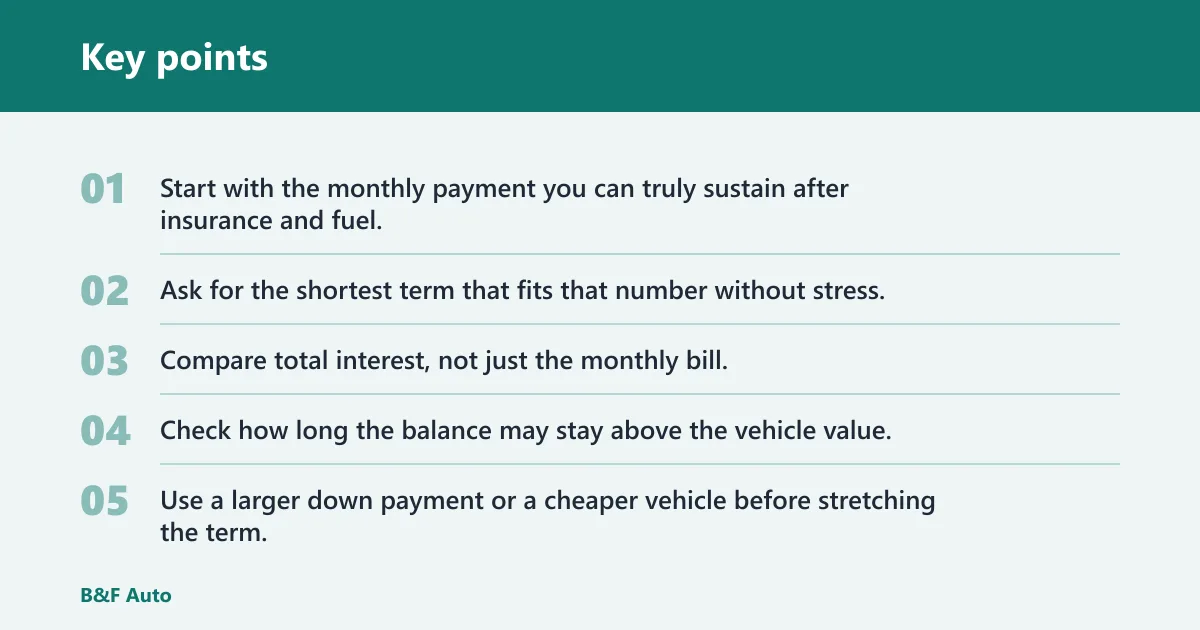
- Start with the monthly payment you can truly sustain after insurance and fuel.
- Ask for the shortest term that fits that number without stress.
- Compare total interest, not just the monthly bill.
- Check how long the balance may stay above the vehicle value.
- Use a larger down payment or a cheaper vehicle before stretching the term.
Frequently asked questions
How many months are car loans typically?
Car loans are typically 36 to 72 months, with 60 and 72 months the most common choices for many shoppers. The market average sits near 69 months for new cars and near 68 months for used cars, but the best term still depends on your budget and total cost.
How many months for a car loan is normal?
A normal car loan often falls at 48, 60, or 72 months. Those terms are common because they balance monthly payment and interest better than very short or very long loans. For many buyers, 60 months is the standard comparison point.
How long does a car loan last?
A car loan can last as little as 12 months with some lenders and as long as 84 months in many standard offers, with some lenders going beyond that. The most practical range for shoppers is usually about 24 to 84 months, depending on the vehicle and the loan terms.
How many years is a car loan?
Convert months to years by dividing by 12. That makes 36 months equal to 3 years, 60 months equal to 5 years, 72 months equal to 6 years, and 84 months equal to 7 years. The paperwork still usually lists the term in months.
What is the longest car loan term available?
For standard dealership offers, 84 months is often the longest common term. Some lenders extend beyond 84 months, but those loans are less common and usually come with higher total interest and more underwater risk. Always check the lender’s cap before you shop.
Are 72-month and 84-month car loans common?
Yes. Both are common, especially when buyers want a lower monthly payment. Auto loans are usually offered in 48, 60, 72, or 84 months, and recent data shows a growing share of loans at 73 months or more.
Can you get a car loan with a 12-month minimum term?
Yes, some lenders offer a 12-month minimum term. U.S. The same source says auto financing has a 12-month minimum term. That said, short terms create high monthly payments, so they work best when the budget can handle the larger bill without strain.