What Are Auto Loan Terms and Conditions?
Auto loan terms and conditions are the contract rules for your financing: loan amount, APR, term length, payment date, fees, collateral, insurance requirements, prepayment rules, and default consequences. Miss one detail, and you can pay more, lose flexibility, or face repossession. This guide breaks down the clauses to verify before you sign.
What are auto loan terms?
Auto loan terms are the repayment length in months. Common lengths include 36, 48, 60, 72, 84, and sometimes 96 months. The same amount financed can produce very different monthly payments depending on term length, and a longer term gives interest more time to add up.
How do term length and loan amount differ?
The loan amount, often called the amount financed, is the principal after your down payment and trade-in value are applied. The term is the time you get to repay that principal. Those are separate contract items, and confusing them can lead you to focus on the wrong number.
If you finance about $24,000, a 60-month loan and an 84-month loan can both cover that same amount. The 84-month version typically lowers the monthly payment while increasing the total interest over the life of the loan.
What are the common auto loan term lengths?
- 36 months: shorter payoff time, with a larger monthly bill.
- 48 months: middle-ground option for buyers who want quicker payoff.
- 60 months: a common balance of payment size and total cost.
- 72 months: lower monthly payment, higher total interest than shorter terms.
- 84 months: long repayment period, often used to reduce payment size.
- 96 months: available from some lenders, but it can carry more total cost and more equity risk.
What are auto loan terms and conditions?
Auto loan terms and conditions are the full contract rules, not just the month count. They may spell out when you pay, what fees apply, whether there is a grace period, whether prepayment costs extra, how payoff quotes are issued, and what happens if you miss payments or default. Read the note and the addenda together.
What belongs in the fine print?
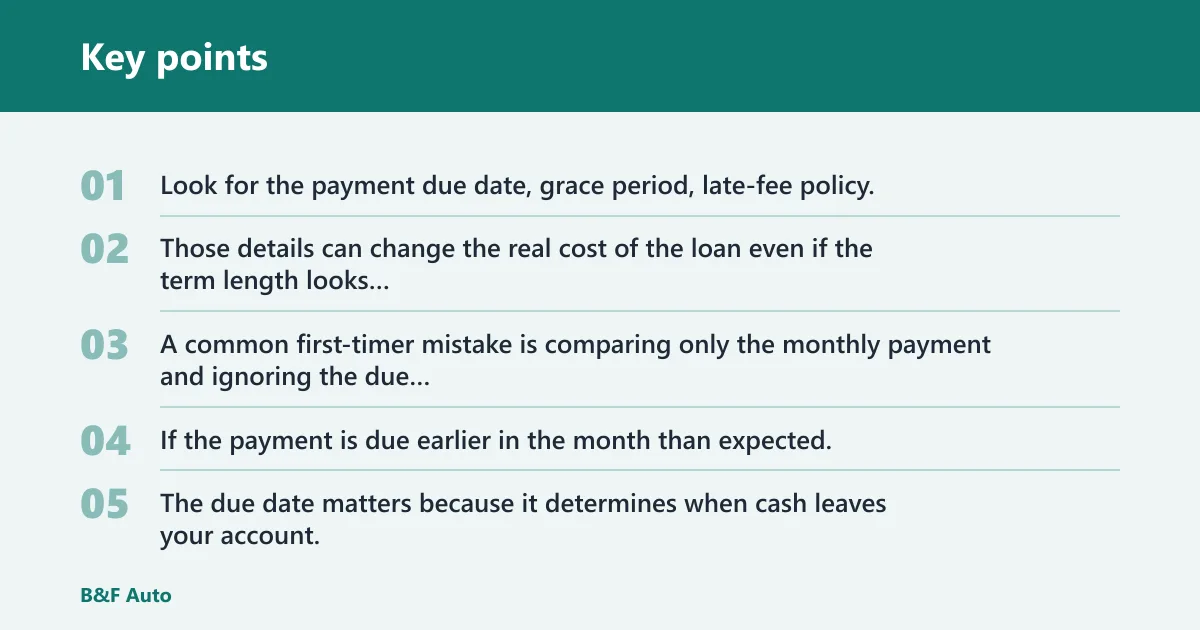
Look for the payment due date, grace period, late-fee policy, add-ons included in the financing, collateral language, insurance requirements, and payoff instructions. Those details can change the real cost of the loan even if the term length looks attractive.
A common first-timer mistake is comparing only the monthly payment and ignoring the due date. If the payment is due earlier in the month than expected, a tight budget can turn into a late fee fast.
How should payment timing and payoff rules be written?
The due date matters because it determines when cash leaves your account. The grace period tells you how long after the due date you can pay before a late charge applies. The payoff section should explain how to request a payoff quote, how long that quote stays valid, and whether interest accrues daily.
If the contract does not clearly explain payoff instructions, ask for the exact process before signing. That matters if you plan to refinance, sell the vehicle, or pay the loan off early.
How do APR, interest rate, and total cost compare?
Interest rate is the price of borrowing before fees. APR is broader because it can include required fees and other finance charges, so it is usually the better comparison number when you are weighing one offer against another. Review monthly payment, finance charge, and total of payments together.
What is the difference between interest rate and APR?
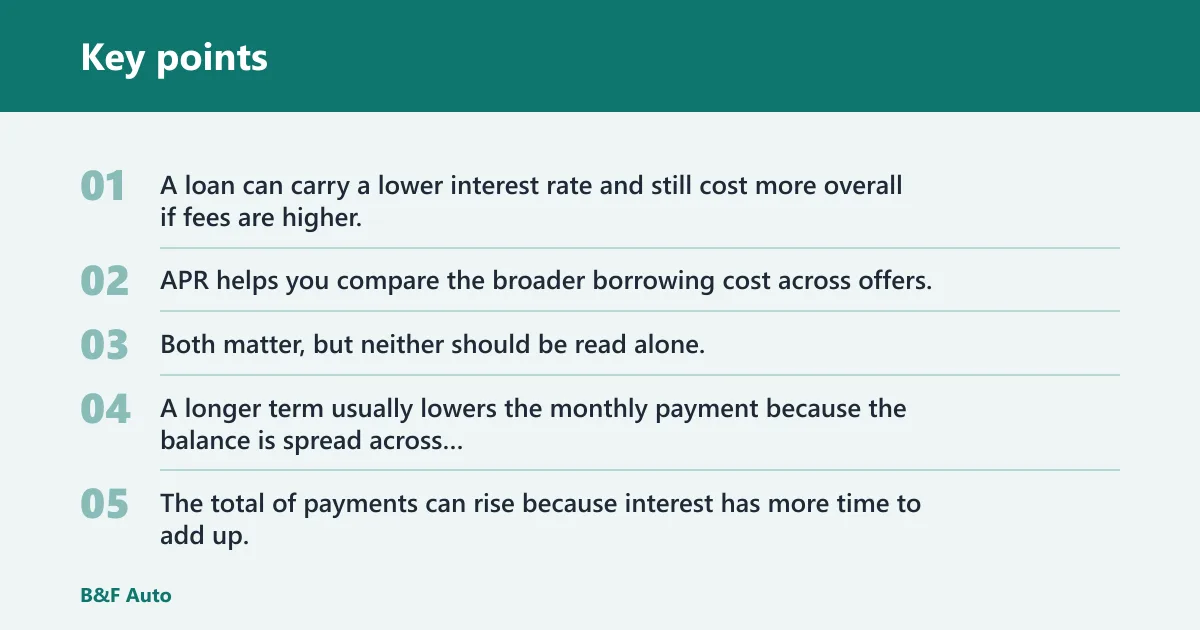
A loan can carry a lower interest rate and still cost more overall if fees are higher. APR helps you compare the broader borrowing cost across offers, while the interest rate shows the base cost of the money itself. Both matter, but neither should be read alone.
| Metric | What it tells you | Why it matters |
|---|---|---|
| Interest rate | Price of borrowing before fees | Drives the finance charge and monthly payment |
| APR | Broader borrowing cost, including required fees | Better for comparing offers side by side |
| Monthly payment | Amount due each month | Shows short-term budget impact |
| Total of payments | Sum of all scheduled payments | Shows the full repayment cost |
How does term length change payment and total interest?
A longer term usually lowers the monthly payment because the balance is spread across more months. That does not mean the loan is cheaper. The total of payments can rise because interest has more time to add up. Compare the monthly bill and the full payoff amount before you sign.
U.S. Bank says monthly payment and APR vary based on term, amount financed, model year, LTV, down payment, credit history, and fees. In its refinance example, a 60-month term for a $30,000 financed amount is shown at $616.22 with an APR of 8.55%.
| Term length | Monthly payment | Total interest | Tradeoff |
|---|---|---|---|
| Shorter term | Higher | Lower | Faster payoff, less interest, tighter budget impact |
| Middle term | Moderate | Moderate | Balanced monthly cost and total borrowing cost |
| Longer term | Lower | Higher | Easier monthly payment, more interest over time |
Assumptions: Same amount financed, same vehicle, same lender pricing structure, and the only variable is loan length. Actual payment and interest vary by APR, fees, down payment, credit, and collateral value.
What should be on an auto loan terms checklist
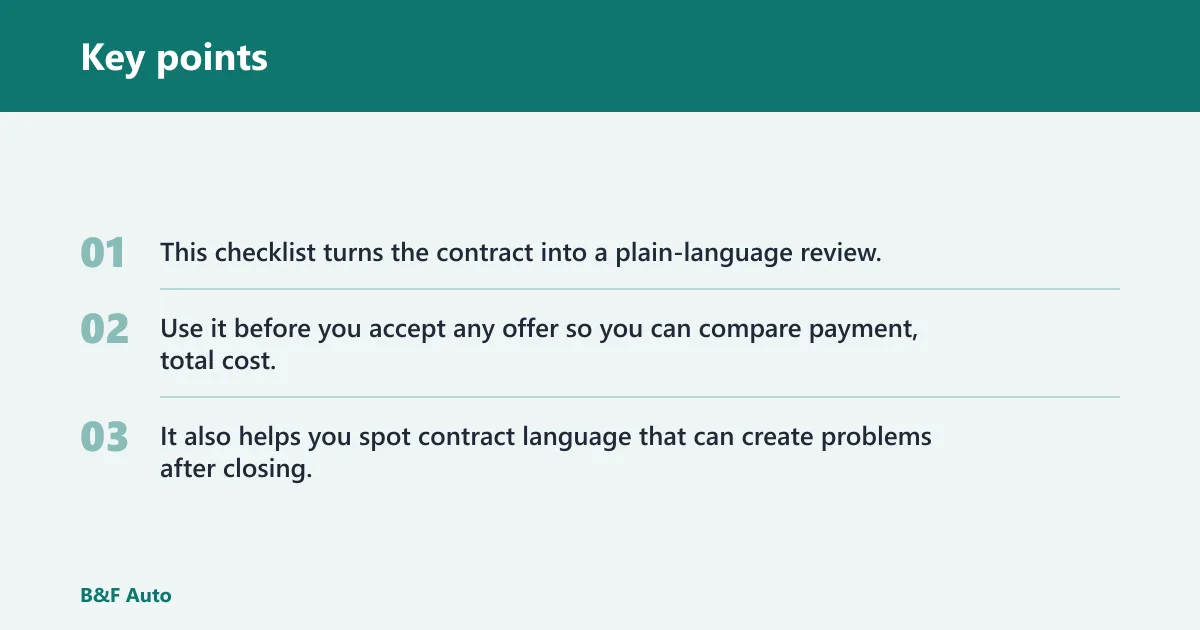
This checklist turns the contract into a plain-language review. Use it before you accept any offer so you can compare payment, total cost, and risk in the same pass. It also helps you spot contract language that can create problems after closing.
| Clause | Why it matters | What to look for | Red-flag example |
|---|---|---|---|
| Term length | Sets how long you repay and how much interest can build | 36, 48, 60, 72, 84, or 96 months | “Payment looks good” with no disclosure of a very long term |
| APR | Shows broader borrowing cost than the interest rate alone | APR printed near the rate and finance charge | APR missing from the offer summary |
| Amount financed | Shows what you are actually borrowing after credits and fees | Clear disclosure of principal, down payment, trade-in, and add-ons | Amount financed does not match the signed buyer’s order |
| Total of payments | Shows the full amount you will repay over the life of the loan | Printed total that includes all scheduled payments | No total of payments shown anywhere in the contract packet |
| Fees | Can raise the true cost of the loan | Origination, documentation, title, or required service fees | Fees added after you think the rate is final |
| Payment due date | Affects cash flow and late-fee risk | A date that fits your pay cycle | Due date falls before your paycheck clears |
| Grace period | Gives a short window before a late fee applies | Exact number of days and whether it applies to every payment | No grace period listed at all |
| Default and repossession | Explains what happens if you miss payments | Default trigger, notice requirements, late charges, repossession rights, and cure steps | Default language is vague or silent on repossession rights |
| Required insurance | Can change your true monthly cost | Collision, comprehensive, liability, gap coverage, or lender-placed insurance rules | Insurance minimums are listed only in a separate addendum |
| Prepayment penalty | Can add cost if you pay early | None, or a clear fee schedule if one exists | Penalty language buried in the note |
| Late-fee policy | Shows the cost of a missed or delayed payment | Fee amount and when it starts | Flat fee with no timing details |
| Rate-lock period | Protects the quoted rate for a set time | How many days the rate stays valid | Quote expires before you can finish the purchase |
| Optional add-ons | Can increase amount financed without adding value you want | Gap coverage, warranties, service plans, or protection products | Add-ons are rolled in without clear consent |
| Payoff quote instructions | Needed if you want to refinance or pay off early | Who to call, how to request it, and how long the quote is valid | No process listed for requesting a payoff amount |
How does term length affect your monthly budget?
A longer term lowers the monthly payment, but it usually increases total interest and keeps the loan open longer. That matters because your budget may feel easier today while the loan costs more over time and the vehicle may lose value faster than the balance falls.
What is negative equity risk with extended terms?
Negative equity means you owe more than the car is worth. With an extended term, that gap can last longer because the balance may stay ahead of the vehicle’s value for more months. That creates problems if you need to sell, trade, or refinance before the loan is well paid down.
Picture a used car with a long loan term and modest down payment. If depreciation outpaces principal reduction, you can be upside down for a longer stretch, even while the monthly payment looks manageable on paper.
When can a longer term make sense?
A longer term can fit a buyer who needs room in the monthly budget and can accept the higher total cost. It becomes a poor fit when the contract also carries high fees, a weak payoff rule, or a payment that leaves little room for maintenance and insurance.
What do lenders check before approving a loan?
Lenders usually look at credit score, income, debt-to-income ratio, payment history, and the vehicle itself. Those factors affect the term you are offered, the APR you qualify for, and sometimes the range of vehicles that can be financed.
What income, debt, and documentation do lenders want?
Truist says auto loan approval is based on factors including income, payment history, and debt-to-income ratio. It also says applicants need income and employment information and a driver’s license. Those details help the lender confirm that the payment fits your profile.
How do vehicle age and mileage affect term options?
Vehicle age and mileage can affect available term options, especially on used cars. Older vehicles and higher-mileage vehicles may qualify for shorter terms or different pricing because the lender is balancing repayment length against collateral value.
The same source says used auto loans at dealerships can have loan terms up to 84 months, and it says new car loans can include a 30-day interest rate lock guarantee. Truist also says it offers no pre-payment fees on secured auto loans.
Can you pay off an auto loan early?
You often can, but you should verify the contract before sending extra money. Some lenders impose a prepayment penalty, while others do not. Early payoff may also change how interest is calculated, so the payoff quote matters just as much as the monthly payment.
What changes when you refinance?
Auto loan refinance can lower the rate or payment, and it may shorten or lengthen the repayment period. The new contract can change the APR, term length, and monthly payment, while other items such as payoff instructions and rate-lock terms may be different from the original purchase loan.
U.S. The same source says refinance decisions are typically given within minutes after applying, and it says applicants need a VIN to refinance an auto loan. That makes it worth gathering vehicle details before you start the application.
What should you confirm before making extra payments?
- Ask whether there is a prepayment penalty.
- Request a payoff quote and check how long it stays valid.
- Confirm whether extra payments go to principal or to future installments.
- Verify that the lender will not apply a fee for paying ahead.
Frequently asked questions
What are car loan terms?
Car loan terms are the number of months you have to repay the loan. Common choices are 36, 48, 60, 72, 84, and sometimes 96 months. Shorter terms usually mean higher monthly payments and less interest, while longer terms usually lower the payment and raise total interest.
What is included in auto loan terms?
Auto loan terms can include items such as the repayment period, APR, monthly payment, amount financed, due date, grace period, late-fee policy, prepayment penalty, rate-lock period, add-ons, and payoff instructions. The term length is only one part of the contract.
How long are car loan terms in months?
Many auto loans run 36, 48, 60, 72, or 84 months, and some lenders also offer 96 months. The right length depends on your monthly budget, the total cost of borrowing, and how long you plan to keep the vehicle.
What is the difference between loan amount and loan term?
The loan amount is how much you borrow. The loan term is how long you take to repay it. The same amount financed can produce very different monthly payments depending on whether the term is 48 months or 84 months.
How do loan term and interest rate affect monthly payment?
A longer term usually lowers the monthly payment because the balance is spread over more months. A higher interest rate raises the payment because borrowing costs more. APR matters too, since it can include required fees and gives a fuller view of the loan cost.
What should I check before accepting an auto loan offer?
Check the term length, APR, amount financed, payment due date, grace period, late fees, prepayment penalty, rate-lock period, add-ons, and payoff instructions. Compare the monthly bill with the total repayment amount so the offer does not look cheaper than it really is.