How Do You Know If Your Car Trade-In Is Upside Down?
Your trade-in is upside down if your loan payoff is higher than the car’s trade-in value; the gap is your negative equity. Ignore it, and you can roll debt into the next loan, raise your monthly payment, and start the next car already behind. This guide gives a fast checklist to confirm the number, then shows when to trade, pay down, keep driving, or sell.
What upside down means
Being upside down, underwater, or in negative equity means the payoff amount on the loan is higher than what the vehicle would bring in a current sale. In plain terms, the car is worth less than the debt tied to it. That gap changes your real trade-in math.
Negative equity, payoff balance, and market value
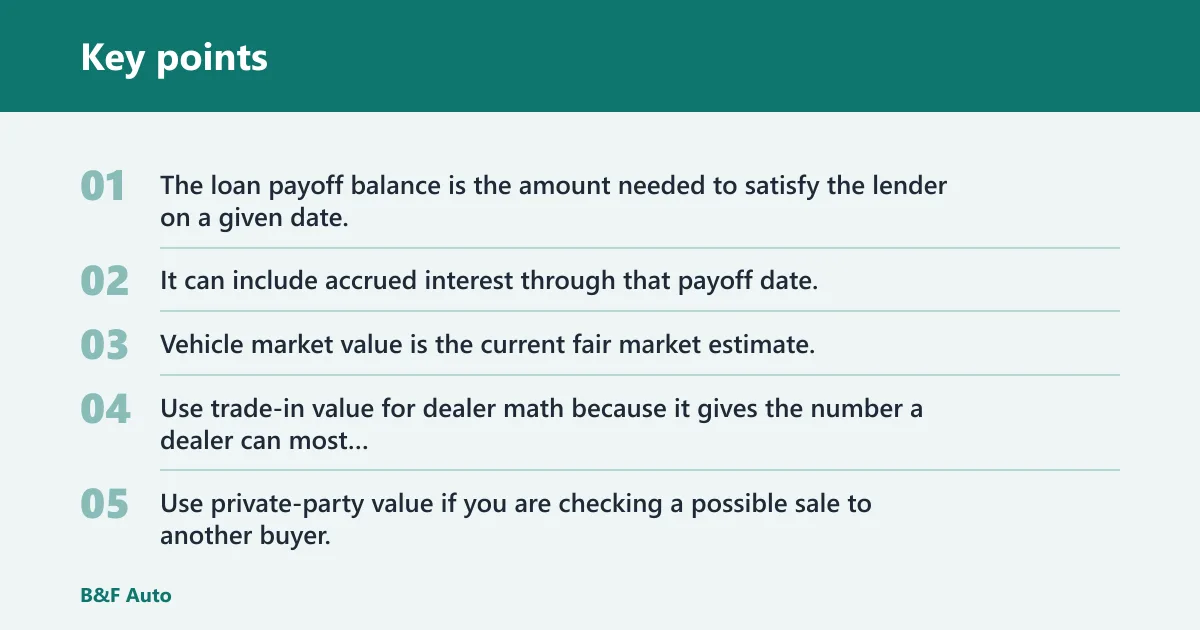
The loan payoff balance is the amount needed to satisfy the lender on a given date. It can include accrued interest through that payoff date, so it may be higher than the latest loan statement balance. Vehicle market value is the current fair market estimate, which varies by condition and location.
Use trade-in value for dealer math because it gives the number a dealer can most directly apply. Use private-party value if you are checking a possible sale to another buyer. A dealer offer is usually lower than private-party value, so it gives the stricter test for upside-down status.
Why depreciation creates the gap
Depreciation is why most cars fall into negative equity early. Debt.org says vehicles lose 20% of value as soon as they are driven off the lot, and vehicles have lost 50% of their value in a few years. Long loans make that gap easier to create.
NerdWallet notes that a 72, 84, or 96 month term can lead to upside-down loans. AutoLoan Rate says many borrowers are upside down for the first 18–36 months of a 60-month loan. That timing is why a car can still look new while the loan is already ahead of its value drop.
Why a trade-in offer can differ from what you owe
A trade-in offer is based on what the dealer expects to resell or wholesale the vehicle for, not on the balance you still owe. If the offer comes in below the payoff quote, the difference is negative equity. A lower online estimate can also be replaced by a lower in-person appraisal.
Say your compact sedan has an approximate $12,000 payoff and an approximately $10,000 trade offer. The car is $2,000 underwater. If the dealer later appraises it at $9,200 because of tire wear or body damage, the gap grows even though the loan did not change.
What numbers do you need?
You need four numbers before you visit a dealer: your loan payoff balance, the dealer trade offer, an estimated private-party value, and the cash down available. Those numbers tell you whether you are upside down, how deep the gap is, and whether you can close it with cash instead of rolling it forward.
Loan payoff balance
Get the payoff quote from your lender portal or by calling the lender. Do not rely only on the current loan balance. Interest can keep accruing, and some lenders also include a payoff quote good only through a specific date.
Trade-in value
Use trade-in value for dealer math because it is the number most likely to match what a dealer can actually apply. It is usually lower than private-party value, so it gives a safer read on negative equity. If trade-in value is below payoff, the car is underwater for a trade.
Private-party value
Use private-party value if you are considering selling the vehicle yourself. It may reduce the apparent negative equity because a private sale often brings more than a dealer trade. The same source says private sale typically yields 5–15% more than dealer trade-in.
Cash down available
Cash down is the amount you can bring to closing to cover part of the shortfall. It can turn a trade that is upside down on paper into one that closes without rolling debt forward. If the cash does not cover the gap, ask how much remains after taxes and fees.
Upside-down trade-in check sheet
This check sheet gives a numbers-first way to confirm whether the trade is upside down before any dealer visit. Fill in the four inputs, calculate the gap, then decide whether to keep the car, trade it, or sell it. Use the payoff quote, not the rough balance.
| Item | Amount | What it means |
|---|---|---|
| Lender payoff | $12,000 | Amount needed to satisfy the lender on the payoff date |
| Dealer trade offer | $10,000 | Value the dealer applies toward the deal |
| Estimated private-party value | $11,200 | Likely sale price if you sell to a private buyer |
| Cash down available | $1,500 | Money you can use to close the gap |
| Negative equity formula | $2,000 upside down | Payoff minus trade offer = $12,000 – $10,000 |
| Decision row | Keep if gap is too large; trade if cash down covers the gap; sell if private-party net exceeds payoff | If cash down is less than the shortfall, you still owe the difference or may roll it forward |
| Payoff quote note | May differ from loan balance | Interest, fees, and timing can change the number before closing |
- Get the payoff quote from the lender.
- Pull a trade-in estimate from a valuation tool.
- Pull a separate private-party estimate.
- Subtract trade-in value from payoff to find negative equity.
- Compare the shortfall with your cash down.
- Decide whether to keep, trade, or sell based on the net number.
Suppose the payoff quote is about $18,400, the dealer offer is about $16,700, and you have about $1,200 to put down. The gap is $1,700, so your cash covers most of it but not all of it. If the dealer adds title, tax, or registration costs to the next loan, the new amount financed can still end up higher than expected.
How do you know before a dealer appraisal?
You can often spot a likely upside-down trade before the appraisal by comparing your payoff quote to current market value, checking how long you have had the loan, and looking at whether the payment seems high for the car’s age and trim. A long term and early depreciation are common warning signs.
Signs you may already be underwater
If your loan is still new, the payment is spread over 72 months or longer, or the car has dropped fast in value, the odds of negative equity go up. Debt.org says vehicles lose 20% of value as soon as they leave the lot. That early drop can outpace the first months of principal paydown.
Another clue is a payment-to-value mismatch. If the monthly payment still reflects a large unpaid balance while market value has already moved down, the loan can stay ahead of the car for a long stretch. A trade appraisal may confirm it, but the gap often exists before you visit the dealer.
How much do I owe versus what my car is worth?
Compare your lender payoff balance to the car’s current trade-in value first. If payoff is higher, you are upside down. If you are selling privately, compare payoff to private-party value instead. That number may be a little higher, but it should not be mixed with trade-in math.
How do I find my loan payoff amount?
Check the lender portal for a payoff quote or call the lender and ask for a dated payoff amount. Ask whether the quote includes interest through a specific day and whether there are fees that could change the total. A statement balance alone is not enough for a clean trade decision.
What happens if you trade it in?
If you trade in a car with negative equity, the shortfall has to be handled at closing. You can pay it in cash, or the dealer can roll it into the next loan if the lender allows it. Rolling the balance forward increases the amount financed and can leave you underwater again.
Paying the difference at closing
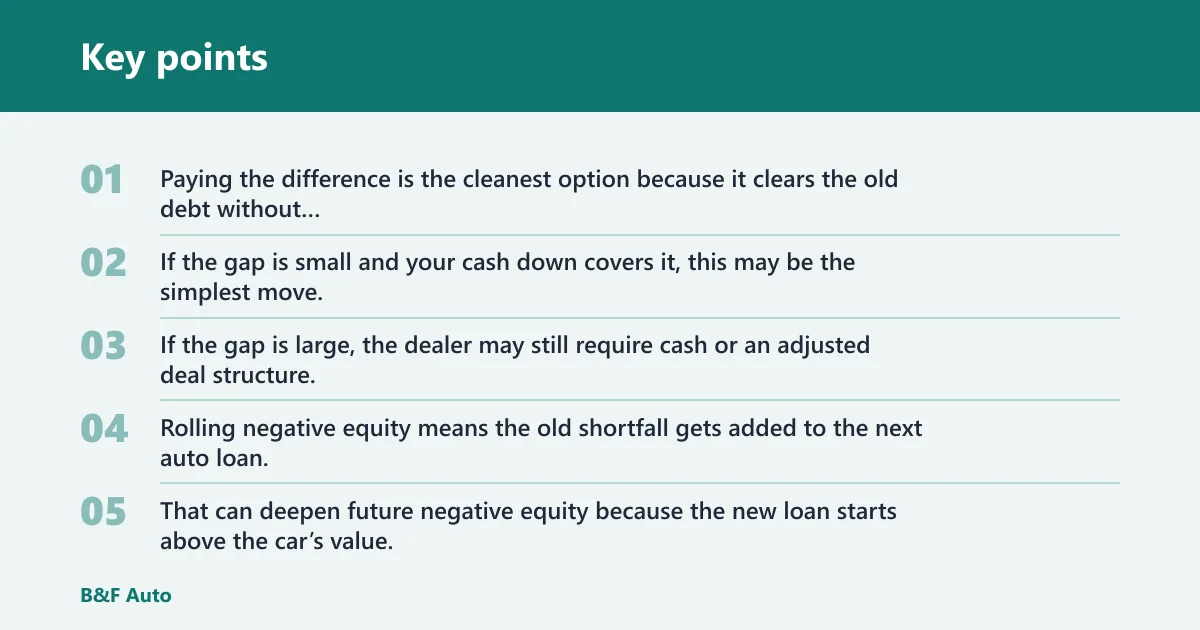
Paying the difference is the cleanest option because it clears the old debt without increasing the next loan. If the gap is small and your cash down covers it, this may be the simplest move. If the gap is large, the dealer may still require cash or an adjusted deal structure.
Rolling negative equity into a new loan
Rolling negative equity means the old shortfall gets added to the next auto loan. That can deepen future negative equity because the new loan starts above the car’s value. It can also raise the payment and stretch the time needed to reach positive equity.
A common first-timer mistake is treating a lower monthly payment as proof that the deal is better. A longer term can hide the added debt while the balance still sits above the vehicle’s value. The payment may feel easier, but the loan can take longer to catch up.
Why that can keep you underwater longer
Extra debt from a rolled-in shortfall reduces the cushion between what you owe and what the car is worth. If the next loan also uses a long term, depreciation can outrun principal paydown again. That is how negative equity can repeat from one car to the next.
The same source says about a third of trade-ins involve some upside-down balance. That is a reminder to check the numbers before you sign, not after. If the new deal includes a trade deficit, ask for the exact amount being financed and how much of it is old debt.
How should you compare trade-in and private sale?
Compare trade-in and private sale by looking at the net proceeds after payoff, not just the headline value. A trade-in is usually faster and simpler, but a private sale may bring more money. The right choice depends on whether the higher sale price is enough to beat the costs and effort.
When trade-in value is the safer math
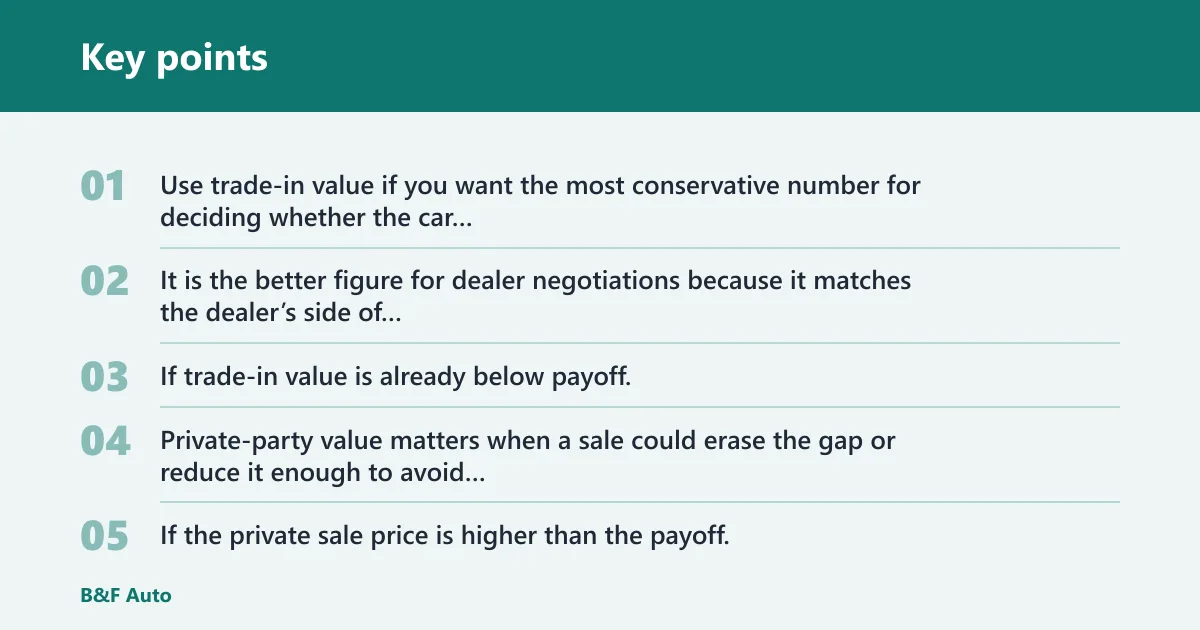
Use trade-in value if you want the most conservative number for deciding whether the car is upside down. It is the better figure for dealer negotiations because it matches the dealer’s side of the transaction. If trade-in value is already below payoff, private-party value should not be used to pretend the trade is positive.
When private-party value changes the decision
Private-party value matters when a sale could erase the gap or reduce it enough to avoid rolling debt forward. If the private sale price is higher than the payoff, selling may leave you with cash instead of a deficit. If it is still below payoff, you may still need cash to close the loan.
How taxes and fees can change the net result
Dealer deals can include title, registration, documentation, and sales-tax effects, depending on your state and transaction structure. Those charges can shrink the amount of cash left from a trade or increase the amount financed on the new loan. A private sale avoids the dealer offer spread, but it can bring its own costs and delays.
GAP insurance is different. It can help if the vehicle is totaled and the insurance settlement is below the payoff, but it does not erase live negative equity on an active trade. It is a loss-settlement tool, not a way to make a current loan balance disappear.
Frequently asked questions
How do I know if my car trade-in is upside down?
Compare the lender payoff balance to the car’s current trade-in value. If payoff is higher, the car is upside down.
What happens if I trade in a car with negative equity?
The shortfall must be covered somehow. You can pay it at closing or roll it into the next loan if the lender allows it. Rolling it forward raises the amount financed and can keep you underwater longer, especially if the next loan is long.
What numbers do I need to calculate negative equity on a trade-in?
You need four numbers: lender payoff, dealer trade offer, estimated private-party value, and cash down available. The core formula is payoff minus trade offer. Use private-party value only when you are checking a possible sale, not when you are testing dealer trade math.
Can I still trade in if I’m upside down and need a different car?
Yes, but the structure matters. If the gap is small and your cash down covers it, trading can work. If the gap is large, rolling it into a new loan may leave you underwater again, so keep the car, pay down the balance, or sell privately if the numbers are better.