How Does a Trade-In Work at a Dealership, Step by Step?
A dealership trade-in moves in three steps: the dealer appraises your car, pays off any loan or lien, and applies the trade-in value as credit toward your next purchase. If you miss the payoff amount or compare the wrong numbers, you can lose part of your equity or roll extra debt into the next loan. This guide explains the appraisal, payoff, and purchase steps, plus the mistakes that most often shrink your credit.
What a trade-in
A trade-in is when you sell your current vehicle to a dealership as part of the next purchase. The trade-in allowance is dealer-applied credit, and it can cover all or part of a down payment. That credit lowers the amount financed, and you can pair it with cash if needed.
Dealers do not value every car the same way. They compare actual cash value, or ACV, along with condition, mileage, year, make, model, and local demand. ACV is the dealer’s willingness to pay, so it is a baseline for comparison, not the same thing as an online estimated value.
Before you visit, check an online valuation tool, gather service records, and clean the car by removing personal items. Remove personal items and fix minor cosmetic issues where it makes sense. Those steps will not turn a worn vehicle into a premium one, but they can help the appraisal reflect the car more fairly.
How does a dealership trade-in work?
A dealership trade-in is typically handled as a three-part handoff: appraisal, payoff, and purchase. The dealer first inspects the vehicle and then makes a trade-in offer. Then the dealer handles any loan payoff or title transfer. Last, the trade-in allowance is applied to the purchase contract as credit.
Appraisal, payoff, and purchase
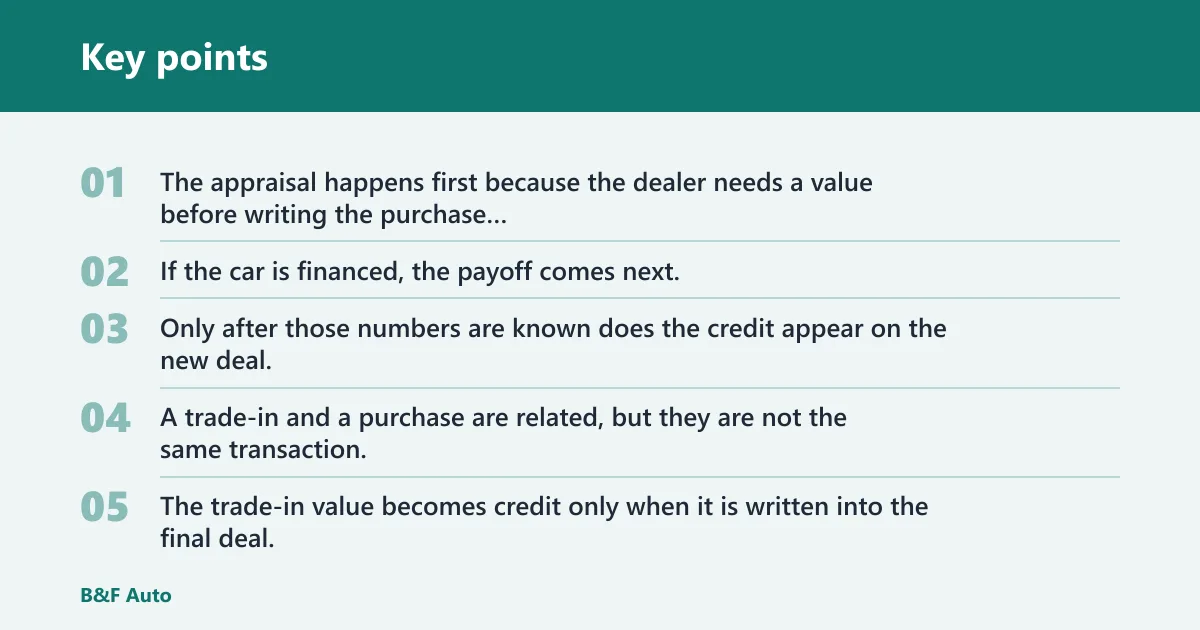
The appraisal happens first because the dealer needs a value before writing the purchase agreement. If the car is financed, the payoff comes next, because the dealer needs the lender’s exact balance to close the old loan. Only after those numbers are known does the credit appear on the new deal.
That separation matters. A trade-in and a purchase are related, but they are not the same transaction. The trade-in value becomes credit only when it is written into the final deal. Until then, it is just an offer that can change after inspection or payoff review.
What happens if the value changes after inspection
If the inspection finds damage, missing equipment, warning lights, or a condition issue that was not obvious at first glance, the dealer may lower the offer. You can accept the revised number or walk away. A fair process depends on the buyer reviewing the adjustment before signing anything.
Say your sedan was quoted at a certain amount online, but the dealer finds a cracked tail light and worn tires during inspection. The offer may drop because the dealer must recondition the car before resale. That is why a preliminary online estimate should never be treated as a final trade-in figure.
Trade-in paperwork
Many buyers will see a short document trail, even if the dealer fills out much of it. For a paid-off car, the title status matters most. For a financed car, the lender payoff and loan account information become part of the handoff. Service records help support the vehicle’s history either way.
| Step | Who acts | What the dealer needs | What the buyer should verify | Typical timing | Common failure point |
|---|---|---|---|---|---|
| 1. Pre-visit check | Buyer | Online value estimate, service records, title status, loan info if financed | Estimate is only a starting point; paperwork is complete | Before the dealership visit | Using an online estimate as the final offer |
| 2. Appraisal | Dealer | Vehicle, keys, mileage, condition, maintenance history | Dealer records the correct trim, mileage, and visible condition | About 30 to 60 minutes | Offer changes after inspection |
| 3. Offer review | Dealer and buyer | Appraisal worksheet and trade-in allowance | ACV, fees, and any adjustment are clear before negotiation | Same visit | Buyer accepts unclear numbers |
| 4. Payoff review for paid-off vehicle | Dealer | Title or title release if available | Title status matches the vehicle’s actual ownership status | Same visit or short follow-up | Missing title details slow closing |
| 5. Payoff review for financed vehicle | Dealer and lender | Loan account number, payoff quote, lender contact details | Payoff quote date and expiration are checked | Same day, but quote may be valid only 10-15 days | Expired payoff quote changes the final balance |
| 6. Equity calculation | Dealer | Trade-in value and payoff amount | Positive equity or negative equity is shown clearly | Minutes after payoff review | Buyer misses how equity affects the new loan |
| 7. Purchase contract | Dealer and buyer | Final purchase worksheet, trade credit, taxes, fees, add-ons | Trade-in credit appears where expected on the contract | Same day | Hidden add-ons or incorrect payoff numbers |
| 8. Final signing | Buyer | Final contract package | All numbers match the agreed deal before signature | A few hours total at the dealership | Signing before reviewing every line item |
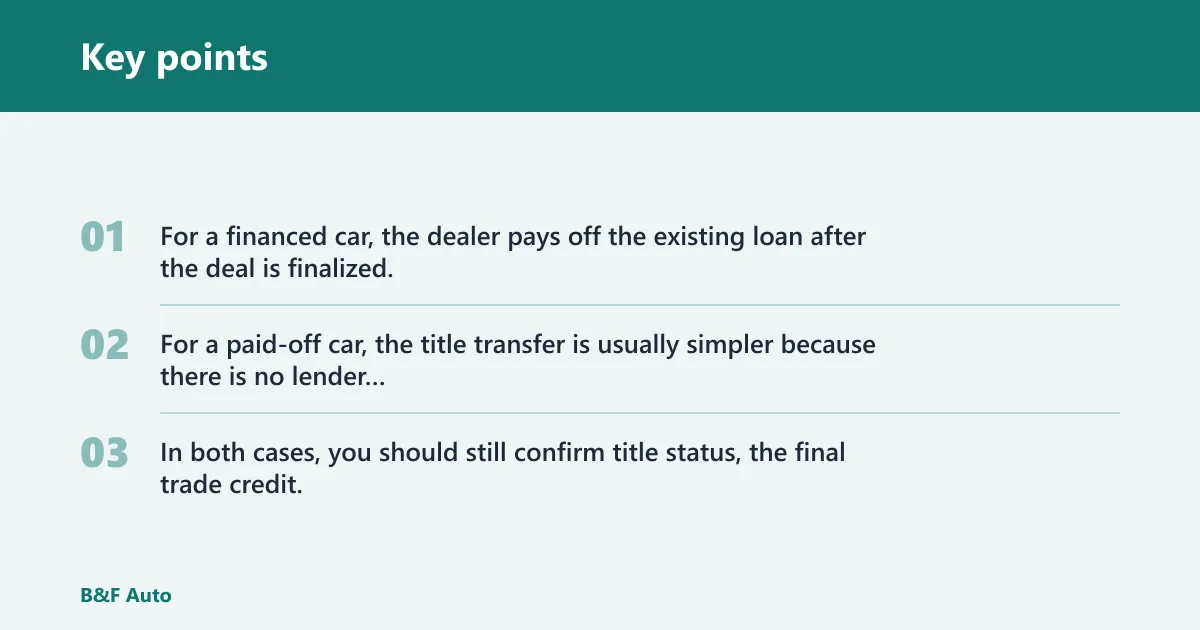
For a financed car, the dealer pays off the existing loan after the deal is finalized. For a paid-off car, the title transfer is usually simpler because there is no lender payoff to settle. In both cases, you should still confirm title status, the final trade credit, and the contract figures before signing.
How do you prepare a car for trade-in?
Prepare the car by cleaning it, removing personal items, and gathering documents before the appraisal. Service records, the title if available, registration, and loan information if the car is financed can all help the process move faster. Small cosmetic fixes can help presentation, but they usually will not change the value dramatically.
Clean and organize the vehicle
A clean car makes inspection easier. Vacuum the interior, clear the trunk, remove toll tags and personal paperwork, and wash the exterior if you can. The goal is simple: show the car as well cared for, because condition is part of the dealer’s valuation.
Gather the right documents
Bring title paperwork if the vehicle is paid off. Bring the loan account number and recent payoff information if it is financed. Service records matter too, because they show maintenance history and can support confidence in the car’s condition.
Fix minor issues before appraisal
Small repairs can help, especially when they are cheap and visible. A broken bulb, a missing interior trim piece, or a small cosmetic defect can make the car look rougher than it is. Bigger repairs rarely pay for themselves in a trade-in, so keep the fix list realistic.
Suppose a compact SUV has a clean cabin but a missing hubcap and a dead license-plate light. Those are the kinds of minor issues you may choose to correct before appraisal. A dented quarter panel or a slipping transmission is a different matter and usually belongs in the negotiation, not a quick prep job.
What happens during the appraisal?
During appraisal, the dealer checks the car’s year, make, model, mileage, condition, and equipment. The dealer also compares the vehicle with local demand and resale history. That is where ACV comes in: it is the dealer’s offer baseline, while an online estimate is only a reference point.
What the dealer looks
Expect a walkaround, a short interior inspection, a mileage check, and a review of visible wear. Tire condition, warning lights, windshield damage, accident repairs, and missing equipment can all affect the number. The dealer is judging what it will cost to recondition and resell the vehicle.
Why mileage, age, and model popularity matter
Lower mileage often helps, because it usually means less wear. Older vehicles can still trade well if they are known for reliability and strong resale demand. Popular trims and engines tend to do better than uncommon versions because dealers know they can move them more easily.
Why ACV is not your online estimate
An online valuation tool can help you set expectations, but it does not inspect the car. ACV reflects what the dealer is willing to pay after considering reconditioning, auction risk, and local demand. That is why two numbers can differ even when they are both reasonable.
What if you still owe money?
Yes, you can trade in a financed car. The dealer pays off the existing loan, then applies any remaining trade value to the new deal. If the loan balance is higher than the vehicle’s value, the shortfall is negative equity. If the value is higher, the difference is positive equity.
Payoff amount and timing
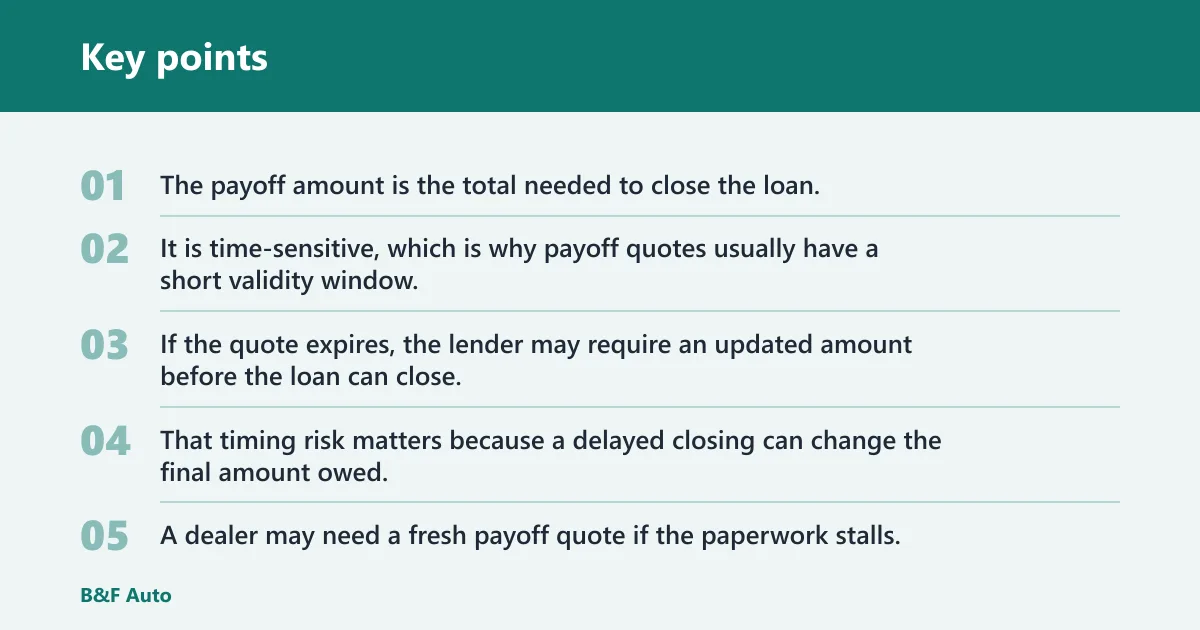
The payoff amount is the total needed to close the loan, and it can include remaining interest or fees. It is time-sensitive, which is why payoff quotes usually have a short validity window, often 10-15 days. If the quote expires, the lender may require an updated amount before the loan can close.
That timing risk matters because a delayed closing can change the final amount owed. A dealer may need a fresh payoff quote if the paperwork stalls. If you are trading in a financed vehicle, check the date on the payoff statement and ask who is responsible for getting the updated figure.
Positive equity versus negative equity
Positive equity means the trade-in value is higher than the payoff amount. That difference can become a down payment on the next vehicle and reduce the new loan amount. Negative equity means the payoff is higher than the trade-in value, and that difference does not disappear just because the car is traded.
Negative equity can be rolled into the new loan, but that raises the amount financed, monthly payment, and total finance charge. A common mistake is focusing on the trade-in credit alone while ignoring the payoff gap. The better sequence is to calculate the gap first, then decide whether the new payment still fits.
How do you compare offers and sign?
Compare at least three appraisals from different dealerships before you decide. The goal is to compare ACV-based offers, payoff handling, and the final purchase worksheet side by side. Before signing, verify the trade-in credit, payoff figure, taxes, fees, and any add-ons that were added to the contract.
How to compare dealer offers
Ask each dealer for a written number that shows the trade-in allowance and how it will be used in the deal. Make sure you are comparing the same vehicle condition, same payoff status, and same purchase scenario. A higher offer is useful only if the payoff and fees are handled cleanly.
What to verify before you sign
Review the final contract line by line. Check that the trade-in credit matches the agreed amount, the payoff figure matches the lender quote, and no unwanted add-ons were slipped in. If anything changed after the appraisal, ask for the updated worksheet before you sign.
Be especially careful with fees and extras that increase the amount financed. If the dealer says the trade-in “covered” them, ask to see the math. The trade-in allowance, payoff amount, and purchase price should all be visible in the final figures, not hidden in a single blended number.
Frequently asked questions
How to trade in a car at a dealership
Start with an online estimate, then gather your title, service records, and loan details if the car is financed. Bring the vehicle cleaned and ready for inspection, compare at least three offers, and read the final purchase contract closely before signing. Make sure the trade credit and payoff numbers match the worksheet.
Can you trade in a financed car?
Yes. The dealer pays off the existing loan as part of the transaction, then applies any remaining trade value to the new purchase. If the payoff is higher than the vehicle’s value, the difference becomes negative equity, which can be rolled into the new loan and raise the monthly payment.
How does the dealer handle the payoff on my loan?
The dealer contacts the lender, gets a payoff quote, and sends payment to close the loan after the deal is finalized. Because payoff quotes expire quickly, usually in 10-15 days, the dealer may need an updated amount if the paperwork takes longer than expected. Verify the payoff date before signing.
What happens if my trade-in is worth less than I owe?
If the vehicle is upside down, the shortfall is negative equity. You can pay it separately, or you can roll it into the next loan. Rolling it over is common, but it increases the amount financed, the monthly payment, and the total cost of the new vehicle.
What paperwork do you need for a trade-in?
Bring the title if the car is paid off, registration if available, service records, and loan account information if the vehicle is financed. Dealers handle much of the paperwork, but you should still verify title status, payoff amount, and the final contract numbers before you sign anything.