Can You Get a Trade-In Value Without a VIN?
Trade-in appraisals are most reliable when the vehicle can be decoded to an exact trim, drivetrain, and title status. In dealership appraisal lanes, the most common failure cases are mismatched trims, missing option packages, incorrect mileage, and branded or missing title records; those issues can move an offer from “solid market range” to “needs manual review” very quickly.
Yes—you can estimate a trade-in value without a VIN if you know the year, make, model, trim, mileage, drivetrain, and condition, but the number is only a rough range until you verify the exact vehicle. Missing trim or options can move a quote by hundreds or thousands of dollars, and a bad estimate wastes time and sets the wrong expectation. This guide shows the minimum data to gather, how each missing detail changes the estimate, and when to stop guessing and look up the VIN. For a deeper payoff on site, see VIN lookup help, our trade-in calculator, title and registration help, and trade-in vs. private-party value.
Confidence band: if year/make/model/mileage/condition are known but trim and title status are not, treat the estimate as medium confidence with a likely error range of about 10% to 20%. If trim, drivetrain, or title status is unknown, confidence usually drops to low and the error range can widen to 20%+ on vehicles with multiple configurations. If the exact trim, mileage, and title status are verified, the estimate is often high confidence and closer to a practical dealer range.
Yes, but only as a rough estimate
A no-VIN estimate can tell you whether a car is worth closer to roughly $4,000 or $14,000. It can also help you judge if a dealer offer is in range. It cannot tell you the exact trade-in number for a specific vehicle until the trim, equipment, and history are pinned down. That is why valuation tools and dealer guides usually treat the VIN as the shortcut to exact decoding, not as a nice-to-have detail; the NHTSA VIN resource explains that the VIN uniquely identifies a vehicle, and many state DMVs use it as the core record match for title and registration administration.
What a no-VIN estimate can tell you
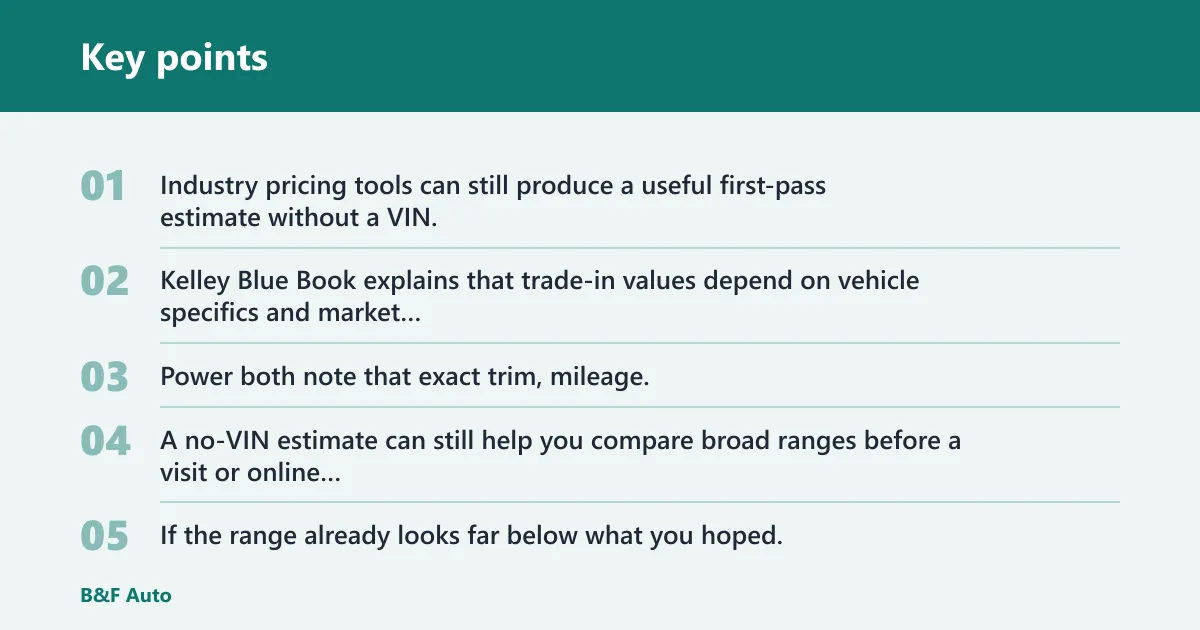
Industry pricing tools can still produce a useful first-pass estimate without a VIN. Kelley Blue Book explains that trade-in values depend on vehicle specifics and market conditions, while Edmunds and J.D. Power both note that exact trim, mileage, and condition are central to a more accurate appraisal. A no-VIN estimate can still help you compare broad ranges before a visit or online appraisal.
Use the estimate to set expectations. If the range already looks far below what you hoped, check the inputs for obvious mistakes before you spend more time on a formal appraisal.
What it cannot tell you yet
Without the VIN, the estimate usually cannot decode the exact trim, factory options, engine, drivetrain, assembly details, or vehicle history. The VIN is the lookup key for those details, and NHTSA’s VIN guidance makes clear that the 17-character code is the standardized identifier used to distinguish one vehicle from another. State DMV title systems rely on the same identifier to connect ownership records to the vehicle being sold or traded.
That missing detail matters. A base trim and an upgraded trim can land in different value bands. So can front-wheel drive versus all-wheel drive, or a truck with a towing package versus one without it.
Where the biggest error usually comes
Condition and mileage drive value most, but missing trim is often the biggest single source of error without a VIN. The valuation tools from Kelley Blue Book, Edmunds, and J.D. Power all require vehicle-specific inputs because small equipment changes can move the result by a meaningful amount. The gap gets wider on models with many equipment combinations.
Picture a midsize SUV with leather, navigation, and a towing package. If the estimate assumes a base model, the quote can land too low. If the vehicle also has a branded title or prior damage, the error can go the other direction.
What you need instead of the VIN
You can still get a usable estimate with a minimum data set: year, make, model, exact mileage, condition, ZIP code or region, and any known trim or option details. The strongest appraisal results come from inputs that let the tool match the vehicle as closely as possible to the real one, even before the VIN is entered. For title and ownership checks, most state DMV sources also rely on the same core details plus a VIN or title record to resolve mismatches.
Do not guess at mileage. Use the odometer or service records. Use the most recent exact reading you can verify.
Year, make, and model
These are the baseline inputs for a rough estimate. They narrow the vehicle to a specific family, but not a specific configuration. A 2019 Honda CR-V is not one value; the trim and equipment still matter.
For calculators, this is enough to begin. It is not enough to settle on a final number.
Mileage from the odometer or records
Mileage should come from the odometer reading, a recent service record, inspection paperwork, or another exact record. Because mileage is a primary value driver, rounding it can distort the estimate more than many owners expect.
If you do not know the mileage, stop and verify it before you compare offers. Estimated mileage is not a substitute.
Condition, options, and ZIP code
Condition includes wear, damage, repairs, warning lights, and service history. That is a major valuation input in nearly every pricing tool. A car in fair condition does not belong in a good-condition calculator path.
Options matter too. Navigation, leather, towing gear, and sport equipment can change the number when the VIN is missing. ZIP code or region also changes the result because local market demand affects pricing. iSeeCars notes that geography can matter, such as pickup trucks in rural Texas versus downtown Boston.
How much accuracy do you lose without the VIN?

You lose the most accuracy where the vehicle can vary in hidden ways: trim level, option packages, engine, drivetrain, and history. A no-VIN estimate can still be useful, but the error band grows fast when those details are missing. If you only know the model name, treat the number as directional. A practical rule is this: the fewer vehicle-specific fields you can verify, the wider the likely error range becomes.
Trim level and option packages
Trim level is often the biggest missing-detail risk. Base versus upgraded trim can materially change value, and option packages can move the quote again. This is why a no-VIN estimate on a loaded model can look too low if the tool assumes a plain version.
Suppose you are estimating a pickup with a crew cab, tow package, and upgraded infotainment system. If those items are not entered, the result may be off by more than a small adjustment. The same problem shows up on luxury cars with leather, panoramic roofs, or factory navigation.
Engine and drivetrain uncertainty
Some models have engine or drivetrain combinations that affect trade-in value enough to matter. A turbo engine, hybrid system, or all-wheel-drive setup can change the number even when year, make, and model are correct. Without the VIN, you may not know which version you have.
If the vehicle was modified or had parts swapped, the uncertainty gets worse. A dealer may need the VIN or build data to verify what is actually installed.
Title status and history gaps
Vehicle history also affects estimate accuracy. Accidents, flood damage, fire damage, title brands, and odometer issues all matter, but a no-VIN estimate cannot always verify them. That is a problem if the car had repairs or an unclear past. State DMV title pages and title-brand rules exist for exactly this reason: title status changes ownership handling and can affect market value, eligibility, and the paperwork needed to complete a trade.
Do not assume badges or appearance prove a clean history. A car can look sorted and still carry a branded title. The VIN is what gets you closer to exact history checks.
No-VIN trade-in accuracy checklist
This checklist helps you judge whether a rough estimate is good enough or too vague to trust. Use the strongest evidence you have for each line. If several rows are uncertain, stop and look up the VIN before you treat the result as real.
| Input | How to verify it without a VIN | Risk if missing | When to pause for VIN lookup | Estimate confidence |
|---|---|---|---|---|
| Year, make, model | Title, registration, owner’s manual, sales paperwork, windshield sticker | Low to moderate; the estimate may still be directionally usable | Pause if the model family has many trims or body styles | High |
| Trim | Owner paperwork, build sheet, window sticker, service records, insurance documents | High; base vs upgraded trim can materially change value | Pause if you only have badges or visual guesses | Low if unknown; medium if documented |
| Mileage | Odometer, recent inspection, service invoice, registration record | High; mileage is a primary value driver | Pause if the number is estimated or stale | High if exact; low if estimated |
| Condition | Walkaround, service notes, repair receipts, warning lights, tire and brake wear | High; poor condition can cut value fast | Pause if there is collision, flood, or mechanical uncertainty | Medium |
| Options | Window sticker, build sheet, equipment list on paperwork, service invoices | Moderate to high; navigation, leather, towing, and sport packages can move the quote | Pause if the vehicle is known to have optional equipment but you cannot confirm it | Low to medium |
| Region | ZIP code, dealer market, local classifieds, insurance region | Moderate; geography changes trade-in demand | Pause if the car will be traded in a different market than it is listed in | Medium |
| Title status | Title, DMV record, loan paperwork, prior sale paperwork | Very high; branded or missing title status can change whether a dealer wants it | Pause if the title is branded, missing, or in another person’s name | Low until verified |
| Engine/drivetrain uncertainty | Underhood labels, service records, build sheet, seller paperwork | Moderate to high; some models price differently by engine or drive type | Pause if the model is sold with multiple engines or drive systems | Low if unknown; medium if documented |
How to verify trim without a VIN
You can often confirm trim without a VIN by combining paperwork, labels, and equipment records. That is better than guessing from badges alone. Badges can be missing, replaced, or misleading after repairs.
Owner paperwork and registration records
Start with the title, registration, purchase paperwork, or loan documents. These often list the model name and sometimes the trim. Insurance cards and policy paperwork can also help if they show a more detailed description. State DMV records are also useful because they often preserve the title and registration description that dealers and lenders use to reconcile the vehicle’s identity.
If the documents disagree, do not average them. Treat the mismatch as a sign that you need the VIN or another hard record.
Badges, labels, and build sheets
Badges can help, but only as supporting evidence. Look for factory labels, option stickers, or a build sheet. A build sheet is far more useful than visual trim clues because it ties equipment to the vehicle as built.
A common first-timer mistake is assuming a shiny grille or wheel style proves a higher trim. That is not enough. Wheels and exterior parts can be swapped.
Insurance cards, service records, and window stickers
Service invoices sometimes list engine, drivetrain, or equipment notes. Window stickers, if still available, are especially useful because they can list factory options. Insurance documents may also confirm enough detail to narrow the estimate.
Use every document as a cross-check, not a substitute for the VIN. The more the records agree, the safer the estimate.
Can a trade-in calculator work with just year, make, and model?
Yes, a trade-in calculator can work with just year, make, and model, but only as a rough first pass. It is good enough to narrow the range and compare broad market value. It is not good enough when the model has many trims, options, or drivetrain choices. A calculator is strongest as a triage tool, especially when paired with a broader valuation source such as our trade-in calculator.
When the result is good enough to start
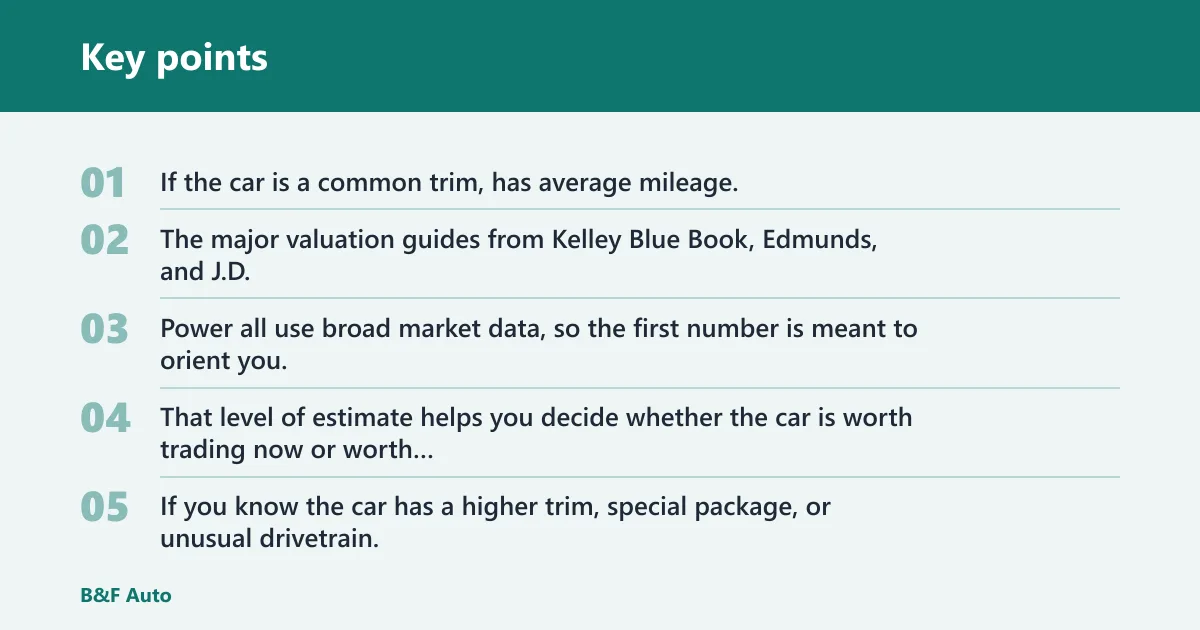
If the car is a common trim, has average mileage, and shows no title or history red flags, the result can be a practical starting point. The major valuation guides from Kelley Blue Book, Edmunds, and J.D. Power all use broad market data, so the first number is meant to orient you, not to replace an appraisal.
That level of estimate helps you decide whether the car is worth trading now or worth cleaning up first.
When the result is too vague to trust
If you know the car has a higher trim, special package, or unusual drivetrain, year/make/model alone is too vague. The same is true if the vehicle has prior damage, a branded title, or swapped parts. In those cases, the calculator can land far from reality.
Trade-in value is usually lower than private-party value, so do not compare the calculator’s trade-in number to a private-sale listing and expect them to match. If you need a side-by-side view, use trade-in vs private-party value before you negotiate.
When to stop and find the VIN first
Stop and look up the VIN first when the estimate will affect a sale, payoff, insurance settlement, or tax planning decision. Also stop if trim, engine, drivetrain, title status, or mileage is uncertain. The VIN is the cleanest way to verify exact specs and history, and NHTSA’s VIN guidance is the most authoritative federal reference for why that identifier matters.
The VIN is also repeated on the windshield dash, door jamb, title, registration, and insurance card, so there are several places to check before you rely on a rough quote. Use the result as a starting point, not a final number.
Can you trade in a car if it is not registered?
Yes, a dealer may still take a trade-in that is not registered, but paperwork becomes more important. The key issue is not the registration sticker alone; it is whether you can prove ownership, identity, and title status. A VIN helps with that verification, and state DMV rules often make clear that title documentation—not just registration—drives ownership transfer.
What a dealer may still accept
A dealer may still accept an unregistered car if you have the title, a valid bill of sale, payoff information, or other ownership records. Some dealers can work through registration problems during the trade, especially if the title is clean and the vehicle identity is clear.
If the title is missing or branded, the process gets harder. The trade may still be possible, but the offer can change.
What paperwork matters most
The title matters most. Registration helps, but it is not the same thing. If the car is financed, payoff information and lender contact details also matter. If the title is not in your name, expect extra verification. State DMV title pages and transfer rules are the best place to confirm what documentation your state requires before a dealer can finalize the transaction.
The VIN helps tie these records together. Without it, the dealer may need more documents or a longer review.
Why the VIN still helps with verification
The VIN lets a dealer confirm the exact vehicle, check history, and match the paperwork to the car in front of them. That matters even more when registration is not current. It reduces the chance of an equipment mismatch or a title problem slowing the deal.
If you do not have a current registration, do not guess your way through the appraisal. Gather the title, odometer reading, and any records that identify the vehicle before you ask for a firm trade-in number.
Frequently asked questions
Can you get a trade-in value without a VIN?
Yes. You can get a rough trade-in estimate without a VIN if you have the year, make, model, mileage, condition, and region. The result is still a starting point because trim, options, drivetrain, and history can move the value enough to matter.
What information do I need if I don’t have the VIN?
Use year, make, model, exact mileage, condition, ZIP code, trim if known, options, title status, and drivetrain. The more exact the equipment and history, the less likely the estimate is to miss by a wide margin. For a more precise lookup, use VIN lookup help to identify the vehicle before you submit a formal appraisal.
How accurate is a trade-in estimate without the VIN?
It can be directionally useful, but accuracy drops fast when trim, options, or history are unknown. Treat the result as a range, not a final offer. As a practical rule, the estimate is most dependable when the vehicle is common, stock, and free of title red flags.
Will a trade-in calculator work with just year, make, and model?
Yes, many calculators will return a number from those three inputs, and that can be enough for a first look. It is weakest on vehicles with multiple trims or packages. Add mileage, condition, and ZIP code before you trust the result.
What if I don’t know my trim level?
Check the title, registration, insurance paperwork, window sticker, build sheet, and service records before you guess. Badges alone are not reliable enough. If you still cannot confirm trim, use the estimate only as a rough range and stop short of calling it exact.
Can I trade in my car if it’s not registered?
Often yes, if you can prove ownership and provide the title or other required paperwork. A dealer may still appraise the car, but missing registration can slow the process. The VIN helps match the car to the records and verify the exact vehicle.
What changes when the VIN is missing from the estimate?
The estimate loses precision on trim, options, engine, drivetrain, and history. That matters because condition, mileage, and geography still influence value, but the missing details can move the number enough to change a deal. A no-VIN estimate is a triage step, not the finish line.
When should I stop and look up the VIN first?
Stop when the estimate will affect a sale, payoff, or trade decision and you are still missing trim, mileage, title status, or history details. Stop too if the car has unusual equipment, a branded title, or swapped parts. At that point, the VIN is the better next step.
Can you get a blue book value with a vin number?
Yes. A VIN makes a Blue Book-style estimate more exact because it can decode the vehicle’s exact specs and history. That matters for trim, equipment, and title records. Without the VIN, you can still get a rough number, but it is less specific.
Sources
NHTSA VIN resource: https://www.nhtsa.gov/vehicle-identification-number-vin
Kelley Blue Book value guidance: https://www.kbb.com/whats-my-car-worth/
Edmunds appraisal and trade-in tools: https://www.edmunds.com/appraisal/
J.D. Power valuation tools: https://www.jdpower.com/cars/values
State DMV title and registration guidance varies by state; for example, California DMV and New York DMV both publish title and registration rules that show why ownership documents matter in trade-ins: https://www.dmv.ca.gov/portal/vehicle-registration/titles/ and https://dmv.ny.gov/registration