Does Auto Loan Preapproval Hurt Your Credit Score?
Auto loan preapproval only hurts your credit if the lender runs a hard inquiry. Soft-pull preapprovals do not lower your score. A hard pull can trim your score and add an inquiry to your report, which matters if you are rate-shopping or planning another credit application soon. The CFPB explains that auto and mortgage rate shopping can be treated as one inquiry within a limited window. This guide shows how to tell soft pulls from hard pulls before you submit anything.
How hard and soft inquiries differ
The short answer is that it depends on the inquiry type. If the lender uses a soft pull, your score should not change. If the lender requires a hard inquiry, the application can lower your score, and the inquiry may appear on your report even if the loan is not funded.
When a preapproval is a hard pull
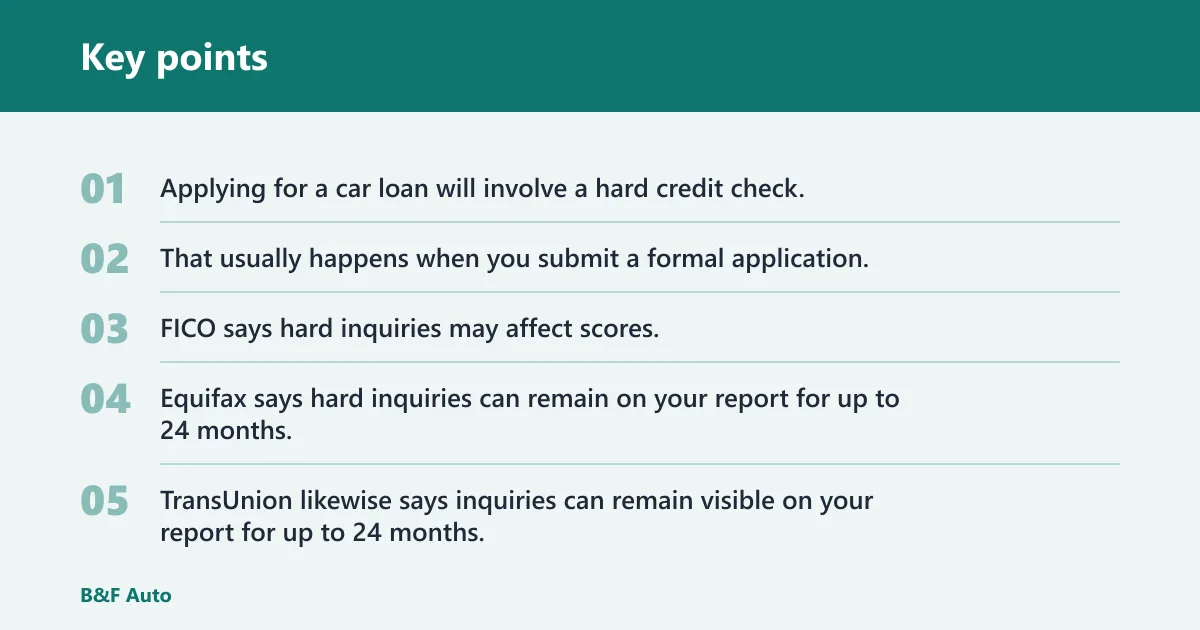
Applying for a car loan will involve a hard credit check. That usually happens when you submit a formal application, not when you are only asking for a rough estimate. FICO says hard inquiries may affect scores, and the size of the effect varies by file and scoring model.
A hard inquiry also shows on credit reports. Equifax says hard inquiries can remain on your report for up to 24 months. TransUnion likewise says inquiries can remain visible on your report for up to 24 months. The exact display rules can differ by bureau and reporting context, so checking the actual report matters.
When a preapproval is closer to a soft check
Some lenders use preapproval language for a softer screening step. In that setup, the lender may give an indicative rate or amount before you submit a full application. That is closer to pre-qualification, and it is not binding until the formal application goes through.
Say you are comparing two lenders online. One says it will “preapprove” you after a soft check, while the other says it must pull credit before showing terms. Those are not the same process, and the score impact is not the same either.
Hard credit inquiry basics
A hard inquiry is a formal credit pull tied to a borrowing decision. It can affect your score, it stays visible on your report, and lenders use it when they need to assess repayment risk more fully. That is why the wording on a lender’s offer matters so much before you apply.
How much a hard inquiry can lower a score?
The standard estimate is about 5 to 10 points, but that is not universal. The impact varies by credit file, score model, and recent credit activity. Thin files, newly opened files, or files with several recent inquiries can move more than a thick, stable file.
That is why a shopper with a mortgage on deck should be careful about timing. Even a small drop can matter when a lender is looking closely at score bands, debt-to-income, and recent credit activity.
How long a hard inquiry can stay on a report?
The inquiry stays on your credit report for 24 months. Lenders may focus most on the recent period, but the record itself can remain visible longer than the score effect lasts. That is another reason to limit unnecessary pulls while you shop.
Soft credit inquiry basics
A soft inquiry does not affect your credit score. Lenders use soft pulls for pre-qualification and other early screening steps, and consumers can use them for self-checks. In some contexts, a soft inquiry may be visible only to the consumer and not treated like a formal lending event.
Why soft pulls do not change the score
Soft inquiries are used when a lender wants a quick look without treating it as a full application. That makes them useful for early rate checks, pre-qualification, and report review. Because the bureau classifies the pull differently, the score is not reduced.
Where soft pulls show up
Soft pulls may appear in your consumer-facing credit file, but they usually do not affect how a scoring model reads your risk. Checking your own credit report is free and considered a soft inquiry. AnnualCreditReport.com is the official source for free credit reports from the three nationwide bureaus.
Why lenders use soft pulls for early screening
Soft pulls let a lender estimate eligibility before a customer commits to a full loan application. That can help set amounts, rates, and term lengths. Capital One Auto Navigator is cited as a soft-pull pre-qual option, which is the kind of setup many shoppers want before visiting a lot.
Auto loan decision table
This table helps you sort common auto-finance actions by the kind of credit pull they usually trigger. Use it before you submit personal information, especially if you plan to shop with more than one lender.
| Action | Likely inquiry type | Documents typically requested | What triggers a hard pull | Unknown-risk warning signs |
|---|---|---|---|---|
| Online pre-qual form | Soft pull | Name, address, income estimate, housing payment, vehicle target | Language that says “formal application,” “final terms,” or “submit to lenders” | No inquiry-type disclosure; asks for full SSN before any rate estimate; no soft-pull language |
| Pre-qualification | Soft pull | Basic identity and income details | Moving from estimate to full credit decision after you consent | “May affect your credit” with no explanation; asks for bank statements up front without explaining why |
| Preapproval | Soft pull or hard pull | Identity, income, residence, employment, possibly proof of funds or insurance | Submission to underwriting or lender network as a formal credit application | Offer says “preapproved” but terms are not subject to verification; no clear pull disclosure |
| Full application | Hard pull | Full legal identity, SSN, income, housing, employment, vehicle details | Any lender decision requiring underwriting or final approval | Requires SSN and consent language; asks you to sign credit authorization before a rate quote |
| Dealer credit app | Hard pull, possibly to multiple lenders | Application, ID, proof of income/residence, trade-in and vehicle information | Dealer sends your file to one or more lenders for approval | Dealer says it “shops” your file; F&I office will not say how many lenders will be contacted |
| Co-signer app | Hard pull for every applicant | Co-signer ID, income, housing, and credit authorization | Both borrowers submit to underwriting or lender review | Co-signer is added after the fact; lender asks for a second signature without explaining credit impact |
| Self-checking your credit | Soft pull | None, unless you are verifying your identity on a report site | Requesting a lender review of your file instead of checking it yourself | Site is not clearly AnnualCreditReport.com or a bureau portal; asks you to “apply” to see your score |
Can multiple auto inquiries count as one?
Yes, often they can. Multiple auto loan inquiries in a short window are often treated as one by major scoring models. The same source says rate shopping can be grouped, while still allowing the inquiries to appear on your report. The CFPB says consumers may have a 14- to 45-day shopping window depending on the model used by the lender. That window is model-specific, so it is better to treat the timing as flexible rather than universal.
How the shopping window works
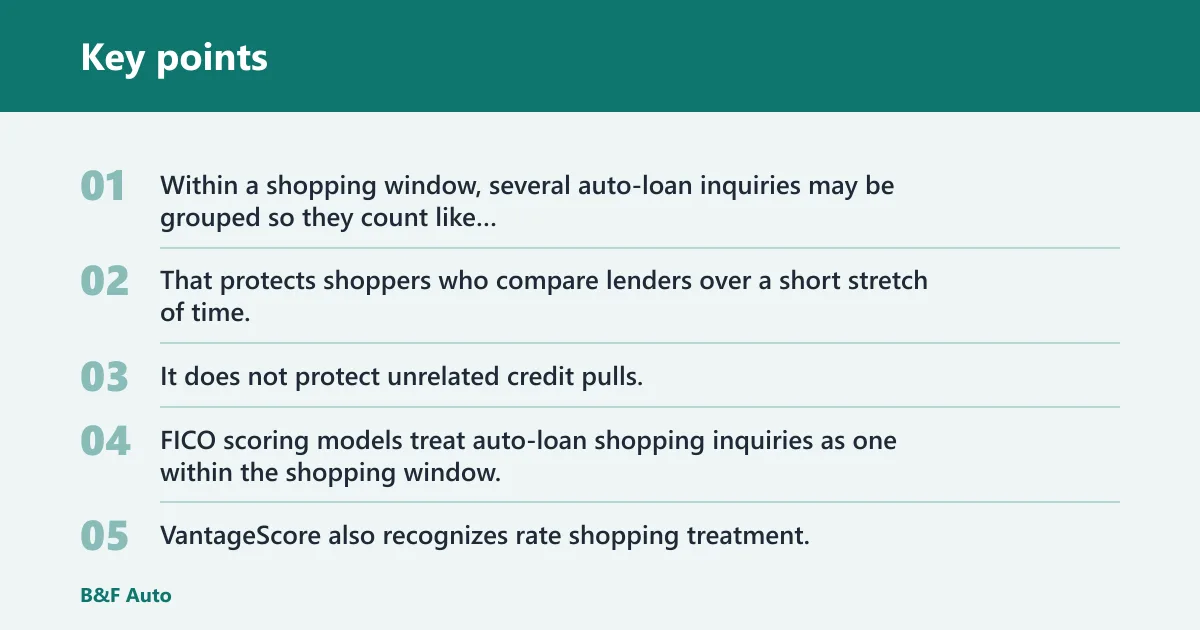
Within a shopping window, several auto-loan inquiries may be grouped so they count like one. That protects shoppers who compare lenders over a short stretch of time. It does not protect unrelated credit pulls, and it does not make every inquiry harmless outside the window.
What FICO and VantageScore do with auto inquiries
FICO scoring models treat auto-loan shopping inquiries as one within the shopping window, and lenders commonly reference these models when they explain score impact. VantageScore also recognizes rate shopping treatment, but the exact window and scoring behavior can differ by version and by file. Grouped inquiries may still appear separately on the report while being scored as one.
Why timing matters for rate shopping
If you spread applications over several weeks, you can miss the grouping window. That can leave you with separate hard inquiries instead of one grouped shopping event. Shopping within a short timeframe is the safer approach, especially if you are trying to protect a score that already has recent activity.
Suppose you apply with three lenders on Monday, then wait a month before trying a fourth. The first three may be grouped, but the fourth can fall outside the shopping window and count separately. That is where timing starts to matter more than the number of lenders.
What happens at a dealership?
Dealer financing can create more visible credit activity than shoppers expect. Those pulls may still fall inside the rate-shopping window, but they can appear on the report.
What the F&I office may submit
That can help the dealer find a fit, but it also means your file may be touched by more than one lender in the same day. If the dealer does not explain the pull type clearly, ask before signing anything.
Why several lender checks can appear at once
When a dealer sends your application to multiple banks, each lender can run its own inquiry. The score models may group those auto inquiries if they fit the shopping window, but the report can still show multiple visible pulls. That is important if another lender or a mortgage underwriter reviews the file later.
How dealer submissions fit the shopping window
Dealer submissions are not automatically a problem. They become a problem when they are scattered over time or mixed with other credit applications. Keep the entire auto-shopping process inside a short window, and avoid opening new credit cards or personal loans while the auto file is active.
How to shop without extra score damage
The safest path is simple: check your own credit report first, ask whether each lender uses a soft or hard pull, and keep the shopping period tight. If you know you may apply for a mortgage soon, be even more selective about which applications you allow.
- Check your own reports first through a free source such as Annualcreditreport.com.
- Ask the lender whether the screen is a soft pull, hard pull, or a preapproval that changes at full underwriting.
- Compare offers within a short window so auto inquiries can be grouped under the scoring models.
- Pause other credit applications until you finish shopping for the car loan.
- Save screenshots or written terms if the lender says the offer is preapproved.
What to ask before you apply
Use direct questions. Ask whether the check is soft or hard, whether the rate is final or estimated, and whether the lender may change terms after underwriting. That last point matters because a “preapproved” offer can still shift if the full file does not match the earlier screen.
What to do if terms change after underwriting
If a lender says you are preapproved and then changes the rate, amount, or term later, compare the new offer against the original screen. Ask what changed in the file, whether the lender used a different bureau, and whether the decision depended on income, debt, or proof of insurance. A change in terms is not unusual, but it should be explained clearly.
Frequently asked questions
Does car loan pre approval affect your credit score?
It can, but only if the lender uses a hard inquiry. A soft-pull preapproval does not lower your score. Before you apply, ask whether the lender is doing a consumer review or a formal credit application, because that difference determines whether the inquiry can affect your file.
Will a auto loan pre approval hurt my credit score?
It may hurt your score if the lender runs a hard pull. The usual drop is about 5 to 10 points, but the size of the effect varies by file and model. If you are shopping lenders, ask for the pull type in writing before you submit personal details.
Does getting preapproved for an auto loan hurt your credit?
Sometimes. A soft-pull preapproval should not affect the score, but a hard-pull version can. The label alone is not enough, because different lenders use the same word for different steps. The safest move is to confirm whether the process is a soft check or a full application.
Is preapproval a hard inquiry or soft inquiry?
It can be either one. Some lenders use preapproval for a soft screen with indicative terms, while others treat it like a formal application and run a hard inquiry. The lender’s process matters more than the word in the offer, so you should ask before you agree to anything.
How many points can a car loan inquiry lower my score?
A hard inquiry can lower scores by about 5 to 10 points, but that is only a general estimate. The actual effect varies by file and scoring model, and thin or recently active files can drop more than that. A shopper with limited credit history should be especially careful about timing.
Can I shop multiple auto lenders without multiple credit hits?
Yes, often you can. Multiple auto loan inquiries in a short window are often treated as one, and the CFPB says the shopping window can fall within a 14- to 45-day range depending on the score model. Keep the applications close together and avoid stretching the process out over several weeks.
How long does an auto loan inquiry stay on my credit report?
An auto loan inquiry stays on your credit report for 24 months. The score effect is usually much shorter than the reporting period, but the inquiry can still be visible later. That is why it helps to limit unnecessary pulls and check your own report before shopping.