What Is a Good Car Payment for Your Income?
A car payment that fits your budget usually sits at about 10% to 15% of monthly take-home pay, a rule of thumb echoed in consumer guidance from the CFPB and other personal-finance educators. If rent, student loans, or credit card balances already take a bite out of your pay, aim near 10% so you still have room for insurance, fuel, maintenance, and savings. This guide shows safe payment ranges by income, how to compare payment versus total transportation cost, and a quick way to check the full cost before you buy.
Use take-home pay as your budget baseline
A good car payment fits your monthly take-home pay and still leaves room for the rest of your bills. A practical target is about 10% to 15% of after-tax income for principal and interest only, with the lower end generally safer when your budget is already tight. CFPB guidance commonly encourages consumers to base auto affordability on what they can comfortably pay after taxes and recurring obligations, while lender and dealer calculators often use similar income-to-payment checks.
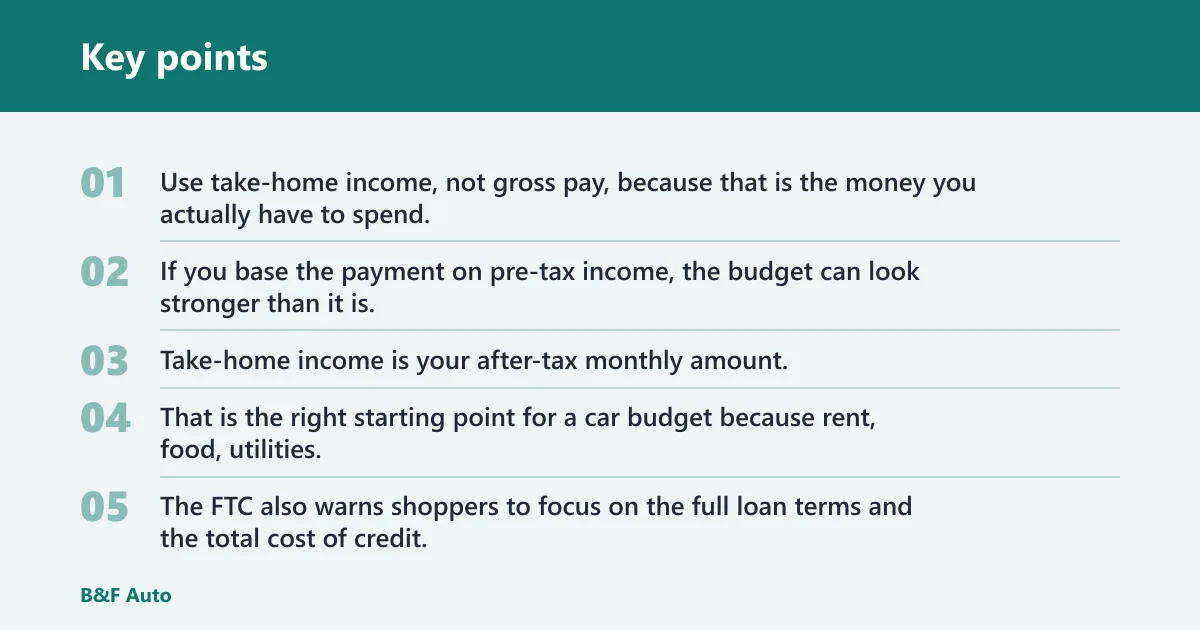
Use take-home income, not gross pay, because that is the money you actually have to spend. If you base the payment on pre-tax income, the budget can look stronger than it is.
Start with monthly take-home pay
Take-home income is your after-tax monthly amount. That is the right starting point for a car budget because rent, food, utilities, debt payments, and savings all come from the same pool. The FTC also warns shoppers to focus on the full loan terms and the total cost of credit, not just the monthly payment.
For example, if your monthly take-home pay is $4,000, a payment near 10% is about $400. At 15%, it is $600. That range is a useful ceiling for principal and interest only.
Low debt versus high debt budgets
If you have little or no monthly debt, you may be able to sit closer to the middle of the range because more of your paycheck is available for transportation. If you already carry credit card balances, student loans, or other fixed bills, the safer choice is usually the lower end of the range. A smaller payment gives you more room for insurance quotes, fuel volatility, and routine savings.
In practice, a buyer with low debt can often treat a 12% payment target as a starting point, while a buyer with high debt may need to cap the payment nearer 10% or even below that if other essentials are crowded.
Single-income versus family budgets
A single-income household typically has less margin for error because one paycheck has to cover all recurring bills. A family budget may have more combined income, but it can also include childcare, groceries, and multiple commuting schedules that raise transportation costs. The right payment is the one that leaves enough slack after every fixed bill is paid.
If the vehicle is for one driver in a one-income budget, a lower payment and a lower-cost used car are often easier to sustain. If the vehicle must serve a family, factor in car seats, school runs, larger cargo needs, and the possibility that one person’s commute or work schedule could increase fuel use.
How much of my income should go to a car payment?
A common rule is 10% to 15% of monthly take-home pay for the car payment itself. If you already have debt or your fixed expenses are high, staying near 10% gives you more room for insurance, fuel, and repairs. This is a benchmark, not a guarantee; lenders may approve more, but approval is not the same as affordability.
Higher percentages can work on paper, but they cut into flexibility. A payment that looks fine by itself can become too large once you add the rest of the vehicle cost and your existing obligations.
When a lower percentage is the safer choice
Choose the lower end if rent already takes a large share of take-home pay, if you carry credit card balances, or if your income is uneven. A smaller payment leaves more room for a repair bill, a higher insurance premium, or a month with extra driving.
Say your take-home pay is $3,200 and you also pay $450 toward student loans. A $400 car payment may still be approved, but it can leave too little slack for insurance, gas, and savings.
Long commute versus short commute
A long commute usually calls for a larger fuel budget, more wear on tires and brakes, and possibly more expensive insurance if the car is driven more miles each year. A short commute can make a modest payment more sustainable because the operating costs stay lower. If you drive many miles each month, the “affordable” car payment should be lower to make room for fuel and maintenance.
In other words, the same payment can fit a short-hop city driver but strain a highway commuter who logs hundreds of extra miles every month.
What counts as a car payment?
The car payment is the monthly principal-and-interest portion of the loan. It does not include insurance, fuel, maintenance, registration, or taxes, so it is only part of the real monthly cost of owning the vehicle.
That split matters. A payment can look reasonable on its own and still strain your budget once the other car expenses are added.
Principal and interest versus the full monthly car cost
Principal and interest depend on the loan amount, APR, and term. The full monthly car cost adds the expenses that come with using the vehicle. Those costs vary by car type, mileage, location, and coverage level. AAA’s driving-cost estimates and insurer pricing data both show that ownership costs can add a meaningful monthly amount beyond the loan payment itself.
Insurance and fuel often push the total higher than shoppers expect. A larger SUV, a sports trim, or a car with expensive parts can make the all-in monthly cost much higher than the loan payment alone suggests.
Payment vs total transportation budget
The best car budget is not just the loan payment. It is the full monthly transportation number: loan payment, insurance, fuel, maintenance, registration, taxes, parking, tolls, and any other recurring car costs. Edmunds and Kelley Blue Book both emphasize that ownership costs can change a vehicle’s real affordability dramatically, even when the payment looks manageable.
A payment that fits your income but blows up the rest of your budget is not truly affordable. If the car forces you to cut savings or miss other bills, the payment is too high.
How ownership-cost ranges change by car type
Compact used sedans often have lower insurance, fuel, and depreciation costs than new SUVs or premium trims. A new vehicle can bring warranty coverage and better efficiency, but the monthly payment and insurance premium may be higher. Used cars can lower the loan payment, though maintenance and repair risk may be more variable depending on mileage and condition.
That is why ownership-cost estimates from sources such as AAA, Edmunds, and Kelley Blue Book are helpful: they show that the cheapest monthly loan is not always the cheapest monthly vehicle.
Car payment budget table
This worksheet turns monthly take-home income into a payment range and a rough all-in vehicle budget. It uses 10% to 15% for the loan payment, then adds sample amounts for insurance, fuel, maintenance, registration, and taxes so you can see the full monthly load. The sample cost ranges below are illustrative only; real costs vary by location, vehicle type, driving habits, coverage, and driving record, as reflected in consumer cost guides and insurer quotes.
| Monthly take-home income | Recommended car payment range | Insurance | Fuel | Maintenance | Registration and taxes | Estimated all-in vehicle cost |
|---|---|---|---|---|---|---|
| $2,500 | $250 to $375 | $150 | $150 | $50 | $50 | $650 to $775 |
| $3,500 | $350 to $525 | $160 | $175 | $60 | $55 | $800 to $975 |
| $5,000 | $500 to $750 | $175 | $200 | $75 | $65 | $1,015 to $1,265 |
| $7,000 | $700 to $1,050 | $200 | $250 | $90 | $75 | $1,315 to $1,665 |
Use the table as a starting point, not a promise. If your insurance quote is high or your commute is long, your real monthly vehicle cost can move well above the sample numbers.
Good car payment worksheet
Use this worksheet to test the full monthly fit. Add your own debt payments, savings target, insurance quote, and fuel estimate, then decide whether the total still leaves room for the rest of your budget.
| Item | Monthly amount | Notes |
|---|---|---|
| Monthly take-home income | $ | Use after-tax income only |
| Existing monthly debt | $ | Student loans, credit cards, personal loans, other car debt |
| Savings target | $ | Emergency fund, retirement, short-term goals |
| Insurance quote | $ | Use a real quote, not a guess |
| Fuel estimate | $ | Based on commute, mileage, and fuel economy |
| Maintenance, registration, taxes | $ | Use a monthly average |
| Target car payment range | $ | 10% to 15% of take-home pay |
| Total transportation budget | $ | Payment + insurance + fuel + maintenance + registration/taxes |
| Affordability result | Pass / Fail | Pass if the total still fits after debt and savings |
Formula to estimate out-the-door price from a payment range: estimated vehicle price = loan amount + down payment + taxes/fees, where loan amount is the present value of the payment stream at your APR and term. In practice, you can approximate the car price by plugging the payment into a loan calculator: monthly payment, APR, and term determine the financed amount; then subtract your down payment and add taxes and fees. For example, a higher APR or shorter term reduces the price you can support at the same payment, while a larger down payment increases it.
Pass/fail affordability check
If the payment range fits on its own but the total transportation budget crowds out savings or leaves you unable to handle a surprise bill, mark it as a fail. A vehicle is only affordable if it fits both the monthly payment and the broader household budget.
For example, a buyer may qualify for a $500 payment, but if insurance is $220, fuel is $180, maintenance averages $80, and existing debt is $600 a month, the total can become too tight for a sustainable budget.
How loan term, APR, and down payment change the payment
Loan term, APR, and down payment are the main levers that move the monthly payment. Longer terms lower the monthly number, but they usually increase total interest. A larger down payment reduces the amount financed and can trim the payment. Consumer guidance from the FTC and CFPB warns buyers to compare the total cost of credit, not just the monthly bill.
APR also matters because it changes both the payment and the total cost of borrowing. Two loans with the same vehicle price can land at very different monthly amounts if the rate or term changes.
Why longer terms reduce the monthly payment
A 72- or 84-month loan spreads the balance over more payments, so the monthly bill drops. That can help cash flow, but it usually means paying interest for longer and owing more for more time. Experian and major auto lenders regularly note that longer terms can make a vehicle look affordable while increasing total interest paid over the life of the loan.
A 60-month loan often lands in a middle ground. It is still long enough to keep the payment manageable for many buyers, without stretching the loan as far as 72 or 84 months.
How APR and down payment move the number
A lower APR reduces the finance charge and can make the same vehicle more manageable. A higher APR does the opposite. The difference can be large enough to change whether a payment stays inside your target range.
A larger down payment lowers the amount financed, which can reduce the monthly payment and the total interest. If you can put more money down without draining your emergency fund, that usually improves the loan math. For more on budgeting the upfront amount, see down payment sizing and auto loan APR.
How to decide what car price you can afford
The car price you can afford is the one that keeps your total transportation costs inside your monthly budget after debt and savings. Start with the payment you can safely handle, then back into a price based on APR, term, and down payment. If you are choosing between two price points, pick the one that keeps you below the payment ceiling without requiring a long loan term.
A useful rule: if the estimated payment only works when you stretch to a longer term or skip a needed emergency reserve, the vehicle price is too high.
Back into a price from your payment cap
Use your payment cap as the starting point, then estimate the financed amount from your APR and term. A lower APR or longer term supports a higher car price, while a higher APR or shorter term supports less. After that, subtract your down payment and compare the result with taxes and fees to get a rough out-the-door price.
If you need a clearer estimate, use a car affordability calculator or compare the same car under different loan terms before you shop.
New car versus used car
New cars usually cost more upfront, but they may offer lower maintenance risk and better fuel efficiency. Used cars usually cost less to buy and finance, which can keep the monthly payment down, though the repair budget may need to be larger. The better choice depends on how much monthly cushion you need and how long you plan to keep the vehicle.
For a deeper comparison, see used vs new car costs.
How does my income affect my car payment?
Your income sets the ceiling for a payment that still leaves room for the rest of your budget. The same $450 payment may be comfortable at $6,000 in monthly take-home pay and too tight at $3,000, especially if you already have debt.
That is why payment-to-income ratio matters. It shows whether the loan fits your pay level, not just whether the lender is willing to approve it.
How debt-to-income ratio changes the risk
Debt-to-income ratio compares your recurring debt payments with your income. If rent, student loans, credit cards, and the new car payment already take a large share of take-home pay, the loan can be risky even when it is approved. A related benchmark is your broader debt-to-income ratio, which you can review at debt-to-income ratio.
Existing debt narrows the margin for error. A household with no other monthly debt can often handle a higher car payment than a household with the same income and several fixed obligations.
Signs the payment is too high even if you qualify
- You would have little left after rent, food, and utilities.
- You would need to skip savings to cover the payment.
- Insurance quotes push the monthly total above your target.
- You would need an 84-month loan to make the deal work.
- One repair or one missed paycheck would put the budget in the red.
How to check whether the payment still fits
Start with the loan payment, then add insurance, fuel, maintenance, taxes, and registration. If the total still leaves room for savings and emergencies, the car is closer to a good fit. If it does not, the payment is too high even if the lender says yes.
Leave space for routine life. A payment that fits only if every month goes perfectly is not a safe budget choice. For a closer look at premium differences and coverage factors, see car insurance cost factors.
Use this quick checklist
- Write down monthly take-home income.
- Set a payment cap at 10% to 15% of take-home pay.
- Add insurance, fuel, maintenance, taxes, and registration.
- Include existing debt payments in the monthly total.
- Check whether savings still fit after all bills are paid.
- Compare more than one vehicle, trim, term, and APR.
Suppose your take-home pay is $4,500 and your current debt payments total $700 a month. A $500 car payment may fit the percentage rule, but the combined debt load can still leave too little breathing room for insurance and day-to-day expenses.
Frequently asked questions
What is a good car payment?
A good car payment is usually about 10% to 15% of monthly take-home pay for principal and interest only. If you already have other debt, stay near the low end. The payment should leave room for insurance, fuel, maintenance, and savings without forcing you to stretch every month.
What is considered a good car payment?
A car payment is considered good when it fits your budget after taxes and still leaves enough money for the rest of your life. Approval alone is not enough. The monthly total should stay comfortable after you add insurance, gas, upkeep, and any existing debt payments.
What is a good car payment monthly?
A good monthly car payment depends on your take-home income. A useful rule is 10% to 15% of monthly after-tax pay.
What car payment fits my budget?
The right payment fits your monthly take-home pay, your debt load, and the full vehicle cost. A payment can look fine on paper and still be too high if insurance is expensive or if other loans already take a large share of your income.
Sources
- Consumer Financial Protection Bureau (CFPB)
- Federal Trade Commission (FTC)
- Experian
- Edmunds
- Kelley Blue Book
- AAA
- Auto insurer pricing data and quote-based estimates