
What Car Payment Budget Rule Should You Follow?
By Jordan Lee, CFP® Editor review by Maria Chen
Use the 20/4/10 rule first: 20% down, a 4-year loan, and total transportation costs capped at 10% of gross monthly income. If insurance, debt, or tight cash flow make that too risky, lower the payment cap. Ignoring those limits can leave you payment-stretched, short on emergency savings, and stuck with a car that strains every month. This guide shows how to apply 20/4/10 and fit it to your actual budget.
Related tools: auto loan term calculator, car insurance budgeting, total cost of ownership, and down payment guides.
What car payment budget rule should you follow?
Start with 20/4/10, then treat it as a guardrail rather than a universal answer. The core version calls for about 20% down, a loan term of roughly four years or less, and total transportation costs kept to about 10% of gross monthly income. If that does not fit your insurance, debt, or cash flow, use a softer cap.
How the 20/4/10 rule works
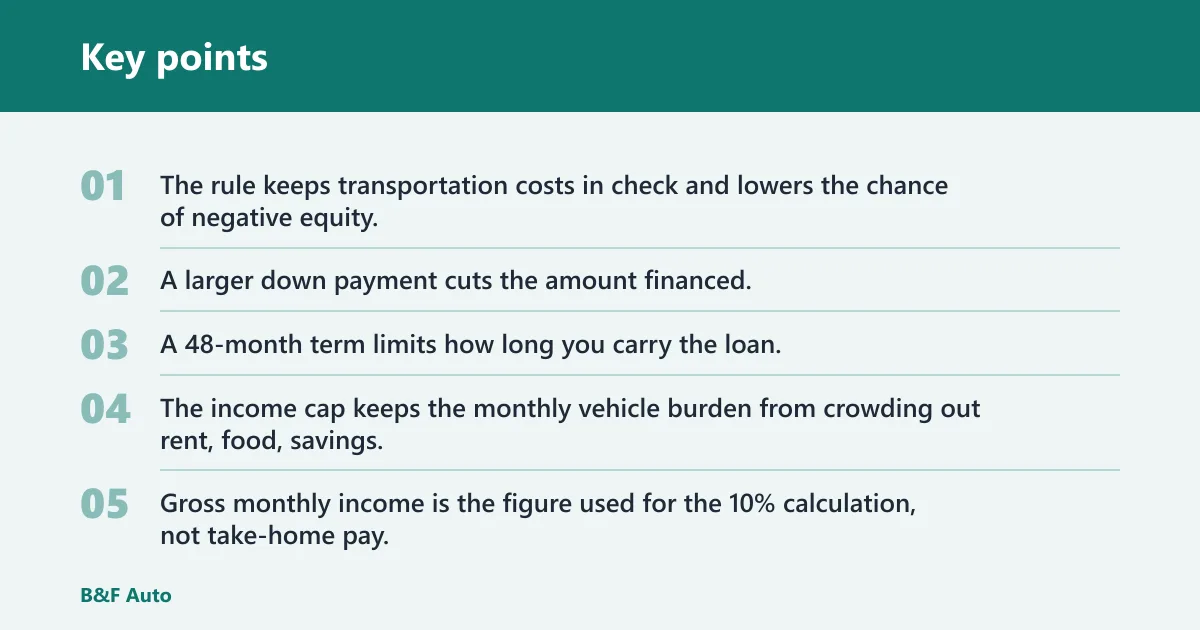
The rule keeps transportation costs in check and lowers the chance of negative equity. A larger down payment cuts the amount financed. A 48-month term limits how long you carry the loan. The income cap keeps the monthly vehicle burden from crowding out rent, food, savings, and debt payments.
The key detail is the income base. Gross monthly income is the figure used for the 10% calculation, not take-home pay. That matters because take-home pay is already reduced by taxes, retirement contributions, health premiums, and other deductions.
Industry guidance commonly defines the rule this way: 20% down, no more than a 4-year loan, and transportation costs at 10% of gross income. CNBC describes the 20-4-10 framework in those terms, and the Consumer Financial Protection Bureau notes that a car payment can crowd out other expenses if it is too large relative to income. Source
What counts in your monthly vehicle cost
Do not stop at the payment. Total transportation costs should include the car payment, auto insurance, fuel, and maintenance and repairs. Some broader budgets also include registration and taxes, but the practical point is the same: the payment alone can look affordable while the full monthly cost is not.
Say your gross monthly income is $5,000. Under the strict 10% version, your total transportation budget is $500 a month. If insurance is $140, fuel is $120, and maintenance reserve is $40, the remaining room for the payment is $200. That is a very different number from the payment you might first have in mind.
For a quick benchmark on maintenance, AAA’s Your Driving Costs study regularly shows that ownership costs rise materially once fuel, maintenance, tires, insurance, and depreciation are included. AAA also publishes annual cost estimates that help you build a more realistic budget. Source
Should you use gross or take-home income?
Use gross income for the 20/4/10 math, because that is how the rule is written and how lenders often frame affordability. Use take-home pay as the reality check. If the payment works on gross income but leaves too little after taxes and fixed bills, the car is still too expensive for your household.
Why gross income is the rule’s base
Gross income gives one consistent yardstick. It lets you compare buyers without mixing in different withholding amounts, benefit choices, or tax situations. CNBC’s description of the 20-4-10 rule uses gross income for the 10% cap, and that structure keeps transportation costs manageable.
When take-home pay should override the headline rule
If your pay is irregular, or if a large share of your paycheck already goes to debt, rent, childcare, or savings goals, take-home pay deserves more weight. A rule that looks fine on paper can still fail in practice if you do not have enough cash after payday.
A common first-timer mistake is to use the payment calculator first and the budget second. That flips the order. Start with income, subtract fixed obligations, then see whether the vehicle still fits without starving the rest of the month.
How existing debt changes the answer
Heavy credit card balances, student loans, or other fixed payments make a soft cap smarter. In those cases, the 10% gross-income ceiling can still be too high, even if the math technically passes. When debt service is already tight, a lower target such as 12% to 15% for total transportation costs is more realistic only if the rest of the budget has room.
That caution aligns with the CFPB’s warning that auto loans can become unaffordable when the payment competes with other required spending. If you are carrying high debt already, treat the car budget as part of a larger household cash-flow plan, not a standalone number. Source
How much of your income should go to a car payment?

For a strict plan, use 10% of gross monthly income for total transportation costs, not just the loan payment. If your insurance is high or you already carry significant debt, the payment portion may need to be much lower so the whole vehicle budget still fits. A 12% to 15% transportation cap is a softer fallback, not a blank check.
A 10% gross-income cap
This is the cleanest starting point. Add up payment, insurance, fuel, and maintenance, then keep the sum under 10% of gross monthly income. RefiJet frames the guideline around car-related expenses, not only the payment, and says a good rule of thumb is to keep vehicle expenses below 10% to 15% of income.
That same source gives an example using a $5,460 monthly salary, with a car payment range of $546 to $819. The important takeaway is not the exact payment number by itself. It is the process: income first, vehicle costs second, and payment third.
A 12% to 15% transportation cap
Use a 12% to 15% cap when the market or your household reality makes 10% too tight, but only if you can still cover insurance, fuel, and maintenance without stress. Many experts recommend 10% to 15% of monthly income for car-related expenses, which gives you room to adjust without treating one formula as universal.
That softer cap helps when insurance is expensive, when you commute farther than average, or when you need a reliable vehicle in a region with higher repair or fuel costs. The AAA cost data and national fuel cost patterns both show why “transportation” should be budgeted as a bundle, not as a single payment line.
How to lower the cap for high insurance or heavy debt
If insurance is unusually high, subtract that first before deciding on the payment ceiling. If debt is already heavy, reduce the cap again. The rule is simple: the more fixed monthly claims on your income, the less room the car payment should have. That keeps the vehicle from squeezing out the rest of your budget.
Insurance quotes vary widely by driver profile, location, and vehicle type, so the safest approach is to get a real quote before setting the budget. If the quote is high, use that number in the worksheet rather than a guess.
How to choose between 10% and 12%-15%
Choose 10% when your budget is stable, your insurance is reasonable, and you want a conservative cap that leaves room for repairs, savings, and irregular bills. Choose 12% to 15% only when the rest of your financial picture can handle it and the car is essential for work, family, or daily logistics. If you need the higher cap to “make the numbers work,” the car is probably too expensive.
Use 10% when these are true
Your emergency fund is intact, your debt payments are manageable, and your insurance quote is not unusually high. In that case, the 10% cap is a practical benchmark that helps prevent the vehicle from crowding out other goals.
Use 12% to 15% when these are true
Your commute is long, your local insurance market is expensive, or you have a higher-cost but necessary vehicle class, such as a family hauler or a truck used for work. Even then, keep the decision rooted in total transportation cost, not just the loan payment.
Do not stretch the rule to justify a bigger car
If the vehicle only fits when you assume ideal fuel prices, low insurance, and no repairs, the budget is not robust enough. A safer plan is to lower the purchase price, add more down payment, or wait until the numbers are cleaner.
Car payment worksheet

This worksheet turns income into a maximum car payment after you account for insurance, fuel, and maintenance. The payment shown is what is left after the listed monthly vehicle costs are subtracted from the cap. Use gross monthly income for the cap math, then compare the result with your actual take-home cash flow.
Methodology: The worksheet uses a simple formula: Maximum car payment = gross monthly income × transportation cap – insurance – fuel – maintenance. The cap is 10% for the strict version of 20/4/10, or 12% to 15% if you need a broader but still disciplined range. Insurance should come from a real quote, fuel should reflect your commute and current gas prices, and maintenance should be a monthly reserve based on expected service, tires, and repairs. For a practical estimate, many households use a conservative maintenance reserve rather than assuming zero repairs.
If your take-home pay is $3,800, that same $500 is 13.2% of take-home pay. That is why the rule uses gross income for the calculation, but your paycheck still has to support the final result.
| Scenario | Gross monthly income | Transportation cap | Estimated insurance | Estimated fuel | Estimated maintenance | Maximum car payment |
|---|---|---|---|---|---|---|
| Strict 20/4/10 | $5,000 | $500 | $140 | $120 | $40 | $200 |
| Moderate 12% to 15% | $5,000 | $600 to $750 | $140 | $120 | $40 | $300 to $450 |
| High-cost insurance exception | $5,000 | $500 | $250 | $120 | $40 | $90 |
Decision box: If the payment you need is higher than the number left in the table, buy cheaper, wait, or save more down. Do not fix a bad fit by stretching the loan first. A smaller vehicle price, a larger down payment, or lower insurance often solves the problem better.
Decision tree: If the car fits under your cap with realistic insurance, fuel, and maintenance, proceed. If it is slightly over, first check whether a lower trim, cheaper vehicle, or bigger down payment closes the gap. If it still does not fit, wait and keep saving. If the only way to buy is to extend the term far beyond 48 months, the answer is usually to buy cheaper.
Quick checklist: Get an insurance quote, estimate fuel from your commute, set a maintenance reserve, and then test the result against your gross-income cap. That sequence is more reliable than starting with a monthly payment target and hoping the rest will work out.
- Set gross monthly income.
- Choose a cap: 10% for strict 20/4/10, or 12% to 15% if that better fits your budget.
- Estimate insurance, fuel, and maintenance.
- Subtract those costs from the cap.
- The remainder is your max monthly payment.
- If the payment is too low for the car you want, lower the vehicle price or delay the purchase.
What if you cannot meet the rule?
If 20/4/10 does not work, do not force the purchase. The safer fallback is to buy a cheaper vehicle, save a larger down payment, or wait until insurance or debt load improves. That keeps you from choosing a payment that looks manageable only because the term is long or the down payment is thin.
Buy a cheaper vehicle
This is usually the cleanest fix. The same source reports average used vehicle prices of about $26,300 and average new-vehicle prices of about $49,461 in April, which helps explain why many buyers struggle to fit the strict rule. A lower purchase price lowers the monthly payment and usually the insurance bill as well.
Save a larger down payment
A bigger down payment reduces how much you finance, which can lower both the payment and the interest you pay over time. It also reduces underwater risk, meaning you are less likely to owe more than the car is worth early in the loan.
Suppose you are deciding between a small down payment and waiting three more months to save. The delay can be worth it if it moves you into a shorter loan amount and a safer payment. That is often better than accepting a stretched budget now and regretting it later.
For buyers comparing down payment targets, a larger upfront amount can also improve loan terms and reduce monthly strain. See our down payment guides for a deeper breakdown of tradeoffs.
Wait until insurance or debt load improves
If your insurance quote is unusually high or your other debt payments are crowding out savings, waiting is often the better move. A slightly better rate or a slightly lower premium helps, but the bigger gain comes from fixing the budget picture before you sign.
Is a longer loan term ever worth it?
A longer term lowers the monthly payment, but it raises total interest and can hide affordability problems. A 72- or 84-month loan may make the number look easier, yet it stretches the time you are paying for a depreciating asset. If you can avoid that, a shorter term is usually safer.
Why 72 and 84 months raise total interest
The same source notes that only 5.6% of new-vehicle loans had 48-month terms, which shows how far the market has drifted toward longer loans. The danger is simple: when the term gets longer, the lender has more time to charge interest. You often pay less each month and more overall.
Federal Reserve consumer data show that longer vehicle loan terms have become common in recent years, reflecting how buyers and lenders have adapted to higher prices and monthly-payment pressure. That trend is exactly why a shorter target remains useful as a discipline check.
How a longer term can hide affordability problems
A 72- or 84-month loan can make an expensive car look “affordable” by lowering the payment alone. That is a trap if the insurance, fuel, and maintenance still sit above what your budget can handle. The payment is only one line in the total cost.
The same source says a used-car example with transportation costs of $996 a month requires about $120,000 annual income, while a new-car example could require roughly $175,000 annual income. Those figures make the point plainly: the total monthly burden, not the sticker price alone, determines whether the car fits.
When a shorter term is the safer choice
If the car only works on a very long term, that is a warning sign. A shorter loan is usually the safer choice when you can still keep the total transportation cost inside your cap. If you cannot, the better move is a cheaper car, not a longer trap.
Frequently asked questions
Is the 20/4/10 rule still realistic in 2026?
It is still a useful standard, but not every buyer can meet it. Higher vehicle prices, insurance costs, and debt loads make the rule hard to follow exactly. That does not make it useless. It means you should use it as a starting point and adjust only when the full budget still works.
Should my car payment be based on gross or take-home income?
Use gross income for the rule itself, because that is the standard reference point for the 10% cap. Then check the result against take-home pay. If the payment only works before taxes and deductions, it is probably too high for your real monthly cash flow.
How much of my income should go to a car payment?
For the strict version, keep total transportation costs under 10% of gross monthly income. Many experts also use 10% to 15% of monthly income for car-related expenses when the budget needs a little more room. The payment should be whatever is left after insurance, fuel, and maintenance.
What if I can’t afford the 20/4/10 rule?
Buy a cheaper vehicle, save more down, or wait until your insurance quote or debt load improves. Do not stretch the loan term as the first fix. A longer loan can lower the payment, but it usually raises interest and can leave you stuck with a car that still strains the budget.
How much should I budget for insurance, gas, and maintenance too?
There is no single number that fits every driver, so build the budget from actual quotes and realistic driving habits. Add insurance, fuel, and a maintenance reserve to the payment, then check whether the total stays under your cap. If it does not, the vehicle is too expensive for now.
Sources
- CNBC: The 20-4-10 rule for buying a car
- Consumer Financial Protection Bureau: Auto loans
- RefiJet: 20/4/10 rule
- Edmunds: 10-20-4-10 rule for buying a car
- AAA: Your Driving Costs
- U.S. Energy Information Administration: Gasoline and diesel fuel update
- Insurance Information Institute: How can you save money on auto insurance?
- New York Fed: Household Debt and Credit Report