Can You Donate a Car Without a Title?
Yes, you can sometimes donate a car without a title, but most charities need the title or an approved substitute, and your state’s rules decide whether the vehicle can be transferred. If you skip the paperwork check, the charity may refuse the car, delay pickup, or leave you with transfer and tax problems. This guide explains when a title is required, when a charity may still accept the car, and how to start with the most common fallback document. For IRS rules on vehicle donations, see IRS Publication 526, Form 1098-C, and Form 8283.
Author: Editorial staff
Legal/DMV review note: Reviewed for general DMV transfer and IRS vehicle-donation guidance using official state and federal sources cited below; state procedures can change.
Last updated: October 30, 2026
Can you donate a car without a title?
The short answer is sometimes, but do not assume it will work. Most reputable charities require a valid vehicle title to transfer ownership legally, yet some states allow another path if the title is unavailable and the charity can still complete the transfer paperwork. IRS rules still apply even if the charity accepts the car; see Publication 526 for charitable contributions and Form 1098-C for vehicle-donation substantiation.
The title is the main proof of legal ownership. If the charity cannot put that ownership record into its name, the donation may stall even if the car is running, driveable, or ready for tow. That is why the first decision is not “Is the car donateable?” but “Can the ownership be transferred cleanly?”
When the title is required
Use the title as the default requirement. If you have it and the name matches the donor, the donation path is usually straightforward. If the title is missing, damaged, or still shows a lender, the charity may ask for more before it schedules pickup. Most states’ DMV title pages treat the title as the key ownership document; representative examples include California DMV title and registration, Texas DMV buying or selling a vehicle, New York DMV title transfer, and Georgia titles and registration.
A missing title can create legal problems, delays, or a rejected donation. That is especially true when the charity resells the vehicle, because the buyer and the charity both need a clear transfer chain.
When a charity might still say yes
Some charities may still accept the car if state law allows the transfer and the charity’s vehicle donation program is set up to handle titleless donations. Acceptance without a title is not universal and should be verified before starting.
Others may want supporting papers such as registration, a bill of sale, or a government ID. The charity’s own policy matters as much as the DMV rule. IRS Publication 526 also makes the donor’s recordkeeping important, so keep the transfer and donation records together even if the charity says yes.
Vehicle title donation checklist
Use this checklist to match the problem to the next step. It separates ownership-transfer issues from IRS donation paperwork, which are not the same thing. If the vehicle cannot be transferred, tax paperwork does not fix that.
| Situation | Likely next step | Documents to gather |
|---|---|---|
| Lost title | Request a duplicate title from the DMV or equivalent agency | Government ID, vehicle registration, VIN, fee payment, any prior title copy |
| Inherited vehicle | Confirm whether the estate or heir can transfer ownership in your state | Death certificate, probate or estate papers, registration, ID, any title in the deceased owner’s name |
| Open lien | Obtain a lien release or payoff statement before transfer | Loan account details, payoff statement, release letter, current registration, ID |
| Title never transferred into your name | Fix the ownership record before donation, if the DMV allows it | Signed prior title, bill of sale, registration, ID, any transfer forms required by the state |
| Junk car | Ask whether the charity accepts nonrunning vehicles without a title | VIN, registration, photos if requested, bill of sale, ownership affidavit if allowed |
| Out-of-state donation | Check both the donor state and the charity’s state rules | Title, registration, ID, odometer disclosure if required, any interstate transfer forms |
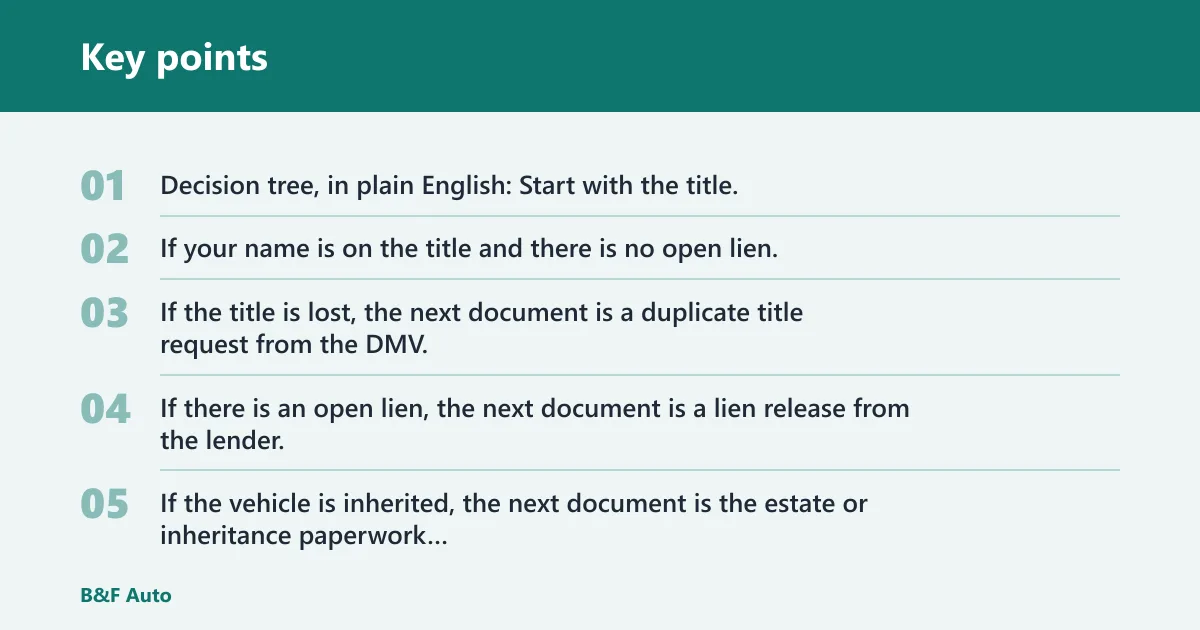
Decision tree, in plain English: Start with the title. If your name is on the title and there is no open lien, the next document is usually the signed title itself, plus any charity form and IRS receipt after pickup. If the title is lost, the next document is a duplicate title request from the DMV. If there is an open lien, the next document is a lien release from the lender. If the vehicle is inherited, the next document is the estate or inheritance paperwork your state requires before transfer. If the car is out of state, the next step is to verify whether your state or the receiving state needs an interstate title transfer form or odometer disclosure. If the car is junk or nonrunning, the next step is to confirm whether the charity will take it with a title substitute or whether the DMV still requires a clean title first.
Say your sedan is parked in the driveway with an Ohio registration in your name, but the paper title vanished during a move. The clean next step is not towing it first. It is requesting a duplicate title from the state DMV, then confirming the charity will accept the car once that document arrives.
Suppose the car was inherited from a parent and the title still names the estate. That is not a simple missing-paper problem. You may need estate paperwork before the DMV or charity will treat you as the person who can transfer it.
What should I do if I lost the title before donating my car?
Start by requesting a duplicate title from the DMV or equivalent agency. In many states, that is the first fallback because a replacement title can restore the normal transfer path. State DMV duplicate title requests usually need identification and a fee, and processing time varies by state. For examples, see California duplicate or replacement title pathways, Texas title and transfer guidance, New York titles, and Georgia motor vehicle forms.
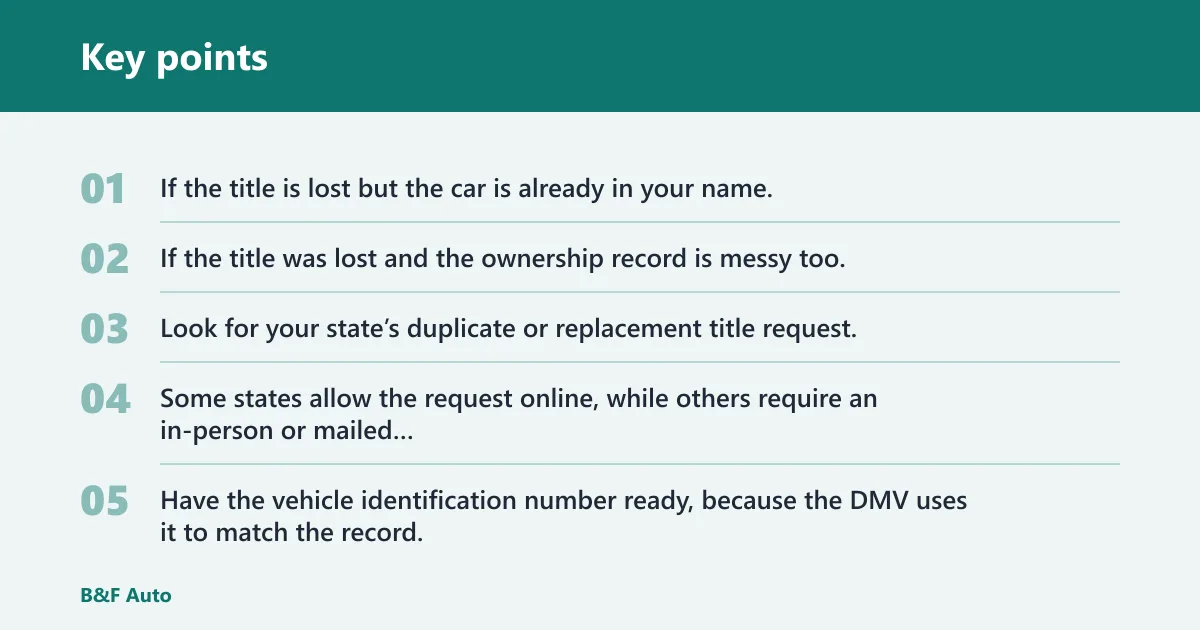
If the title is lost but the car is already in your name, a duplicate title is often stronger proof than any substitute document. If the title was lost and the ownership record is messy too, you may need to solve both problems before the charity can accept the vehicle.
Requesting a duplicate title from the DMV
Look for your state’s duplicate or replacement title request. Some states allow the request online, while others require an in-person or mailed application. Have the vehicle identification number ready, because the DMV uses it to match the record.
Some states allow a motor-vehicle record search or a bonded title as substitutes. That can matter when the record is old, the title never arrived, or a prior transfer was never completed correctly. Check the official title pages for the state involved before you rely on a charity’s general guidance.
What identification and fees are usually needed
Expect to show government identification and pay a fee. The exact fee amount depends on the state, so check the DMV before you submit the request. If the title was issued to more than one owner, the agency may require both signatures or proof that the other owner is unavailable.
Keep copies of everything you submit. If the charity later asks for proof that you are the person who requested the duplicate, those copies help.
How long replacement title processing can take?
Processing time varies by state. Some duplicate titles arrive quickly, while others take longer if the record needs a manual review or if mail handling slows the request. Do not schedule towing until you know whether the charity will hold the vehicle for you.
Ask the charity whether it can tentatively reserve the pickup date while you wait. That avoids a wasted tow if the title does not arrive on time.
What documents can replace a title?
Some documents can support your ownership claim, but they do not all carry the same weight. Vehicle registration, a bill of sale, and an affidavit of ownership may help in limited cases, yet none is a universal substitute for a title. Acceptance depends on state law and the charity’s policy, and the DMV’s title page still controls whether the vehicle can be retitled or transferred.
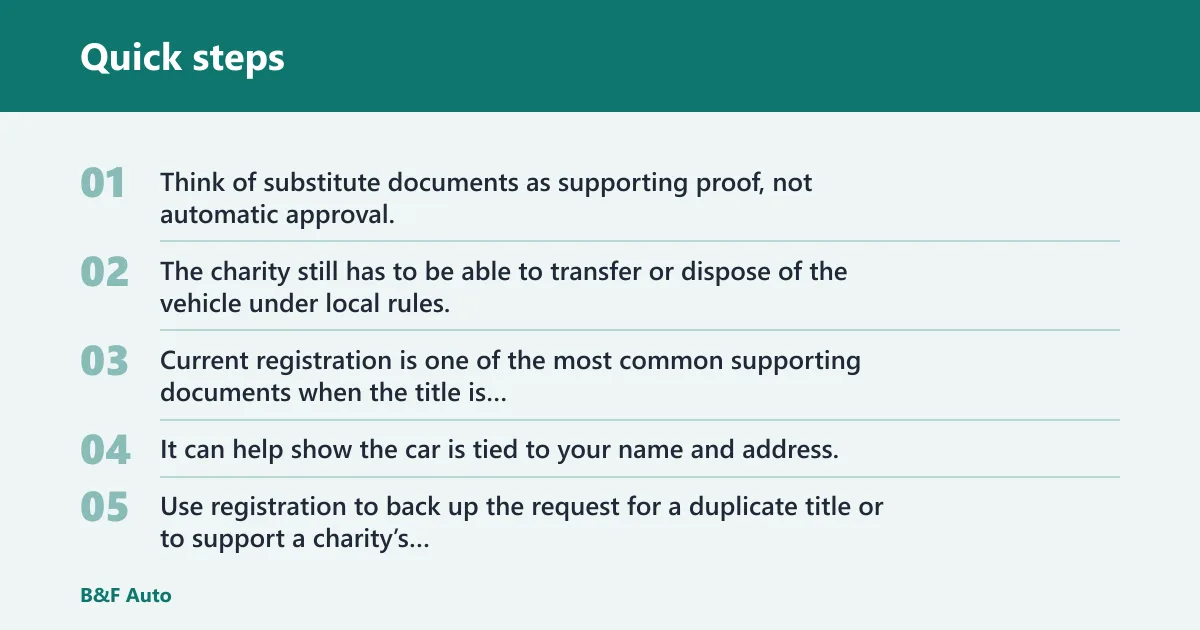
Think of substitute documents as supporting proof, not automatic approval. The charity still has to be able to transfer or dispose of the vehicle under local rules.
Vehicle registration as supporting proof
Current registration is one of the most common supporting documents when the title is missing. It can help show the car is tied to your name and address, but it does not universally replace the title.
Use registration to back up the request for a duplicate title or to support a charity’s review of the vehicle record. Do not treat it as a guaranteed stand-in.
Bill of sale as partial proof
A bill of sale may help if the charity and the state both accept it, but it is not a universal substitute for a title. It works best when the paperwork trail is simple and the donor name on the bill of sale matches the rest of the record.
Can a charity accept a bill of sale or registration instead of a title? Sometimes, yes, but only when the charity’s program rules and the state transfer rules both allow it. Verify that before pickup.
Affidavit of ownership in limited cases
An affidavit of ownership is a notarized or sworn statement used in some jurisdictions as alternative proof. Acceptance varies by state.
If the charity asks for an affidavit, confirm the exact wording it wants before you sign anything. A vague statement can slow the transfer if it does not match the charity’s checklist.
Why these documents are not universal substitutes
These papers help prove a claim. They do not always prove transferable legal ownership. That is the key difference.
A charity that accepts one form in one state may reject it in another. That is why the first question should always be, “What document does your program require for this vehicle in this state?”
What if the car has a lien?
If the lender still has a claim on the vehicle, a lien release may be required before the charity can receive a replacement title or transfer the car. Without it, the title record may still show another party’s interest. For DMV guidance on lien handling, see California lien releases, Texas title forms and lien-related forms, New York title after paying off a loan, and Georgia titles.
That matters because the charity cannot accept ownership cleanly while a lender’s claim is still active in the record. In many cases, the DMV will not issue a clean replacement title until the lien is cleared.
Why a lien release matters
The lien release tells the DMV and the charity that the debt was satisfied or that the lender no longer claims the vehicle. If you are still paying on the car, ask the lender what document it will issue after payoff.
Do not confuse a loan statement with a release. The charity needs proof that the lien is gone, not just that the loan exists.
Payoff statements versus release letters
A payoff statement shows how much remains owed. A release letter shows the lender has ended its claim. Only the latter usually clears the title issue.
If you have paid off the loan recently, ask the lender whether the DMV receives the lien release directly or whether you need to request it. That keeps the transfer from getting stuck in transit.
Why a replacement title may wait until the lien clears
Even if the title is missing, the DMV may still need the lien cleared before issuing a duplicate title. That is because the replacement should reflect the same ownership status as the original record.
If the lender is slow to respond, start there first. A duplicate title request without the lien release may get delayed or denied.
California: how to donate a car without a title
California often pushes donors toward the official title path first. If the title is missing, the California DMV title and registration pages are the place to start, and the car can usually not move forward as a clean donation until ownership can be shown or replaced. The exact path depends on whether the title is lost, the vehicle has a lien, or the donor is an heir. Start with the DMV’s title page at California DMV title and registration and, if needed, the title and lien pages at California title transfer and California lien releases.
Concrete path: If you are the owner on record and the title is lost, request a replacement or transfer-ready title from the California DMV before the pickup. If a lien is open, get the lender’s release first. If the vehicle is inherited, confirm whether the estate paperwork is enough for the DMV to release or transfer title before you call the charity. California charities and towing companies will generally want the ownership record to match the donor before they take the car.
Caveat: California’s paper trail is often where donations fail in practice: the donor has the car, but not the title; the title exists, but the lien was never released; or the heir has possession but not the estate authority to sign the transfer. In each case, the next document is different, so do not guess. Ask the California DMV and the charity which document closes the gap.
Texas: how to donate a car without a title
Texas also relies heavily on the title record. If you do not have the title, the safe first move is to check the Texas DMV transfer and title guidance and then verify whether the vehicle can be donated only after a replacement title or other ownership document is issued. Start with Texas DMV buying or selling a vehicle, Texas title and registration guidance, and the state’s title and lien-related forms page at Texas vehicle title and registration forms.
Concrete path: If your name is on the record and the title is missing, ask Texas DMV what duplicate title option applies before scheduling pickup. If a lender still has an interest, get the lien release documented first. If the vehicle was inherited or you are handling it for an estate, verify whether Texas needs additional inheritance or probate documents before the charity will accept it. If the car is out of state, make sure Texas recognizes the ownership document before you attempt the transfer.
Caveat: Texas donation failures often happen when the paperwork path is split between the charity and the DMV. A charity may be willing to pick up the car, but the DMV still may not accept the ownership transfer without the title or a clean replacement path. Do not let towing come before the paperwork decision.
What to confirm with the charity before pickup
Before you arrange towing, confirm whether the charity’s vehicle donation program accepts titleless donations, which documents it will accept, and whether it will help coordinate paperwork. That call can save a failed tow, a rejected vehicle, or a stalled donation.
Do not assume that one charity’s policy applies to another. Verify the specific program that will receive the car, and ask how it handles your exact paperwork problem.
Whether the program accepts titleless donations
Ask directly whether the charity accepts a car without a title in your state. Charity acceptance without a title is not universal and should be verified before starting.
Also ask whether the vehicle can be transferred without a title or whether the charity only accepts it if you first obtain a duplicate title or another approved document.
Which documents the charity will accept?
Ask for the exact list. Some charities will take current registration, bill of sale, proof of ownership, or government ID, while others want a duplicate title or an affidavit. Do not rely on a general website statement if the vehicle has an ownership problem.
If the answer is “maybe,” ask what would make it a firm yes. That is usually the missing document or a state-specific form.
Whether the charity helps coordinate paperwork
Some programs help donors work through DMV forms, lien release questions, or ownership affidavits. Others only accept the vehicle once the paperwork is already complete. Ask which side of that line the program falls on.
That question matters most when the car is being donated from a different state or when the title record does not match the current driver.
How to avoid a failed towing appointment
- Confirm the charity accepts the vehicle without the title or with the fallback document you have.
- Ask what proof it needs at pickup, not just before approval.
- Check whether the tow company needs a signed release or key handoff form.
- Keep the title, duplicate-title receipt, or supporting documents ready for the driver.
- Do not schedule pickup until the paperwork path is clear.
Will I still get a tax deduction if I donate without the title?
Maybe, but the tax rules are separate from the ownership-transfer rules. A donation receipt alone does not create a deduction, and a missing title can affect whether the charity can complete the gift properly. The deduction depends on the vehicle’s sale proceeds or fair market value, plus the required IRS paperwork. In some cases, exceptions can apply when the charity uses the vehicle in a way that is significant to its mission or materially improves the vehicle before selling it.
If the charity sells the vehicle for more than $500, the deduction is generally limited to the amount received. If the vehicle sells for $500 or less, the donor may claim the lesser of fair market value or $500.
Written acknowledgment and IRS forms
A written acknowledgment is required. The receipt should include the charity’s name, donor details, vehicle details, and donation date. Form 1098-C or Form 8283 may be involved depending on the amount and the filing situation.
Do not mix up the charity’s pickup paperwork with the IRS filing record. You need both to be in order if you want a clean donation file.
What to keep for your records
Keep the donation receipt, any towing record, the title or substitute paperwork, and any letter showing the charity accepted the vehicle. If the title issue is resolved through a duplicate title or lien release, keep those copies too.
That paper trail matters if the IRS asks how the vehicle changed hands or how the value was determined.
Related guides
If you need the next step instead of the donation step, these related pages usually help:
- duplicate title
- lien release
- donating a junk car
- vehicle tax deduction rules
- donating inherited vehicles
Frequently asked questions
Can you donate a car without a title in california?
California-specific rules can differ from another state’s rules, so do not assume the answer. The charity may accept the vehicle only if the DMV path or another approved ownership document is available. Check both the state transfer rule and the charity’s donation policy before you proceed. Start with the official California DMV title pages linked above.
Can you donate a car without a title in texas?
Texas may have its own document path, but that does not mean every charity will accept a titleless donation there. Ask whether a duplicate title, registration, or sworn ownership statement is required. The safest move is to verify the state rule and the charity’s vehicle program together through the official Texas DMV pages linked above.
Can you give away a car without a title?
You may be able to, but only if the legal ownership transfer can still be completed. Giving a car away without a title can create the same problems as donating it: the DMV may not accept the transfer, and the recipient may not be able to register the vehicle.
Can a charity accept a bill of sale or registration instead of a title?
Sometimes, but not as a universal rule. A bill of sale or current registration may support your ownership claim, yet many charities still require a title or duplicate title. Acceptance depends on state law and the charity’s program rules, so ask before you schedule towing.
What happens if the car has a lien and I don’t have the title?
Start with the lender. A lien release may be required before a replacement title can be issued, and the release should show that the lender no longer claims the vehicle. Until the lien clears, the charity may not be able to take the car or finish the transfer.
Sources and official references
Federal IRS references: IRS Publication 526, Form 8283, and Form 1098-C.
Representative DMV references for title, duplicate title, and lien handling: California DMV title and registration, California title transfer, California lien releases, Texas DMV buying or selling a vehicle, Texas title and registration guidance, Texas vehicle title and registration forms, New York DMV titles, New York title transfer, New York title after paying a vehicle loan, Georgia titles and registration, and Georgia titles.