
What Are Typical Auto Loan Terms for Used Cars?
Used-car loan terms are commonly reported in the 36- to 72-month range; about 48 to 60 months fits many buyers, 72 months can work for newer used cars and stronger credit, and 36 to 48 months can suit older cars or tighter budgets. Longer terms lower the payment but increase total interest, and they can keep you underwater longer or increase negative-equity risk. This guide shows which term length fits your credit tier, vehicle age, and monthly budget.
What are car loan terms?
A car loan term is the repayment length in months, and the vehicle itself secures the loan. The term and APR work together: a longer term usually lowers the monthly payment, while the rate and extra months can raise the total amount you repay.
That matters because a loan is not only about what fits today’s budget. The same vehicle price can look manageable at one term and costly at another once interest is added.
How term and APR work together
Term length changes how long interest has to build. APR changes how fast it builds. A 72-month loan at a lower APR can cost less than a 60-month loan at a much higher APR, so the right choice is never just “longer is cheaper.”
How many months is a typical used car loan?

Typical used-car loan terms are 36 to 72 months, with 24, 36, 60, 72, and sometimes 84 months appearing in lender menus. For most used-car buyers, 48 to 60 months is the usual middle ground. Older cars, higher mileage, and weaker credit often push you toward shorter terms or tighter lender limits.
What lenders usually offer for older cars
Lenders get more selective as a vehicle ages. Many cap vehicles at 8 to 10 model years at purchase or origination, and many cap mileage at 100,000 to 125,000 miles at purchase or origination. That means the term you want may not be the term you can get.
Used-car term decisions
| Term | Credit tier that most often fits | Vehicle age / mileage band | Monthly payment effect | Total interest tradeoff | Usually prudent or risky? |
|---|---|---|---|---|---|
| 24 months | Super-prime, prime | Recent used car; low mileage; strong lender comfort with resale value | Highest payment, least cash-flow relief | Lowest total interest | Prudent if the payment fits |
| 36 months | Super-prime, prime, some near-prime | Newer used car; moderate mileage | High payment, but much easier than 24 months | Low interest compared with longer terms | Usually prudent |
| 48 months | Prime, near-prime | Typical used car; middle-aged vehicle; mileage still inside lender limits | Balanced payment | Moderate interest | Usually prudent |
| 60 months | Prime, near-prime, some subprime | Typical used car; slightly older or higher-mileage vehicle | Lower payment than 48 months | More interest than 48 months | Usually prudent if budget needs it |
| 72 months | Prime, near-prime, limited subprime | Newer used car; lower mileage; stronger resale protection | Noticeably lower payment | Meaningfully higher interest | Borderline; prudent only if the car will last the term |
| 84 months | Super-prime to prime on newer used cars; uncommon elsewhere | Very new used car; low mileage; lender willing to stretch payoff date limits | Lowest payment, but only on paper | Highest total interest and highest equity risk | Usually risky on used cars |
That table is the practical definition of “typical.” It is not only a list of month counts. It shows which term is normal for the vehicle, the borrower, and the lender’s risk rules.
A common first-timer mistake is choosing the payment that feels easiest and ignoring how much time remains before the vehicle needs major repairs or loses value fast. If the term runs longer than the car’s useful ownership window, the loan can outlast the vehicle’s best years.
How does credit score change used-car APR and term?
Credit quality affects both the rate you are offered and, in many cases, how far a lender will stretch the term. Used-car rates are usually higher than new-car rates, and they rise as credit quality falls. Recent industry data cited in the article puts excellent-credit used auto rates around 6.29%, good-credit around 8.81%, fair-credit around 13.93%, bad-credit around 19.10%, and deep-subprime around 21.62%.
Used car rates versus new car rates
Auto loans are often cheaper than personal loans because they are secured by the vehicle. That does not mean all used-car loans are cheap. It means secured auto lending is usually cheaper than unsecured borrowing, while still carrying higher rates than many new-car offers.
Lower credit scores can also narrow term options. A lender that offers 72 months to a prime buyer may stop at 60 months, or shorter, for a near-prime or subprime applicant. That is because the lender is pricing both credit risk and vehicle risk at the same time.
How lower scores affect approval and pricing
When credit is weaker, the payment can jump from two directions at once: a higher APR and a shorter allowed term. That double hit is why a buyer with fair or bad credit should compare lenders before signing, then compare the actual payment, total interest, and down payment requirement.
When does a longer term make sense?
A longer term makes sense when the payment fits your budget only at that length and the car is new enough that it should still be dependable for most or all of the loan. It can also help if you need room in your monthly cash flow, but it should not be used to hide an unaffordable purchase.
Payment-to-income and budget fit
Loan payment alone is not the full budget test. You also need fuel, insurance, maintenance, and registration. A longer term may be acceptable if it keeps the total car cost within a reasonable share of take-home pay, but the shorter affordable term is usually the better choice.
Say your budget can handle $425 a month, and the dealer offers 60 months at that payment or 72 months at $370. If the 60-month version already fits your income, the shorter term usually wins because it trims interest and helps you build equity faster.
Suppose a buyer chooses a 72-month loan on a six-year-old car with 90,000 miles. If the car needs major repairs before the loan ends, the owner may still owe money on a vehicle that is worth less than the balance. That is the downside case lenders and shoppers often miss.
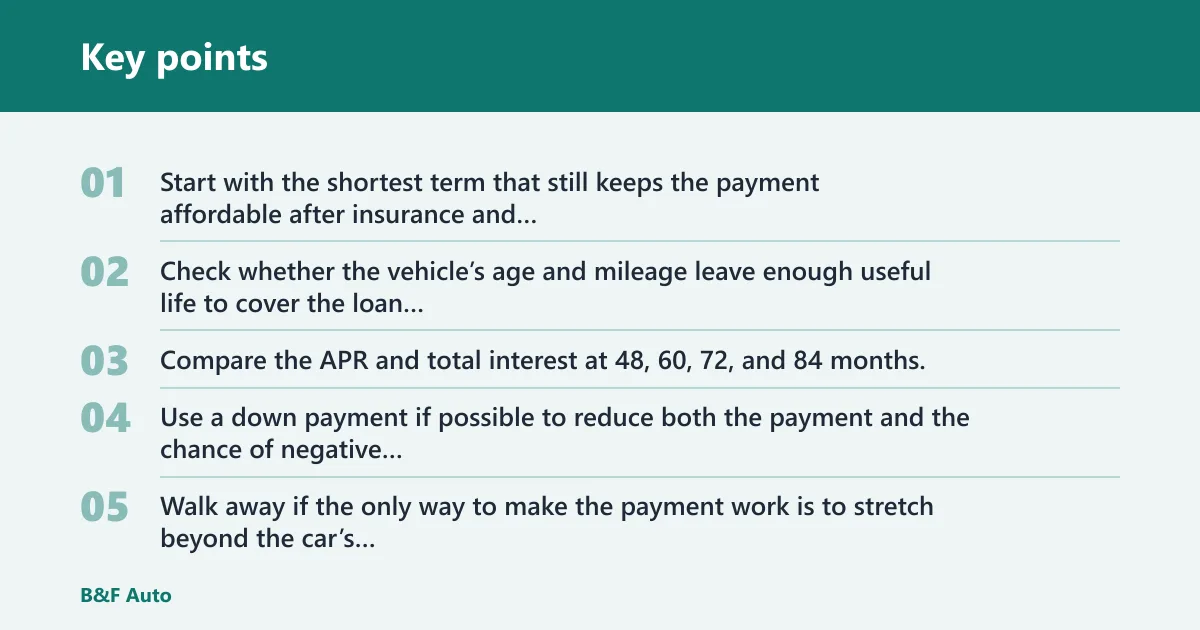
- Start with the shortest term that still keeps the payment affordable after insurance and operating costs.
- Check whether the vehicle’s age and mileage leave enough useful life to cover the loan term.
- Compare the APR and total interest at 48, 60, 72, and 84 months.
- Use a down payment if possible to reduce both the payment and the chance of negative equity.
- Walk away if the only way to make the payment work is to stretch beyond the car’s realistic ownership window.
What lender limits affect used-car financing?
Lender rules can block a term even when your budget could handle it. The biggest limits are model-year caps, mileage caps, title restrictions, and whether the vehicle is bought from a dealer or a private party. These rules are common because they help lenders protect the car’s value as collateral.
Model-year caps
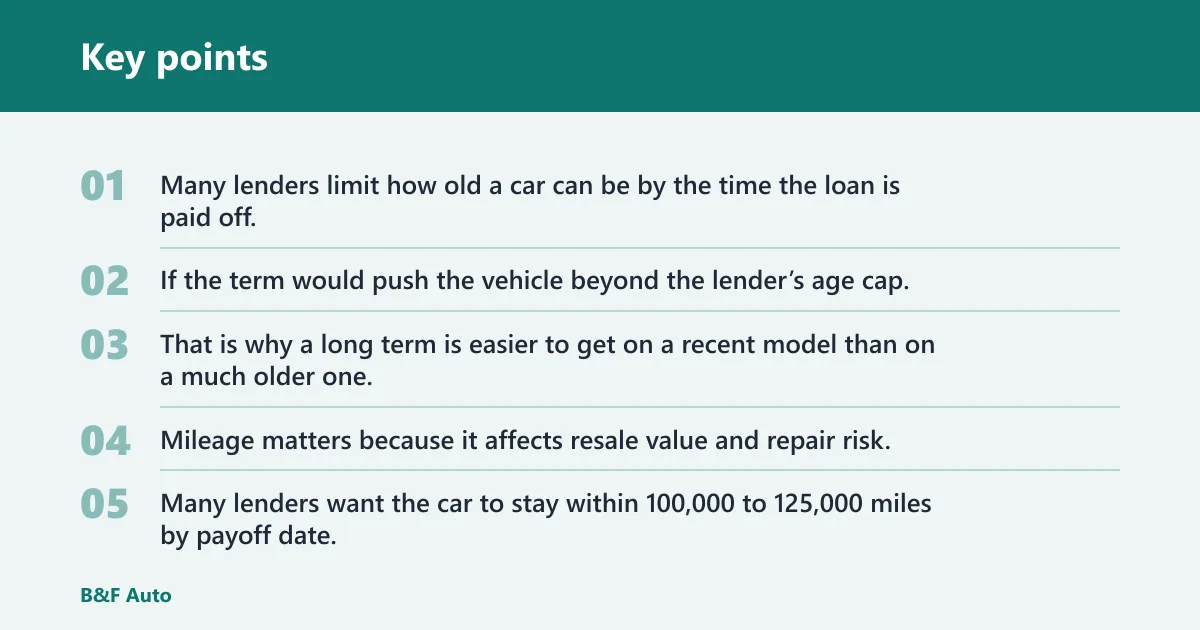
Many lenders limit how old a car can be by the time the loan is paid off. If the term would push the vehicle beyond the lender’s age cap, the loan may be shortened or declined. That is why a long term is easier to get on a recent model than on a much older one.
Mileage caps
Mileage matters because it affects resale value and repair risk. Many lenders want the car to stay within 100,000 to 125,000 miles by payoff date. A car that is already near those limits may only qualify for a shorter term, a larger down payment, or a different lender.
Title and purchase-type restrictions
Salvage and rebuilt-title vehicles often face tighter lender rules. Some lenders will not finance them at all. One competitor notes that personal loans may be used for salvage or rebuilt-title vehicles, which is one reason buyers sometimes switch financing methods when the car falls outside auto-loan eligibility.
Private-party purchases can also be restricted. Some lenders finance dealer sales more readily than private-party sales because dealer paperwork, title handling, and vehicle inspection requirements are easier to verify.
Can you refinance a used car loan later?
Refinancing may be possible later if you make on-time payments and your credit improves, or if market rates fall. The goal is usually to lower the APR, reduce the monthly payment, or both. It works best when the car still has enough value left to support the new loan.
Refinancing is worth checking after a strong payment streak, especially if your original rate came from fair, bad, or deep-subprime credit. If the loan balance is close to the vehicle’s value, though, a lender may be less interested.
When refinancing is worth checking
Check refinancing when your payment feels manageable but overpriced, when your credit score has moved up a tier, or when the original term is still long enough that interest savings matter. It is less useful if the loan is nearly paid off or the vehicle has depreciated sharply.
What loan term should I choose for my budget?
Choose the shortest term you can afford after you account for insurance, fuel, maintenance, and your down payment. For most used-car shoppers, that means 48 to 60 months. Move to 72 months only when the vehicle is newer, the lender allows it, and the payment gap is large enough to matter.
The average used car loan was $28,506 in 2023, and the average used car monthly payment was $525 in 2023. Those figures are a reminder that the payment is only one part of the decision. A smaller payment can still cost more overall if the term is stretched too far.
Use this rule: if the car will likely still be useful at the end of the term, the term may be reasonable; if the loan would run past the car’s realistic ownership window, it is too long. That is especially true on older, higher-mileage vehicles.
Frequently asked questions
What is the average used car loan term?
In practice, many used-car shoppers land around 48 to 60 months because it balances payment size, total interest, and the vehicle’s remaining useful life.
Are 84-month used car loans common?
They do exist, but they are generally uncommon for most used cars. An 84-month term usually fits only newer used vehicles with lower mileage and borrowers with strong credit. On many used cars, the term is longer than the lender or the vehicle’s age and mileage limits allow.
How does loan term affect monthly payment?
Longer terms lower the monthly payment because the balance is spread across more months. The tradeoff is more total interest. Shorter terms do the reverse: higher monthly payment, lower total cost. The right choice depends on whether the payment still fits your budget comfortably.
Do used car loans have higher rates than new car loans?
Usually, yes. Used-car APRs are generally higher than new-car APRs because the collateral is older and depreciates faster. Credit score also matters a lot: excellent-credit rates are much lower than fair, bad, or deep-subprime rates, and the term can affect the final cost too.