
How to Fill Out a Car Title Transfer Correctly
Fill out the title exactly as printed, in order, using blue or black ink. Do not erase, cross out, or leave blanks unless your state’s title says to skip that field. A single mismatch can delay the transfer or send it back from the DMV. This guide walks you field by field through the seller, buyer, odometer, sale price, signatures, and date.
What a title transfer covers
A title transfer moves ownership from seller to buyer on the vehicle title certificate. The title is the legal ownership document, and the transfer is generally considered complete when the correct section is completed, signed, and accepted by the state DMV. Some titles use the front, some the back, and some need extra forms.
Start by finding the transfer area on the title itself. If the title is missing, you may need a duplicate title before the sale can move forward. State rules vary, so check your DMV’s title-transfer instructions before you write anything.
What you’ll need
- Vehicle title certificate
- Government ID for buyer and seller
- Vehicle Identification Number from the car and the title
- Odometer reading at the time of sale
- Bill of sale, if your state requires it or if the DMV asks for it
- Lien release, if the vehicle had a loan
- Any state transfer, tax, inspection, or disclosure form
- Notary public, if your state requires notarization
What information has to be written on the title transfer form?
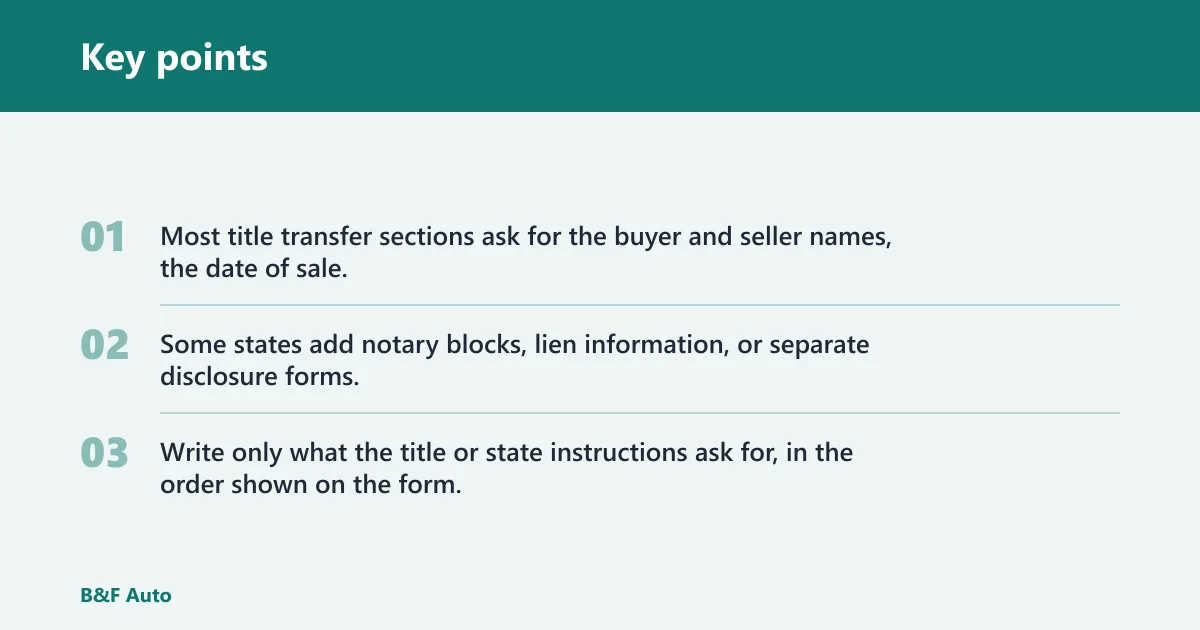
Most title transfer sections ask for the buyer and seller names, the date of sale, the sale price, the VIN, the odometer reading, and signatures. Some states add notary blocks, lien information, or separate disclosure forms. Write only what the title or state instructions ask for, in the order shown on the form. (Wikihow)
Title transfer error-prevention checklist
| Field to complete | What to verify before writing | What to do if it is already wrong |
|---|---|---|
| Title section | Use the correct front or back transfer area named on the title certificate. | If you wrote in the wrong section, stop and ask the DMV whether a replacement title is needed. |
| Buyer and seller names | Check the names as shown on the title and IDs, including full legal names, suffixes, and any co-owner formatting. | If the name is wrong, do not guess a fix; a DMV may require a corrected title or supporting paperwork for a name change. |
| VIN | Match every digit to the vehicle and the title; even one wrong digit can delay or invalidate the transfer. | If the VIN is wrong, do not cross it out; confirm with the DMV whether the title must be reissued. |
| Odometer reading | Record the mileage at the time of sale, and use the exact place the form asks for it. | If the reading is wrong or missing, check whether a separate odometer disclosure form can correct it or whether the title must be redone. |
| Sale date and price | Use the actual sale date and the agreed price from the transaction. | If either is wrong, ask the DMV whether a new bill of sale or corrected title is required. |
| Seller signature | Sign only in the seller signature area and only if the title instructions say to sign there. | If the signature is missing or signed in the wrong spot, the transfer may need a replacement title or a corrected form. |
| Buyer signature | Some titles need a buyer signature on the title, while others use a separate form. | If the buyer signed where they should not have, the DMV may require a new title or a fresh transfer packet. |
| Notary box | Check whether your state or title form requires notarization before submission. | If the notary section was skipped in a state that requires it, the document may be rejected and need re-execution. |
| Lien release | Confirm the lender has released its interest before the title is signed over. | If the lien release is missing, contact the lender and obtain the release before filing the transfer. |
| Bill of sale | Make sure it lists the vehicle, date, sale price, and both parties’ signatures if your state wants it. | If the bill of sale is incomplete, replace it with a corrected version signed by both parties. |
How to fill out car title transfer
Complete the title in the exact order the form lays out: check the title section first, then write the buyer and seller names, then add the VIN and odometer reading, then enter the sale date and price, and sign last. If your state requires a notary, stop before signing and follow that step in the right order.
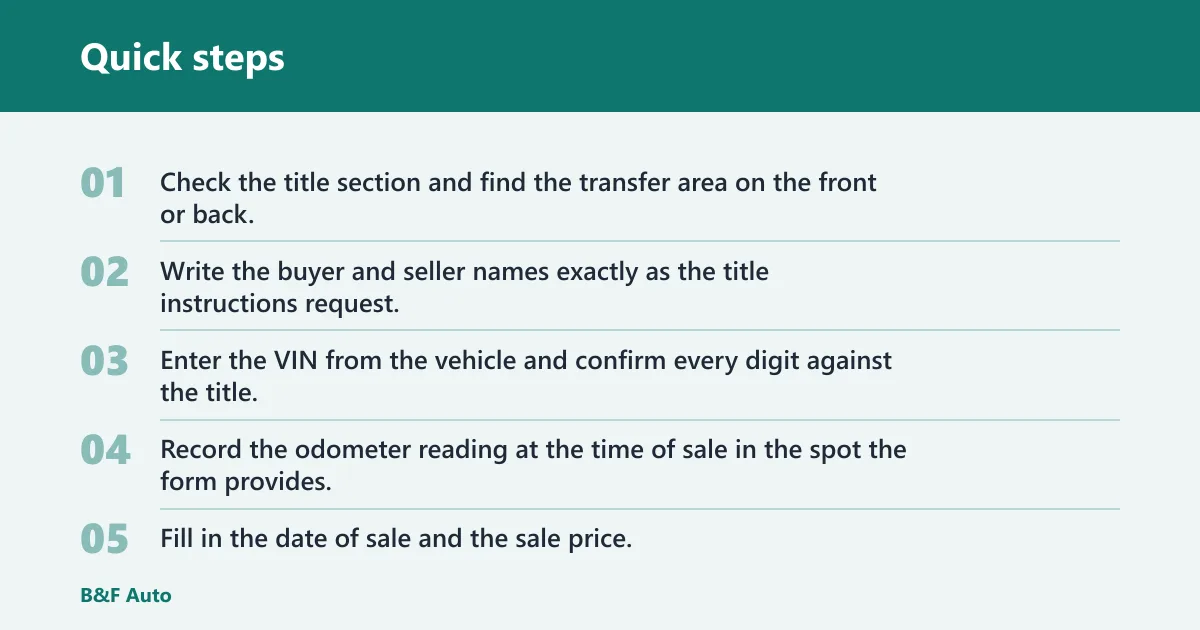
- Check the title section and find the transfer area on the front or back.
- Write the buyer and seller names exactly as the title instructions request, using the same legal name format shown on the paperwork.
- Enter the VIN from the vehicle and confirm every digit against the title.
- Record the odometer reading at the time of sale in the spot the form provides.
- Fill in the date of sale and the sale price.
- Sign only in the seller signature box unless the title or state form also asks for the buyer’s signature there.
- Complete notarization, if required, before submitting the packet.
- Attach the bill of sale, lien release, and any state forms the DMV requires.
A common first-timer mistake is writing the buyer’s nickname instead of the name on the title and ID. If the title says “Robert A. Garcia Jr.” and the form asks for the buyer name, use the title format unless your DMV says another format is allowed in that state.
Suppose the odometer line is on the back of the title, but the bill of sale is separate. You still write the mileage where the title asks for it, then place the sale price and date on the bill of sale if your state wants both documents. Do not duplicate a field unless the instructions say to repeat it.
Bill of sale and lien release
The bill of sale records the price and date, and it can support the transfer if the state asks for proof of the transaction. The lien release matters when the vehicle was financed, because the lender’s interest must be cleared before the title can pass cleanly to the buyer. Keep both documents with the title packet.
If the vehicle still has a lien listed on the title, do not submit the transfer as if the title were clean. Check the lender payoff status first, then get the release or lien satisfaction paperwork before visiting the DMV.
State DMV requirements
Rules vary from state to state. Some DMVs want inspection paperwork, tax payment, or extra forms with the signed title. Others want notarization, a separate odometer disclosure, or an original bill of sale. Check the official state DMV instructions before the sale is finalized so you do not have to redo the packet.
Where do you sign the title when selling a car?
Sign in the seller signature area named on the title, and only in that section unless the form says otherwise. Many titles place the seller signature on the back transfer panel, but some use the front or a separate assignment area. The buyer may sign elsewhere, or on a separate form, depending on the state.
Seller signature areas
Look for labels such as “seller,” “transferor,” “owner,” or “assignment.” If there are multiple signature lines, use the one tied to the seller or co-owner section. Do not sign where the buyer information is printed unless the title specifically directs you to do so.
When the buyer signs elsewhere
Some states want the buyer to sign an application, odometer form, or title transfer statement instead of the title itself. That is normal. Follow the form labels exactly, because a buyer signature in the wrong box can create a rejected packet just as easily as a missing signature can.
What to do if the title has multiple signature lines
If the title shows more than one seller line, match each signature to the ownership wording. A line marked for a co-owner should be signed by that co-owner unless the title language says one signature is enough. If the ownership wording is unclear, stop and verify the DMV rule before signing.
What if the title has two owners?
Two-owner titles need careful attention to the words between the names. Titles marked “and” often require both owners to sign. Titles marked “or” may allow one owner to sign, depending on state rules. The order of the names also matters if the title sets out a specific signature pattern.
Titles marked
When the title uses “and,” both owners are usually treated as required signers. Make sure both names appear on the transfer paperwork in the same order the title shows them. If one owner cannot sign, ask the DMV whether a power of attorney or replacement title is needed.
Titles marked
When the title uses “or,” the ownership may allow either owner to act, but state rules still control the final answer. Confirm whether one signature is enough before the sale. If the DMV requires both signatures anyway, do not assume the title wording overrides that rule.
Co-owner signatures and name order
Use the exact name order printed on the title, especially if one owner uses a suffix, middle initial, or name change from marriage. If the title lists “Maria Lopez or David Lopez,” keep that order on the transfer line unless the state form says otherwise.
What happens if you make a mistake?
Wrong entries can make the title packet invalid, especially if the mistake is in the VIN, odometer reading, signatures, or ownership names. Minor errors sometimes require a corrected form, but crossed-out entries, white-out, or blank lines often push the transfer into replacement-title territory. The safest move is to stop and verify before submitting.
Mistakes that usually void the title entry
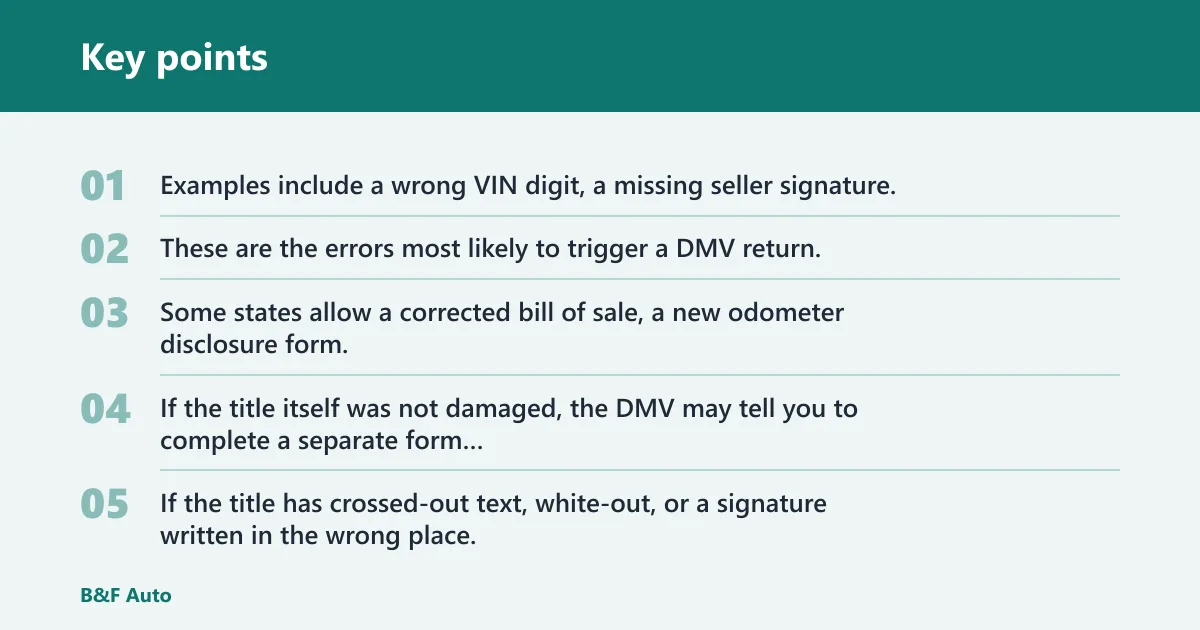
Examples include a wrong VIN digit, a missing seller signature, a signature in the wrong box, an altered odometer figure, or a name that does not match the ownership section. These are the errors most likely to trigger a DMV return.
When a correction is possible
Some states allow a corrected bill of sale, a new odometer disclosure form, or a notarized correction affidavit. If the title itself was not damaged, the DMV may tell you to complete a separate form instead of starting over. Ask before you guess.
When to start over with a replacement title
If the title has crossed-out text, white-out, or a signature written in the wrong place, a replacement title is often the cleaner fix. That is especially true if the title section itself is already filled in incorrectly. A new title is slower, but it can prevent a rejected filing.
Picture a title that has the correct buyer name but the wrong odometer number by one digit. That small error can matter more than a larger-looking sale-price mismatch, because mileage disclosure is one of the fields DMV staff compare closely against the title and any separate disclosure form.
Prevention is simple: complete the form in one sitting, compare each line against the vehicle and ID, and keep the bill of sale and lien release together before anyone signs.
What should you do after you complete the title transfer paperwork?
After the form is signed, gather the title, bill of sale, lien release, ID copies if your DMV wants them, and any state forms. Then submit the packet to the DMV or title office exactly as your state instructions say. If your state requires tax, inspection, or a separate application, include those items in the same visit.
Keep a photocopy or scan of every signed page before you hand anything over. If the DMV later questions a field, you will know exactly what was written and when. If the transfer is mailed, use the address and envelope type the DMV lists for title work.
Frequently asked questions
How do I fill out a transfer title without making a mistake?
Read the title from top to bottom before writing anything, then copy each field exactly as requested and compare every entry against the vehicle and IDs. Do not use white-out or cross-outs. If a field is wrong, ask the DMV whether a corrected form or replacement title is required.
What if the title has two owners on it?
Check the word between the names. “And” usually means both owners must sign, while “or” may allow one signer, depending on state rules. Use the names and order shown on the title. If one owner cannot sign, the DMV may require a replacement title or other proof.
Do I need a bill of sale and odometer disclosure too?
Often yes, but not always in the same form. The bill of sale records price and date, and the odometer disclosure may appear on the title or on a separate form. Some states require one or both for registration, so check the DMV instructions before the handoff.
What happens if I write the wrong information on the title?
Wrong VINs, names, signatures, or odometer entries can lead to a rejected transfer. Do not erase or alter the title. If the error is already there, ask the DMV whether the fix is a corrected form, a notarized correction, or a replacement title.
How do I know if a lien has to be released first?
Look for a lender name or lien notation on the title, then confirm whether the loan is paid off. If a lien is still listed, the lender must release its interest before a clean transfer. Do not sign over a title with an unresolved lien unless the DMV gives you the exact exception.