How Much Should You Save Before Buying Your First Car?
A common target is to save enough for 20% down, taxes, title, registration, dealer fees, insurance, and about $1,000 to $2,000 for the first 90 days. For a cheap used car, that can often mean roughly $4,000 to $8,000 before you buy. If you skip the buffer, repairs, fees, and insurance can push a cheap first car out of reach after you sign. This guide breaks down the upfront-cost formula and shows how to set a realistic cash target.
How much should you save for your first car?
Save for the car itself, then add the costs that show up before and right after purchase. A practical target is the price of the car, plus a down payment, plus taxes and registration, plus a pre-purchase inspection, plus the first insurance bill, plus a repair reserve, plus a 90-day cushion. The exact total depends on price, financing, and vehicle type.
Start with the car price you can afford
The easiest way to set a target is to work backward from the monthly payment you can handle. Experts recommend keeping total car-related costs below 20% of monthly take-home pay, and Chase says total monthly transportation costs should be below 15% of income. Use take-home pay, not gross pay, because that is the money available for the loan, insurance, fuel, and maintenance.
That monthly ceiling tells you what price range to shop in. Do not fixate on sticker price alone. A cheaper car can still cost more each month if it needs higher insurance or more repairs.
Add taxes, registration, and other upfront fees
Save more than the sticker price. Bimmer Mag says savings should include registration fees and taxes, and those charges vary by location and vehicle price. Title, plate, documentation, and other local fees can add another layer of cash needed before you can drive away legally.
For a used first car, those charges can be the difference between being able to buy and being stuck short at signing. If the seller quotes a low price, check the out-the-door total before you commit.
Set a 90-day cushion before you shop
The first 90 days are the danger period. Insurance bills may be due before the next pay cycle, small repairs can appear early, and routine items such as oil changes or tires may need attention sooner than expected. A cushion of $1,000 to $2,000 gives you room to absorb those costs without missing a payment.
Say your first car is a 10-year-old sedan that looks affordable on paper. If it needs a battery, an alignment, and a higher-than-expected insurance deposit in the first month, a small buffer keeps that problem from turning into a financial setback.
First-car savings worksheet
Use this worksheet to turn a car price into a cash target. The example numbers below are placeholders for planning, not a quote. Replace them with your own target price and local fees.
| Worksheet item | Example amount | How to set it |
|---|---|---|
| Target car price | $12,000 | Your shopping target before fees and financing |
| Down payment | $1,200 | 10% on a used car, or 20% on a new car |
| Estimated taxes and registration | $900 | Based on local rate, title, plates, and registration |
| Pre-purchase inspection | $150 | Independent check before you buy |
| First-month insurance | $200 | First premium, deposit, or down payment on the policy |
| Immediate maintenance buffer | $500 | Battery, tires, fluids, brake work, or other early repairs |
| 90-day emergency reserve | $1,500 | Room for the first three months of ownership |
| Recommended minimum cash goal | $4,450 | Down payment plus fees, inspection, insurance, and cushion |
| Safer goal range | $5,000 to $7,000 | More room for higher fees, higher insurance, or early repairs |
A simple formula works well:
cash goal = down payment + taxes and registration + inspection + first insurance payment + immediate maintenance buffer + 90-day emergency reserve
For a lower-priced used car, the cash goal can still land well above the sticker price if the buyer needs a meaningful buffer. That is normal. It is also safer than stretching to cover the car and ignoring the first 90 days.
How much should I put down on my first car?
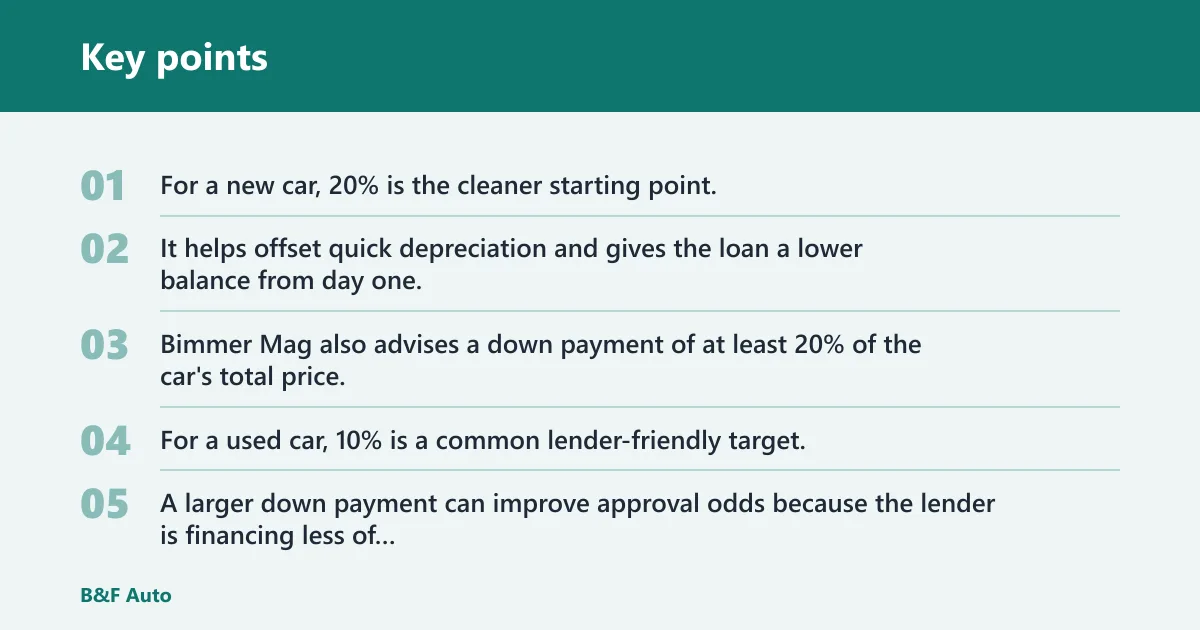
A common target is 20% for new cars and 10% for used cars. Chase notes a larger down payment, such as 20% for new vehicles, and 10% down for used cars as a lender-friendly target. A bigger down payment lowers the loan amount, reduces monthly payments, and can cut total interest charges over time.
New car down payment target
For a new car, 20% is the cleaner starting point. It helps offset quick depreciation and gives the loan a lower balance from day one. Bimmer Mag also advises a down payment of at least 20% of the car’s total price.
Used car down payment target
For a used car, 10% is a common lender-friendly target, though more can be better if the buyer wants a smaller loan. A larger down payment can improve approval odds because the lender is financing less of the vehicle value. It also leaves less interest to pay over the life of the loan.
How a larger down payment changes the loan
Suppose a $15,000 used car needs a 10% down payment. That means $1,500 upfront before taxes and fees. If the buyer puts down $3,000 instead, the loan is smaller, the monthly payment drops, and the total interest charged usually falls too. Shorter loan terms help as well; Chase recommends loan terms ideally under 60 months.
When paying cash can make sense
Paying cash can make sense if the buyer still keeps a real emergency cushion after the purchase. Do not drain savings just to avoid a loan. A cash purchase only works when there is enough left for insurance, maintenance, and the first 90 days of ownership.
What should your monthly car budget be?
Use take-home pay, not gross pay, and set a ceiling before shopping. Total transportation cost should include the loan payment, insurance, fuel, and maintenance, and experts recommend keeping total car-related costs below 20% of monthly take-home pay. The same source says some financial experts suggest keeping transportation costs below 15 percent.
Include loan payment, insurance, fuel, and maintenance
Monthly ownership costs are bigger than the loan payment alone. Insurance premium, fuel costs, and routine maintenance all belong in the budget because they continue after the sale. A cheap monthly payment can still produce an expensive car if the insurance rate is high or the car needs frequent repairs.
Vehicle type matters here. Sedans and hatchbacks often cost less to buy, insure, and maintain than larger vehicles such as many SUVs. New cars may bring a higher purchase price, while used cars may need a larger repair budget.
Set a monthly ceiling before shopping
Take monthly take-home pay and assign a ceiling to total transportation cost. If income after taxes is $3,000 a month, then 15% is $450 and 20% is $600. That ceiling has to cover everything tied to the car, not just the payment.
A common first-timer mistake is buying a car that fits the payment but breaks the rest of the budget. The result is simple: insurance, fuel, and upkeep squeeze out savings elsewhere.
Upfront costs to save

Save for more than the car price. Registration, taxes, title, inspection, and the first insurance bill can all hit before or just after delivery. These costs vary by state, county, insurer, and car value, so build them into the savings target rather than treating them as extras.
Taxes and registration by location
Sales tax and registration fees change by location and vehicle price. That makes them hard to guess from a listing alone. Ask for an out-the-door estimate and save for that figure, not the advertised price.
Title, plate, and documentation fees
Title transfer, plate issuance, and documentation charges are part of the upfront cash need. They are usually smaller than the down payment, but they still matter when savings are tight. If a dealer quote does not list them clearly, ask for the full breakdown.
Pre-purchase inspection costs
A pre-purchase inspection is a small expense that can prevent a much larger one. It is especially useful for used cars, where repair risk is higher and the history may be incomplete. Budget for it even when the car looks clean.
First insurance payment or deposit
Insurance is both an upfront and recurring cost. Some buyers must pay the first premium or a deposit before taking the car home, especially if the policy starts at purchase. Insurance premiums also vary by vehicle age, value, and buyer profile, so get a real quote before setting the savings target.
Used car checks before you buy
Used car history checks reduce risk before money changes hands. CCPC advises checking for outstanding finance, crash history, and correct mileage. Those checks, paired with a mechanic inspection, help you avoid a car that looks cheap but comes with hidden problems.
Crash history and title status
CCPC says to check whether the car has ever been crashed. That matters because prior damage can affect safety, value, and repair needs. Title status also matters; a car with a problem title can create legal and financing trouble after purchase.
Mileage and odometer consistency
The same source says to check if the mileage is correct. Compare the odometer reading with the service record, listing, and vehicle history report if available. A mismatch is a warning sign and should slow the deal down, not speed it up.
Outstanding finance or lien checks
CCPC advises checking for outstanding finance before buying. A lien can prevent a clean transfer of ownership. Never assume the seller has cleared it just because the car is listed for sale.
Why a mechanic inspection matters
A mechanic inspection can reveal wear that a short test drive will miss. Brakes, suspension parts, tires, leaks, and cooling-system problems can all affect your first 90 days of ownership. That inspection should be part of the budget, not something you skip to save a small amount of cash.
How should your emergency cushion work?
Your emergency cushion should cover the first 90 days after purchase. That is the period when insurance billing, registration follow-up, small repairs, and routine maintenance are most likely to appear. A cushion of $1,000 to $2,000 is a practical minimum for many first-time buyers.
Why the first 90 days are the risk window
The first 90 days are risky because the buyer is still learning the car’s condition and real running costs. If the car needs an unexpected repair right after purchase, a cushion prevents the loan payment from colliding with a surprise bill. That is especially important for used cars.
What to cover if repairs show up early
Use the cushion for fast-moving costs: tire repair, battery replacement, brake work, an alignment, fluid service, or another issue found after purchase. Immediate maintenance buffer and emergency reserve are not the same thing. The buffer handles near-term repair needs; the reserve keeps you stable for the first quarter of ownership.
How much to keep after the purchase
Keep enough cash after signing to cover one insurance cycle, routine upkeep, and a repair that is annoying but not rare. If buying a cheaper used car leaves no money behind, the deal is too tight. A safer plan is to buy a slightly less expensive car or wait longer and save more.
Frequently asked questions
How much should I save to buy my first car?
For many first-time buyers, a realistic starting point is the car price plus 20% down for a new car or 10% down for a used car, plus taxes, registration, inspection, insurance, and a 90-day reserve. For a lower-priced used car, that often lands between $4,000 and $8,000.
How much should I spend on my first car?
Base the spending limit on monthly take-home pay and total transportation cost, not just the sticker price. Experts recommend keeping total car-related costs below 20% of monthly take-home pay, and Chase says some financial experts suggest staying below 15 percent. That ceiling should include loan payment, insurance, fuel, and maintenance.
How much do I need saved for taxes, fees, and registration?
Save more than the vehicle price because taxes, registration, title, plate, and documentation fees can add a meaningful amount at purchase. The same source says savings should include registration fees and taxes. The exact number depends on where you register the car and how the local tax is calculated.
How much should I keep aside for insurance and maintenance?
Keep enough for the first insurance payment or deposit, plus a maintenance reserve for early upkeep. Insurance varies by vehicle age, value, and buyer profile, while routine maintenance can include oil changes, tires, inspections, and normal wear items. Used cars usually need a larger early repair buffer than newer ones.
How big should my emergency cushion be after buying a first car?
That cushion helps cover early repairs, insurance timing, or routine maintenance that appears soon after purchase. If the car is older or the budget is tight, a larger cushion is safer before you sign.