How Does a Car Title Transfer Work?
A car title transfer works when the seller signs the title, the buyer completes the required forms, and the DMV accepts the paperwork. Some states may also require a notary, lien release, odometer disclosure, or bill of sale for title transfer. Miss a signature or deadline, and you can delay registration, trigger fees, or leave liability attached to the wrong person. This guide covers who must sign, what can stop DMV approval, and how to close the handoff without an ownership gap.
Title transfer decision table
| Scenario | Required documents | Who signs | Where it is filed | Likely blockers | First fix |
|---|---|---|---|---|---|
| Private sale | Original title, bill of sale, odometer disclosure, ID, state transfer form | Seller signs over title; buyer signs application and related forms | DMV or vehicle registry | Missing signature, wrong mileage, unpaid lien, damaged title | Get the seller to correct the title or request a duplicate title |
| Dealer purchase | Title paperwork from dealer, buyer application, odometer disclosure, fees | Dealer signs dealer assignment; buyer signs purchase and registration forms | DMV or vehicle registry, sometimes handled by dealer | Missing dealer paperwork, title in transit, unpaid fees | Ask the dealer which filing step is still open |
| Family gift | Title, gift affidavit or gift statement if required, ID, transfer form | Giver signs as seller or donor; recipient signs buyer section | DMV or vehicle registry | State gift form missing, value not declared as required, bad signature placement | Use the state gift form and confirm the tax treatment before filing |
| Inherited car | Title, death certificate, probate or inheritance papers if needed, transfer form | Executor, administrator, or heir signs as allowed by the estate process | DMV or vehicle registry, sometimes after probate court steps | Estate not settled, no death certificate, title still in deceased owner’s name only | Ask the registry which estate document it needs before transfer |
| Out-of-state car | Out-of-state title, bill of sale, odometer disclosure, inspection or emissions proof, state form | Seller signs title; buyer signs local application and tax forms | DMV or vehicle registry in the new state | VIN mismatch, inspection not current, missing prior-state title release | Match the VIN on every paper and complete local inspection first |
| Financed car | Title, lien release, payoff confirmation, transfer form, buyer or seller ID | Owner signs; lender releases lien when loan is paid | DMV or vehicle registry after lien release is available | No lien release, lender still listed, payoff not posted | Wait for the lender’s release or request the correct release document |
| Title with co-owner | Title, transfer form, possible notarization, lien release if needed | One or both co-owners sign depending on “and” or “or” wording and state rules | DMV or vehicle registry | Wrong owner signs, one signature missing, signature placed in the wrong section | Check the exact title wording before anyone signs |
What documents do you need?
You usually need the vehicle title, a bill of sale, an odometer disclosure, and your state’s transfer form. Add a lien release if the car had a loan. Some states also want your ID, a notarized signature, inspection or emissions proof, and payment for taxes and filing fees.
Title, bill of sale, and odometer disclosure
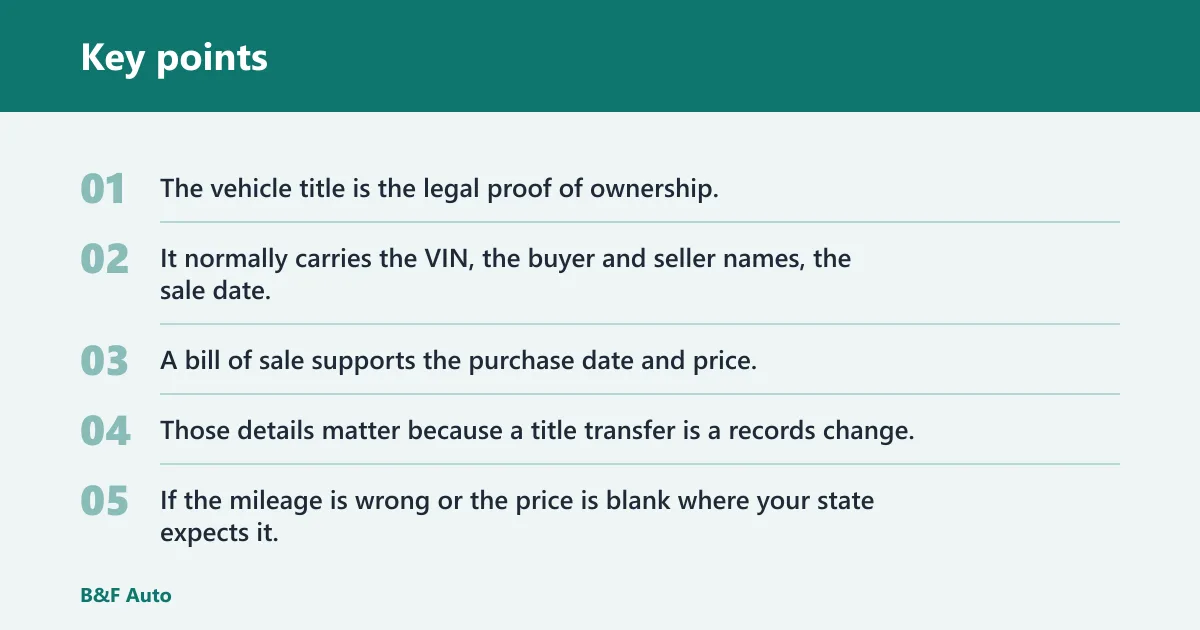
The vehicle title is the legal proof of ownership. It normally carries the VIN, the buyer and seller names, the sale date, the odometer reading, and the price. A bill of sale supports the purchase date and price, and the odometer disclosure records mileage so the paperwork matches the car.
Those details matter because a title transfer is a records change, not just a handoff of keys. If the mileage is wrong or the price is blank where your state expects it, the DMV can reject the filing.
Lien release if the car had a loan
If a lender had a security interest, the title transfer needs proof that the loan is paid off. That proof is the lien release. Without it, the title still shows a lender claim, and the registry may not clear the ownership change.
Do not assume the payoff alone is enough. Some lenders send a separate release letter, and some states want the original lien release with the title packet.
ID, application form, and any state fees
The buyer usually needs a state application, a government ID, and payment for transfer taxes or filing fees. The seller may also need to sign a state-specific transfer section. Some states require in-person filing, while others accept mailed paperwork or limited online steps.
That is one reason the title transfer process is essentially the same in general, but the filing details are not. The core handoff stays the same; the state form set changes.
Extra papers your state may ask
State-specific transfer requirements can include inspection, emissions, plate handling, or extra forms. A notary public may need to witness signatures in states that require notarization. In some transfer or refinance situations, a limited power of attorney is used, and some states accept faxed POA documents while others require the original.
Check the DMV website or vehicle registry rules before you sign. That office controls the filing, and it may require a single visit, a mailing, or a specific order for each document.
How does the signing work?
The signing works when each person signs the correct section of the title and any required state forms. The seller signs to transfer ownership, the buyer signs to accept it, and a notary signs only where the state requires it. Co-owner wording can change who must sign.
Where the seller signs
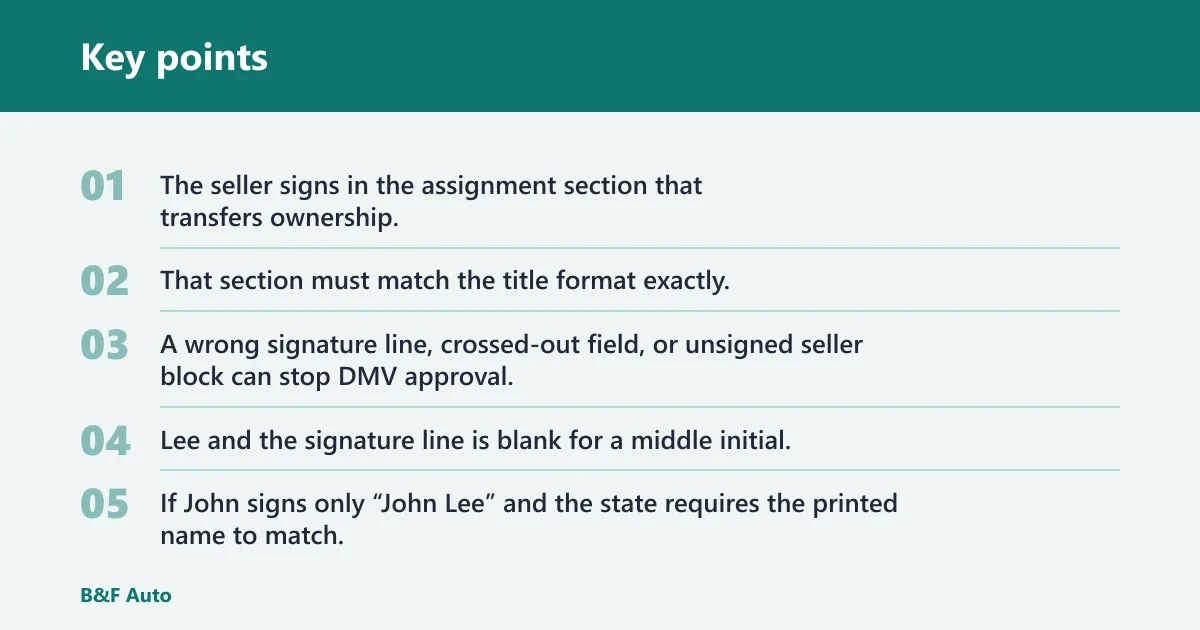
The seller signs in the assignment section that transfers ownership. That section must match the title format exactly. A wrong signature line, crossed-out field, or unsigned seller block can stop DMV approval.
Suppose the title says the seller is John M. Lee and the signature line is blank for a middle initial. If John signs only “John Lee” and the state requires the printed name to match, the clerk may ask for a corrected title or a new signature page.
Where the buyer signs
The buyer usually signs the application or buyer section, not the seller’s assignment line. The buyer also confirms the odometer disclosure and, in some states, the tax or fee form. If the buyer signs in the wrong place, the filing can be voided or sent back.
A common mistake is thinking a signed title by itself completes the transfer, even though the buyer still needs the proper paperwork filed with the state. The title starts the transfer, but the buyer’s form set often finishes it.
When notarization is required
Some states require notarized signatures for title transfer paperwork. Notarization verifies identity and witnessing. If the notary block is missing in a state that needs it, the DMV will usually reject the filing until the signatures are properly witnessed.
Bring ID for the signer and do not sign early if the notary must watch the signature. A notarized form signed at home may not count where live witnessing is required.
How to handle a co-owner name
Co-owner signature rules depend on how the names are printed on the title. The scoopmeadow article says both owners must usually sign if the title shows “and.” It also says either owner may sign if the title shows “or.”
That wording is not decorative. It changes who can authorize the transfer. If one co-owner is unavailable and the title wording needs both signatures, the filing may stall until the missing owner signs or a state-approved POA is accepted.
When can title transfer fail?
Title transfer can fail when the title, signatures, mileage, or supporting papers do not match the registry’s rules. Common rejection points are wrong names, missing lien releases, damaged titles, and forms signed in the wrong section. A rejected filing does not always mean starting over, but it does mean fixing the defect first.
Wrong name, date, or mileage
WikiHow lists names, signatures, sale date, price, VIN, and odometer as common transfer details. If any of those are wrong, the paperwork can be sent back. The seller name on the title should match the signer, and the odometer disclosure should reflect the car’s actual reading.
Match every number before anyone signs. VIN, date, and mileage should agree across the title, bill of sale, and transfer form.
Missing or late lien release
A lien release is a common blocker when the car was financed. The scoopmeadow article says a private sale buyer usually needs the signed original title and lien release documentation. If the release is missing, the DMV may not accept the ownership change even if the sale is otherwise complete.
Picture a buyer who has the signed title and cash receipt but no release from the lender. The title still shows the loan interest, so the registry can pause the transfer until the release arrives.
Damaged title or crossed-out fields
A damaged or altered title can be a problem because registries need a clean assignment trail. If the seller does not have the original title, wikiHow advises checking for a duplicate title. Crossed-out fields, erasures, or blank areas can also trigger rejection.
Do not guess at corrections. Ask the DMV whether a replacement title or a corrected assignment is the proper fix.
State filing rejected by the DMV
The transfer is filed as a change of owner or operator on the vehicle register, and one registry visit can complete it in some places. But if the office finds a mismatch, it can reject the packet. That usually means the transfer is not complete yet, so liability and registration can still be unsettled.
Keep a copy of everything you submit. If the filing is rejected, the copy helps you correct only the failed item instead of rebuilding the packet from scratch.
How do you handle a special case?
Special cases need the same core documents plus the document that explains why the title is changing hands. Marketplace sales, gifts, inheritances, and lender-linked titles all follow the same ownership logic, but each one adds a different proof step. Do not assume the seller-signs-buyer-files pattern covers every situation.
Marketplace private sale
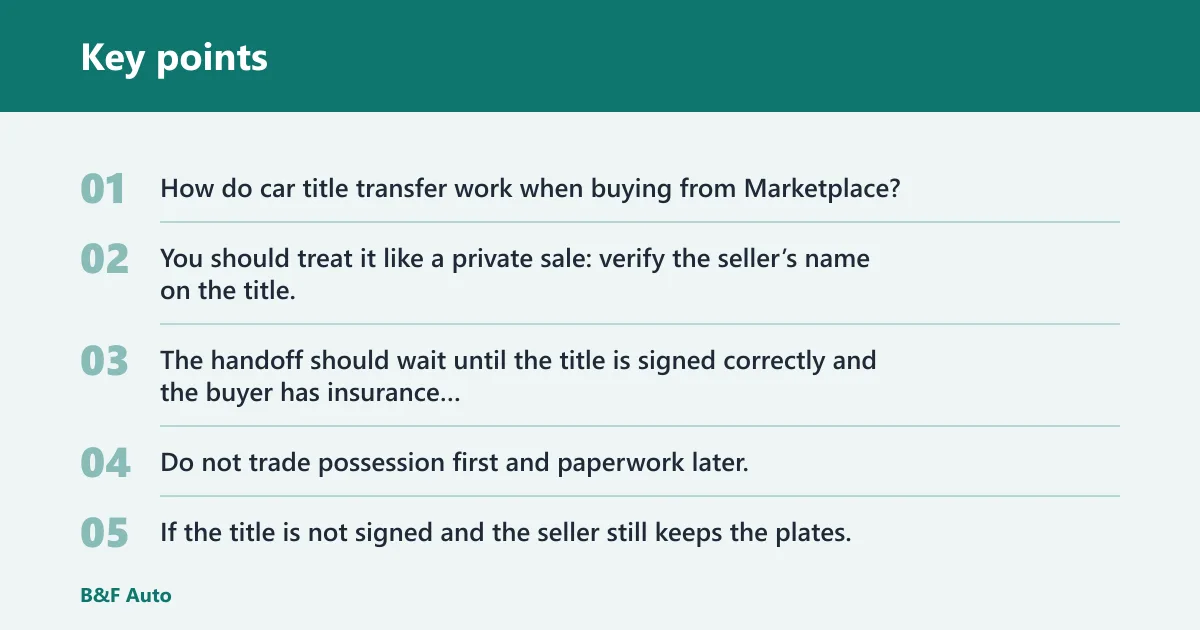
How do car title transfer work when buying from Marketplace? You should treat it like a private sale: verify the seller’s name on the title, compare the VIN to the car, confirm the odometer reading, and get a bill of sale. The handoff should wait until the title is signed correctly and the buyer has insurance arranged.
Do not trade possession first and paperwork later. If the title is not signed and the seller still keeps the plates, liability can remain tangled after the car leaves the driveway.
Gift to a family member
How do you sign over a car title as a gift? The owner signs the title transfer section and may need a state gift form or affidavit. The recipient usually still files a transfer packet, even if no sale price changes hands. Some states still want tax-related disclosure for a gift transfer.
Use the state’s gift wording if it exists. A missing gift form can make the DMV treat the transfer like a sale and ask for different tax documents.
Inherited vehicle
What do you need to transfer a car title? For an inherited car, you may need the title, a death certificate, and estate papers if the vehicle passed through probate. The scoopmeadow article says inheriting a vehicle may require a death certificate. The registry may also need the executor or heir to sign the transfer forms.
Do not sign as if the deceased owner were still available. The estate process controls who can act for the vehicle.
Car with a lender or co-owner
What happens if there is a lien on the car title? The lender must release its interest before the title can clear, unless the state has a specific payoff workflow. What happens if the title has two owners? Then the exact wording on the title decides whether one or both owners must sign, and the DMV may also ask for notarization or a POA.
Capital One says all owners listed on the title must sign a POA for it to be valid, and some states accept fax for POA while others require the original. That matters when one signer cannot appear in person.
Can you transfer a title online?
Can I do car title transfer online? Sometimes, but only where your state allows it and only for the parts the state has digitized. Many states still require an office visit, mailed originals, a notary, or an in-person inspection for certain transfers. Online tools do not replace state rules.
When online filing is allowed
Some states let you start the transfer online, pay fees, or upload part of the paperwork. That can cut down on office time, but it does not always finish the transfer. The DMV may still need original signatures, a lien release, or a title with notarized blocks completed.
When you still need an office visit
You usually still need a visit when the title has a lien, the seller’s signature must be notarized, the title is damaged, or the state needs identity verification. An inherited title or out-of-state vehicle can also require an in-person check if the registry wants to inspect the papers or the car.
What states often keep in person
Many states keep in-person steps for title transfers that involve inspections, emissions, lien releases, or estate documents. That is also common when the filing must be signed before a clerk or notary. The safest rule is simple: if the state wants the original, plan for a visit.
What happens after the handoff?
The handoff is not finished when the keys change hands. Ownership, plates, insurance, and possession should change in a controlled order so the wrong person is not left responsible for tickets, crashes, or registration problems. Keep the paper trail aligned with the physical handoff.
Keys, plates, and possession timing
Transfer possession when the title is signed, the paperwork is exchanged, and the parties agree on when the car leaves the seller’s control. In many private sales, the buyer gets the keys at signing, but the plates often stay with the seller unless the state rules say otherwise. Keep the car parked until the transfer package is complete if the state requires it.
If the seller keeps the plates, the buyer should not drive away until temporary tags or insurance are in place where required. That avoids a gap between possession and lawful registration.
Insurance and registration changes
Buyer insurance should be active before driving the car home. Seller insurance should not stay attached to a car that is no longer in the seller’s control. Registration follows the DMV acceptance of the title transfer, not the handshake.
That timing matters because the DMV filing is the step that finalizes ownership change. Until then, the title handoff is still in process.
Keep copies for your records
Keep a copy of the signed title, bill of sale, odometer disclosure, lien release, and the filed application. If the DMV later questions the transfer date or signature, those copies help show what was submitted and when. They also help if the title was damaged or a duplicate must be requested later.
Frequently asked questions
How does a car title transfer work?
A title transfer works when the seller signs the title, the buyer signs the required state forms, and the DMV accepts the filing. Some transfers also need a lien release, odometer disclosure, bill of sale, or notarized signature. The exact packet depends on state rules and the deal type.
How do car title transfer work when buying from Marketplace?
For a Marketplace private sale, verify the seller’s name, VIN, mileage, and title status before paying. Get the signed original title, a bill of sale, and any lien release if needed. Do not take possession as a shortcut around filing; the DMV still has to accept the transfer.
How does car ownership transfer work?
Ownership transfers when the legal title changes hands and the state office records the change. The title is the proof of ownership, but the registry filing is what closes the loop. If the paperwork is incomplete, ownership and liability can remain split until the defect is fixed.
How does title transfer work when selling a car?
As a seller, you sign the assignment section, give the buyer the documents the state requires, and keep copies of what you handed over. If the car has a lien, include the release. If the state wants notarization or plate return, follow that step before you hand off the car.
What happens if the title has two owners?
If the title has two owners, the signature rule depends on how the names are written. The scoopmeadow article says “and” usually means both must sign, while “or” usually lets either owner sign. Always check the exact wording before the sale or gift.
What happens if there is a lien on the car title?
If there is a lien, the lender’s interest has to be cleared before the title can transfer cleanly. That usually means waiting for a lien release after payoff. If the release is missing, the DMV may reject the filing even if the buyer and seller already signed the rest of the forms.