Can You Trade in a Financed Car with a Loan Balance?
Yes, you can trade in a financed car with a loan balance. The dealer pays the lender, and any difference between the payoff and the trade-in value becomes equity or negative equity. If the payoff figure is off, you can roll debt into the next loan or wait on title release delays. This guide covers payoff quotes, equity checks, and the paperwork order.
How dealers handle your existing loan payoff
Yes. You do not need to own the car free and clear to trade it in. In a normal dealer trade, the dealer pays off your loan, applies any equity to the next purchase, and handles the old loan paperwork as part of the sale.
That part is simple. The timing is not. The balance shown in your lender app often differs from the amount needed to close the loan on the day the dealer sends payment.
What the dealer does with your old loan
The dealer usually sends payoff funds directly to your lender at closing. The lender then closes the account and releases the lien after the payoff clears. That lien release is what lets the title move cleanly.
Until the lender accepts the payoff and processes the release, the loan still matters. A dealer can finish the sale before the title is fully free, but the payoff and title trail still need follow-up.
Why you do not need to pay it off first
You can trade in before the loan is paid off because the dealer can settle the balance for you. That is the standard dealer workflow. The key is using the payoff quote, not the app balance, as the number in the deal.
Say your lender app shows $12,400 owed, but the payoff quote is $12,515 because interest keeps running through a specific date. If the dealer sends the lower number, the loan may not close cleanly and a small balance can remain.
Payoff vs. balance: what changes
The balance in your account and the lender payoff amount are often different. The payoff amount is the figure that closes the loan on a stated date, and it can include interest through that payoff date. The quote can expire if the dealer pays after that date.
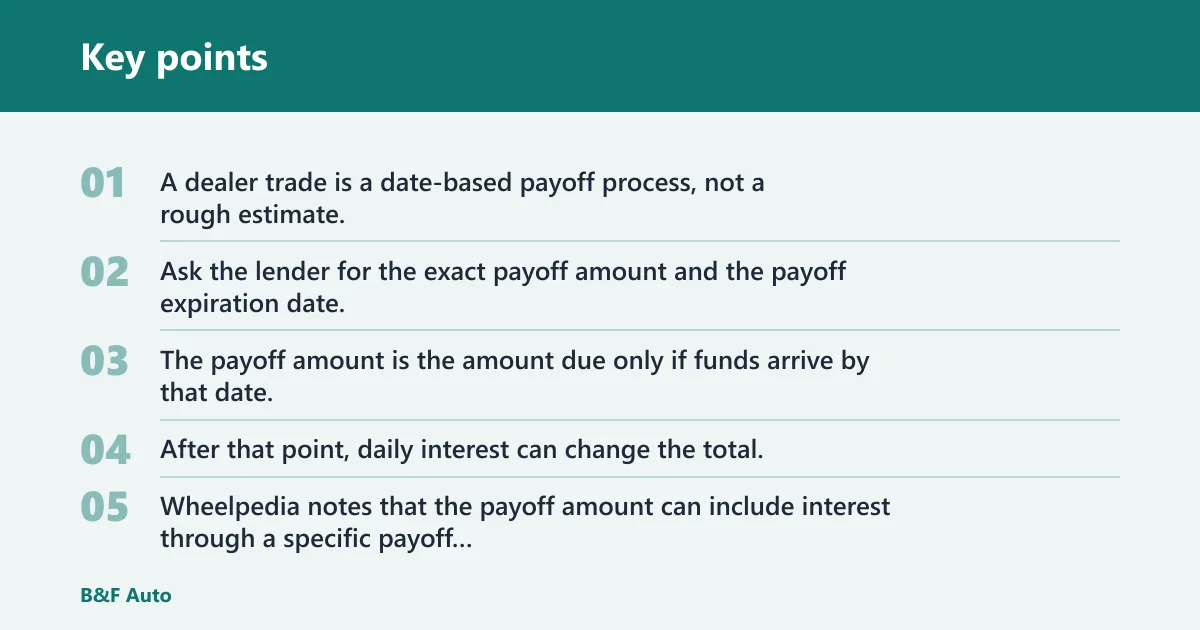
That is why a fresh payoff quote matters. A dealer trade is a date-based payoff process, not a rough estimate.
Payoff amount and payoff expiration date
Ask the lender for the exact payoff amount and the payoff expiration date. The payoff amount is the amount due only if funds arrive by that date. After that point, daily interest can change the total.
Wheelpedia notes that the payoff amount can include interest through a specific payoff date. That detail matters because a quote that is valid today may be short by the time the dealer’s payment posts.
Per-day interest and why timing matters
Also ask for the per-day interest amount. If the dealer pays after the payoff date, the lender may add one or more days of interest. That small number can leave a residual balance and delay the lien release.
A common first-timer mistake is assuming the app balance is “close enough.” It is not always close enough for a dealer payoff. Even a small daily interest charge can matter if the quote expires during the weekend.
Why the app balance can be too low
The app balance often reflects the loan principal and accrued interest up to the last update, not the exact settlement amount for a future closing date. It may also miss a per-day interest charge, fee timing, or a payoff window that has already expired.
Use the payoff quote as the closing number. Use the app balance only as a rough starting point.
Positive equity and negative equity
Trade-in value and payoff amount decide whether you have positive equity or negative equity. If the trade-in value is higher than the payoff, the difference is positive equity. If the payoff is higher, the shortfall is negative equity.
That gap changes the next deal. It can lower what you finance, or it can raise it.
When trade-in value is higher than payoff
Positive equity means the dealer’s offer exceeds the lender payoff. The extra amount becomes credit toward the next purchase or can act like a down payment. In that situation, the amount financed on the new vehicle drops.
For example, a trade-in with $5,000 value and $2,000 owed leaves $3,000 equity. That $3,000 reduces what you need to borrow on the next car.
When payoff is higher than trade-in value
Negative equity means the loan payoff is larger than the trade-in allowance. You can pay the difference upfront, bring cash to cover the shortfall, or roll the amount into the new loan if the lender approves.
For example, a vehicle with $1,000 value and $2,000 owed creates a $1,000 gap. That gap does not disappear. It must be handled in the deal.
How rolled negative equity changes amount financed
If the lender allows it, the unpaid gap gets added to the new loan principal. That increases the amount financed, which can raise the monthly payment and total interest cost over time. It can also make the loan harder to escape if the next car loses value quickly.
Rolling negative equity is a financing choice, not free money. It only makes sense when the payment increase is manageable and the car deal is otherwise strong.
What paperwork the dealer needs
The dealer needs the payoff details, the lender’s payment instructions, and the title status before closing. Exact paperwork cuts the chance of a leftover balance or a title delay after the sale.
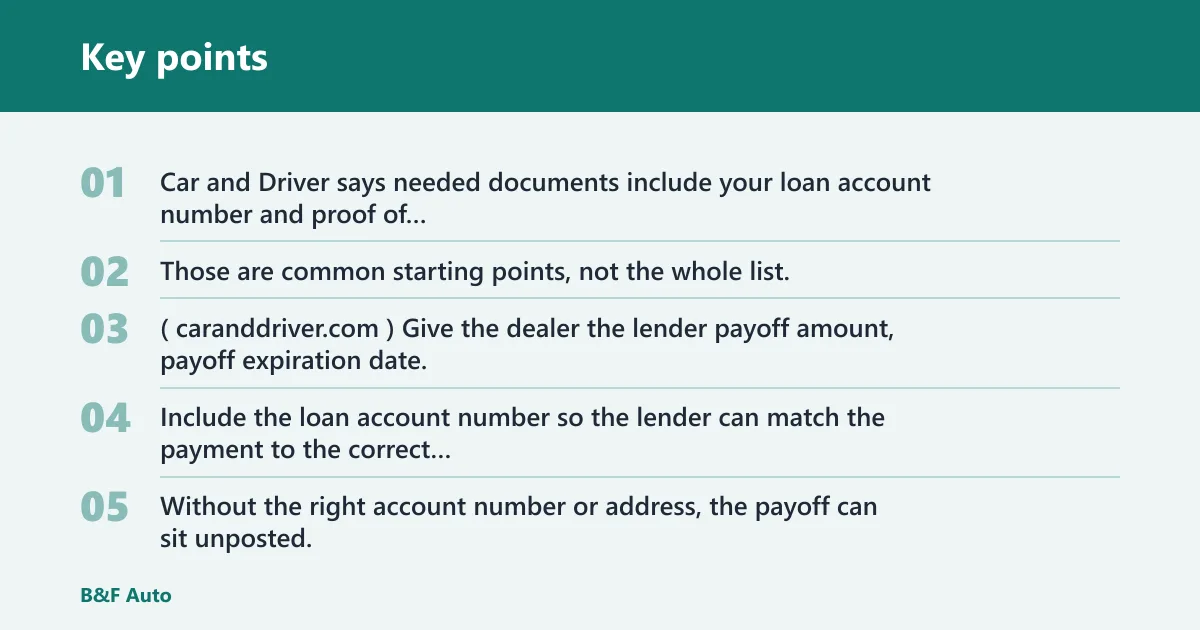
Car and Driver says needed documents include your loan account number and proof of insurance. Those are common starting points, not the whole list. (Caranddriver)
Payoff amount, lender payoff address, and account number
Give the dealer the lender payoff amount, payoff expiration date, and the payoff address or payment instructions. Include the loan account number so the lender can match the payment to the correct account.
Without the right account number or address, the payoff can sit unposted. That can hold up the release even if the dealer sent the money.
Title and lien status
Ask whether the title is held by the lender and whether a lien is recorded. A lien is the lender’s legal claim on the vehicle until the loan is paid. If a lien is active, the lender must release it after payoff before the title transfer is complete.
Jointly titled cars can add a second layer. If two names are on the title, both owners may need to sign trade-in paperwork. If there is a co-signer only on the loan, the lender may still need both borrowers’ information for payoff and release.
Trade-in allowance and signed payoff authorization
Make sure you know the dealer’s trade-in allowance, not just the payoff number. The allowance is the dealer’s value for the car, adjusted for condition and mileage. It can differ from a private-party value because the dealer is pricing a wholesale resale path.
Also sign the payoff authorization the dealer needs to contact the lender and send funds directly. That document gives the dealer permission to complete the payoff workflow on your behalf.
What happens to sales tax?
In many states, trade-in credit reduces the taxable amount on the next purchase. That means sales tax may be charged on the difference between the new vehicle price and the trade-in allowance, not on the full price. State rules control this, not your loan balance.
Private sales work differently. A private sale usually does not give you the same tax treatment as a dealer trade-in, even if the numbers are similar.
How trade-in credit works in many states
If your state allows trade-in credit, the dealer subtracts the trade-in allowance from the taxable purchase price. That can lower the tax due at signing. The loan payoff itself does not create the tax credit; the trade-in allowance does.
That separation matters. A financed car can still qualify for a trade-in tax benefit if the state allows it and the dealer documents the allowance correctly.
Why private sales are different
Private-party sale proceeds go to you, not through a dealer trade structure. That means the tax treatment may be different or unavailable. It also means you have to collect the sale price, pay off the lender yourself, and make sure the lien gets released.
Trade-in is often more convenient than private sale. It is also simpler when the title is tied to a lender and the dealer is already handling the payoff paperwork.
Trade-in payoff checklist
This checklist keeps the payoff and title process in order before you visit the dealer. Get every item from the lender or dealer before signing, and confirm the payoff posts after the sale.
| Document or number needed | Where to get it | Why it matters | Common mistake |
|---|---|---|---|
| Payoff amount | Lender payoff statement or account portal | Shows the exact amount needed to close the loan by the stated date | Using the app balance instead of the payoff quote |
| Payoff expiration date | Payoff quote from the lender | Sets the date the quoted amount stays valid | Letting the quote expire before the dealer sends payment |
| Per-day interest | Lender payoff quote or customer service | Shows how much the payoff grows after the quoted date | Ignoring one or more extra days of interest |
| Lender payoff address | Lender payoff instructions | Tells the dealer where to send the funds | Using the regular mailing address instead of the payoff address |
| Account number | Loan statement or lender portal | Matches the payment to the correct loan | Leaving off a digit or using the wrong account |
| Trade-in allowance | Dealer appraisal and purchase order | Shows the amount credited for the vehicle | Mixing up dealer allowance with private-party value |
| Title and lien status | Lender, DMV record, or title paperwork | Shows whether the lender must release a lien before title transfer is complete | Assuming the title is already clear |
| Confirmation steps after signing | Dealer payoff receipt and lender account update | Verifies the old loan is closed and the title release is moving | Stopping after the sale without checking for a posted payoff |
Should you roll negative equity into the next loan?
Only if the payment increase and extra interest are acceptable. Rolling negative equity raises the new amount financed, so the next loan starts larger than the car’s price alone would suggest. That can make sense in a limited number of deals, but it is easy to overpay for the next vehicle.
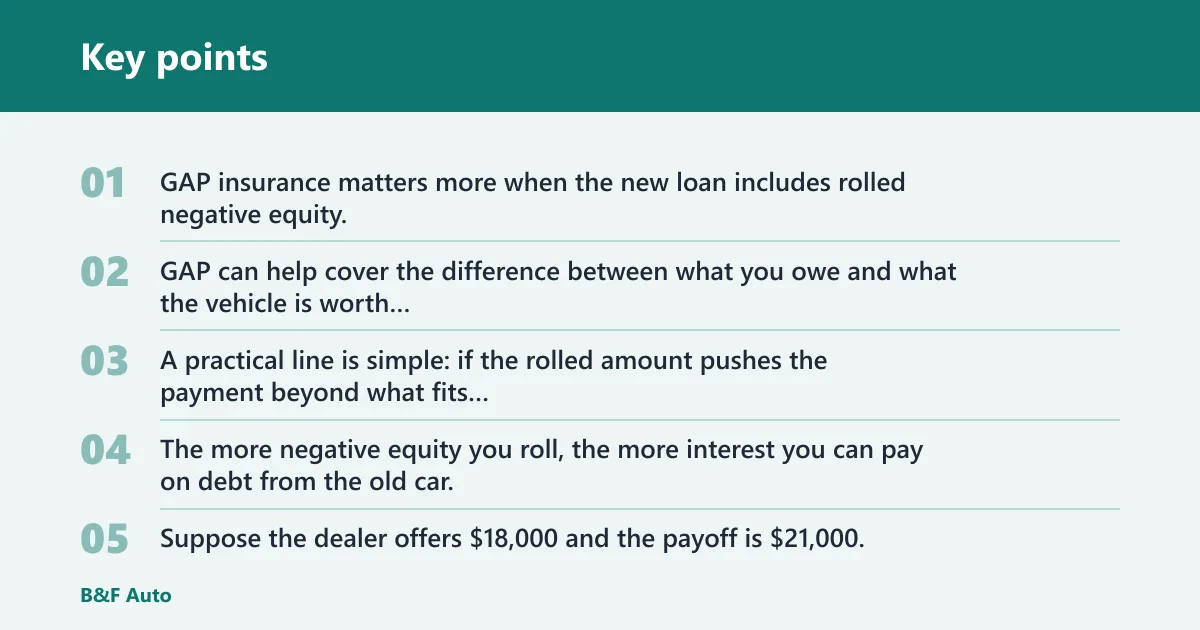
GAP insurance matters more when the new loan includes rolled negative equity, because the value gap after a total loss can be larger. GAP can help cover the difference between what you owe and what the vehicle is worth after a covered loss, but it does not make the larger loan a good deal by itself.
When the extra balance gets expensive
A practical line is simple: if the rolled amount pushes the payment beyond what fits your budget, or if it extends the loan far past the car’s strongest value years, the extra balance is expensive. The more negative equity you roll, the more interest you can pay on debt from the old car.
Suppose the dealer offers $18,000 and the payoff is $21,000. Rolling the $3,000 gap into a new loan may be manageable on paper, but it also means the next loan starts underwater.
When paying the shortfall upfront is cleaner
Paying the shortfall upfront is cleaner when the gap is small enough to absorb without stress. It keeps the next loan smaller, reduces interest, and avoids carrying old debt into a new vehicle. That is often the cleaner choice when the new car is already at the top of the budget.
Car and Driver notes that the dealer can roll what you owe into the new car loan. That option exists, but it should be weighed against the payment and total cost, not treated as automatic relief.
What happens after the dealer pays off the loan?
After the dealer sends the payoff, the lender should close the account and release the lien. The title transfer can lag behind the sale, so do not assume the process is finished the same day the keys change hands.
That lag is normal. What is not normal is silence for too long without a payoff update.
Lien release timing
The lien release may take days or longer, depending on the lender and title system. If the account shows closed but the title has not been released, follow up with the lender and dealer until the lien status updates.
Keep the payoff receipt and any dealer confirmation. Those records help if the title release stalls.
How to verify the account closes
Check the lender account after the dealer says the payoff was sent. Confirm that the amount posted matches the payoff quote, that no extra interest was added, and that the account shows zero or closed status as expected.
Car and Driver says you may have about a month before the first payment is due on the next loan. Use that window to confirm the old account closed cleanly and the new contract numbers match the trade-in credit.
What to do if a small balance remains
If a small residual balance remains, pay it right away. Small differences can come from expired payoff quotes, extra per-day interest, or a posting delay. A tiny leftover amount can still block full closure and title release.
Do not assume the dealer will spot the difference automatically. Ask for written confirmation of the final payoff and keep checking until the lien is released.
Frequently asked questions
Can you trade in a financed car with a loan balance?
Yes. The dealer usually pays off the existing loan at closing, so you can trade in a financed car before it is paid off. The key is matching the lender payoff amount to the dealer transaction and confirming that any equity or shortfall is handled in the deal.
What happens to the loan balance when you trade in a financed car?
The balance is paid off with the dealer’s payoff funds, but the payoff amount may differ from the app balance. If the trade-in is worth more than the payoff, the extra becomes credit. If the payoff is higher, the remaining amount becomes negative equity.
Do you need to pay off the loan before trading in a car?
No. You can trade in a car with an active loan, and the dealer will typically pay the lender directly. Paying it off first is optional, not required, unless you want to avoid dealing with payoff timing, title follow-up, or a potential shortfall.
What if you owe more on the car than it’s worth?
That is negative equity. You can pay the difference upfront, cover it with cash, or roll it into the new loan if the lender approves. Rolling it forward raises the amount financed and can increase both the payment and total interest cost.
Should you trade in or sell privately if you still owe money?
Trade-in is usually simpler because the dealer handles the payoff and title paperwork. A private sale may bring a higher price, but you must collect enough to satisfy the lender and manage the lien release yourself. The better choice depends on the payoff gap and your tolerance for extra steps.
Can the dealer roll negative equity into a new loan?
Often yes, if the lender approves. The dealer can add the unpaid balance to the new amount financed. That can make the deal easier to close, but it also increases the new loan size, which can raise your payment and make GAP insurance more relevant.