Printable Used Car Inspection Checklist for a Private Sale
Use a printable used car inspection checklist that starts with about 5 walk-away checks: title/VIN mismatch, warning lights that stay on, heavy fresh engine oil or coolant leaks, frame or flood damage, and no-start or overheating. Miss those and you can buy a car with hidden damage, title problems, or repair bills that wipe out any private-sale savings. This guide gives you a private-sale-first checklist, a timed inspection sequence, and clear points for continue, negotiate, or leave.
How to use the checklist at a private sale
A solid private-sale checklist should front-load the fastest failure points, then move through paperwork, body, fluids, tires, underbody, and a short road test. That order helps you avoid spending time on a car that already fails on title, flood, frame, or warning-light issues. It also keeps the decision simple: continue, negotiate, or leave.
What should you bring to inspect a used car?
Bring a flashlight, a phone or camera for photos, a notebook, a tire tread gauge if you have one, disposable gloves, and a rag or paper towel. A printed sheet works better than a phone alone because you can mark pass/fail fast, compare the VIN on the car with the title, and keep notes while you walk around.
A printable one-page checklist is most useful when it has a simple pass/fail path, room for notes, and a final verdict line. That format makes it easier to capture title photos, VIN photos, and the vehicle history report in one place before money changes hands.
How much time should you budget for the inspection and road test?
Plan about 30 minutes for the inspection plus a common rule of thumb is a 15 to 20 minute test drive. If the seller only allows a short stop, spend the first minutes on the quick fail gates and paperwork. If those checks pass, keep going. If they do not, leave.
Can I use a used car inspection checklist on my phone instead of printing it?
A phone can work as a backup, but it is weaker than a printed sheet for a private sale. Printing gives you a clean one-page decision path, room for notes, and a physical record of the VIN, title, and pass/fail calls. Use the phone for photos and the report, not as the only checklist.
How do you check paperwork and VIN before buying a used car?
Start with the paperwork before you inspect the body. A private sale needs more than a glance at the hood badge. Match the VIN on the car and documents, confirm the title status, and make sure the seller can prove they have the right to sell it. NHTSA and state DMV title pages are the right place to verify VIN and ownership basics.
How do you match the VIN in three places?
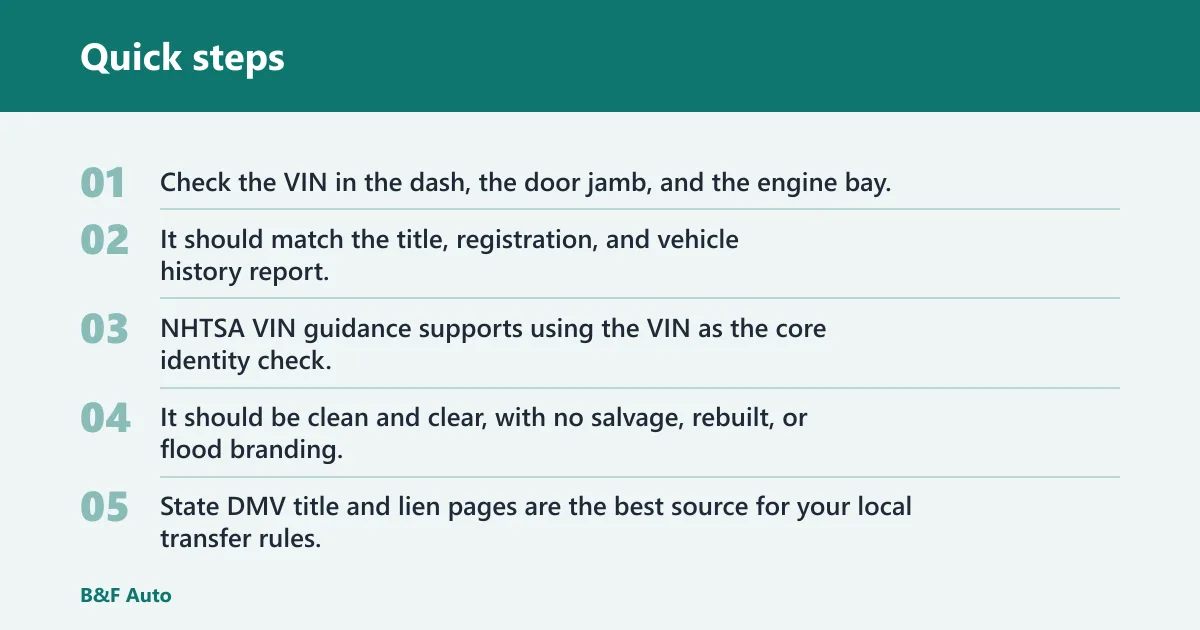
Check the VIN in the dash, the door jamb, and the engine bay. It should match the title, registration, and vehicle history report. NHTSA VIN guidance supports using the VIN as the core identity check, and a mismatch is a hard stop in a private sale.
What should you look for on the title and lien status?
Ask to see the title before you go further. It should be clean and clear, with no salvage, rebuilt, or flood branding, and no sign of an outstanding finance claim or lien. State DMV title and lien pages are the best source for your local transfer rules, and a missing lien release should stop the deal.
Why should you pull a vehicle history report?
Use the report to check accident entries, title events, odometer data, and salvage, rebuilt, or flood flags. The report is not a substitute for the physical inspection, but it can tell you where to focus. NHTSA odometer resources and FTC used-car guidance both support treating mileage and history mismatches as serious warning signs.
How do you confirm the seller and keys are legitimate?
Compare the seller’s ID to the name on the title. Ask for all keys, fobs, spare remotes, and any accessory that should come with the car. If the seller cannot show title, ID, or the right number of keys, stop before you get deep into the inspection.
| Check | Pass/Fail | Action |
|---|---|---|
| VIN matches dash, door jamb, engine bay, title, registration, and history report | Pass / Fail | Fail = walk away |
| Title is clean and clear, with no salvage, rebuilt, or flood brand | Pass / Fail | Fail = walk away |
| No lien, no missing ownership paper, seller ID matches title | Pass / Fail | Fail = do not pay |
| Vehicle history report shows no major mismatch or odometer issue | Pass / Fail | Fail = inspect further only if other checks are strong |
What should you check first when inspecting a used car in person?
Check the fastest stop signs first: VIN, title status, flood clues, frame damage, and whether the seller allows a basic inspection. Those items decide whether the car is worth your time. If any of them fail, you do not need to finish the walkaround or start the drive.
What are the quick fail gates before the walkaround?
Walk away if the VIN does not match, the title is branded or missing, the seller will not show paperwork, the car has a damp mold smell with visible moisture, or the underbody shows crash repair or frame damage. Also stop if the car will not start cold, overheats, or has warning lights that stay on at key-on. NHTSA warning-light and odometer resources, plus state title rules, support that order of priority.
How do you move from first glance to deeper checks?
If the car passes the first gate, move to body, tires, fluids, and the interior. Use the vehicle history report as a map, not a verdict. A car with one repair note may still be acceptable. A car with multiple warning signs usually needs a mechanic before you commit.
Say your seller opens the hood on a sedan with 112,000 miles and you see fresh black sealant on the frame rail plus a strong damp odor inside. That is not a “keep looking” car. It is a leave-now car, because the pattern points to hidden repair work and possible water intrusion.
How do you spot body damage, repaint, and flood signs?
Body checks are about symmetry and honesty. You are looking for signs of repair, water intrusion, and hidden rust. Panel gaps, paint tone, and underbody finish can reveal more than a seller’s description. NICB flood guidance is especially useful here because flood damage often shows up in several small clues, not one obvious defect.
What do panel gaps, paint match, and overspray tell you?
Check for rust, dents, repaint, and panel gaps by looking for mismatched paint, uneven panel gaps, overspray on trim or seals, and fresh underseal. Small stone chips are normal. A hood that sits differently from the fender, or a door with a wider gap on one side, can signal crash repair or poor alignment.
What rust, sealant, and underbody clues matter most?
Look under the car for rust, repair marks, bent metal, fresh sealant, and uneven welds. Frame damage is a walk-away item unless a professional inspection says otherwise. Fresh underseal can hide corrosion or repair work, so compare the coating across both sides of the car.
What flood damage signs are most important?
Flood damage signs include a damp or moldy smell, water under carpets, corrosion in hidden areas, and water lines in trim or lamps. Open floor mats, feel carpet edges, and check under the spare tire area if accessible. Do not let a strong air freshener distract you. NICB flood guidance treats hidden moisture and corrosion as major red flags.
What glass, lamps, and trim clues should you compare?
Look for fogging inside lamps, residue in trim seams, and mismatched glass etching or stickers. Water marks near the base of the interior trim or inside headlamps can support a flood-damage concern. One clue alone is not proof, but several together should push you toward leaving.
How do you check the engine bay and fluids on a used car?
The engine bay can reveal neglect and hidden damage fast. Check for leaks, sludge, smoke signs, and fluid condition before the test drive. If the seller pre-warmed the car, ask when it was last started and whether it had a cold start that day. Odometer and warning-light concerns are easier to catch before driving.
What should you look for in oil, coolant, brake fluid, and transmission fluid?
Check oil condition first. A milky oil film can indicate a head gasket or coolant problem, so that is a major warning sign. Look at coolant level and color, brake fluid level and appearance, and transmission fluid where it is accessible. Low or dirty fluid does not prove a failure, but it does raise the risk.
What belt, hose, leak, and sludge checks matter most?
Look for cracked belts, swollen hoses, wet spots under the engine, and heavy sludge around caps or covers. Fresh oil, coolant, or transmission fluid on the ground after the car has been parked is a serious clue. Blue smoke points to burning oil, and thick white smoke points to burning coolant.
What does a warning light at key-on mean?
Turn the key to check warning-light behavior. The check-engine light should illuminate at key-on, then go out if the system is normal. A flashing light is more serious than a steady one, and a missing bulb can hide a problem. A light that never comes on deserves suspicion. FTC and NHTSA guidance both treat hidden or ignored warning indicators as a meaningful consumer-risk sign.
How do you inspect tires, brakes, and the underbody?
Tires and brakes tell you how the car has been used and maintained. Uneven wear can point to alignment or suspension trouble. The underbody can show crash repair, rust, and frame issues that are hard to see from the curb. Tire minimums and date-code interpretation should come from a tire-industry source or your state law, not a brand claim.
What should you check for tread depth, wear pattern, and DOT dates?
Check for even wear, matching brands, and matching date codes across the tires. Tire-industry guidance and state inspection standards commonly use 2/32 inch as the legal minimum tread depth and 4/32 inch as a wet-safety replacement point. Uneven tire wear can signal suspension or alignment issues.
Check the DOT code for tire age. A tire with enough tread can still be old enough to replace if the date code shows long storage or age-related cracking. Matching brands are not mandatory, but a mixed set can point to piecemeal repairs or neglect. Tire-industry or state-law guidance is the right source for DOT date code interpretation.
What brake wear and pedal feel clues should you notice?
Listen for scraping, grinding, or a pulsing brake pedal. A pulsing brake pedal usually means warped rotors. Look through the wheels if possible and compare rotor surfaces and pad thickness. A soft pedal, warning light, or uneven pull during braking needs further review.
What rust, repair marks, and frame checks matter most?
Inspect the underbody for rust, fresh sealant, bent metal, and uneven welds. Frame repair marks are a major concern because they can point to a crash that reached the structure. If the frame rails or floor pan show obvious repair signs, stop and consider a professional review before any offer.
How should you evaluate the test drive?
The drive is where small problems become visible. Keep it short but varied: cold start, low-speed acceleration, braking, steering, and a brief highway stretch if allowed. You are checking behavior, not trying to prove the car is perfect. A clean road test does not erase title, flood, or frame concerns.
What should you notice about acceleration and shifting?
From a cold start, note idle quality, throttle response, and gear changes. Hesitation, hard shifts, slipping, or unusual flare between gears can mean transmission trouble. If the seller will not allow a cold start, that matters. A warmed car can hide hard starting or rough idle.
What do braking, steering, and pull tell you?
Apply the brakes at low and moderate speeds. The car should stop straight and feel consistent. Steering pull, vibration, or a pulsing pedal points to alignment, tire, rotor, or suspension issues. Any strong pull during braking deserves a closer look before you negotiate.
What should you listen for at noise, vibration, and highway speed?
At highway speed, listen for wheel bearing noise, drivetrain hum, wind noise from poor body alignment, and vibration through the wheel or seat. A common first-timer mistake is to focus only on the engine and miss a shake at 60 mph that becomes obvious on the road.
Suppose the car tracks straight in town but pulls left at 55 mph and the steering wheel shakes under braking. That pattern points to more than a simple tire issue. It is enough to move the car from “maybe” to “needs mechanic before any commitment.”
What fails the drive test immediately?
Any overheating, a warning light that appears during the drive, heavy smoke, harsh shifting, or brake fade should stop the deal. If the car feels unsafe, noisy, or unpredictable, do not talk yourself into “just one more look.” Leave and compare it with better options.
How do you use a one-page private sale decision sheet?
This one-page sheet turns the inspection into a yes, no, or maybe decision. Use it to sort quick fail gates from issues that support negotiation. Keep it with the title photos, VIN photo, and vehicle history report so you can review the same facts later. The structure should be simple: Check, Pass-Fail, and Action.
What should the one-page printable asset include?
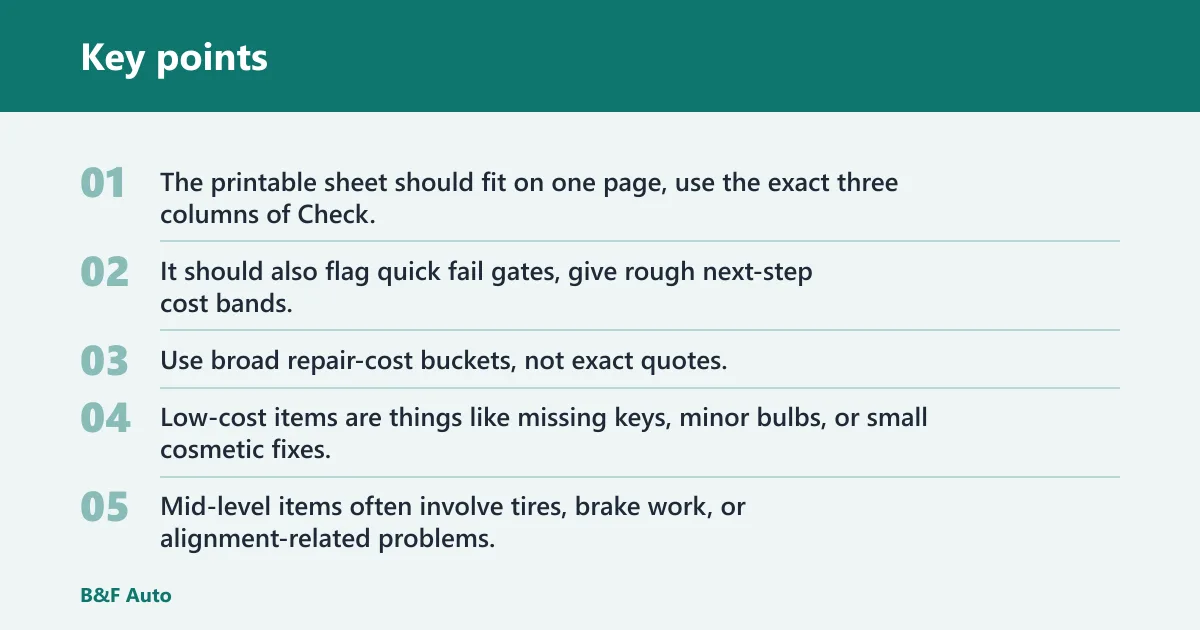
The printable sheet should fit on one page, use the exact three columns of Check, Pass-Fail, and Action, and sit near the top of your packet as a downloadable asset. It should also flag quick fail gates, give rough next-step cost bands, and end with a final verdict line so the buyer can act fast at the curb.
| Check | Pass/Fail | Action |
|---|---|---|
| VIN matches dash, door jamb, engine bay, title, registration, and report | Pass / Fail | Fail = walk away |
| Title is clean and clear, no salvage, rebuilt, flood, or lien issue | Pass / Fail | Fail = walk away |
| No damp smell, mold, water lines, or hidden moisture | Pass / Fail | Fail = walk away |
| No frame damage, bent metal, uneven welds, or fresh hidden sealant | Pass / Fail | Fail = walk away |
| All warning lights behave normally at key-on and stay off after start | Pass / Fail | Fail = inspect further or leave |
| Tires show even wear, acceptable tread, and reasonable DOT age | Pass / Fail | Fail = negotiate or replace before driving much |
| Engine fluids look normal and no major leaks or smoke appear | Pass / Fail | Fail = needs mechanic |
| Test drive is smooth through acceleration, braking, steering, and highway speed | Pass / Fail | Fail = negotiate or leave |
What estimated cost bands should you use?
Use broad repair-cost buckets, not exact quotes. Low-cost items are things like missing keys, minor bulbs, or small cosmetic fixes. Mid-level items often involve tires, brake work, or alignment-related problems. High-cost items include transmission issues, cooling-system problems, frame repair signs, flood damage, or major title concerns.
What should the final verdict line say?
Write one of three outcomes at the bottom of your sheet: walk away if any quick fail gate fails, inspect further if the car is promising but still has a major unknown, or negotiate if the car is solid but needs a clear, limited repair allowance.
Do you still need a mechanic after using a used car inspection checklist
Yes, if the car still looks promising. An independent mechanic pre-purchase inspection is still the safest next step before commitment. A checklist can filter out bad cars, but it cannot fully confirm hidden engine, transmission, frame, or flood issues.
Frequently asked questions
What should be on a printable used car inspection checklist for a private sale?
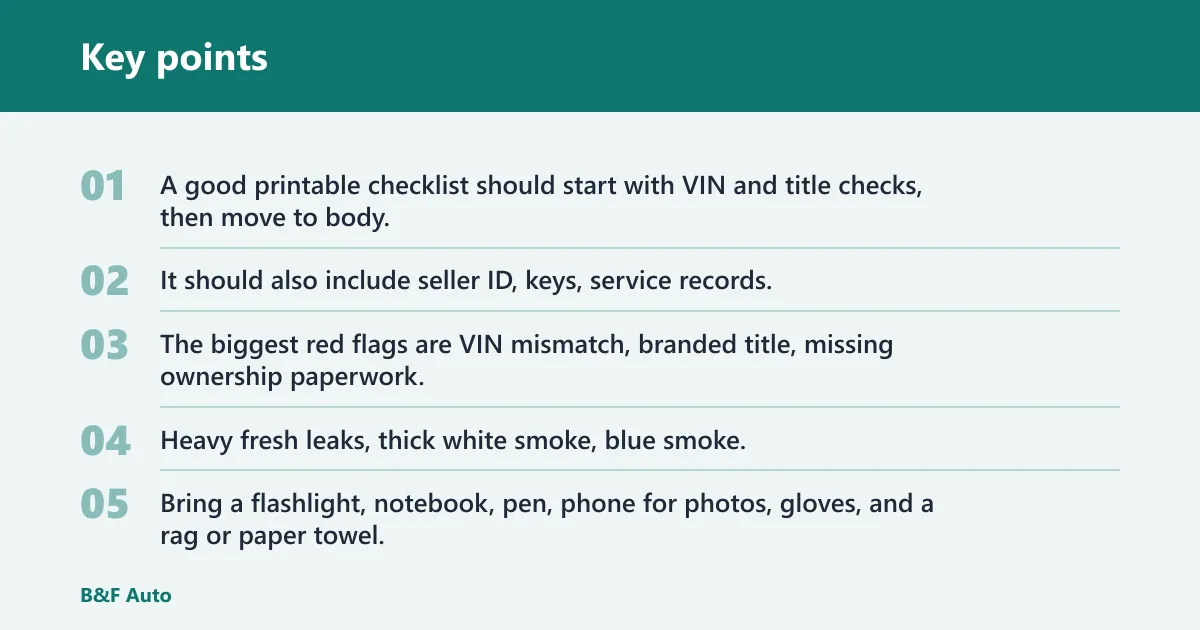
A good printable checklist should start with VIN and title checks, then move to body, flood clues, fluids, tires, brakes, warning lights, and a short test drive. It should also include seller ID, keys, service records, and a final pass/fail line so you can decide whether to walk, negotiate, or inspect further.
What are the biggest red flags when buying a used car privately?
The biggest red flags are VIN mismatch, branded title, missing ownership paperwork, flood signs, frame damage, no-start or overheating, and warning lights that stay on. Heavy fresh leaks, thick white smoke, blue smoke, and severe brake or steering problems also justify walking away rather than bargaining over the issue.
What tools should I bring to inspect a used car?
Bring a flashlight, notebook, pen, phone for photos, gloves, and a rag or paper towel. A tire tread gauge helps, and a mirror can help you see under the car. A printed checklist is still the most useful tool because it keeps the inspection in order and gives you a clean record.
How do I spot accident damage or flood damage during a used car inspection?
Look for mismatched paint, uneven gaps, overspray, fresh underseal, bent metal, and repair marks on the underbody. For flood damage, check for damp odor, moisture under carpets, corrosion in hidden areas, and water lines in trim or lamps. One sign is not enough; several together mean leave or get a mechanic involved. NICB flood guidance is especially relevant here.
What should I do if the seller refuses a pre-purchase inspection?
Treat that refusal as a serious warning. A seller who will not allow an independent mechanic inspection may be hiding a fault, a title issue, or both. If the car is truly good, a fair seller should not object to a professional check before you commit money.
How long does it take to inspect a used car before buying?
A practical private-sale inspection takes about 30 minutes, plus a 15 to 20 minute test drive. If the seller pushes you to move faster, focus on the walk-away checks first. That order protects you when time is tight and prevents you from missing title, flood, or frame issues.
What paperwork should I check in a private used car sale?
Check the title, the VIN on the car, the registration if available, the seller’s ID, any lien or finance release, and the vehicle history report. Also ask for the keys, fobs, remotes, and service records. If the name on the title does not match the seller, stop before discussing price.