Car Payment Budget: How Much Car Can You Afford?
A common rule of thumb is to keep the monthly loan payment around 10% to 15% of take-home pay, and to stay around 15% to 20% all-in once insurance, fuel, maintenance, registration, and parking are included. Lender approval by itself can still leave you car-poor, short on savings, and stretched when repairs or other bills hit. This guide shows you how to set that cap, turn it into an affordable vehicle price, and check it against debt, cash flow, and emergency savings.
A common rule of thumb is to keep the car payment under 10% of take-home pay, and NerdWallet says total car costs should be no more than 20% of take-home pay. Treat those as starting limits, not proof that a car fits. The real test is whether the full monthly cost still leaves room for debt payments, savings, and ordinary life expenses.
What determines your real car budget?

Your real car budget starts with monthly take-home pay, then subtracts the full cost of ownership and the strain from other debts. A lender may approve a payment that works in its formulas, but your budget still has to carry insurance, fuel, maintenance, taxes, and a savings cushion without forcing cuts elsewhere.
Take-home pay sets the starting line
Use monthly after-tax income, the money that actually reaches your bank account, to set the budget. Rent, groceries, utilities, childcare, and card payments are paid with spendable dollars, so the car budget should start from that same number.
Gross income still matters for lending. Debt-to-income ratio, or DTI, compares monthly debt obligations to gross income, and Auto Credit Express says lenders typically prefer borrowers with a DTI below 45%. That matters for approval, but it does not measure comfort.
Payment affordability is not ownership affordability
Total cost of ownership is the payment plus insurance, fuel, maintenance, repairs, registration, taxes, and parking where applicable. Buyers who budget only for the note often see the gap a month later, when the first insurance bill arrives and fuel spending shows up.
NerdWallet says total car costs should be no more than 20% of take-home pay. That is why a payment that looks fine on its own can still fail the larger budget test.
Why lender approval can overshoot your comfort zone
Lenders look at credit, gross income, existing debts, and the structure of the loan. Dealers can also make a vehicle look affordable by stretching the term. A lower monthly payment alone does not prove the car fits.
Auto Credit Express says a loan payment should not exceed 20% of monthly income, but that figure is far looser than the 10% of take-home-pay payment rule many budget-first shoppers use. Approval says the loan may be possible. It does not mean the budget stays healthy after insurance, repairs, and savings.
How much car payment can you afford each month?
A practical ceiling is to keep the payment near 10% of take-home pay, then move lower if debt is high, savings are thin, or income swings month to month. For many households, the better answer is the payment that keeps total monthly car cost under 20% of take-home pay.
A practical payment-to-income ceiling
A good rule of thumb is to keep your car payment under 10% of take-home pay. That is a self-check, not a lender promise. It works because it leaves room for the other costs that show up every month, new car or used.
NerdWallet’s calculator starts with the monthly payment amount you choose. That is the right sequence: set the monthly cap first, then work backward to vehicle price, APR, term, and down payment.
When to set a lower ceiling than the rule of thumb
Some buyers should stay below 10%. That includes anyone carrying expensive credit-card debt, rebuilding an emergency fund, working variable hours, or facing high insurance rates because of age, location, or driving record.
Say your take-home pay is stable, but you already have student loans and a large rent payment. A car note equal to 10% of take-home pay may still be too much if it pushes the all-in total close to the 20% ceiling and leaves no margin for tires, deductibles, or a missed shift.
A quick example for $3,000 monthly take-home pay
For example, if take-home pay is about $3,000 a month, the payment cap at 10% is about $300, and the all-in cap at 20% is about $600. If insurance, fuel, maintenance, and registration or parking add up to about $280, the payment needs to stay at about $320 or less to remain within the total limit.
That is why the answer is not “whatever payment the lender offers.” It is “whatever payment still fits after the rest of ownership costs are counted.”
How much car can you afford from that payment?
Once the payment ceiling is set, the affordable car price depends on APR, loan term, down payment, and taxes and fees. A higher APR or shorter term reduces the vehicle price you can safely target, while a larger down payment increases room by reducing the amount financed.
How APR changes the payment
APR is the interest rate on the loan, and it changes both the monthly payment and the total interest cost. The same source reports average auto loan interest rates between 6.39% and 11.43%. A buyer at the high end of that range will need to aim for a lower vehicle price than a buyer at the low end if the payment cap is the same.
The borrower’s credit tier explains much of that spread in rates. Better credit usually brings a lower APR, and a lower APR means more of each payment reduces principal instead of covering interest.
How loan term changes the payment and total cost
A longer term spreads the balance over more months, so the monthly payment drops, but the loan collects interest for longer and the total interest bill rises. The same source recommends aiming for 60 months or less for new cars and 36 months or less for used cars.
Picture two loans on the same vehicle. The longer one may cut the payment enough to pass a dealer quote, yet still fail the real budget because the buyer stays tied to the loan for years longer and pays more in total interest.
That matters even more with depreciation. The same source says new vehicles can lose as much as 20% of their value in the first year. Stretching the term can leave the loan balance out of step with the car’s value for longer.
How down payment changes the amount financed
A down payment reduces the amount borrowed, trims the monthly payment, and cuts interest paid over the life of the loan. It can also offset some of the taxes and fees that would otherwise be rolled into financing.
Suppose two buyers choose the same car, same APR, and same term. The one who puts more down may keep the payment inside the budget ceiling, while the other has to extend the loan or choose a cheaper vehicle.
How taxes and fees shrink the vehicle price target
Sales tax and registration fees are state-dependent closing costs, and they raise the true out-the-door price. If those charges are financed, they increase the loan amount and monthly payment. If they are paid in cash, they still reduce the cash available for the down payment.
This is where buyers often overstate their budget. A vehicle price may look fine on a listing, then fail once tax, title, registration, and dealer fees are added. The safe move is to work backward from the payment cap after those costs are included.
- Set your payment cap. Start with about 10% of monthly take-home pay as the payment ceiling. Lower it if your debt is heavy, your savings are thin, or your insurance quote is likely to run high.
- Estimate ownership costs. Add insurance, fuel, maintenance, parking, tolls, and registration to build the all-in monthly cost. Keep the total around 15% to 20% of take-home pay, with the tighter end for volatile income.
- Choose loan inputs. Run the payment with the APR and term you are likely to qualify for, not the best advertised case. Keep new-car terms at 60 months or less and used-car terms at 36 months or less if the budget allows.
- Subtract taxes and fees. Reduce the target vehicle price until the out-the-door amount, down payment, and financed balance still produce a payment below your cap. This is the step that turns a listing price into a real budget.
- Stress-test the result. Check whether the budget still works after ordinary savings, debt payments, and one uneven month. If the answer depends on skipping savings or carrying repairs on a card, the car is too expensive.
Car affordability worksheet
| Monthly take-home pay | Max payment | Estimated insurance | Fuel | Maintenance | Parking/registration | Final safe car budget | Pass/fail rule |
|---|---|---|---|---|---|---|---|
| $3,000 | $300 | $140 | $120 | $75 | $40 | $675 total monthly cost | Fail: total exceeds 20% cap of $600 |
| $3,000 | $225 | $140 | $120 | $75 | $40 | $600 total monthly cost | Pass: payment under 10% and total at 20% |
| $4,500 | $450 | $165 | $160 | $85 | $40 | $900 total monthly cost | Pass: payment at 10% and total at 20% |
| $4,500 | $520 | $210 | $180 | $90 | $50 | $1,050 total monthly cost | Fail: payment above 10% and total above 20% |
Use the worksheet in this order: take-home pay first, payment cap second, then ownership costs. The final safe car budget is the total monthly number that either passes or fails the affordability test. If the line fails, lower the vehicle price target, bring more cash, or postpone the purchase.
What costs count besides the car payment?
The payment is only one line in the budget. Insurance, fuel, maintenance, repairs, registration, taxes, parking, and tolls can turn an acceptable note into an expensive ownership month, especially for financed vehicles, long commutes, older used cars, and drivers in high-premium areas.
Insurance and coverage requirements on financed cars
Insurance counts toward the car budget. For most financed vehicles, the lender requires more than minimal liability coverage, and that raises the monthly cost compared with an owned car carrying lighter coverage.
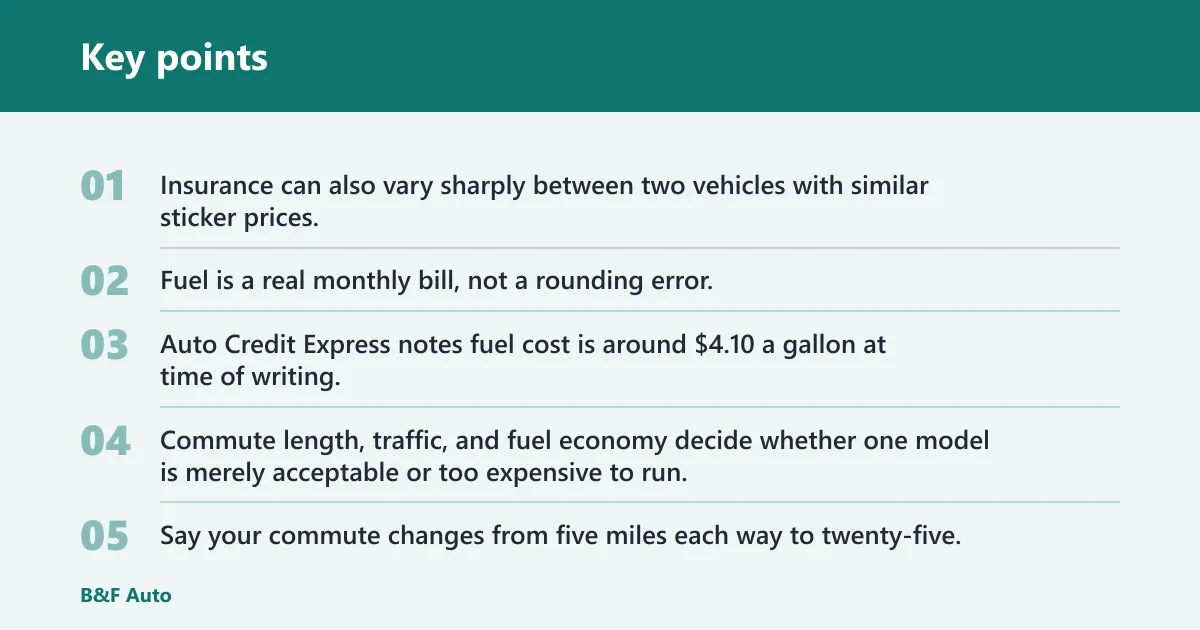
Insurance can also vary sharply between two vehicles with similar sticker prices. A performance trim, expensive parts, theft rates, or driver profile can raise premiums enough to break the budget even if the loan payment looks manageable.
Fuel, parking, tolls, and commuting costs
Fuel is a real monthly bill, not a rounding error. The same source notes fuel cost is around $4.10 a gallon at time of writing. Commute length, traffic, and fuel economy decide whether one model is merely acceptable or too expensive to run.
Say your commute changes from five miles each way to twenty-five. The payment does not change, but the fuel line does. That one variable can be enough to move a budget from pass to fail.
Maintenance, repairs, tires, and warranty limits
Maintenance and repairs vary by age, mileage, drivetrain, tire size, and warranty status. New cars may carry fewer immediate repair risks, but used cars may cost less to buy and insure. The budget has to reflect the actual vehicle, not a generic guess.
Tires matter too. Larger wheels and performance tires often cost more to replace. An older used vehicle with no warranty may fit the payment cap, then fail when brakes, tires, or suspension work arrive close together.
Registration, property tax, and other state or local fees
Registration fees may be annual, semiannual, or tied to vehicle value depending on the state. Some areas also charge local property tax, parking permits, emissions fees, or toll transponder costs. Those items belong in the monthly budget even if they are billed less often.
How debt, savings, and income stability change the answer
Debt, emergency savings, and income stability can lower the car budget even when the payment ratio looks acceptable. A buyer with solid cash reserves and steady pay may handle the top end of the range, while someone with heavy debt or variable income usually needs a tighter cap.
DTI versus real monthly cash flow
DTI is useful because it shows whether the lender may approve the loan. It compares monthly debt obligations to gross income. The same source says lenders typically prefer borrowers with a DTI below 45%.
But DTI is not a household budget. It does not ask whether groceries ran high this month, whether insurance renews next week, or whether the savings account can absorb a deductible. Monthly cash flow does.
High debt load and thin emergency savings
If card balances are expensive or the emergency fund is thin, lower the payment cap before shopping. A car payment that works only when nothing goes wrong is not affordable.
A common first-timer mistake is treating every leftover dollar as available for the note. That leaves no room for a repair, a tire, or a higher-than-expected first insurance bill. In that case, the better move is a cheaper car, a larger down payment, or more time to save.
Variable income, seasonal work, and commission pay
Variable income needs a more conservative method. Use a low, repeatable monthly take-home figure rather than a peak month. If income swings widely, keeping the all-in car cost closer to 15% than 20% of take-home pay is the safer call.
For seasonal workers or commission-based earners, a payment fixed at the edge of a good month can become a problem in a slow one. The car budget should survive the lean months, not only the best months.
How to set a safe budget before you shop
- Total your real take-home. Use a normal monthly after-tax figure based on recent pay, not hoped-for overtime or future raises. If income varies, use the lower steady month so the payment still works when work slows.
- Set the monthly caps. Keep the loan payment around 10% of take-home pay and the all-in car cost near 15% to 20%. If savings are thin or other debts are high, stay toward the lower end.
- Collect live cost quotes. Get insurance estimates on the exact vehicles you are considering, then estimate fuel, maintenance, registration, and parking. This is the fastest way to catch a car that looks affordable on paper but fails in real life.
- Run the loan math. Use a calculator with realistic APR, down payment, term, taxes, and fees. We recommend entering the payment cap first, then adjusting vehicle price until the financed amount fits the budget.
- Apply a stop/go test. Go forward only if the payment, ownership costs, debt obligations, and savings plan all work in the same month. If any line needs a stretch term, card balance, or skipped savings transfer, treat that as a stop.
When the car is too expensive even if the lender says yes
A car is too expensive when the payment technically fits but the all-in cost breaks the monthly budget, stretches the loan term too far, or leaves no room for repairs and savings. Lender approval is about loan viability. Affordability is about whether the household can still breathe after the purchase.
The payment fits but insurance breaks the budget
This is a common failure case. Two cars can have similar selling prices and very different insurance costs. If the premium pushes the all-in total above the limit, the cheaper-to-insure car is the affordable one.
The payment fits only with a long loan term
If the only way to make the payment work is to stretch the term beyond a sensible range, the vehicle is priced too high for the budget. The same source recommends aiming for 60 months or less for new cars and 36 months or less for used cars for a reason: the lower monthly bill from a longer term comes with more interest and more time exposed to depreciation.
The budget leaves no room for repairs or savings
If buying the car means pausing emergency savings, hoping the tires last another year, or charging routine maintenance, the answer is no. A comfortable budget has slack in it.
New versus used in a payment-first budget
New and used can both make sense, but the better choice is the one with the lower all-in monthly cost after payment, insurance, fuel, repairs, taxes, and financing are compared side by side. Sticker price alone is not enough.
Where new can raise the all-in monthly cost
New vehicles usually mean a higher purchase price. Auto Credit Express cites a new-car ATP of $49,855 in July 2026, which explains why many new-vehicle budgets get tight quickly. Insurance may also run higher, and early depreciation can be steep.
Where used can raise repair and financing risk
Used cars can lower the purchase price, but the math changes if the APR is higher, the warranty is gone, or maintenance is overdue. Older vehicles also carry more repair uncertainty, which means the monthly budget needs a larger maintenance reserve.
How to compare two vehicles on the same monthly budget
Run both options through the same worksheet. Keep take-home pay, all-in cap, and savings goal unchanged. Then compare payment, insurance, fuel, and maintenance line by line.
Carmoola shows a representative example of 60 payments of £290 on a £12,500 loan at 14.9% APR, with a total cost of credit of £4,900. The exact market and currency differ, but the lesson carries over: a manageable-looking payment can still hide meaningful borrowing cost if APR is high.
Frequently asked questions
How much car can I afford on my monthly income?
Start with take-home pay, not gross income. A common rule is to hold the payment near 10% of take-home pay and total car costs near 20% once insurance, fuel, maintenance, registration, and parking are added. Then lower the target if debt is high or savings are thin.
What car payment can I afford if I take home $3,000 a month?
Using the 10% payment rule, the starting payment cap is $300 a month. Using the 20% all-in limit, total monthly car cost should stay near $600. If insurance, fuel, maintenance, and registration total $375, the payment needs to be closer to $225, not $300.
How much should my car payment be as a percentage of income?
A good rule of thumb is to keep the payment under 10% of take-home pay. Some lenders may allow far more, and Auto Credit Express says a loan payment should not exceed 20% of monthly income, but that is not a comfort target for most household budgets.
What other costs should I include besides the car payment?
Include insurance, fuel, maintenance, repairs, tires, registration, taxes, parking, and tolls. For financed vehicles, insurance is especially important because lender-required coverage can raise the monthly cost. If any of those lines are missing, the budget is incomplete.
How does a down payment affect how much car I can afford?
A larger down payment reduces the amount financed, lowers the monthly payment, and cuts total interest. It can also absorb part of the taxes and fees due at signing. That may let a buyer stay within the payment cap without stretching the loan term.
How do taxes and fees change my real car budget?
Sales tax, registration, title, and related fees raise the out-the-door price above the listed vehicle price. If financed, they increase the loan balance and payment. If paid in cash, they reduce funds available for the down payment, which can also force a lower vehicle price target.